Block 9 Lesson 1
 Call Kai
 Learn
Learn Practice Test
 Spaced Repetition
 Match
Match Flashcards
 Knowt Play
1/18

Earn XP
Description and Tags
Milky Way and other Galaxies
Name | Mastery | Learn | Test | Matching | Spaced | Call with Kai |
|---|
No analytics yet
Send a link to your students to track their progress
19 Terms
Describe the Milky Way Galaxy
Nuclear bulge in centre, with evidence for black hole.
Globular clusters with relatively old stars surround halo.
Disc with spiral arms of young stars, gas, dust and sites of star formation.
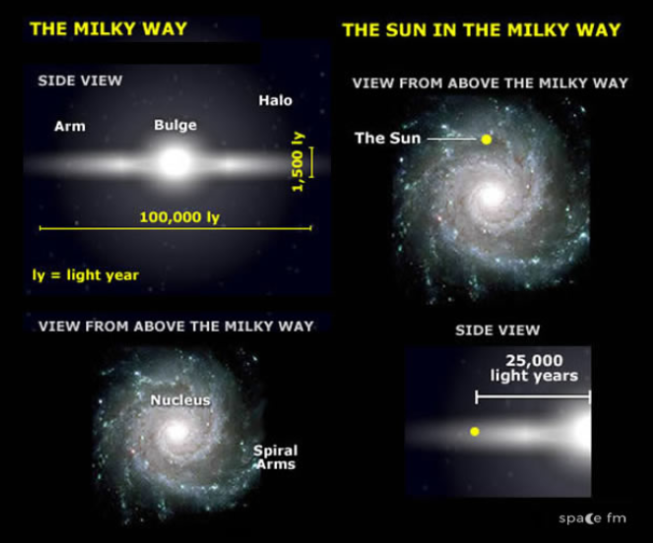
How far is the Sun from the centre of the galaxy and in which of the spiral arms is it in?
The Sun is 30,000 light years from the centre of the galaxy.
It is in one of the spiral arms, in the Orion arm.
What is the local group?
A group of around 50 galaxies gravitationally linked to the Milky Way and Andromeda.
The local group is a part of the Virgo Supercluster.
3Mpc in diameter (I think)
What is the Virgo Supercluster
Larger group
45Mpc in diameter (I think)
100 galaxy groups and clusters
How do clusters and superclusters exist?
Clusters and superclusters exist because the universe isn’t uniform and there's different matter and dark matter densities across the universe.
Describe the Milky Way Galaxy ( how many stars, diameter, shape, whatever else u remember)
100-400 billion stars
Diameter: 1x10⁵ly
Second largest in the local group
Centre of gravity in Local Group between Milky Way and Andromeda
Eventually will collide with Andromeda
A barred spiral galaxy (SBb)
Describe Andromeda Galaxy (how many stars, how far from the milky way, diameter, shape, apparent magnitude, why it’s named this, Messier catalogue number)
~1000 billion stars
2.5 x10⁶ly away from Milky Way
Diameter: 2.2 x10⁵ly
Largest galaxy in local group
A barred galaxy
Apparent Magnitude is 3.4, visible with
little light pollution and no moon to the
naked eye.
Appears in the Andromeda constellation.
M31 (Messier catalogue number)
Roughly the same mass as the Milky Way.
Describe the Large Magellanic Cloud (distance from the Milky Way, diameter, what type of galaxy)
1.6x10⁵ly away from Milky Way
Diameter: 3.2x10⁴ly
Second smallest
Irregular dwarf galaxy
Describe the Small Magellanic Cloud (distance from the Milky Way, diameter, what type of galaxy)
2.1x10⁵ly away from Milky Way
Diameter: 2x10⁴ly
Smallest
Irregular dwarf galaxy
Describe the Triangulum Galaxy (distance from the Milky Way, diameter, Messier catalogue number, type of galaxy, why it’s named this)
2.7x10⁶ly from Milky Way
Diameter: 6x10⁴ly
Third largest member of the local group.
M33 (Messier catalogue number)
Spiral galaxy.
Appears in the Triangulum constellation (why it's named this, not because it's a triangle).
Furthest away.
What are the 4 main types of galaxies?
Spiral
They have a circular core, and they look more elliptical in the centre. The spiral arms wind around the nucleus
Spiral Barred
They have an elliptical core. The spiral arms extend from a bar through the nucleus.
Elliptical
Usually the largest galaxies containing over a trillion stars. Some of these are spherical, some a cigar shaped.
Irregular
Don’t fit the other classifications.
What diagram shows the different types of galaxies?
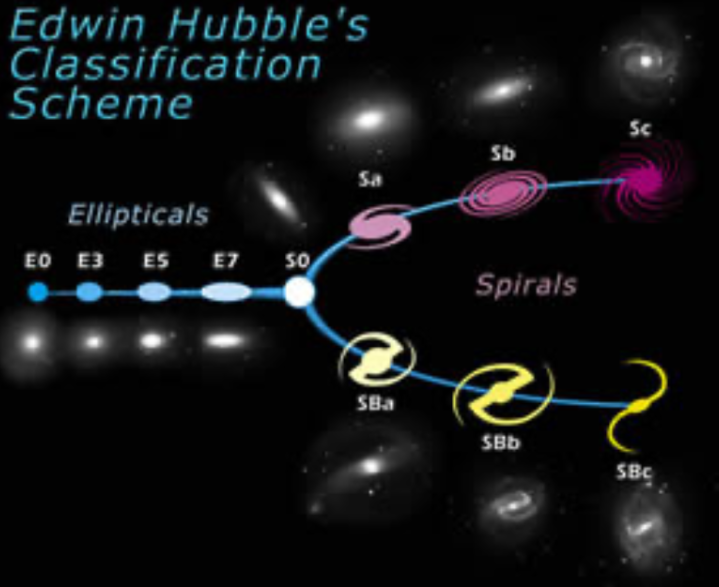
Edwin Hubble created a diagram to show the different types (Tuning Fork diagram).
They are not consequences of each other and are just in groups.
SB are spiral barred, S are spiral, S0 is lenticular (a galaxy between spiral and elliptical), and E are elliptical. Irregular aren’t included.
0-7 tell us how elliptic the E galaxies are
a, b and c tell us how tightly wound or open the S or SB galaxies are
What are the 3 theories for the formation of galaxies?
Gas and dust accumulation theory
Lumps of matter formed galaxies
Black holes first
What is the gas and dust accumulation theory?
Gas and dust were evenly spread out after the Big Band and through random motion, they moved closer to each other.
This caused more dense areas of gas, which have higher gravitation pull, which form stars in large groups.
What is the lumps of matter formed galaxies theory?
Matter wasn’t evenly spread out after the Big Bang. They were in lumps, and those lumps started to form into galaxies.
What is the black hole first theory?
Black holes formed first, merged with other black holes and then accrued material around them.
What is an open cluster + example of one?
An open cluster consists of young stars that are close to each other but aren’t in any specific pattern.
They’re usually very bright which indicates they’re young stars.
They can be anywhere from a dozen to thousands of stars along the galactic plane.
An example of an open cluster is the Pleiades.
What is a globular cluster + example of one?
Globular clusters are more spherically shaped and fuzzy.
They’re located around the galactic nucleus and are usually old white dwarfs and red giants.
There are thought to be 100,000 to a million stars in every globular cluster.
An example of a globular cluster is M13 in Hercules.
What are binary stars?
Many of the stars in the sky are binary stars.
These consist of two or more stars which share a gravitational bond.
They are normally two stars that orbit around the same orbit.
Some stars have more than one star in their binary system. For example, Castor in the constellation Gemini has more than one binary pair. There are actually 6 stars in 3 sets of binaries which orbit each other.