Chem AO3 U1 research task
 Call Kai
 Learn
Learn Practice Test
 Spaced Repetition
 Match
Match Flashcards
 Knowt Play
1/24

There's no tags or description
Looks like no tags are added yet.
Name | Mastery | Learn | Test | Matching | Spaced | Call with Kai |
|---|
No analytics yet
Send a link to your students to track their progress
25 Terms
What is the general formula for alkanes, and how does octane fit into this formula?
Alkanes are saturated hydrocarbons.
“Saturated” means:
all carbon-carbon bonds are single bonds
n = number of carbon atoms
Octane has:
8 carbon atoms
Substitute n=8n = 8n=8:
so
C8H18

2. Explain the concept of a homologous series and provide examples of alkanes that are part of this series. why do the physical properties change?
A homologous series is a family of organic compounds with:
the same functional group
similar chemical properties
the same general formula
gradual changes in physical properties
each successive member differs by CH₂
Why Physical Properties Change
As chain length increases:
molecular mass increases
intermolecular forces become stronger
Therefore:
boiling point increases
melting point increases
Why is crude oil considered a non-renewable resource? and why does this matter?Why This Matters
Heavy reliance on crude oil leads to:
Crude oil is considered non-renewable because:
it takes millions of years to form
it cannot be replaced on a human timescale
humans consume it much faster than it forms naturally
Once crude oil reserves are depleted:
they cannot realistically be replenished
Why This Matters
Heavy reliance on crude oil leads to:
resource depletion
energy insecurity
environmental damage
greenhouse gas emissions
This is why scientists investigate:
renewable fuels
circular economy strategies
sustainable chemistry
Describe the process by which crude oil is formed.
formed from the marines of ancient marine organisms that were buried under layers of sediment and subjected to heat and pressure over millions of years.
Converts organic material into hydrocarbons and is exracted and refined for fules
What is the significance of the octane rating in gasoline?
The octane rating measures a fuel’s resistance to “knocking” during combustion.
What is Knocking?
Knocking occurs when fuel combusts unevenly inside an engine.
This causes:
reduced efficiency
possible engine damage
What do higher octane rating mean?
smoother combustion
better engine performance
greater resistance to premature ignition
Premium fuels therefore have higher octane ratings.
Write the balanced chemical equation for the combustion of octane.
Complete combustion occurs when there is excess oxygen.
Products are:
carbon dioxide
water
7. Discuss the environmental impact of burning octane as a fuel.
Greenhouse Gas Emissions
Combustion produces:
carbon dioxide
CO₂ is a greenhouse gas that contributes to:
global warming
climate change and air pollution
Greenhouse gases trap infrared radiation in Earth’s atmosphere. which leads to?
ising global temperatures
altered weather patterns
melting ice caps
sea level rise
How can the principles of a circular economy be applied to the use of octane and other fossil fuels?
Circular Economy Definition
A circular economy aims to:
minimise waste
maximise reuse of resources
keep materials circulating as long as possible
This contrasts with a linear economy:
take → make → dispose
Applying Circular Economy Principles to octane and other fossil fuels
Applying Circular Economy Principles 1. Improve Fuel Efficiency
Using less fuel reduces:
emissions
resource depletion
2. Carbon Capture and Storage (CCS)
CO₂ from combustion can be:
captured
stored underground
reused industrially
This reduces atmospheric emissions.
3. Recycling Materials
Petroleum-based plastics can be:
mechanically recycled
chemically recycled
reducing demand for new crude oil extraction.
4. Transition to Renewable Alternatives
Using:
bioethanol
biodiesel
renewable electricity
reduces reliance on fossil fuels.
What is the general formula for alcohols, and how does ethanol fit into this formula?

R represents an alkyl group
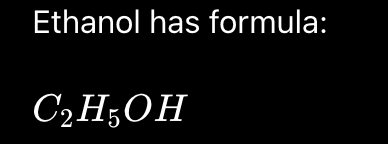

Why is bioethanol considered renewable?
Bioethanol is renewable because it is produced from biomass:
corn
sugarcane
crops
Plants can be regrown within short timescales.
Unlike fossil fuels:
it does not require millions of years to form.
Carbon Cycle Link
Plants absorb atmospheric CO₂ during photosynthesis.
When bioethanol burns:
CO₂ returns to atmosphere
This can make bioethanol closer to carbon-neutral.
Describe the process by which bioethanol is produced from biomass.
Step 1 — Biomass Contains Sugars/Starch
Examples:
sugarcane
corn
Step 2 — Fermentation
Yeast enzymes break down sugars in plants
Products:
ethanol
carbon dioxide
tep 3 — Distillation
Ethanol is purified from the fermentation mixture.
What is the significance of octane rating in bioethanol fuel?
Bioethanol has a high octane rating.
This means:
good resistance to knocking
smoother combustion
efficient engine performance
This makes ethanol useful in petrol blends.
Discuss the + environmental impact of burning bioethanol.
enewable
lower net CO₂ emissions
cleaner combustion
fewer pollutants
Discuss the - environmental impact of burning bioethanol.
Disadvantages
still emits CO₂
agricultural land required
possible deforestation
fertiliser use may damage ecosystems
8. Circular economy and bioethanol
Bioethanol supports a circular economy because:
produced from renewable biomass
agricultural waste can be reused
reduces fossil fuel dependence
Advanced biofuels can also use:
waste biomass
crop residues
which reduces waste generation.
What is the general structure of a biodiesel molecule?
Biodiesel molecules are esters.
long hydrocarbon chains

Describe step 1 in biodiesel production.
Hydrolysis
Triglycerides react with water.
glycerol
fatty acids

Triglycerides
the most common type of fat in your body
Transesterification / Condensation
Fatty acids react with methanol.
Products:
biodiesel
water
Catalyst:
NaOH or KOH
Why is biodiesel renewable?
Because feedstocks can be replenished:
vegetable oils
animal fats
used cooking oil
Plants regrow rapidly compared to fossil fuels.
Environmental benefits of biodiesel
Lower Emissions
Produces less:
particulate matter
carbon monoxide
sulfur compounds
Biodegradable
Breaks down more easily than petroleum diesel.
7. Biodiesel and circular economy
Excellent circular economy example because:
waste cooking oils are reused
waste converted into useful fuel
fewer materials discarded
lower fossil fuel dependence
Advantages in engines and emissions
Better Lubricity
Reduces engine wear.
Cleaner Combustion
Lower toxic emissions.