Ch. 11 - Retailing and Wholesaling
 Call Kai
 Learn
Learn Practice Test
 Spaced Repetition
 Match
Match Flashcards
 Knowt Play
1/32

There's no tags or description
Looks like no tags are added yet.
Name | Mastery | Learn | Test | Matching | Spaced | Call with Kai |
|---|
No analytics yet
Send a link to your students to track their progress
33 Terms
Retailing
All activities involved in selling, renting, and providing goods and services to ultimate customers for personal, family, or household use.
Engages consumers by offering a place for showcasing products that creates interest and excitement.
Distribution involves creating a place where the customer can access a product. It is a key and evolving component of the marketing mix.
As technology enables customers to access multiple channels of distribution, the challenge of retailers becomes anticipating customer needs and providing them with favourable purchasing options.
Consumer Utilities Offered by Retailing
The utilities provided by retailers create value for consumers.
Time
Place
Form
Information
Possession
are offered by most retailers in varying degrees, but one utility is often emphasized more than others.
Time and place utility offer convenience to a consumer.
Global Retail Picture
Retailing is also a very important factor in the global economy, and it is a difficult retail climate for store owners.
The worldwide economy has been challenged by issues such as terrorism, economic downturn, reduced tourism, political crises, and low consumer confidence.
All of these issues translate into lower sales for retail.
At the same time, consumers are empowered, and it is more difficult to gain and maintain their loyalty.
Technology is making the industry more sophisticated and streamlined, and consolidation makes some competitors large and very powerful.
Form of Ownership Types
(IR / CC / CS)
Distinguishes retail outlets on the basis of whether individuals, corporate chains, or contractual systems own the outlet. Each form has its own benefits and challenges.
This includes:
Independent Retailer
Corporate Chain
Contractual System
Independent Retailer
Form of Ownership
One of the most common forms of retail ownership is the independent business, owned by an individual. Small independent retailers account for more than 60 percent of the total retail trade in Canada.
Includes bakeries, sporting goods stores, jewellery stores, or gift stores.
Other types of small independent retailers include restaurants, automotive supply stores, bookstores, paint stores, flower shops, and women’s accessories outlets.
Owner is that he or she can be his or her own boss. For customers, the independent store can offer convenience, quality personal service, and lifestyle compatibility.
This is mainly due to the smaller organization being able to adapt and to be more efficient than its larger competitors.
Corporate Chain
Form of Ownership
Involves multiple outlets under common ownership.
Includes Hudson’s Bay or Real Canadian Superstore.
In a chain operation, centralization of decision-making and purchasing is common.
Advantages in dealing with manufacturers, particularly as the size of the chain grows.
A large chain can bargain with a manufacturer to obtain good service or volume discounts on orders.
The buying power of chains is obvious to consumers who compare prices at chain stores with other types of stores.
Consumers also benefit in dealing with chains because there are multiple outlets with similar merchandise and consistent management policies.
Retailing has become a high-tech business for many large chains.
Contractual System
Form of Ownership
Involve independently owned stores that use leverage to act like a chain. Include retailer-sponsored co-operatives, wholesaler-sponsored voluntary chains, and franchises.
One retailer-sponsored co-operative is Home Hardware, which is a collection of independent hardware and home-renovation stores across Canada.
Created its own wholesale operation to take full advantage of dealings with manufacturers and suppliers.
As a co-operative, members can take advantage of volume discounts commonly available to chains and also give the impression of being a large chain, which may be viewed more favourably by some consumers.
In a franchise system, an individual or firm (the franchisee) contracts with a parent company (the franchisor) to set up a business or retail outlet.
By selling franchises, an organization reduces the cost of expansion, although they lose some control.
To ensure mutual benefits to all parties involved, a good franchisor concentrates on enhancing the image and reputation of the franchise name, as well as keeping things modern.
Selecting a Target Market
Target Market Selection and Positioning
Define a target market, describing it in detail. Without customers, even the best-conceived retail concept is nothing, so focusing on customers is the guiding principle of successful retail businesses.
This focus involves understanding wants and needs, knowing customer preferences, analyzing behaviour, and deciding how to craft all of the dimensions of the retail concept to appeal to the targeted customer.
Now the retailer has to interest, engage, and delight customers in order to foster loyalty.
Shopper Marketing
Target Market Selection and Positioning
A discipline designed to understand how consumers behave as shoppers in different channels and formats.
Consequently, shopper-marketing practices extend well outside of the store, to the place and time when a consumer first thinks about purchasing a product. That might be on a treadmill at the gym, at home reading a magazine, or in the car while driving to work.
A multi-channel practice that makes use of traditional media, new media, direct marketing, loyalty, trade promotion, and innumerable other marketing technique.
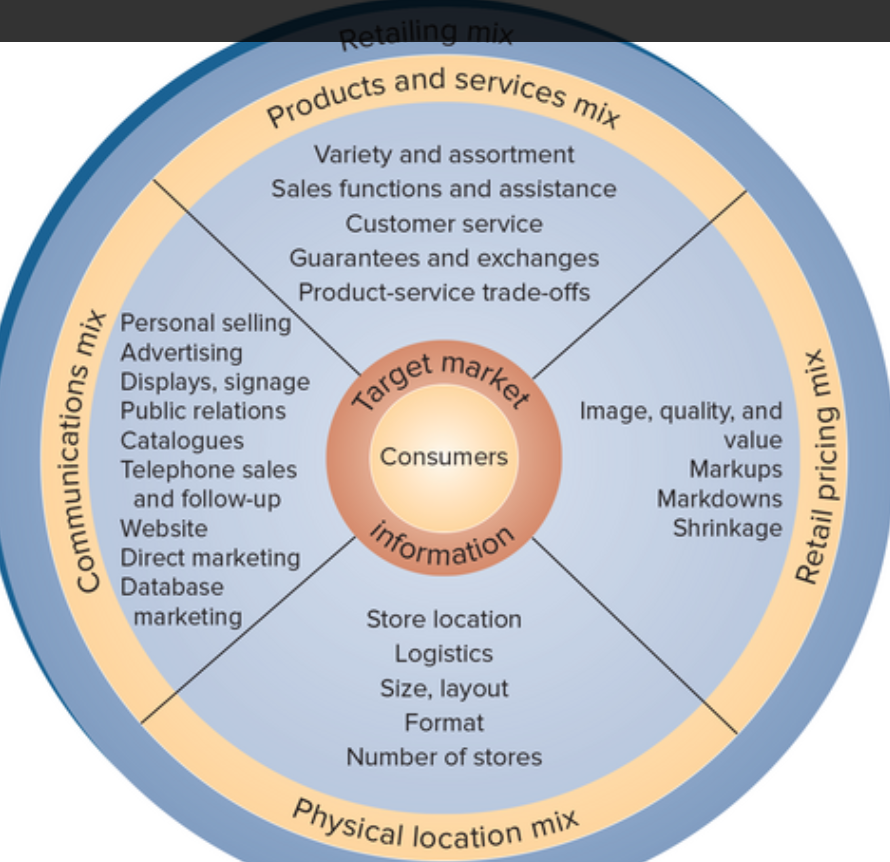
Retailing Mix
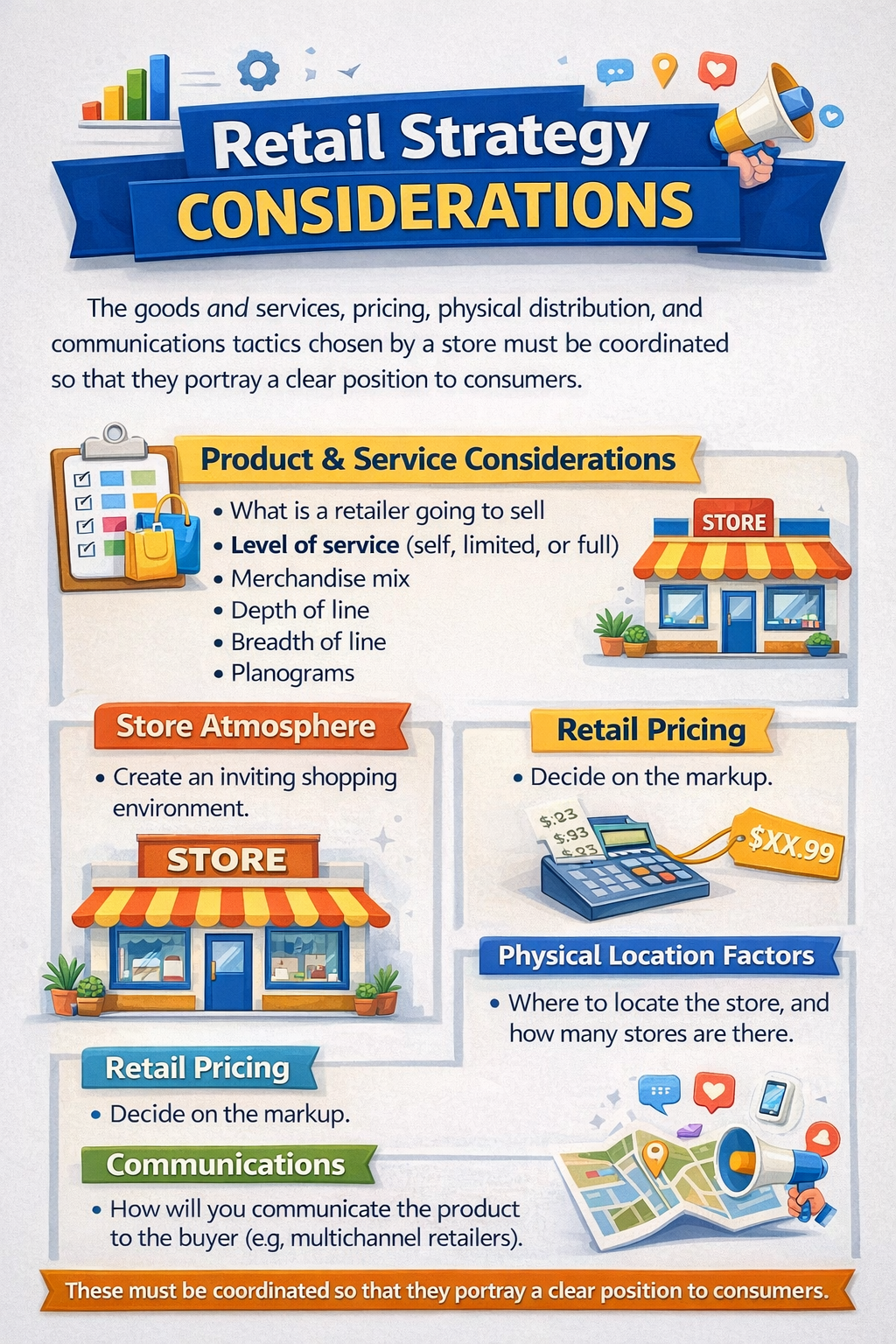
Product and service considerations: What is a retailer going to sell.
Level of service (self, limited or full).
Merchandise mix
Depth of line
Breadth of line
Planograms
Store atmosphere
Retail pricing: Decide on the markup.
Physical location factors: Where to locate the store, and how many stores are there.
Communications: How will you communication the product to the buyer (e.g. multichannel retailers).
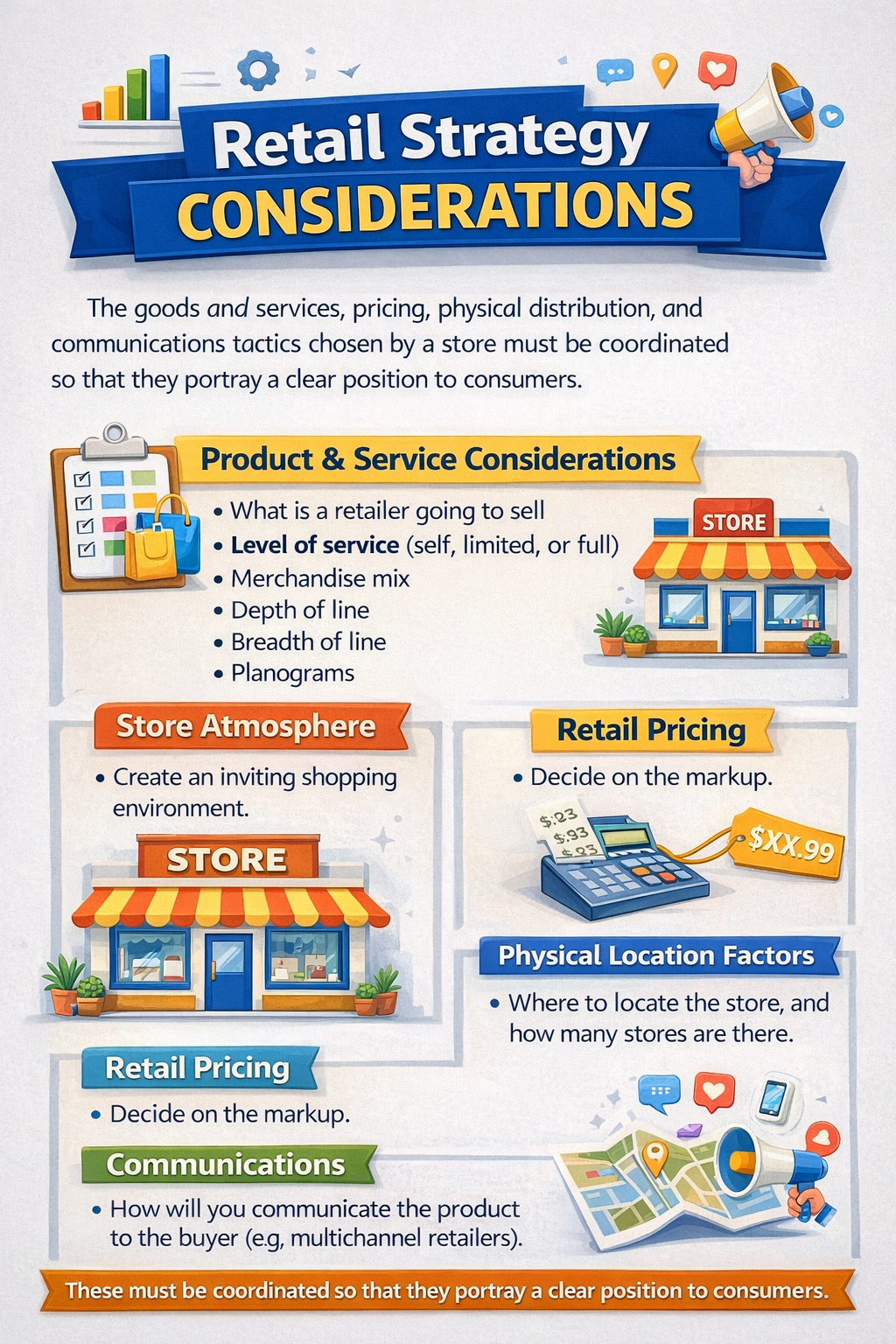
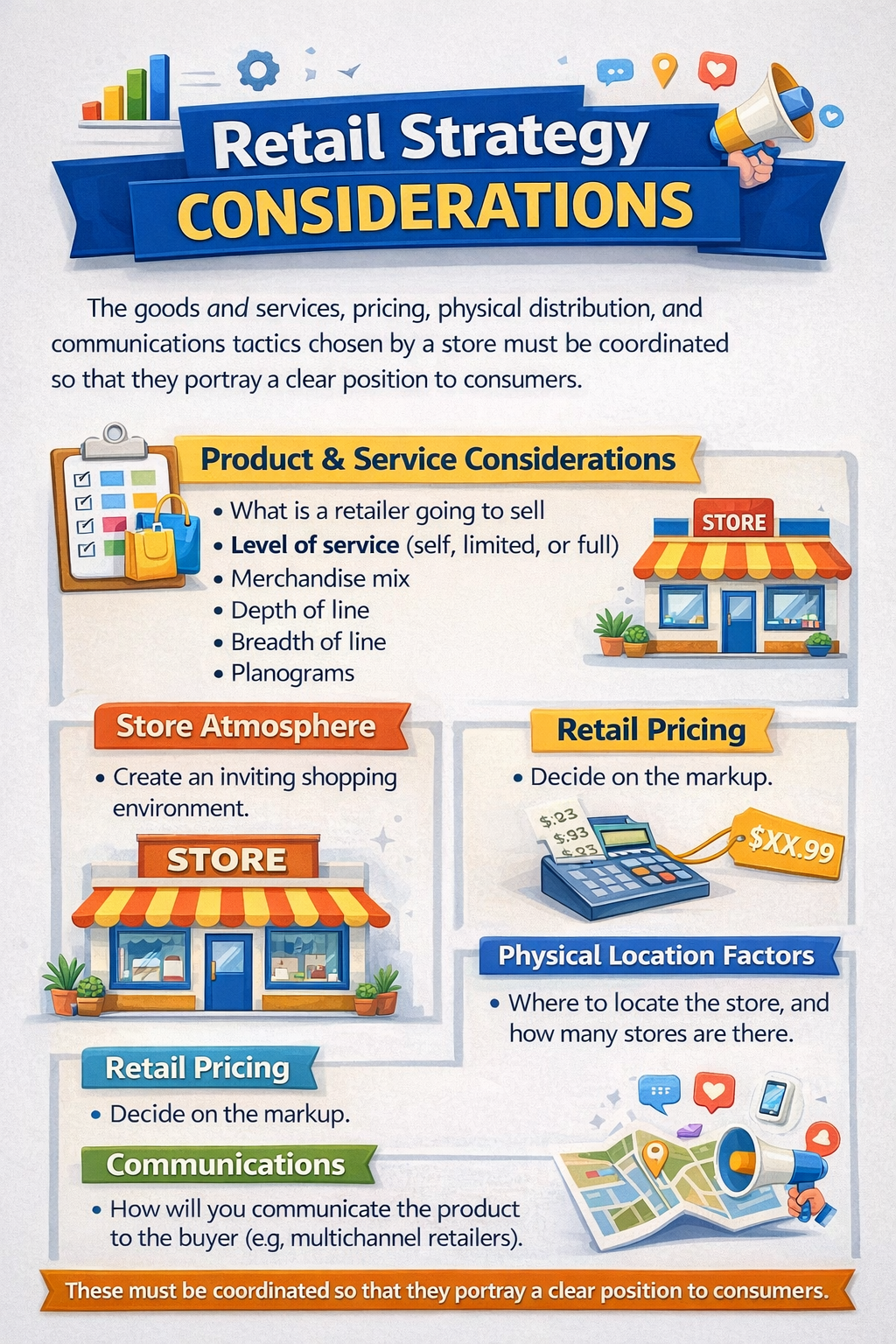
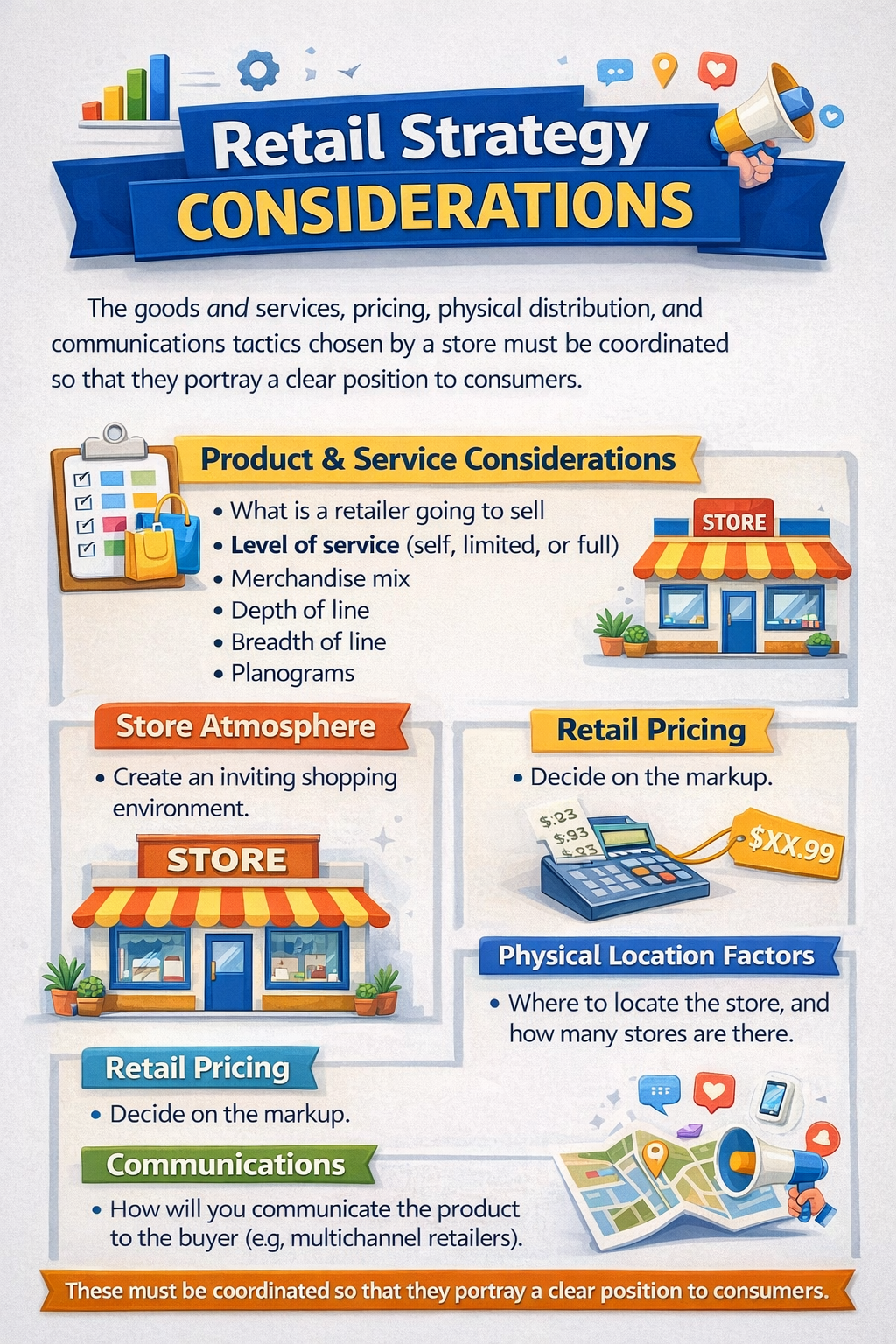
The goods and services, pricing, physical distribution, and communications tactics chosen by a store. Must be coordinated so that they portray a clear position to consumers.
Product and Service Considerations
Retailing Mix
One of the first decisions that retailers make is what they are going to sell. Usually, both services and products are offered.
Differences among retailers are more obvious in terms of level of service. Level of service is used to describe the degree of service provided to the customer (this includes self service, limited service and full service).
Merchandise mix: How many different types of products a store carries and in what assortment.
Depth of line: Stores that carry a large assortment (depth) of a related line of items are limited-line stores.
Breadth of line: How many different product categories a retailer offers.
Level of Service
Product and Service Considerations
Differences among retailers are more obvious in terms of level of service. Level of service is used to describe the degree of service provided to the customer (this includes self service, limited service and full service).
Self service: Customer performs many functions and little is provided by the outlet.
Limited service: Limited-service outlets provide some services, such as credit and merchandise return, but not others, such as alterations to clothes
Full service: which include most specialty stores and department stores, provide many services to their customers.
Merchandise Mix & Greentailing
Product and Service Considerations
Describes how many different types of products a store carries and in what assortment.
Merchandise selection is one of the major attracting factors for customers, so choices and combinations must be made carefully and continually updated to reflect current trends and tastes.
This involves finding sources of supply of the products, or having them manufactured, as well as managing inventory and warehousing.
Greentailing: Suggests that the move to carrying eco-friendly products, and promote sustainability is another factor in retailers’ merchandise mix decisions.
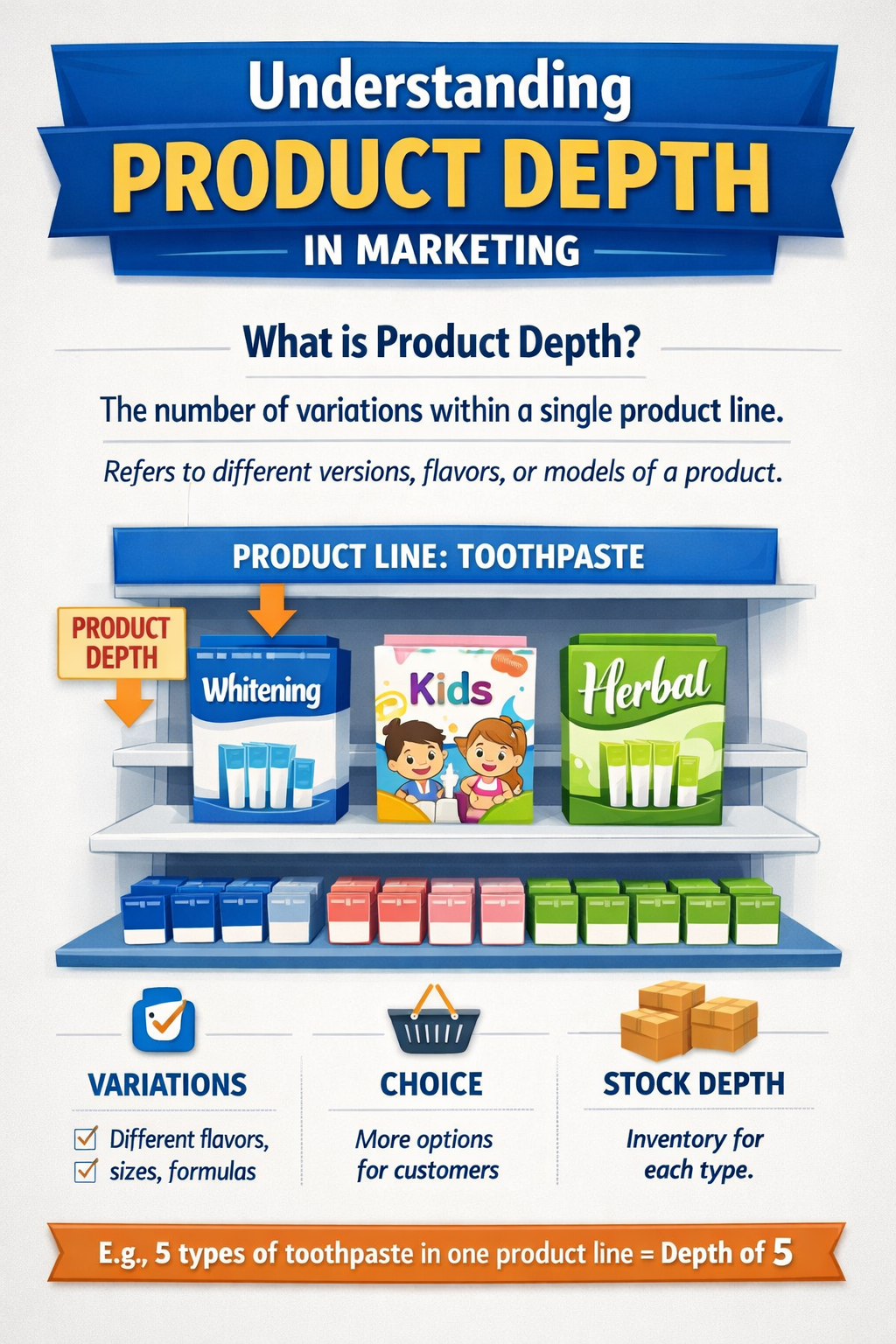
Depth of Line
Product and Service Considerations
Stores that carry a large assortment (depth) of a related line of items are limited-line stores. Both limited and single line stores are often referred to as specialty outlets.
Sport Chek carry considerable depth in sports equipment (e.g. golf accessories to running shoes).
Victoria’s Secret carries great depth in women’s lingerie.
Specialty outlets focus on one type of product, such as electronics (Best Buy), office supplies (Staples), or books (Indigo Books & Music) at competitive prices.
These outlets are referred to in the trade as "category killers" because they often dominate the market in one area.
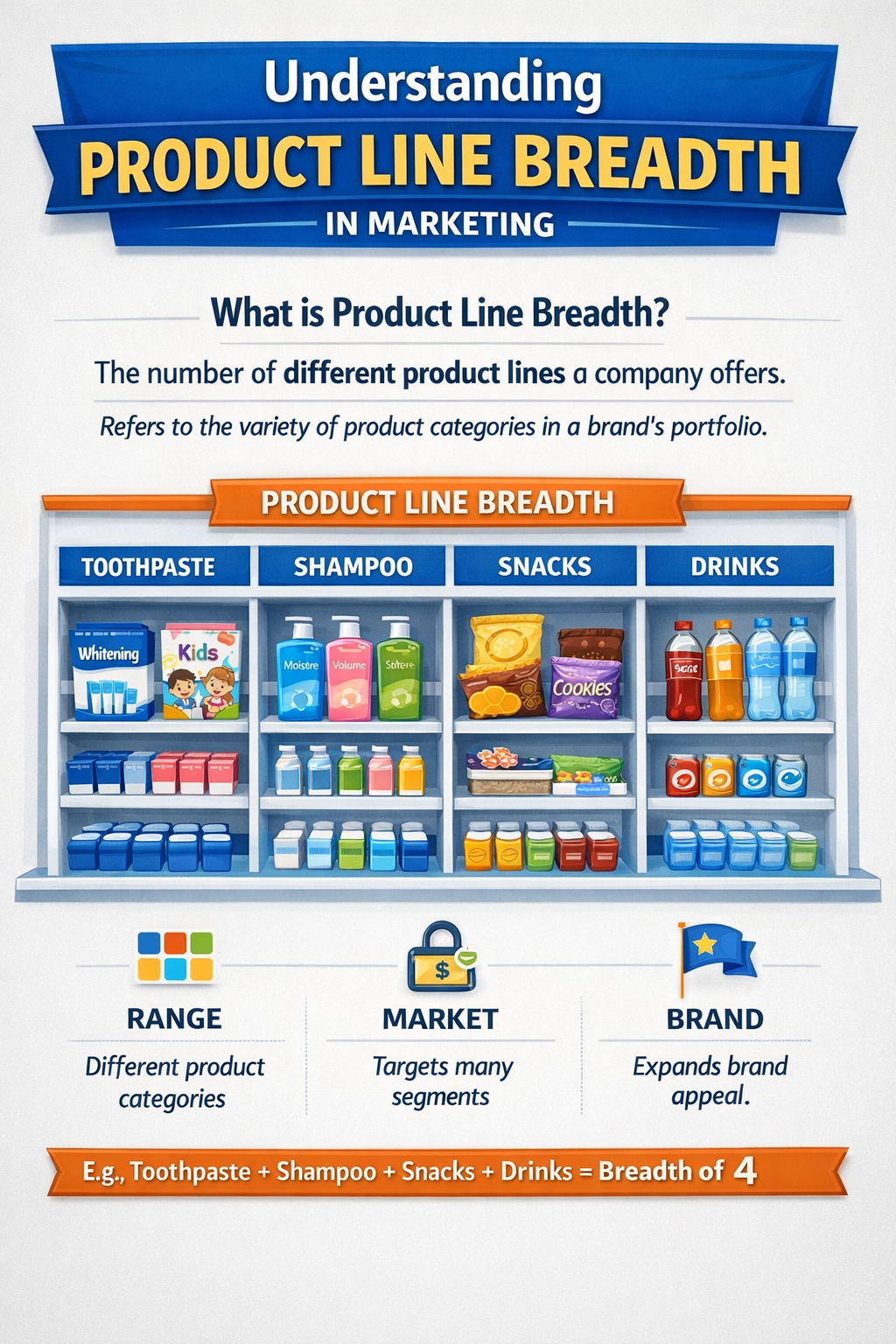
Breadth of Line
(Scrambled Merchandising & Intertype Competition)
Product and Service Considerations
Stores that carry a variety of product lines, with limited depth, are referred to as general merchandise stores. The breadth and depth of merchandise lines are important decisions for a retailer. Traditionally, outlets carried related lines of goods. Includes:
Scrambled merchandising: Offering several unrelated product lines in a single retail store. The modern drugstore carries food, cosmetics, camera equipment, magazines, paper products, toys, small hardware items, and pharmaceuticals.
Intertype competition: Competition between very dissimilar types of retail outlets. A local bakery may compete with a department store, discount outlet, or even a local gas station.
Scrambled merchandising and intertype competition make retailing more challenging.
Planograms
Product and Service Considerations
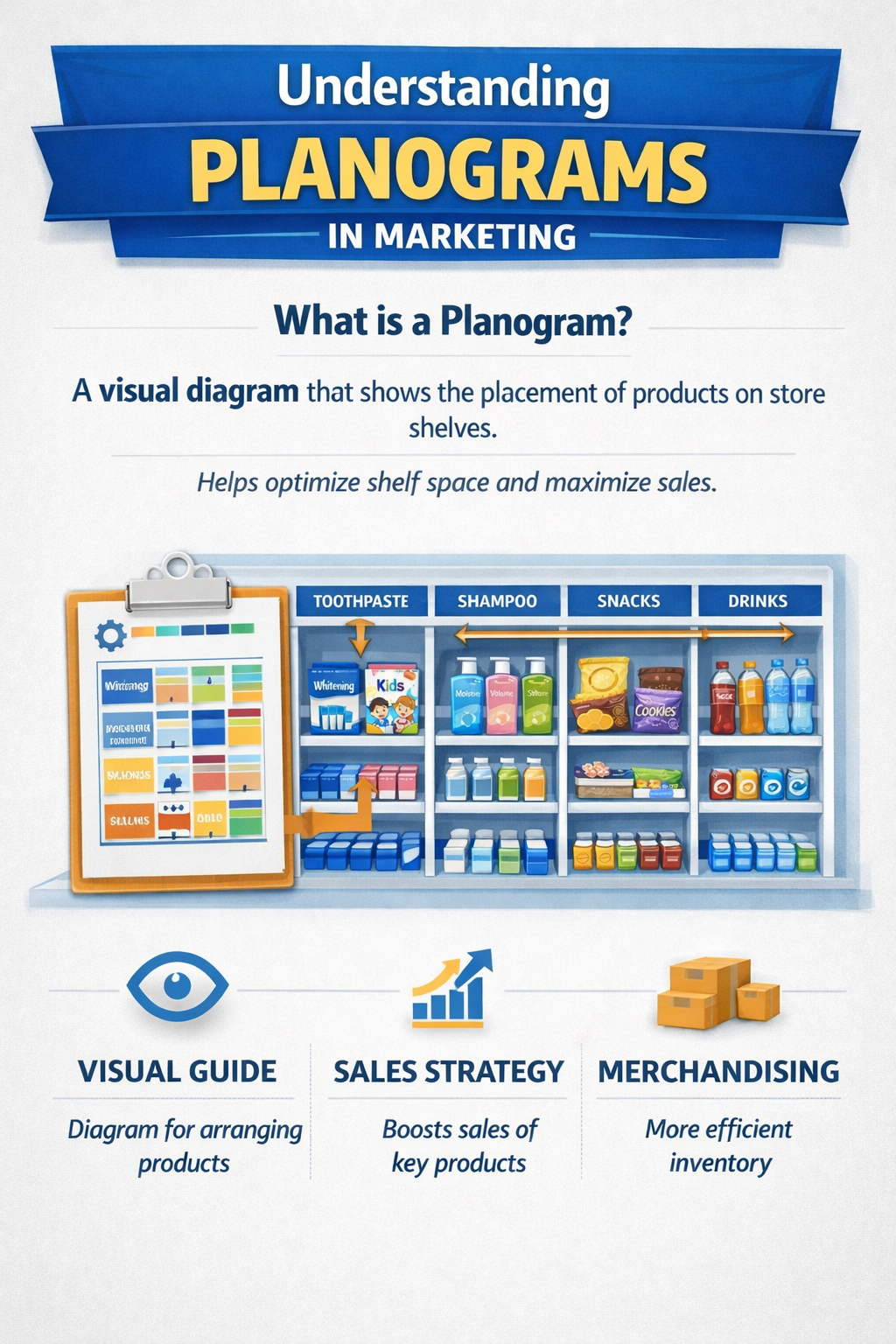
A visual diagram or drawing of fixtures and products that illustrates how and where retail products should be placed on a store shelf. It also illustrates how many facings should be allocated for each stock-keeping unit (SKU).
Arranged so that the fastest-moving high-margin products get the most space on the shelf.
For example, Procter & Gamble works closely with Walmart by providing the retailer with planograms, which lead to higher profits than if products were placed indiscriminately on the shelf.
As competition increases, we’re seeing suppliers and retailers becoming more aware of the importance of correctly merchandising their products.
Some retailers produce their own planograms while others, such as Walmart, receive planograms from suppliers such as Procter & Gamble.
Store Atmosphere
Product and Service Considerations
Refers to the physical characteristics of a store that provide an overall impression to the consumer. These characteristics consist of the exterior and interior appearance and physical layout of the store.
Store atmosphere is related to the positioning of a store. For example, Costco has a warehouse appearance that is consistent with the low prices that it offers.
The Apple Store’s customer-friendly layout encourages consumers to mingle and sample the products.
Apple successfully trademarked its store design and continues to trademark the distinctive design and layout of its retail store in Canada.
Retail Pricing
Retailing Mix
Retailers must decide on the markup. The markup refers to how much should be added to the cost the retailer paid for a product to reach the final selling price.
The difference between the final selling price and retailer cost is called the gross margin.
Discounting a product, or taking a markdown, occurs when the product does not sell at the original price and an adjustment is necessary. Often, new models or styles force the price of existing models to be marked down.
The timing of a markdown can be important. Many retailers take a markdown as soon as sales fall off, to free up valuable selling space and obtain cash. However, other stores delay markdowns to discourage bargain hunters and maintain an image of quality.
Shrinkage
Retail Pricing
Breakage and theft of merchandise by customers and employees.
Off-price Retailing
Retail Pricing
Selling brand-name merchandise at lower than regular prices. Bought by the retailer from manufacturers with excess inventory at prices below wholesale prices.
Winners is an example.
Physical Location (and Five Settings)
Retailing Mix
Deciding where to locate the store and how many stores to have. Most stores today are near several others in one of five settings: the central business district, the regional centre, the community shopping centre, the strip, or the power centre.
Central business district: Oldest retail setting, the community’s downtown area.
Regional centre: Consist of 50 to 150 stores that typically attract customers who live or work within a 5- to 15-km range
Community shopping centre: Typically has one primary store (usually a department store branch) and often about 20 to 40 smaller outlets. Generally, these centres serve a population of consumers who are within a 2- to 5-km drive.
Strip location: Many neighbourhoods have clusters of stores, to serve people who are within a 5- to 10-minute drive.
Power centre: A large shopping strip with many national stores
Communications
Retailing Mix
How a retailer communicates with customers to inform them about products, persuade them to buy, and build the store’s image.
Multichannel retailers: Businesses that sell their products through more than one type of distribution channel.
Using this allows a broad reach.
Able to share information through different channels (layered approach).
Multichannel retailers utilize and integrate a combination of traditional store and non-store formats (e.g. catalogues, online retailing).
Different formats allow retailers to offer unique benefits and meet particular needs of various customer groups. Combine many of the formats to offer more benefits and experiences.
Non-store Retailing
Occurs outside a retail outlet through activities that involve varying levels of customer and retailer involvement.
Forms of non-store retailing include automatic vending, television home shopping, and direct marketing (direct mail and catalogue retailing, telemarketing, direct selling, and online buying).
Many traditional bricks-and-mortar stores are involved in non-store retailing, making them “click and mortar” concepts; for example, Indigo Books & Music.
Direct Marketing and Types
Direct marketing is an interactive process of marketing that uses advertising media or direct consumer contact to offer products or services. When a direct communication to a consumer or a business market is intended to generate a response from the recipient, direct marketing is the tactic being used.
This includes:
Vending machines and kiosks.
Television home shopping.
Direct marketing: An interactive process of marketing that uses advertising media or direct consumer contact to offer products or services.
Telemarketing: Using the telephone to interact with and sell directly to consumers.
Direct selling: Direct sales of goods and services to consumers through personal interactions and demonstrations in their home.
Online Retailing
Allows customers to search for, evaluate, and order products through the Internet. For many customers, the advantages of this form of retailing are the 24-hour access, the ability to comparison shop, and the in-home privacy.
Canadians are the world’s heaviest Internet users, spending on average 34 hours online monthly.
However, Canadians are not the heaviest online consumers, with one in five stating they have never purchased anything online.
Why Customers Shop and Buy Online
Convenience: Websites must be easy to locate and navigate, and image downloads must be fast.
Choice: There are two dimensions:
Selection: Numerous websites for almost anything consumers want.
Assistance: Interactive capabilities of Internet/Web-enabled technologies assist customers to make informed choices.
Communication: Three forms:
Marketer-to-consumer email notification
Consumer-to-marketer buying and service requests
Consumer-to-consumer chat rooms and instant messaging.
Customization: Internet/Web-enabled capabilities make possible a highly interactive and individualized information and exchange environment for shoppers and buyers.
Cost: Many popular items bought online can be purchased at the same price or cheaper than in retail stores.
Showrooming refers to the practice of consumers visiting stores to physically examine products before purchasing them online at a lower price.
Control: Online shoppers seek information, evaluate alternatives, and make purchase decisions on their own time, terms, and conditions.
Merchant Wholesalers
Independently owned firms that take title to, and buy the merchandise they handle. They go by various names. About 83 percent of the firms engaged in wholesaling activities are merchant wholesaler. Includes full service, and limited service wholesalers.
Full-Service Wholesalers
General merchandise (full-line): Wide range of products, but limited depth in each line.
Specialty merchandise (limited-line): Narrow product range, but deep assortment within those lines.
Limited-Service Wholesalers
Rack jobbers: Stock and maintain retail shelves; retailers pay only for items sold (consignment).
Cash and carry: Buyers pick up goods, pay cash, and transport them themselves.
Drop shippers: Do not handle products; orders shipped directly from producer to buyer.
Truck jobbers: Deliver fast-moving or perishable goods directly to retailers from trucks.
Agents and Brokers
Do not take ownership (title) of goods
Earn commissions or fees, not profit from resale
Perform fewer channel functions
Types of Agents
Manufacturers’ agents: Represent multiple producers, sell complementary products in a territory.
Selling agents: Represent one producer and handle the entire marketing function (pricing, promotion, distribution).
Brokers
Bring buyers and sellers together to make a sale.
Usually no ongoing relationship after the deal.
Food brokers
Specialized brokers in the grocery industry.
Represent producers long-term and earn commissions.
Mobile Commerce (M-Commerce) in Retail
Retailers use smartphones as a key customer touchpoint for shopping and product information.
Shoppers can research prices, read reviews, scan barcodes/QR codes, and make purchases on mobile devices.
QR codes link customers to online information such as websites, reviews, or promotions.
GPS technology allows retailers to send location-based offers or coupons in-store.
Mobile apps and websites help increase customer engagement and loyalty.
Mobile Commerce Benefits
Better shopping information and convenience
Personalized promotions and incentives
Improved customer experience across channels
Mobile Commerce Challenges
Customers can compare prices with competitors in-store.
Retailers need mobile-friendly websites to retain customers.
Wholesaling Intermediaries in Retail
Many retailers and businesses rely on intermediaries for product selection, availability, and services.
Main intermediaries include wholesalers, agents, and manufacturers’ sales offices.
They help distribute products from manufacturers to retailers and businesses.
Their role is to ensure businesses can access the products they need efficiently.