predicted economics paper 2
 Call Kai
 Learn
Learn Practice Test
 Spaced Repetition
 Match
Match Flashcards
 Knowt Play
1/8

There's no tags or description
Looks like no tags are added yet.
Name | Mastery | Learn | Test | Matching | Spaced | Call with Kai |
|---|
No analytics yet
Send a link to your students to track their progress
9 Terms
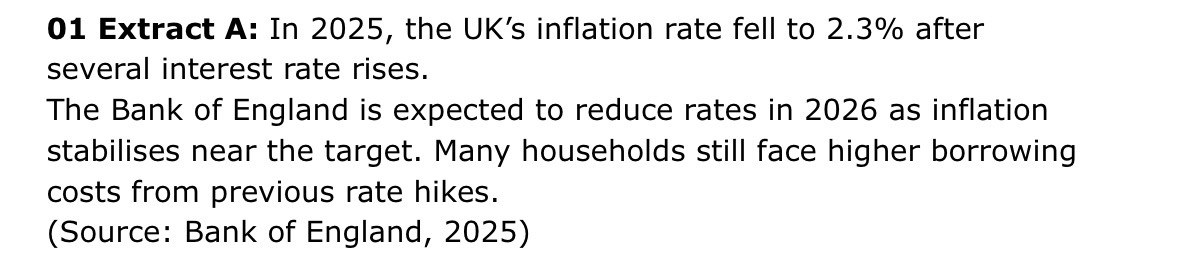
A) Explain one likely reason why inflation fell in 2025 (2)
B) Explain one likely reason why inflation fell in 2025 (2)
A) higher interest rates reduce borrowing and AD, (application), tighter monetary policy reduces consumer spending and investment → less pressure on prices
B) stable prices increase real income and certainty, higher real income can raise confidence and boost consumption
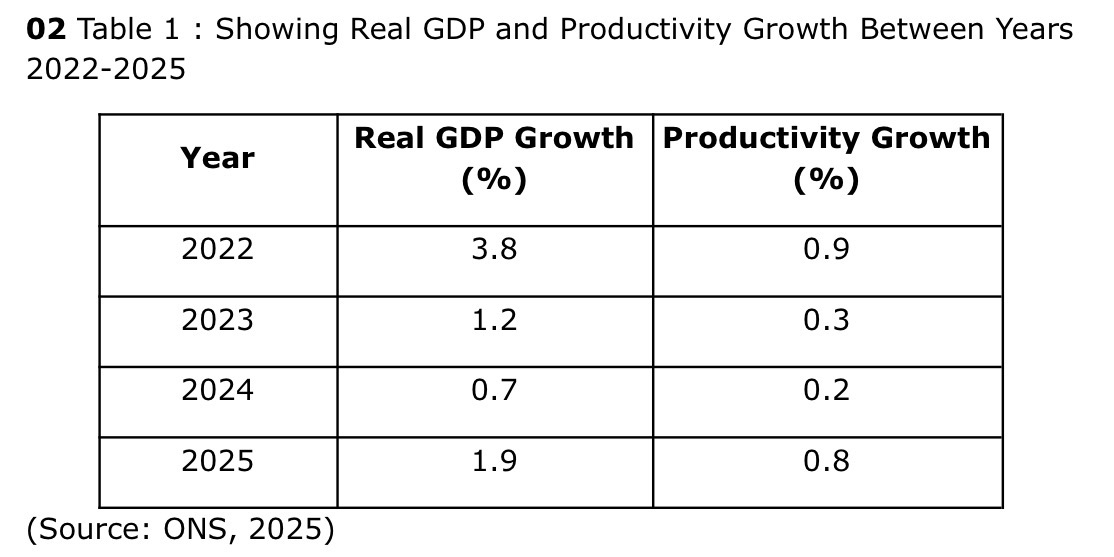
Explain one reason why higher productivity can raise potential economic growth (4)
Higher productivity means workers produce more output per hour using the same resources, reducing firms unit costs and boosting efficiency across the economy
In the UK, productivity per hour rose by only 0.6% in 2024, compared to an average of 1.4% across the G7, according to the ONS (2025). This persistent gap suggests that UK firms are producing less output per worker than competitors in 🇺🇸/🇩🇪 → limiting competitiveness
If gov policies such as the Future Growth fund or apprenticeship schemes successfully raise productivity, firms can expand output at lower costs → this shifts the LRAS curve rightward, increasing potential GDP + supporting non-inflationary LR economic growth and higher real incomes
Calculations reminder
When working out percentage change never put ➖
Explain one likely effect of reducing government borrowing on economic growth (2)
K: lower borrowing reduces government spending and AD
An: may slow SR growth but improve fiscal sustainability and investor confidence
(SR fall in AD offset by long-term gain if lower interest rates stimulate private investment)
Explain one likely effect of an appreciation on the UK’s current account (2)
K: stronger pound makes UK exports dearer and imports cheaper
An: exports fall, imports rise → worsening of the current account balance
(PED matters — if exports are elastic, trade may deteriorate more)
Explain one likely effect of lower unemployment on inflation (4)
As unemployment falls, firms compete for fewer available workers and raise wages to attract staff
In the UK, unemployment fell to around 4.2% in mid-2025, its lowest since before the pandemic, while sectors such as hospitality and construction reported persistent labour shortages
Rising wages eg the National living wage increasing to £12.71 per hour pushes up business costs, leading to cost-push inflation as firms raise prices
At the same time, more people in work have greater disposable income, particularly boosting consumer spending on services which can cause demand-pull inflationary pressure in the SR
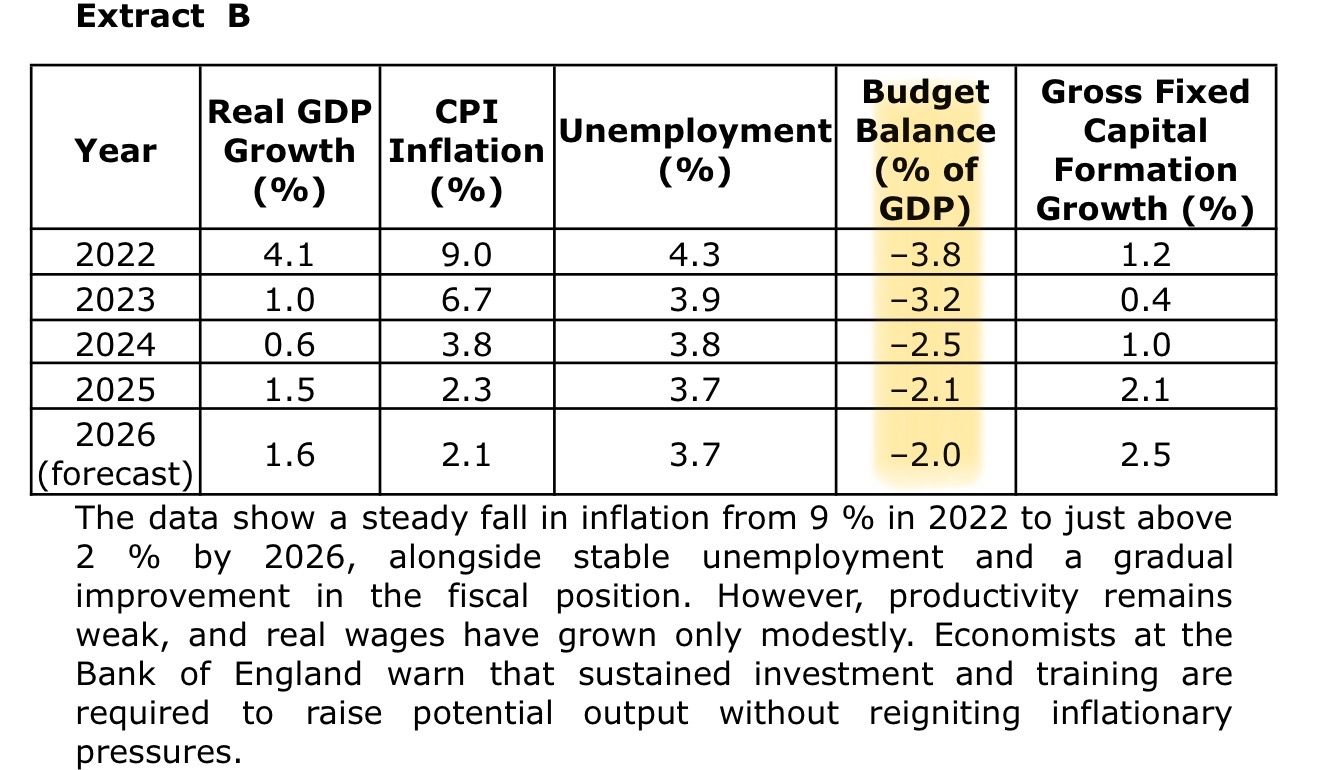
Using extract B, identify one trend in the UK budget balance between 2022 and 2026
K: The budget balance measures the difference between government spending and tax revenue, expressed as a percentage of real GDP
K: States that a deficit occurs when spending exceeds revenue
App: Extract B shows that the UK’s budget deficit gradually narrowed from -3.8% of GDP in 2022 to -2.0% of GDP in 2026, meaningful rhetorical government has been borrowing less each year relative to national income
An: This suggests that the government has adopted a policy of fiscal consolidation, either by increasing tax revenues or controlling spending
An: As a result, the fiscal position has improved, reducing the need for borrowing and helping to stabilise the public-debt-to-GDP ratio
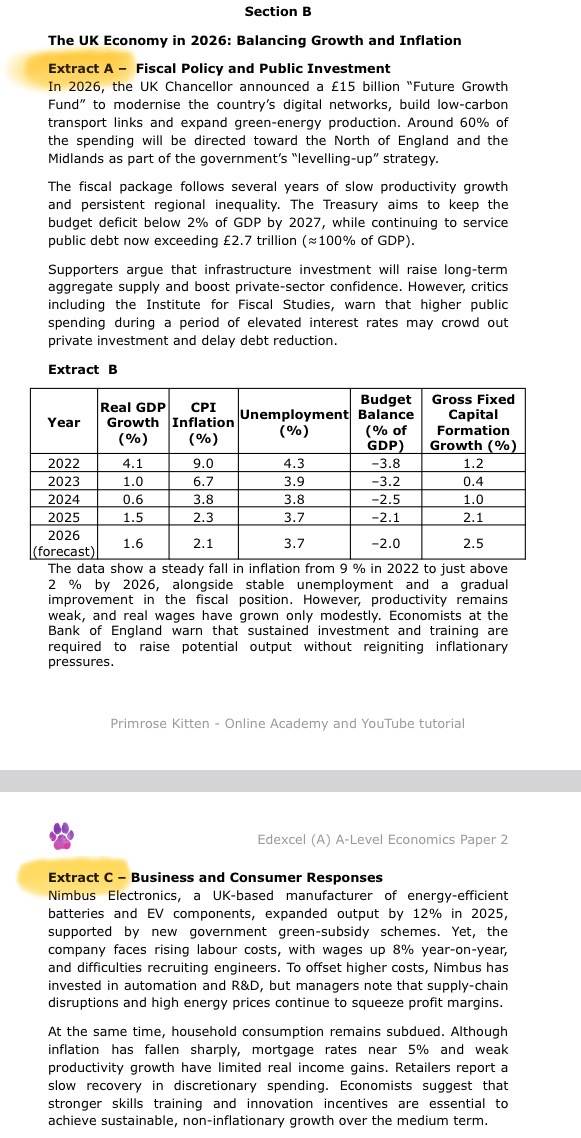
With reference to extract A and C, explain two possible causes of low productivity growth in the UK economy (8)
K: Productivity measures the amount of output produced per worker or per hour worked
K: 2 major causes of weak productivity growth in the UK are skills shortages and low investment
App: Extract C shows that firms such as Nimbus electronics face labour shortages and rising wages costs, indicating a lack of qualified engineers and technicians. This means firms struggle to expand output efficiently or adopt new tech, reducing output per worker and slowing LR growth. Extract A adds that the UK has suffered ‘slow productivity growth and regional inequality’ despite gov investment in infrastructure
An: If private firms are not investing enough in new machinery or innovation, capital per worker remains low, limiting gains in efficiency
Ev: However, the govs Future Growth Fund could help raise productivity overtime by improving infrastructure and encouraging private-sector confidence. Better transport and digital networks reduce firms’ costs and increase expected profit, which can ‘crowd in’ private investment, more capital + r&d spending expand capital per worker and eventually lift national productivity
Using extract A and B and your own knowledge of economics, analyse how fiscal policy can be used to promote long-run economics