Fundamentals of Tooth Preparation
 Call Kai
 Learn
Learn Practice Test
 Spaced Repetition
 Match
Match Flashcards
 Knowt Play
1/163

There's no tags or description
Looks like no tags are added yet.
Name | Mastery | Learn | Test | Matching | Spaced | Call with Kai |
|---|
No analytics yet
Send a link to your students to track their progress
164 Terms
True / False: enamel is brittle
True
Enamel has --- elastic modulus and ---- tensile strength
high elastic modulus
low tensile strength
Fractures in enamel occur along ----
rods
True / False: dentin is compressive
True / False: amalgam is brittle
true
Amalgam requires --- for strength
bulk
Amalgam requires ---- margins for restorations
90 degree
Amalgam requires creating ---- for retention
undercuts
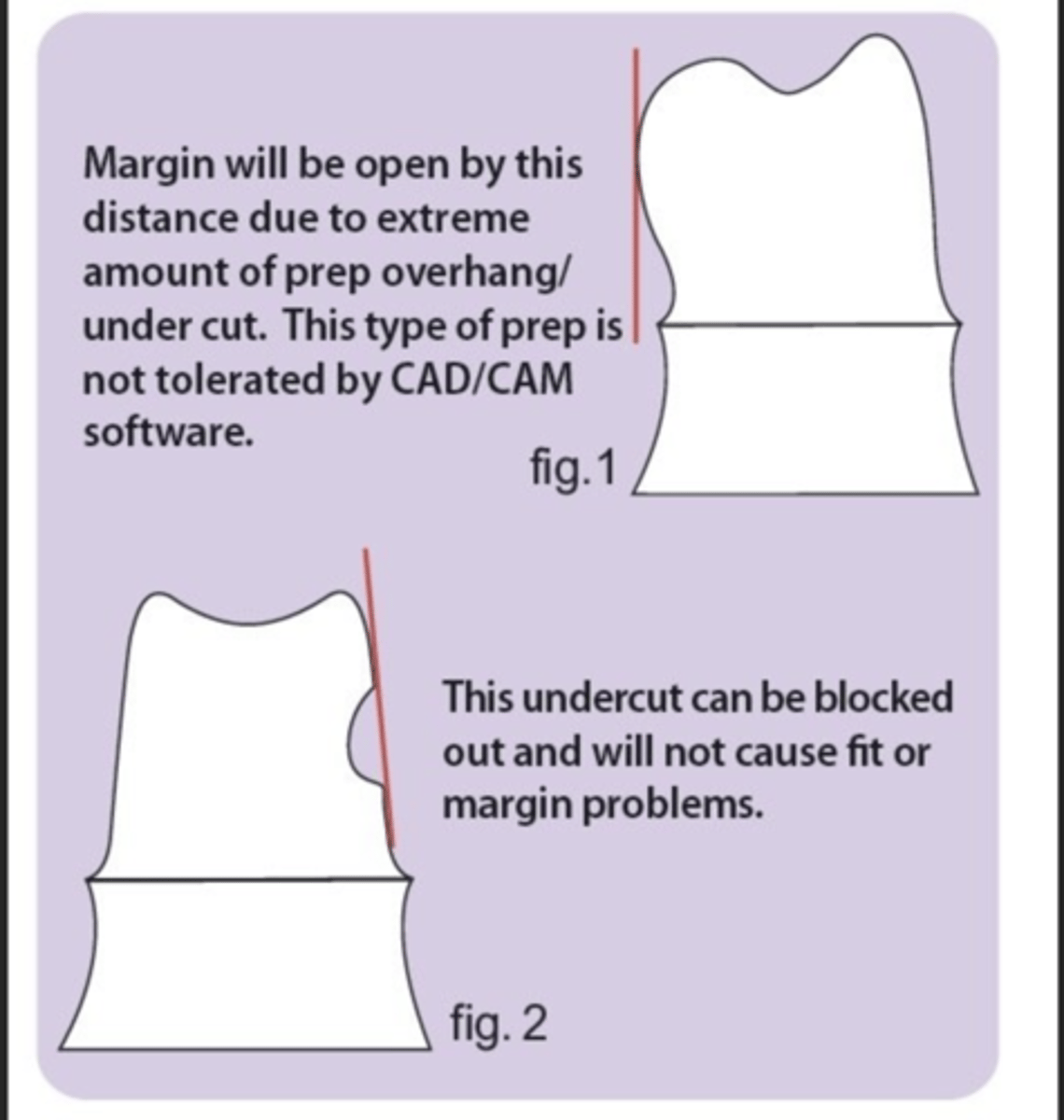
True / False: undercuts can exist because of natural tooth morphology and counter
Undercuts create ---- featureas
retentive
Composite is made of
filler particles embedded into a matrix
i.e glass in Bis-GMA
Amalgam is made of
silver/copper/tin/zinc in mercury
Amalgam is an
alloy = mercury and a metal
Composites bond to enamel and dentin using
acid etching
What are the initial stages of cavity preparation?
1. initial depth (0.2mm) and outline form
2. primary resistance form
3. primary retention form
4. convenience form
What are the final stages of cavity preparation?
5. remove decay and old restorative material
6. pulp protection
7. secondary resistance and retention
8. finish external walls
9. final procedure = cleaning and inspecting
True / False: When creating an outline form, material indicates --- depth
initial
When creating a restoration the most important aspect is to ---- tooth structure
conserve
How do you proceed from initial to final tooth preparation?
by extending the external margins to remove existing decay
Decay on internal walls is removed: first or last?
last
The initial depth for amalgam prep is --- mm into dentin
0.5mm
Isthmus
narrow anatomical part that connects two larger structures
The isthmus width for amalgam prep is --- mm
1 mm
True / False: composite preparations require varies initial depth and isthmus width
true
Ceramic requires --- mm initial depth and isthmus width
2 mm
Purpose of primary resistance form
The shape and placement of the preparation walls that enables the tooth structure and restoration to withstand masticatory forces
What is completed during primary resistance form?
Create the MINIMUM cavity depth / isthmus width for restorative material used
Remove unsupported enamel at cavomargins
Remove decay
Round internal and external line angles
Purpose of primary retention form
The shape and placement of the preparation walls that enables the tooth structure and restoration to withstand displacement via lifting or tipping
What is performed during primary retention form?
Mechanical undercuts for amalgam
Micro-mechanical and mechanical undercuts for composite = acid etching and undercuts
What 2 steps are completed in primary retention form?
Creating mechanical and micro-mechanical features to withstand displacement
Convenience form
form that allows for accessibility in preparing and restoring the tooth
When creating a convenience form the preparation must be opened enough for ----
adequate inspection
True / False: all staining is not considered decay
true - color of dentin changes due to mineralization and re-mineralization
Affected dentin can
remineralize
Does affected dentin have to be removed?
No can remain and re-mineralize if isolated from oral environment
Decay spreads at the ---
DEJ
When preparing a restoration the --- and --- must be free from caries
cavosurface margin and lateral walls
What is the heathy texture of dentin?
Dry and leathery
What is decayed texture of dentin?
Soft and moist
True / False: it is acceptable to probe the area over the pulp
FALSE = will cause penetration and exposure
Bases are used for ---- protection
thermal
Liners are used for ---- protection
Mechanical
Bases are not needed for ---- protection under ---
bases are not needed for thermal protection under composites
What occurs during secondary resistance and retention?
Macro-mechanical and micro-mechanical alterations
Macro-mechanical alterations refers to
grooves, slots, boxes, pins
Micro-mechanical alterations refers to
enamel and dentin conditioning = acid etching
Class 5 amalgam preparation requires ---- placement for proper retention
secondary groove placement
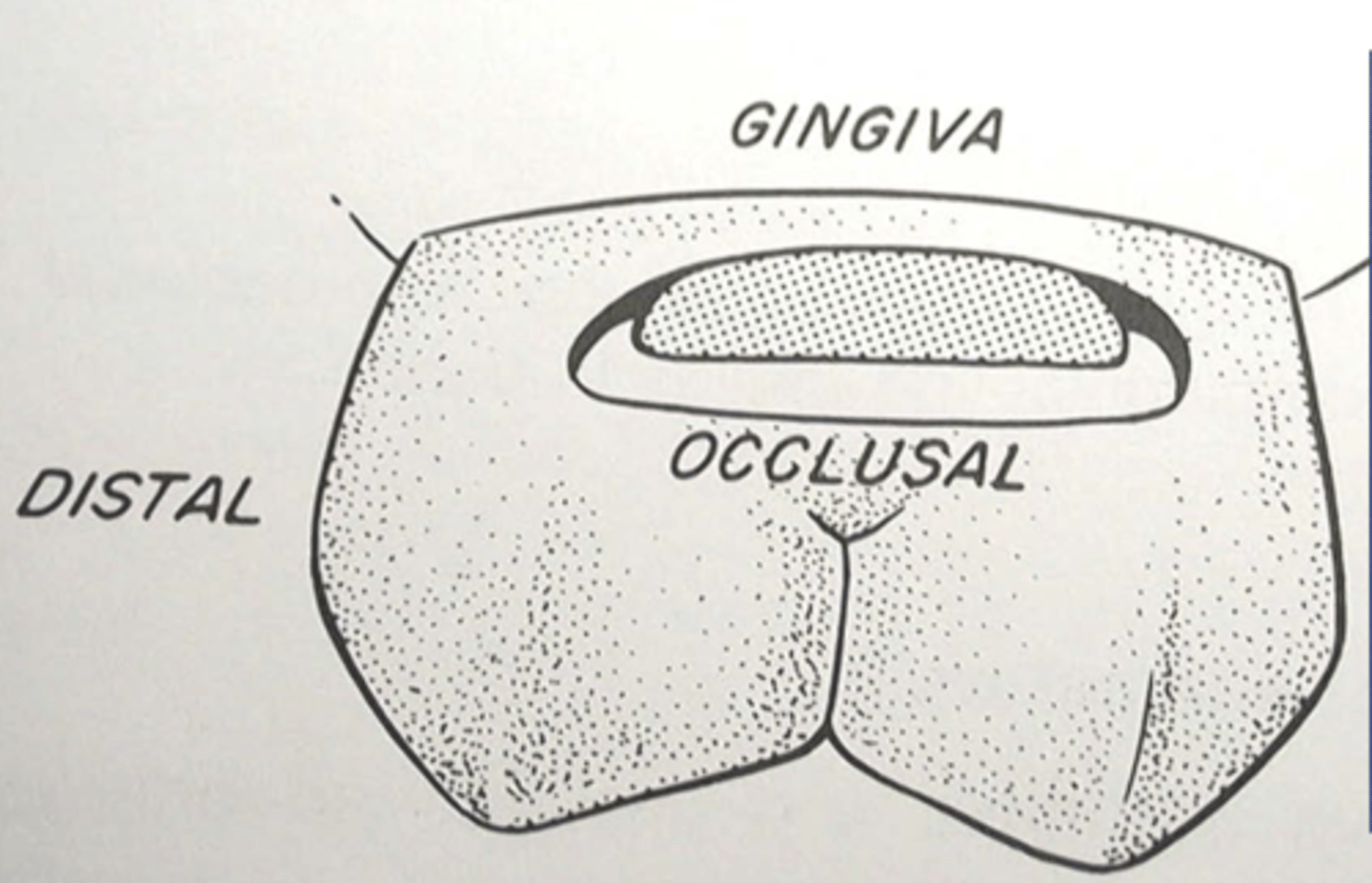
What are the two types of cavosurface margins?
1. Butt joint
2. Beveled
Class 5 composite preparterm-58ation extending below CEJ requires --- placement for proper retention
secondary groove placement
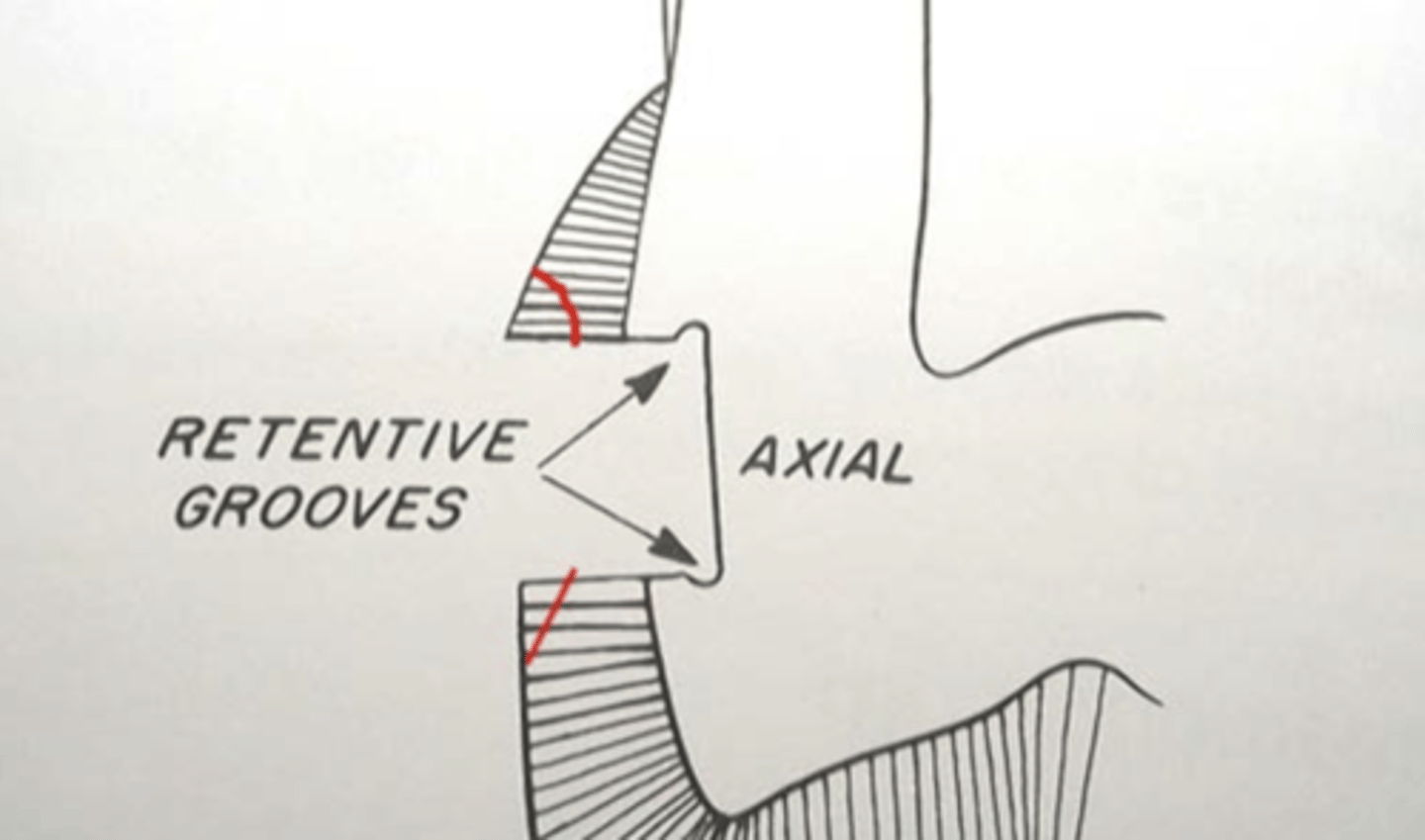
Butt joint margins have ---- degree angle between the restorative material and tooth
90 degree
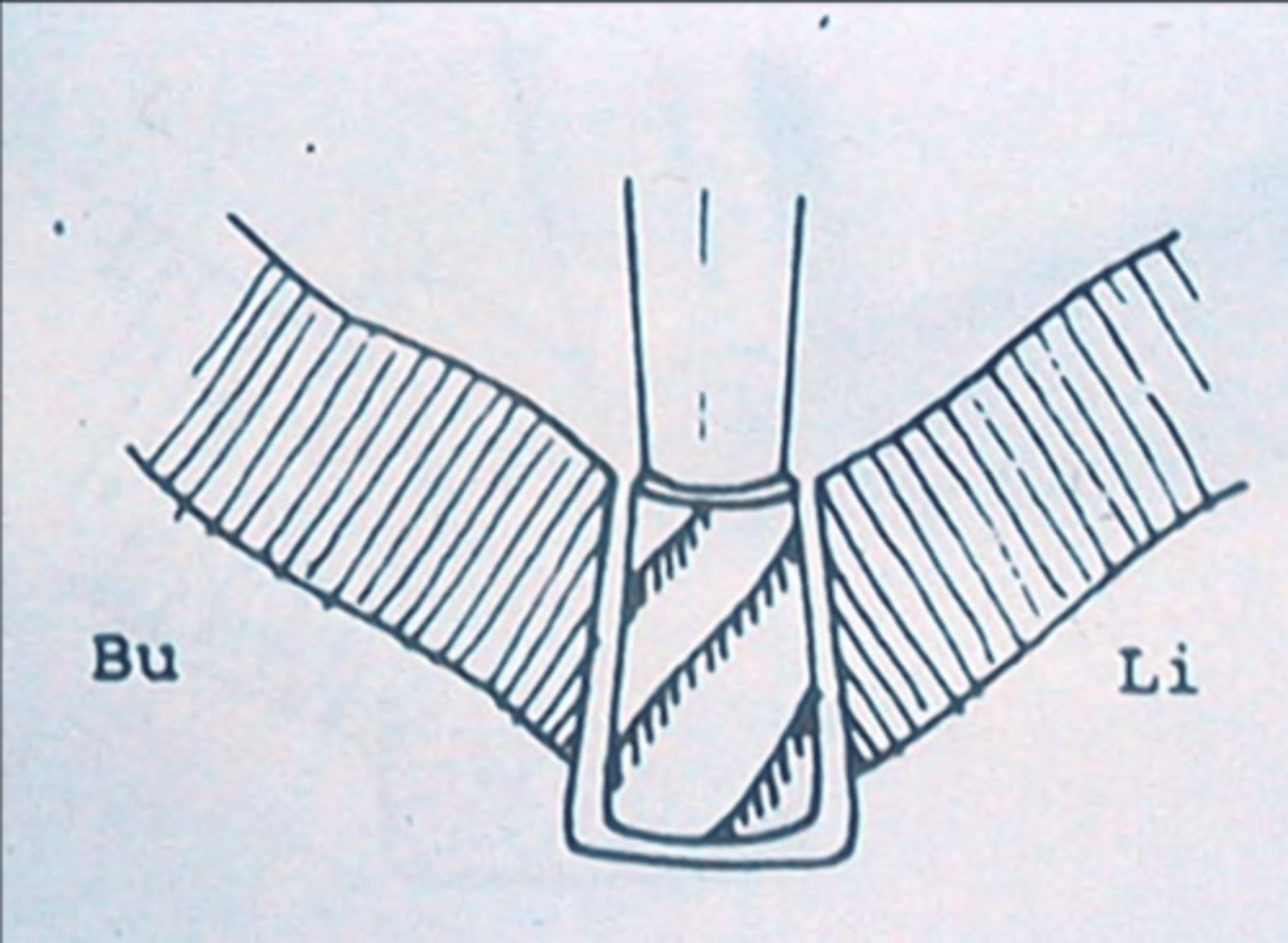
Beveled margins have a ---- angle between the restorative material and tooth
sloped
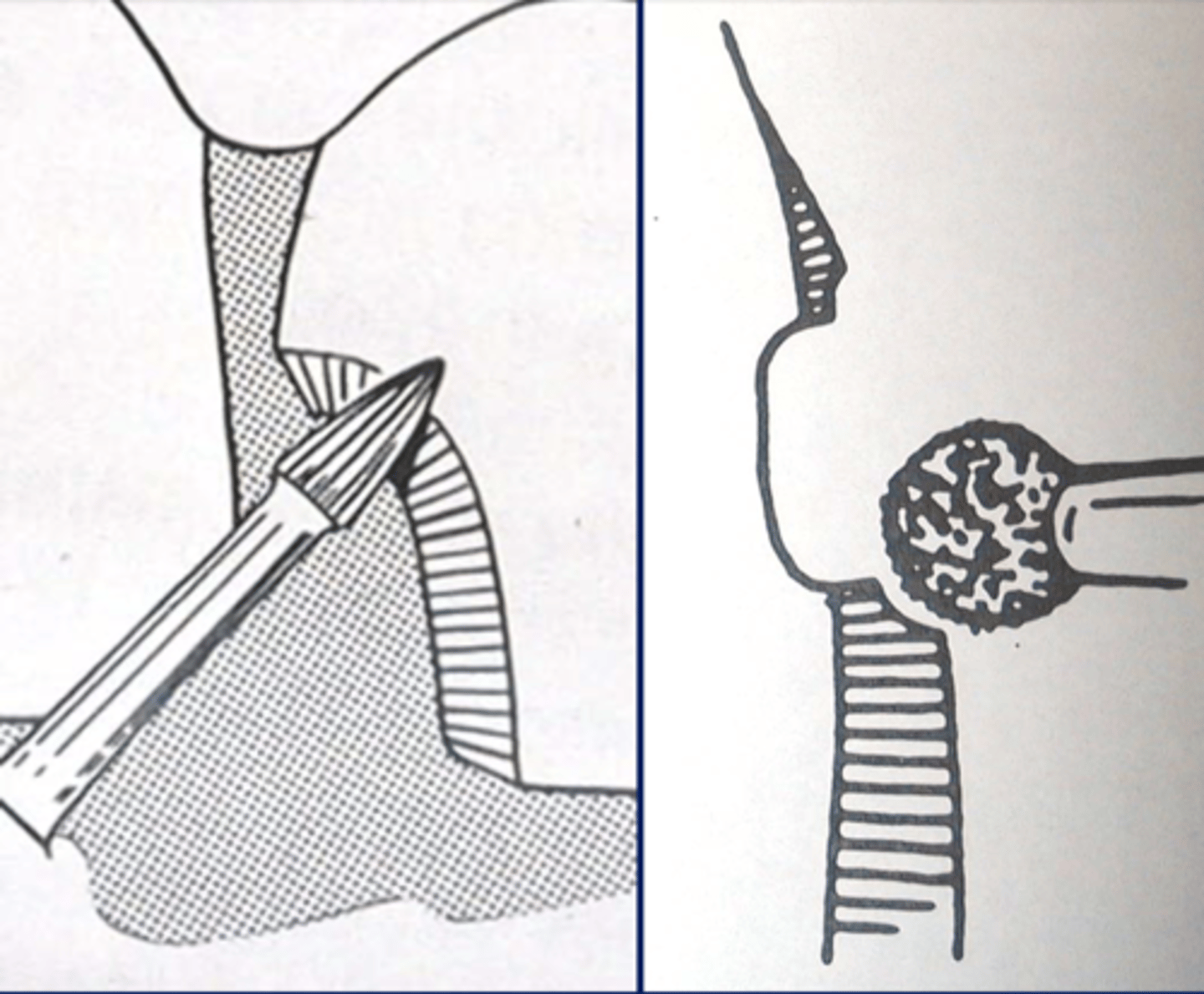
When finishing the external walls of a preparation ceramic requires ---- margins
butt joint
When finishing the external walls of a preparation amalgam requires ---- margins
butt joint
When finishing the external walls of a preparation composite requires ---- margins
butt joint or beveled
When finishing the external walls of a preparation cast requires ---- margins
beveled
What is used under amalgam to minimize leakage / sensitivity?
Varnishes / bonding agents
What minimizes leakage in composites?
Acid etching improves bonding and decreases leakage
Never --- a preparation
Dessicate = dry
Why should a preparation never be dessicated (dried)?
causes collagen in dentin to collapse = decreases bond strength / pulp damage
A number 245 burr has a length of ---- mm
3 mm
A number 330 burr has a length of ---- mm
3 mm (pear shaped)
Cavity preparations begins with a --- cut
punch cut
The initial punch is done in the area of ----
decay
The initial depth of preparation is measured at the ---- area of the tooth, which would be the --- area
measured at the shallowest area of the tooth = pit area
The bur is oriented with its long axis ---- to the long axis of the tooth
parallel
True / False: the pulpal floor may measure greater than 2.0 mm in the area of the cusps and that is acceptable because it is the depth into dentin that is most important
true - the depth must be 0.5 mm into dentin with amalgam preparation
True / False: Multiple passes should be avoided because this can result in cavitypreparations with a wide faciolingual width, overconvergence ofthe facial and lingual walls and irregular internal line angles
True
Why should internal line angles be rounded?
to reduce stress concentration
materials condense more easily into rounded line angles
Once the initial depth is complete only areas requiring ---- removal should be deepened
decay
True / False: it is necessary to flatted the entire floor to the depth of the decay
True
What happens when the burr is tilted?
One wall severely undercut and the other wall severely over tapered
Primary retention is obtained by using a bur which produced cavity walls that ---- occlusally
converge
Tapered fissure burs produce walls that ---- occlusally
diverge
Pear shaped burs produce walls that ---- occlusally
converge
When should occlusal walls diverge?
when preparing indirect restorations
For class 1 preparations the buccolingual width should be less than ----- the buccolingual intercuspal dimensions
1/4
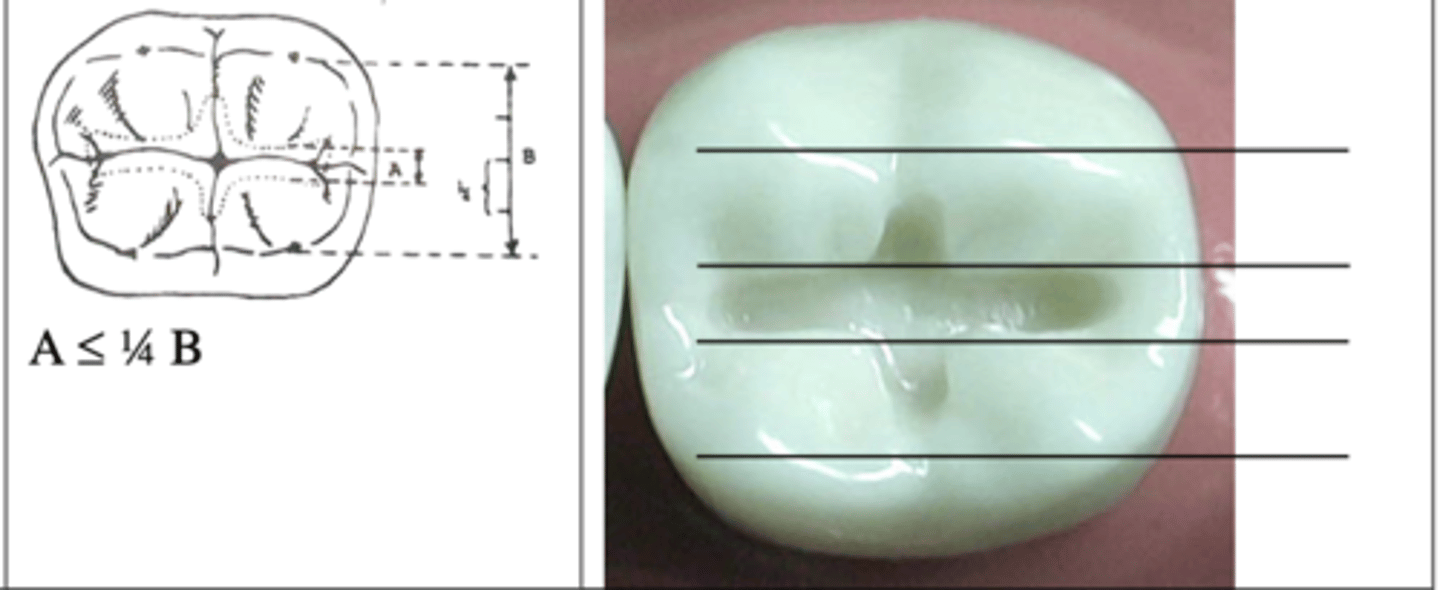
Why is flaring present in class 1 prep of mandibular first molar?
to incorporate pit without weakening the marginal ridge
The generic shape for a class 1 prep of a mandibular second molar is ---
plus shaped
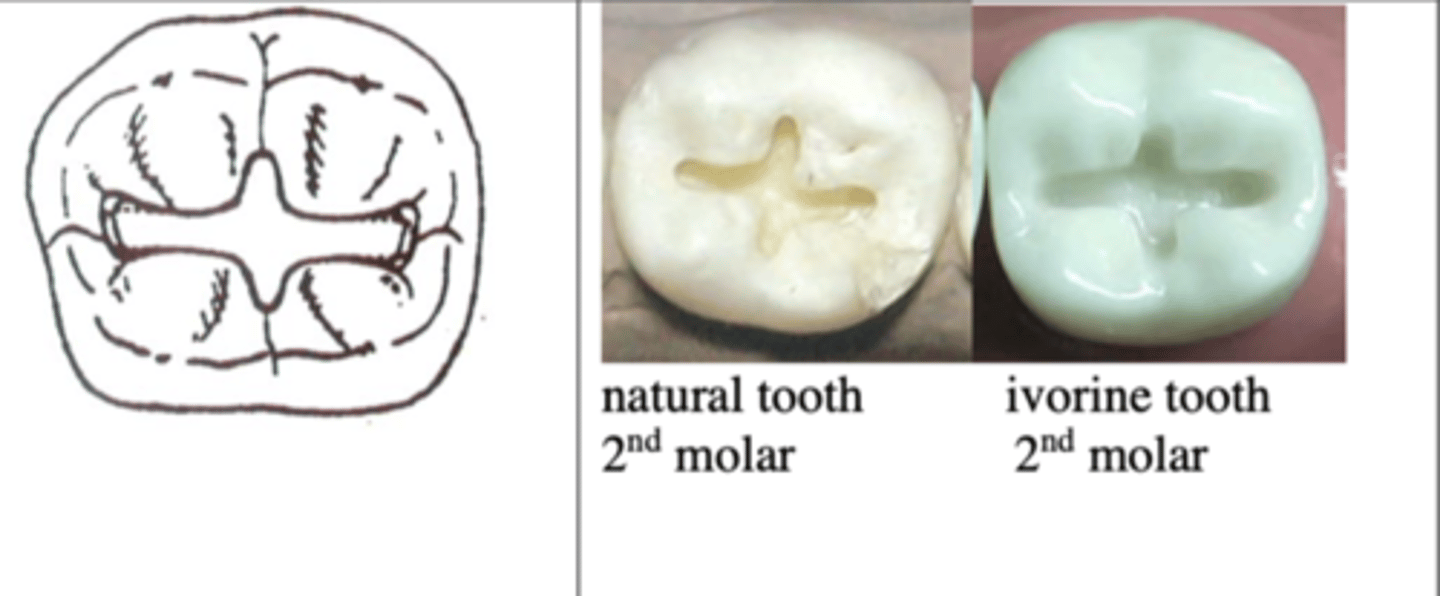
For the class 1 prep of mandibular third molars outline generally follows the ---- and ----
deep fissures and pits
For the class 1 prep of mandibular second premolars the outline generally follows a ---- or ---- shape
Y or H shape
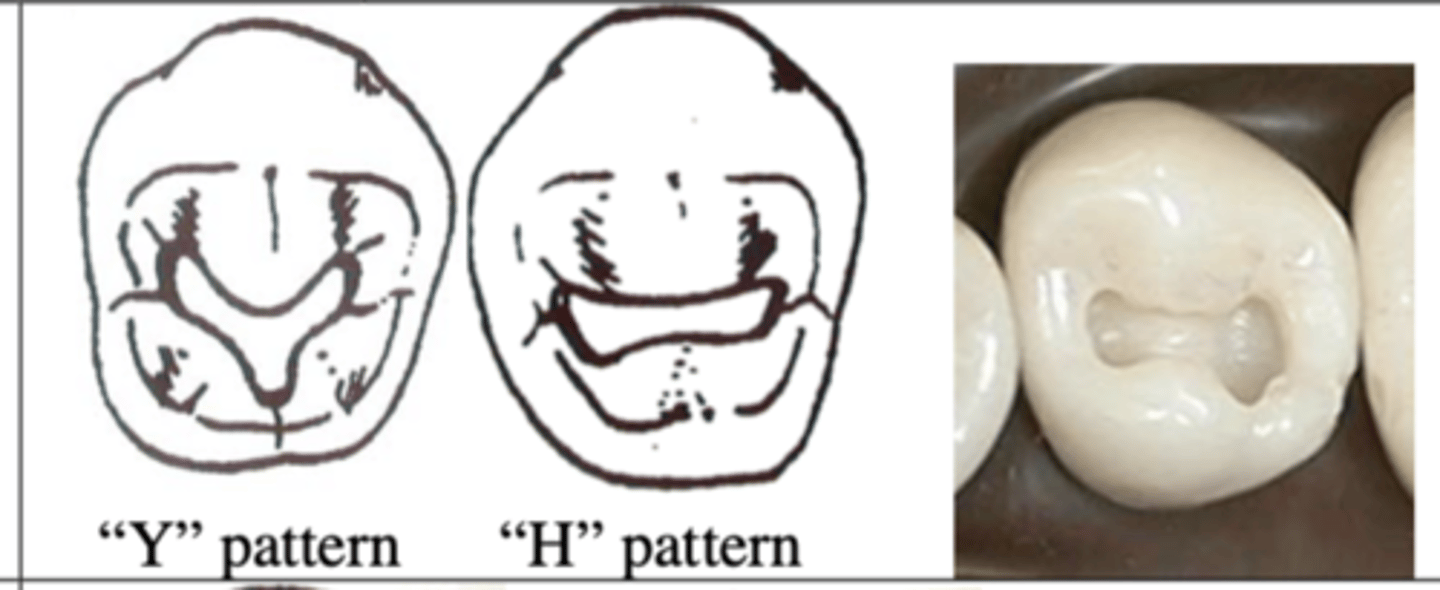
For the class 1 prep of mandibular first premolars it is important to not cross the ----
transverse ridge
For the class 1 prep of mandibular first premolar first prepare the --- and ---- pits
Mesial and distal pits
What happens if decay undermines the transverse ridge in a mandibular first premolar?
cross the transverse ridge from mesial to distal pits and create one large occlusal preparation
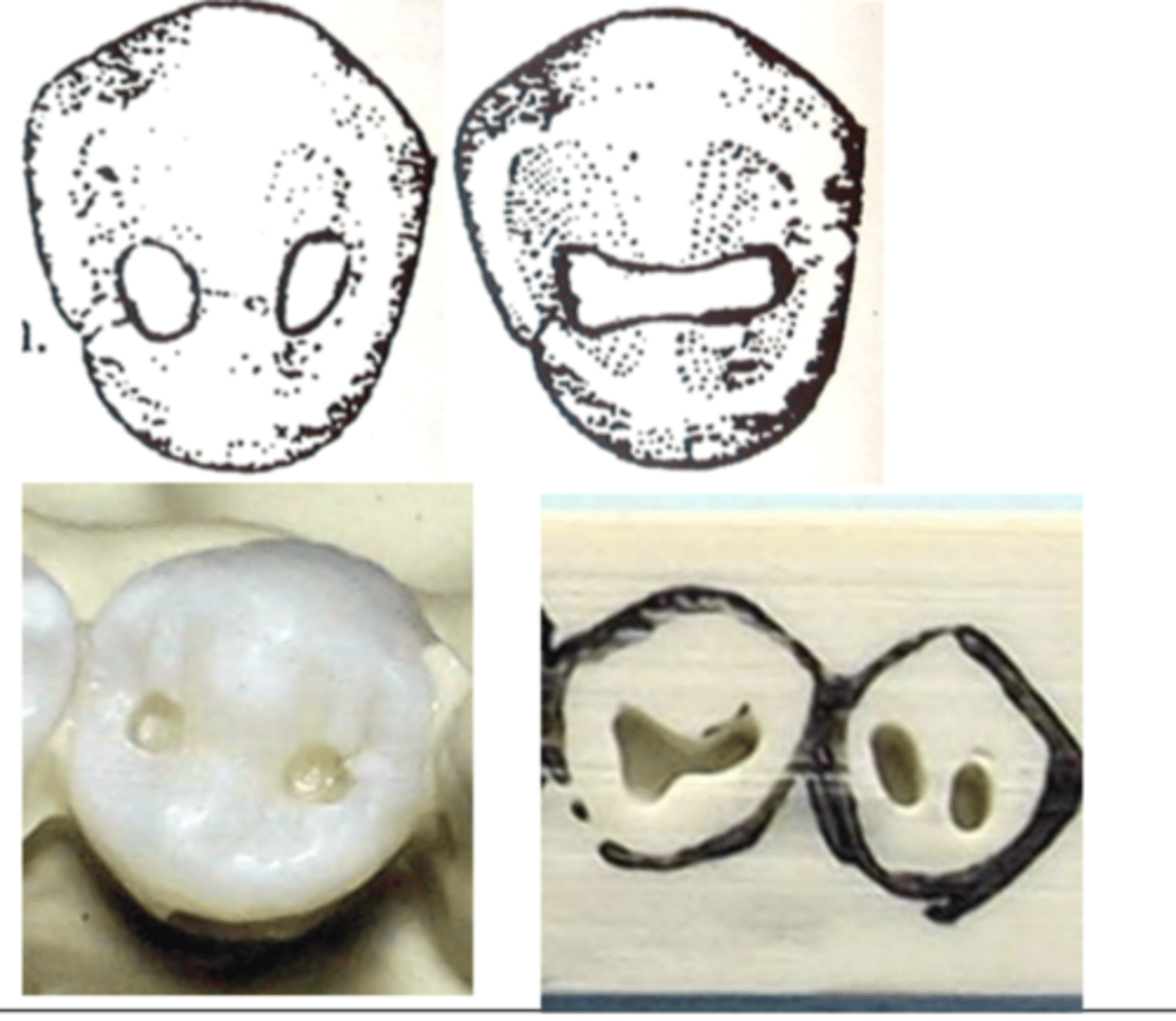
For the class 1 prep of maxillary first and second premolars the outline form follows the ----
primary fissure
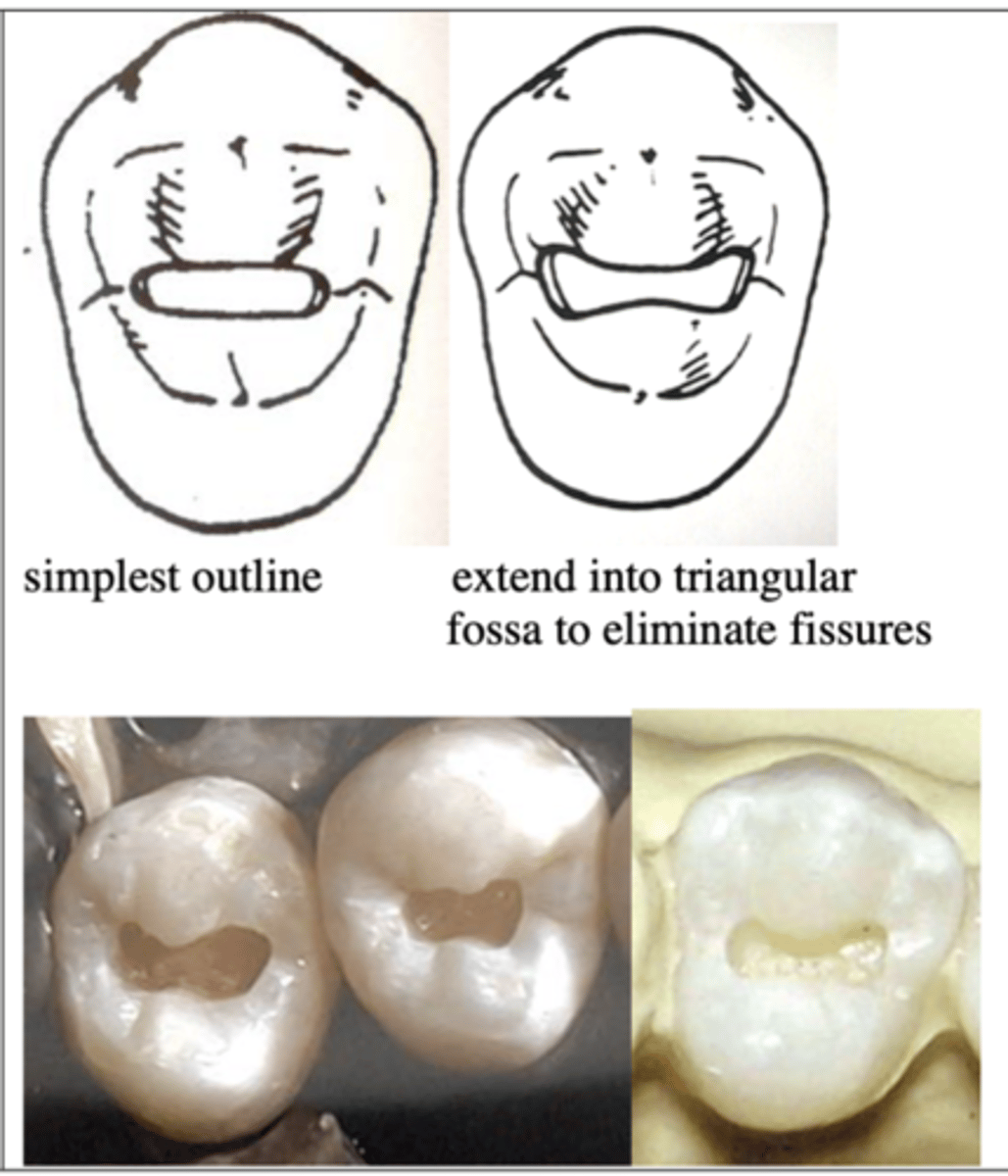
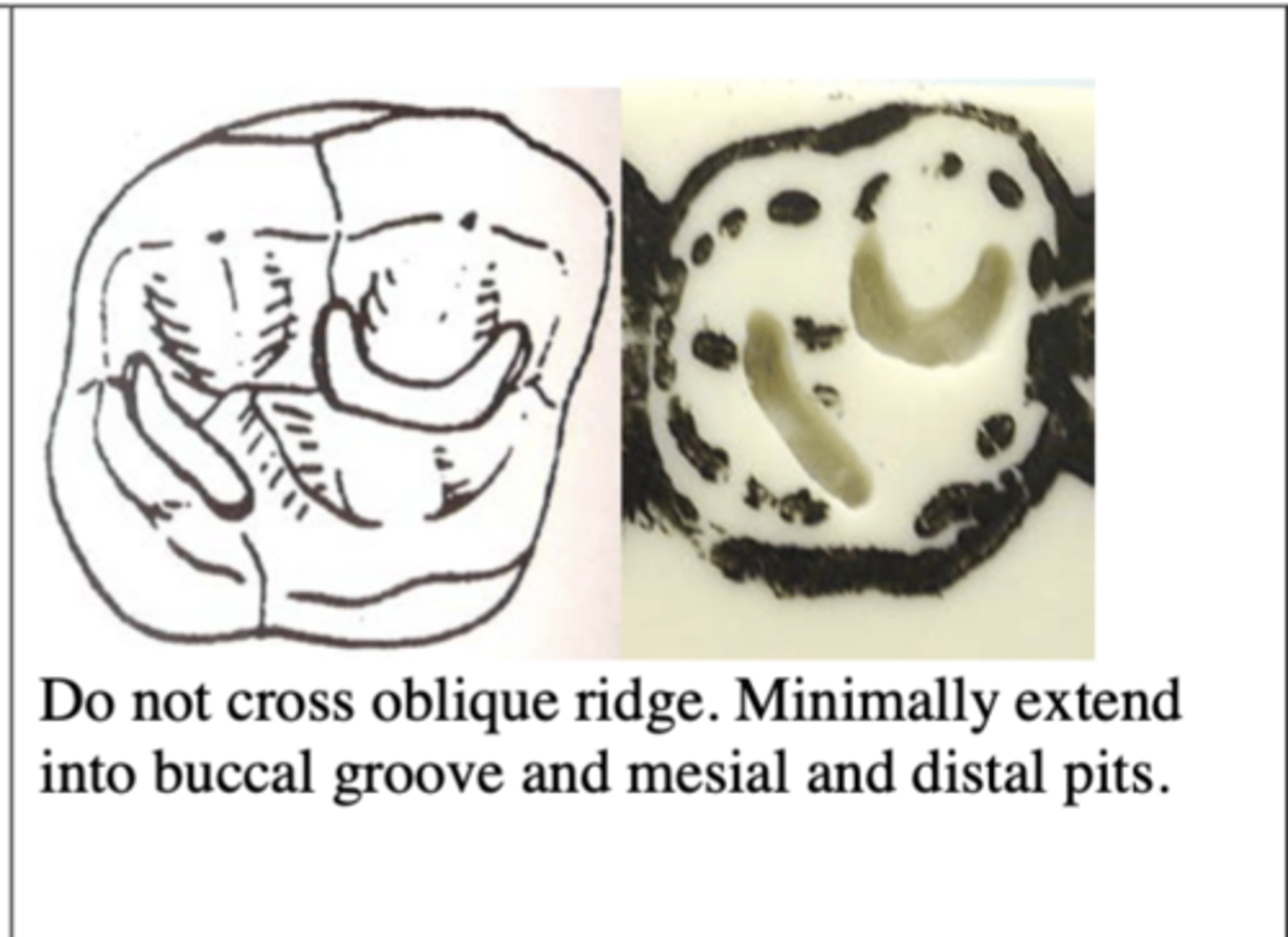
For the class 1 prep of maxillary first and second molars the ---- should be preserved
oblique ridge
For the class 1 prep of maxillary first and second molars prepare separate ---- and ---- cavity preparations
O and OL
A caveated lesion is treated with an ----- procedure
Operative
A non-cavitated lesion that does not involve dentin is treated with a ---- procedure
Medical = non-invasive
Enamel that remains over carious dentin is described as
unsupported enamel
Carious lesions can be divided into 3 types
1. pits / fissures
2. smooth surface
3. root surface
Smooth surface lesions of enamel resembles an ----
irregular cone
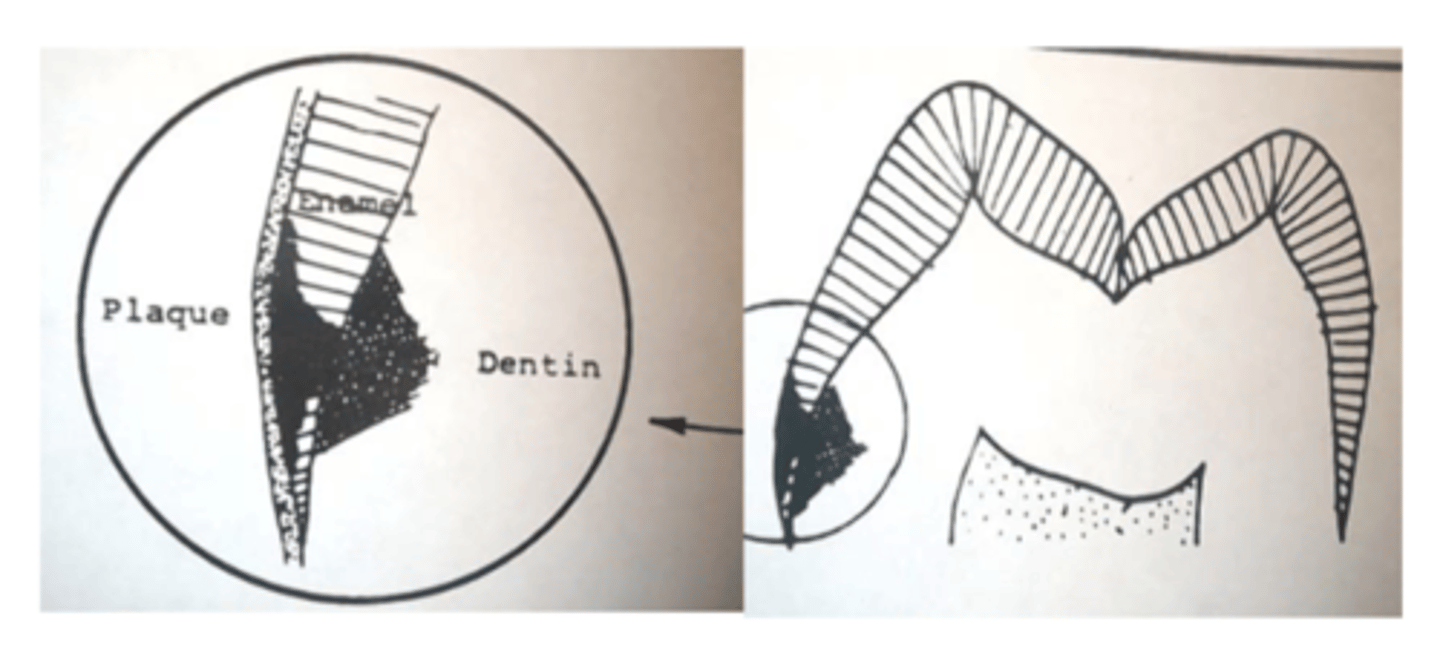
The base of a smooth surface lesion is in the ----
The apex of a smooth surface lesion is in the ----
base = enamel
apex = DEJ
Cones of decay in smooth surface lesions are described as
apex to base
The base of a pits/fissure lesion is in the ----
The apex of a pits / fissure lesion is in the ----
base = DEJ
apex = enamel
Cones of decay in puts and fissures caries are described
base to base
Beginning carious lesions confined to enamel are known as
incipient
Incipient lesions are described as ---- or ----
E1 or E2
E1 lesions are
halfway into enamel
E2 lesions are
reach DEJ but do not extend into dentin
Reversible superficial lesions that often appear frosty white are called
white spot lesions