chp13
 Call Kai
 Learn
Learn Practice Test
 Spaced Repetition
 Match
Match Flashcards
 Knowt Play
1/16

There's no tags or description
Looks like no tags are added yet.
Name | Mastery | Learn | Test | Matching | Spaced | Call with Kai |
|---|
No analytics yet
Send a link to your students to track their progress
17 Terms
Economists normally assume that the goal of a firm is to
maximize its profit.
Profit is defined as
total revenue minus total cost.
For a firm, the production function represents the relationship between
quantity of inputs and quantity of output.
The marginal product of an input in the production process is the increase in
quantity of output obtained from an additional unit of that input
Kate is a florist. Kate can arrange 20 bouquets per day. She is considering hiring her husband William to work for her. Together Kate and William can arrange 35 bouquets per day. What is William’s marginal product?
15 bouquets (35-20)
Suppose a certain firm is able to produce 165 units of output per day when 15 workers are hired. The firm is able to produce 181 units of output per day when 16 workers are hired, holding other inputs fixed. The marginal product of the 16th worker is
16 units of output.
Table 13-1
Number of Workers | Total Output | Marginal Product |
0 | 0 | -- |
1 |
| 30 |
2 |
| 45 |
3 |
| 60 |
4 |
| 50 |
5 |
| 40 |
Refer to Table 13-1. What is total output when 1 worker is hired?
30
Table 13-2
Number of Workers | Total Output | Marginal Product |
0 | 0 | -- |
1 | 300 |
|
2 | 500 |
|
3 | 600 |
|
4 | 650 |
|
Refer to Table 13-2. What is the marginal product of the third worker?
100 units
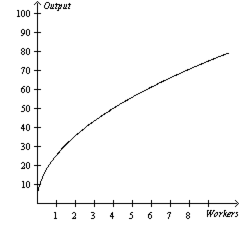
Refer to Figure 13-2. As the number of workers increases,
total output increases but at a decreasing rate.
Some costs do not vary with the quantity of output produced. Those costs are called
fixed costs
Total cost can be divided into two types of costs:
fixed costs and variable costs.
Harry's Hotdogs is a small street vendor business owned by Harry Huggins. Harry is trying to get a better understanding of his costs by categorizing them as fixed or variable. Which of the following costs are most likely to be considered fixed costs?
the cost of bookkeeping services
Marginal cost is equal to
ΔTC/ΔQ.
Marginal cost tells us the
amount by which total cost rises when output is increased by one unit.
Table 13-8
Quantity | Fixed | Variable |
0 | $20 | $0 |
1 | $20 | $10 |
2 | $20 | $40 |
3 | $20 | $80 |
4 | $20 | $130 |
5 | $20 | $200 |
6 | $20 | $300 |
Refer to Table 13-8.What is the marginal cost of producing the fifth unit of output?
$70 ($200-$130)
Table 13-8
Quantity | Fixed | Variable |
0 | $20 | $0 |
1 | $20 | $10 |
2 | $20 | $40 |
3 | $20 | $80 |
4 | $20 | $130 |
5 | $20 | $200 |
6 | $20 | $300 |
Refer to Table 13-8.What is the average fixed cost of producing 5 units of output?
$4 ($20 / 5)
Table 13-8
Quantity | Fixed | Variable |
0 | $20 | $0 |
1 | $20 | $10 |
2 | $20 | $40 |
3 | $20 | $80 |
4 | $20 | $130 |
5 | $20 | $200 |
6 | $20 | $300 |
Refer to Table 13-8.What is the average variable cost of producing 5 units of output?
$40 ($200/5)