Reading words
 Call Kai
 Learn
Learn Practice Test
 Spaced Repetition
 Match
Match Flashcards
 Knowt Play
1/23

There's no tags or description
Looks like no tags are added yet.
Name | Mastery | Learn | Test | Matching | Spaced | Call with Kai |
|---|
No analytics yet
Send a link to your students to track their progress
24 Terms
What has been found in relation to writing and reading?
Evolutionarily unexpected, experience dependent abilities → surviving writing dates back to around 3500 BC
6.6 million adults are functionally illiterate in England
Writing represents units of spoken language (words, syllables, sounds).
What has been found about visual word processing and understanding of language?
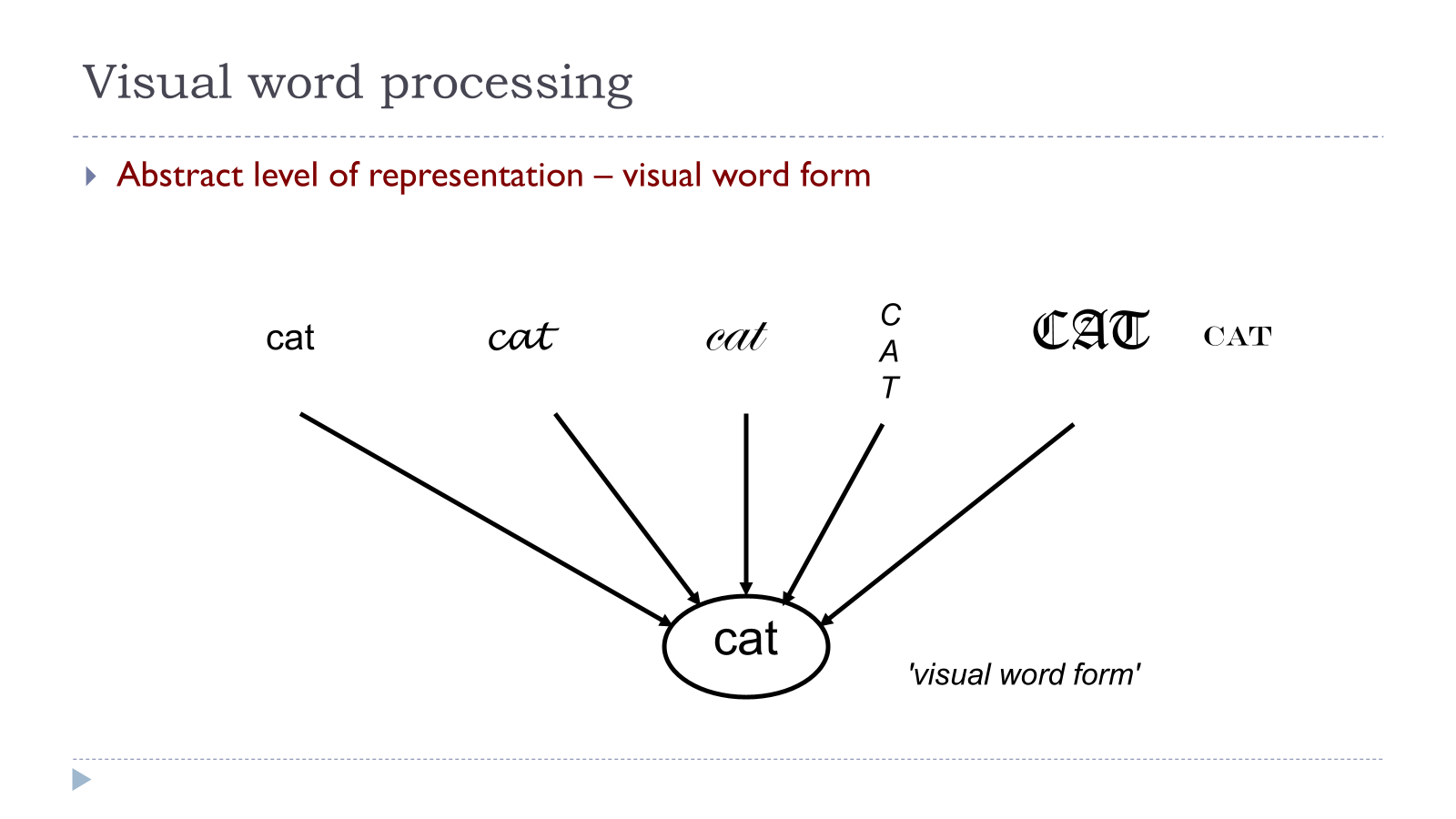
We read words in many forms, and we extract or generalise the typical features → E.g. many fonts, orientations
What has been found in visual word processing when words are jumbled in sentences?
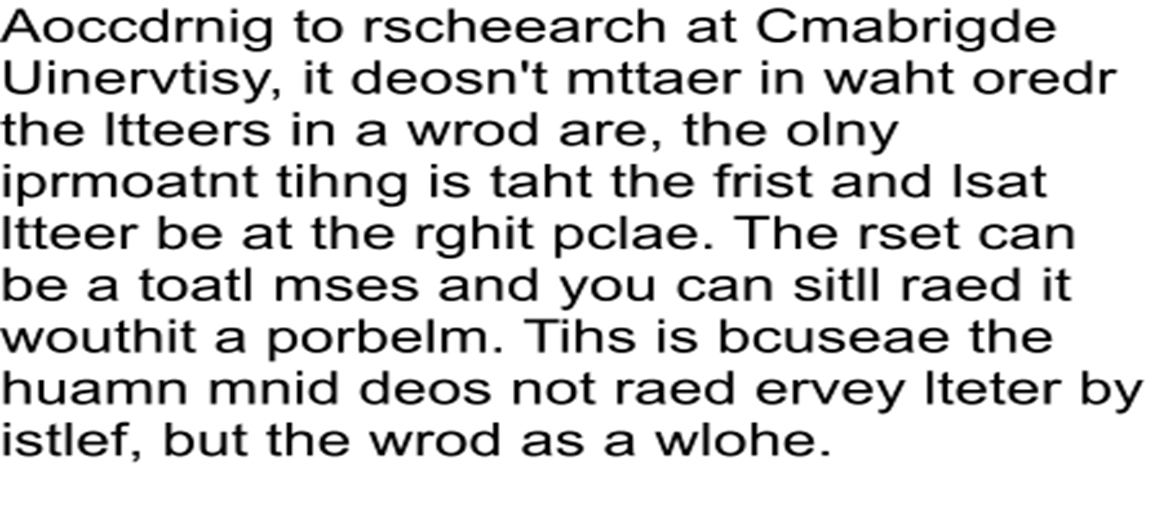
First and last letter only needed to identify word, focus on whole words not every single letter.
Word recognition comes from shape
What is visual word form?
Abstract level of representation → words contain typical set of features that the visual system can use to recognise word
What has been found in relation to accessing visual word forms and serial vs global recognition?
Global recognition in RVF/LH
Words presented in RVF processed faster due to global rapid visual recognition in LH
LVF/RH processing more serial, words recognised by identifying letters and sharing with LH for word identification
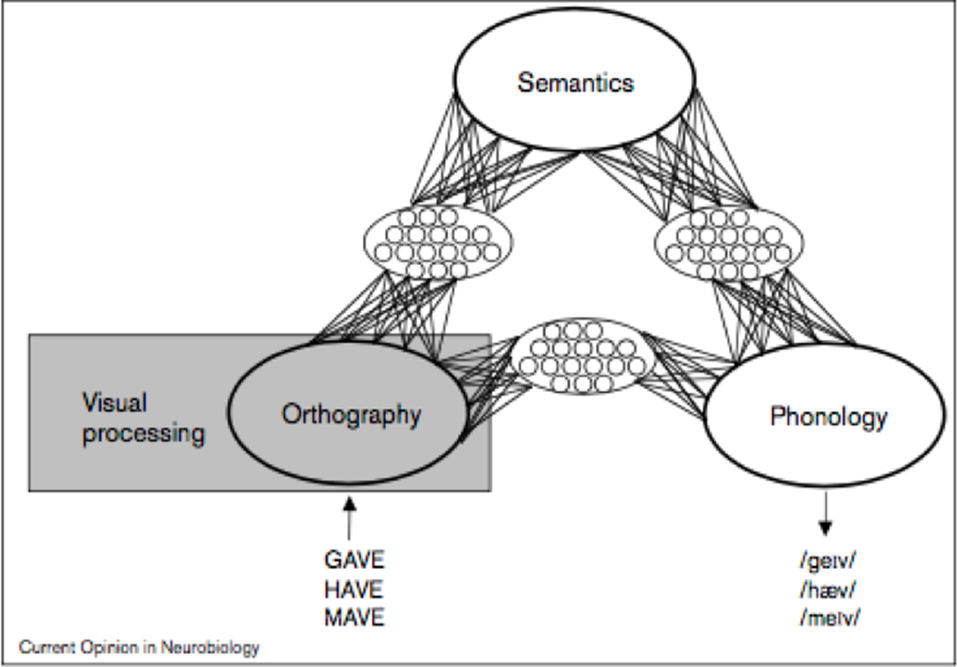
What is the triangle model of lexical knowledge?
Posits three main centres or nodes → orthographic, phonological and semantic representations.
Nodes interconnected and can be simultaneously activated in given task or can influence each other.
Where is the visual word form area?
In the fusiform (occipitotemporal) gyrus
What does the visual word form area respond to?
Words more than false fonts or consonant strings (chair vs ckmn)
Upper and lower case equally → chair vs CHAIR vs ChAir
Real words more than non words sounding the same → taxi> taksi
Orthographic identity of the word
What has been found from fMRI in relation to visual word form area and respond to LVF/RVF presentation (McCandliss et al, 2003)?
VWFA in LH responds equally strongly to right of left visual field presentation
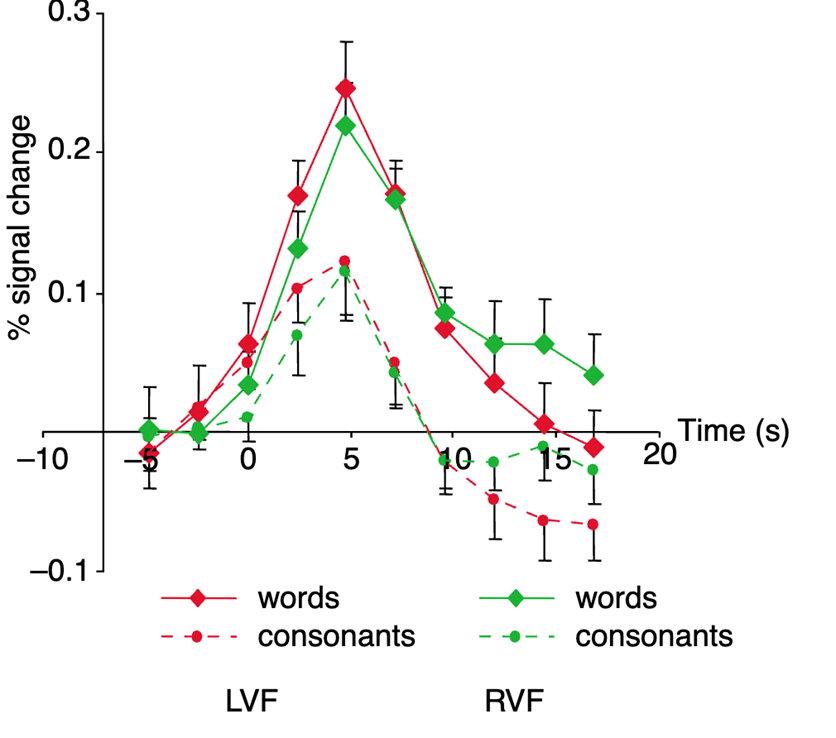
Suggests that word recognition or identification is performed in the LH in typical readers.
What did Dehaene and Cohen find in a study comparing activity in VWFA in literates, illiterates and ex-illerates from different countries?
VWFA becomes specialised for visual word recognition
Experience modulates brain development
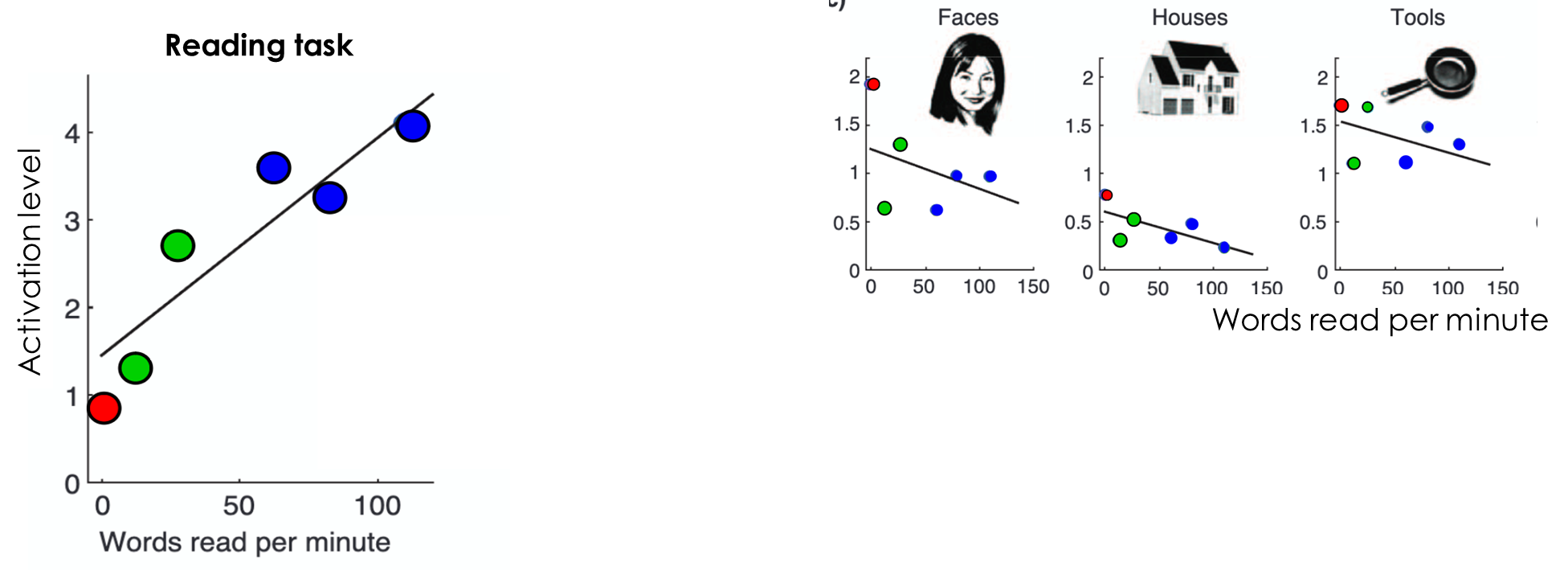
Illiterates have higher activation for faces, house and tools.
In typical adults what else also activates the VWFA?
Auditory words and object naming → suggests region has some role in visual object processing.
Blind braille readers also have word area (no selectivity for vision).
How might auditory input also lead to activations in VWFA?
Automatic links between nodes are established with learning, so sounds also activate VWFA.
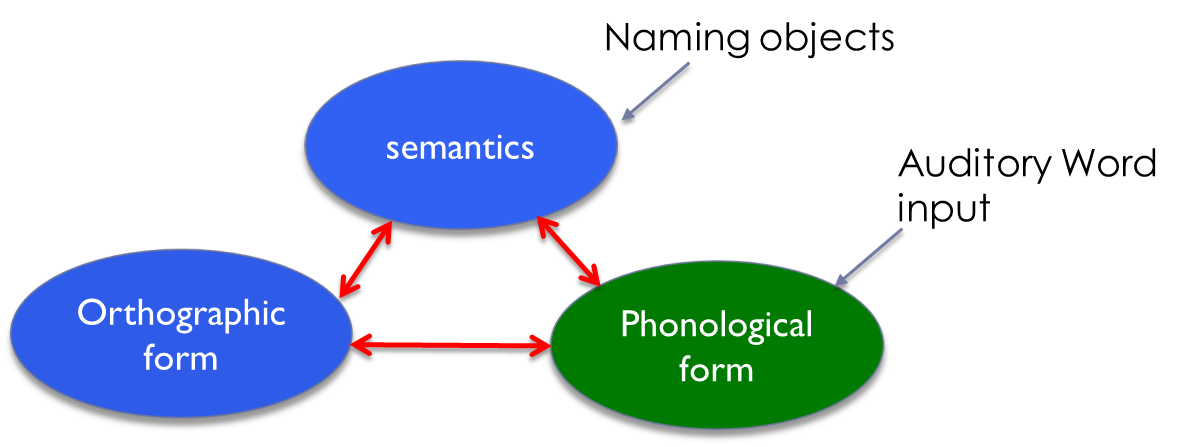
VWFA results from developing reading expertise, but may not be exclusively involved in reading or visual processing
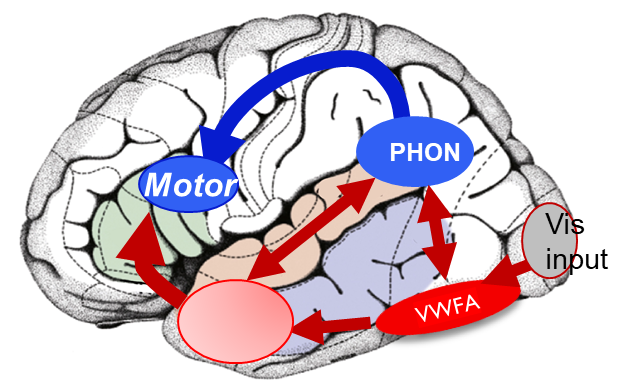
What route is taken in the brain when sounding out non words?
Visual input → VWFA ←→ phonological representation and motor command to say sounds
No meaning activation
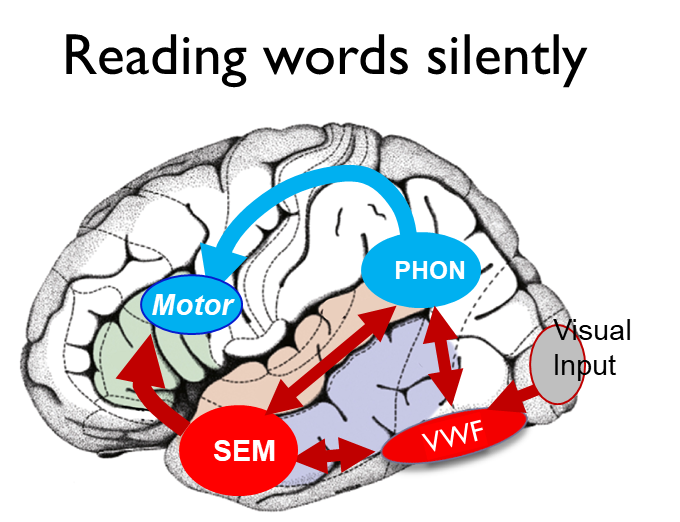
What route is taken in the brain when reading words silently?
Visual input → VWFA ←→ phonological representation and semantic representation. Ventral route
Less of dorsal route
If move tongue while reading → dorsal route will be activation → motor system while reading
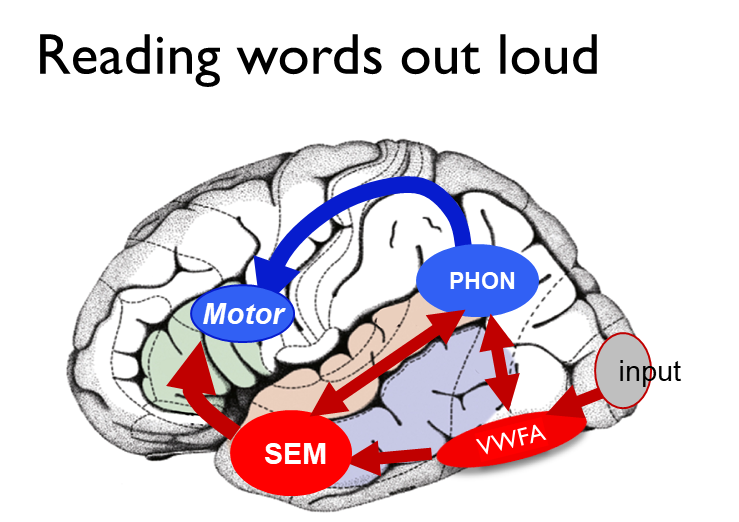
What route is taken in the brain when reading words out loud?
Activation of both dorsal and ventral route
Visual input → VWFA → semantics → phonological and motor representations
What is developmental dyslexia?
Difficulty in learning to read → below standard appropriate to age
No apparent issue with spoken language
Hereditary component
Phonological impairment → decomposing words into individual sounds, making sound judgements
What deficits are involved with developmental dyslexia?
Non word repetition
Naming pictures
Phonological working memory
Rhyming
How is phonological awareness impaired in developmental dyslexia?
This can be seen as a problem of sound decoding, but it probably also involves some aspects of phonological working memory, i.e., the ability to hold and manipulate sounds in working memory
What has been shown in the brain for dyslexic children compared to controls?
Deactivation in the reading network, particularly the phonological route
Often, overactivation in left inferior frontal gyrus
Differential grey and white matter volume: anatomical structures and connections
How are improvements seen in some dyslexics?
Adults may develop alternative strategies and networks to read
Hypothesised → RH assumes some of the functions performed by LH in typical readers
Which area of the brain do adult dyslexics show overactivation in?
Broca’s area (IFG)
What is acquired phonological dyslexia (due to stroke)?
Fine visual lexicon and comprehension but can’t pronounce unfamiliar words
Non words misread as familiar word
STM for speech sounds and manipulation of sounds
Impaired grapheme to phoneme conversion in reading or writing → struggles to translate written letters or letter combinations (graphemes) into corresponding speech sounds (phonemes)
What did Racpsak et al find in a study of non word reading and phonological dyslexia?
Misreading of words → e.g. doop read as droop, dusp read as dust
How do patients with phonological dyslexia perform in tests where they have to tick items with same sounds?
Tick words such as duet, cruet
Don’t recognise quay and key is same sound