CLAUDE should know for exam 3
 Call Kai
 Learn
Learn Practice Test
 Spaced Repetition
 Match
Match Flashcards
 Knowt Play
1/14

There's no tags or description
Looks like no tags are added yet.
Name | Mastery | Learn | Test | Matching | Spaced | Call with Kai |
|---|
No analytics yet
Send a link to your students to track their progress
15 Terms
The haploid gametophyte stage produces_____ through _____.
haploid gametes, mitosis
The diploid sporophyte stage produces _____ through _____.
haploid spores, meiosis
Which of the following is NOT an advantage to the first terrestrial plants?
Water-dependent reproduction
In nonvascular plants, the _____ stage is dependent on the _____ stage
porophyte is dependent on the gametophyte
Which adaptation protects spores and pollen from desiccation?
Sporopollenin
Microsporocytes are diploid. They produce _____ via _____ that will undergo _____ to produce pollen.
4 haploid microspores, meiosis, mitosis
The male gametophyte consists of which two cells?
Generative cell and pollen tube cell
Which describes the process of conifer fertilization?
pollen lands → pollen tube cell germinates → generative cell produces 2 sperm → 1 sperm fuses with egg → diploid embryo → mitosis → new sporophyte
Which of the following is NOT true regarding gymnosperms?
They are pollinated by wind and animals
Which statement best describes angiosperm double fertilization?
1 sperm + egg = zygote; 1 sperm + polar nuclei = triploid endosperm
Parallel leaf venation and fibrous roots are characteristic of:
Monocots
Which tissue performs photosynthesis?
Ground tissue
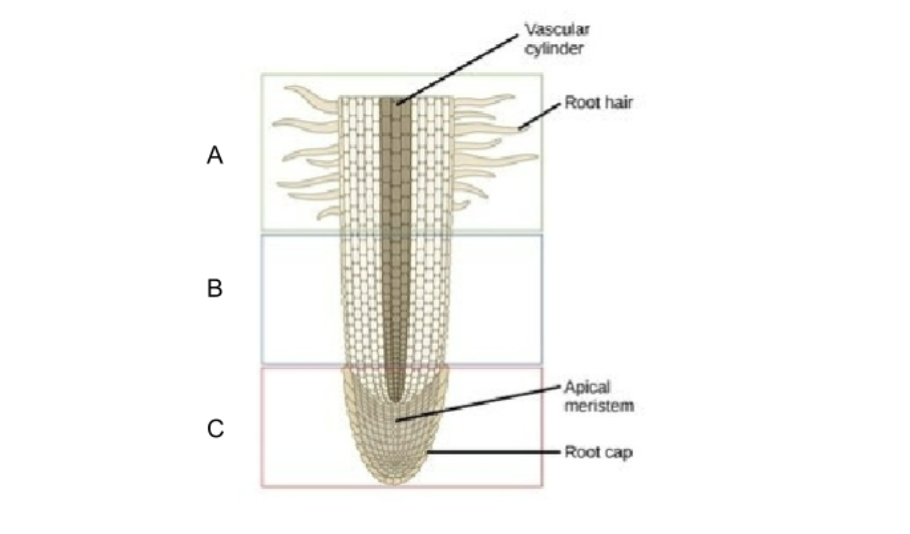
Root zones listed bottom to top
→ zone of elongation → zone of maturation. Using a diagram, identify which lettered zone is elongation (middle zone)
A cross section of a leaf shows a loosely packed, irregularly shaped layer below a tightly packed columnar layer. The loosely packed layer is:
Spongy parenchyma
Which part of the flower forms the fruit?
Ovary