Topic 7 Magnetism
 Call Kai
 Learn
Learn Practice Test
 Spaced Repetition
 Match
Match Flashcards
 Knowt Play
1/48

There's no tags or description
Looks like no tags are added yet.
Name | Mastery | Learn | Test | Matching | Spaced | Call with Kai |
|---|
No analytics yet
Send a link to your students to track their progress
49 Terms
Poles of a magnetic
The poles of a magnet are the places where the magnetic forces are strongest
When two magnets are brought close together they exert a force on each other
Two like poles repel each other. Two unlike poles attract each other
Attraction and repulsion between two magnetic poles are examples of non-contact force
What is a permanent magnet?
A permanent magnet produces its own magnetic field and remains magnetic without needing an external magnetic field
What is an induced magnet?
An induced magnet is a material that becomes magnetic when placed in a magnetic field. It loses most or all of its magnetism when the magnetic field is removed
What happens when like poles of two permanent magnets are brought together?
Like poles repel each other
North–North → Repel
South–South → Repel
What happens when unlike poles of two permanent magnets are brought together?
Unlike poles attract each other
North–South → Attract
How can you compare permanent and induced magnets?
Permanent magnet: Produces its own magnetic field and stays magnetic
Induced magnet: Only becomes magnetic in a magnetic field and quickly loses its magnetism when the field is removed
Induced magnets always attract a magnet
What are the four types of magnetic material?
Iron
Steel (alloy of iron)
Cobalt
Nickel
These materials can be made into a permanent or induced magnet
What is a magnetic field?
A magnetic field is the region around a magnet where a force acts on another magnet or on magnetic materials (iron, steel, cobalt, nickel)
What happens when a magnetic material is placed in a magnetic field?
It is always attracted to the magnet (the force is always attraction, not repulsion)
How does magnetic field strength change with distance?
The magnetic field is strongest close to the magnet, especially at the poles, and becomes weaker as distance increases
How can you plot a magnetic field pattern using a compass?
Place the compass near the north pole of a bar magnet
Mark the position of the north end of the compass needle (e.g. with a dot or cross)
Move the compass so that the south end of the needle is placed on the previous mark
Mark the new position of the north end of the compass needle again
Repeat this process to form a series of points
Join the points smoothly to form a magnetic field line
Show the direction of the field line using an arrow (direction always runs from North pole to South pole)
Repeat from different starting positions to map the full magnetic field pattern
What is the direction of a magnetic field line?
The direction is the force on a north pole placed in the field. Field lines go from the north pole to the south pole of a magnet
What does the spacing of magnetic field lines tell you?
The closer the field lines are together (high concentration of field lines), the stronger the magnetic field
Where is the magnetic field strongest on a bar magnet?
At the poles, where the field lines are closest together
What does a compass tell us about Earth’s magnetic field?
A compass needle aligns north–south, showing that Earth has its own magnetic field
It suggests that Earth has a magnetic source in its core, meaning the core must be magnetic or contain moving magnetic material
What happens when current flows through a wire?
A magnetic field is produced around the wire
Conventional current flows from + to -
How can you show that a current-carrying wire produces a magnetic field?
Use a compass:
Current OFF → needle points N–S (Earth’s field)
Current ON → needle deflects, showing a new magnetic field is present
What affects the strength of the magnetic field around a wire?
Size of current (I) → bigger current = stronger field
Distance from wire → closer = stronger field
What happens to the magnetic field if current direction is reversed?
The direction of the magnetic field also reverses (shown by opposite compass deflection)
What rule is used to find the direction of the magnetic field around a wire?
The Right-Hand Grip Rule:
Do a thumbs up
Thumb = direction of current (points to North Pole)
Fingers = direction of magnetic field lines (direction on current)
What is a solenoid?
A coil of wire that produces a strong, uniform magnetic field when current flows through it
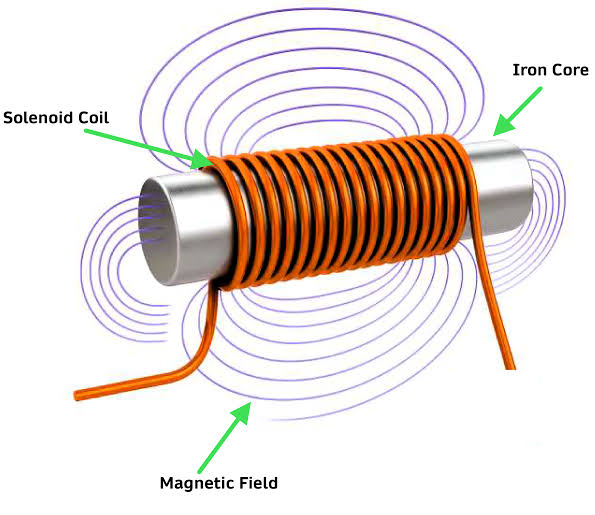
How does a solenoid’s magnetic field compare to a bar magnet?
It has a similar shape to a bar magnet, with clear north and south poles
What is an electromagnet?
A solenoid with an iron core, which greatly increases magnetic field strength
How do you find the poles of a solenoid?
Use the Right-Hand Grip Rule:
Fingers curl in direction of current
Thumb points to the North pole
How can you increase the strength of a solenoid’s magnetic field?
Increase current (I)
Increase number of turns / coils (N)
Add an iron core
What is a solenoid containing an iron core called?
An electromagnet
Why are electromagnets useful?
Because the strength of the magnetic field can be changed by changing the size of the current
An electromagnet can be turned on or off
Why does an iron core increase the magnetic field?
It concentrates magnetic field lines, making the field much stronger
What is the motor effect
The motor effect is the force exerted on a current-carrying conductor placed in a magnetic field
The magnetic field around the wire interacts with the external magnetic field
This causes the wire and magnet to exert forces on each other
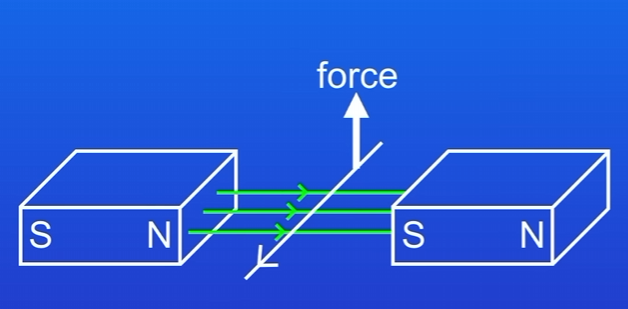
What conditions are needed for the motor effect to occur?
You need:
A current-carrying conductor
An external magnetic field
The force is greatest when the conductor is at right angles (90°) to the magnetic field
What is the unit for magnetic flux density?
Tesla (T)
What happens if the conductor is parallel to the magnetic field?
No force acts on the conductor, so it does not move
Exam fact: Force is only produced when the conductor has a component at right angles to the magnetic field
What is magnetic flux density?
Magnetic flux density (B) is a measure of the strength of a magnetic field
What three factors affect the size of the force in the motor effec
The force increases when:
Magnetic flux density (B) increases
Current (I) increases
Length of conductor in the magnetic field (l) increases
How do you use Fleming's Left-Hand Rule?
Hold your left hand so the thumb, first finger and second finger are at right angles
First finger = magnetic Field (N → S)
Second finger = Current (+ → −)
Thumb = Force (motion)
What does Fleming's Left-Hand Rule show?
It shows the relative directions of:
The magnetic field
The current
The force on the conductor
What happens if the current direction is reversed?
The direction of the force reverses, so the conductor moves in the opposite direction
What is the basis of an electric motor?
The motor effect
When a current-carrying conductor is placed in a magnetic field, it experiences a force. In an electric motor, these forces cause a coil of wire to rotate
Why is the motor effect important?
The motor effect is the principle behind electric motors, where forces on current-carrying coils cause rotation
Why does a coil of wire rotate in a magnetic field?
urrent flows in opposite directions on opposite sides of the coil.
This causes:
An upward force on one side
A downward force on the other side
The opposing forces create a turning effect (torque/moment), causing the coil to rotate
How can Fleming's Left-Hand Rule be used in an electric motor?
It is used to determine the direction of the force on each side of the current-carrying coil
First finger = magnetic Field
Second finger = Current
Thumb = Force
Why would a simple motor stop rotating?
When the coil reaches about 90°, the forces would reverse direction
This would push the coil back towards its original position, preventing continuous rotation
What is a split-ring commutator?
A split-ring commutator is a split metal ring connected to the coil that reverses the current direction every half turn
Why is the split-ring commutator important?
It reverses the current just as the coil passes 90°
This keeps the forces acting in the same rotational direction, allowing the motor to continue spinning
What is the role of the brushes in an electric motor?
Brushes:
Maintain electrical contact with the rotating split-ring commutator
Allow current to flow into and out of the coil
What happens when the current reverses in the split-ring commutator?
The forces on the sides of the coil also reverse
This means the turning effect continues in the same direction, producing continuous rotation
What is meant by torque (moment)?
Torque is the turning effect of a force
In an electric motor, the upward and downward forces on opposite sides of the coil create a torque that rotates the coil
Explain how the force on a conductor in a magnetic field causes rotation in an electric motor. (6-mark style)
A current flows through a coil placed in a magnetic field
Due to the motor effect, opposite sides of the coil experience forces in opposite directions
These forces create a turning effect (torque), causing the coil to rotate
A split-ring commutator reverses the current every half turn so that the forces continue to act in the same rotational direction
This allows the coil to rotate continuously
