10.2 - Recovery & recrystallisation
 Call Kai
 Learn
Learn Practice Test
 Spaced Repetition
 Match
Match Flashcards
 Knowt Play
1/5

There's no tags or description
Looks like no tags are added yet.
Name | Mastery | Learn | Test | Matching | Spaced | Call with Kai |
|---|
No analytics yet
Send a link to your students to track their progress
6 Terms
What’s cold deformation?
What does it lead to?
A deformation that occurs at temperatures below the recrystallisation temperature
→ highly increases dislocation density :)
→ decreases plastic deformability :(
Note: high dislocations density = high energy = thermodynamically unstable
What if the (“low”) temperature is maintained after cold deformation?
What can we do to overcome this?
The metal keeps its changes it underwent during cold deformation, including the plastic deformability decrease :(
→ a heat treatment allows to counteract / undo the damage
→ = annealing (recovery OR recrystallisation)
What is the heat treatment used after cold deformation to counteract damage called?
What are the 2 different stages of it? Explain them. How are they activated?
Annealing: recovery OR recrystallisation
Recovery = rearrangement of lattice defects (dislocations) to a more stable state (lower energy) w/ changing grains shape & size → slight reduction of the dislocations density
→ occurs at LOW temperatures
Recrystallisation = complete microstructure reconstruction
→ the old, stressed, deformed grains completely disappear, being consumed by new forming grains
→ occurs at HIGH temperatures
They’re thermally activated
What are the prerequisites for recovery?
(Mechanisms, how the lattice defects move to rearrange)
Explain how they work.
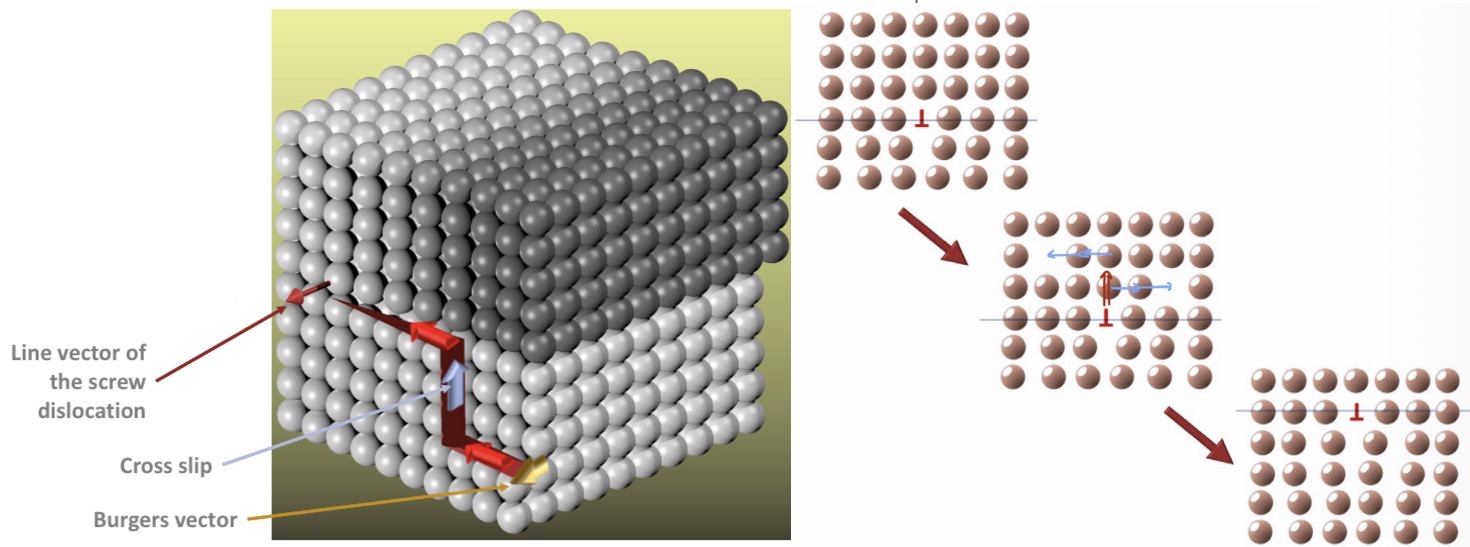
climbing of edge dislocations
→ at high temperatures, thermal energy drives diffusion, which makes atoms move towards less dense areas
→ atoms diffuse towards vacancies
→ if a vacancy appears at the end of the edge dislocation, it has “climbed” up of one atom and is no longer on the slip plane
“Non-conservative” because it needs to absorb or release point defects (vacancies or interstitial atoms)
Requires high temperatures
cross slip of screw dislocations
→ gliding of dislocations is not constrained to a single slip plane
→ when a screw dislocation is gliding forward on its primary plane & encounters a hindrance (obstacle), it simply switches onto an intersecting slip plane that crosses its original path
→ the dislocation glides along this alternative “detour” plane & and then switch back onto a plane parallel to its original path
“Conservative” because it doesn’t need any atom diffusion
Can happen with lower temperatures
The metals gets softer because both edge & screw dislocations use their thermal energy to overcome obstacles → lower energy = more stable state = less internal stresses
When does recovery occur?
What are the 2 key recovery mechanisms? (How do dislocations rearrange?)
Occurs at low temperatures
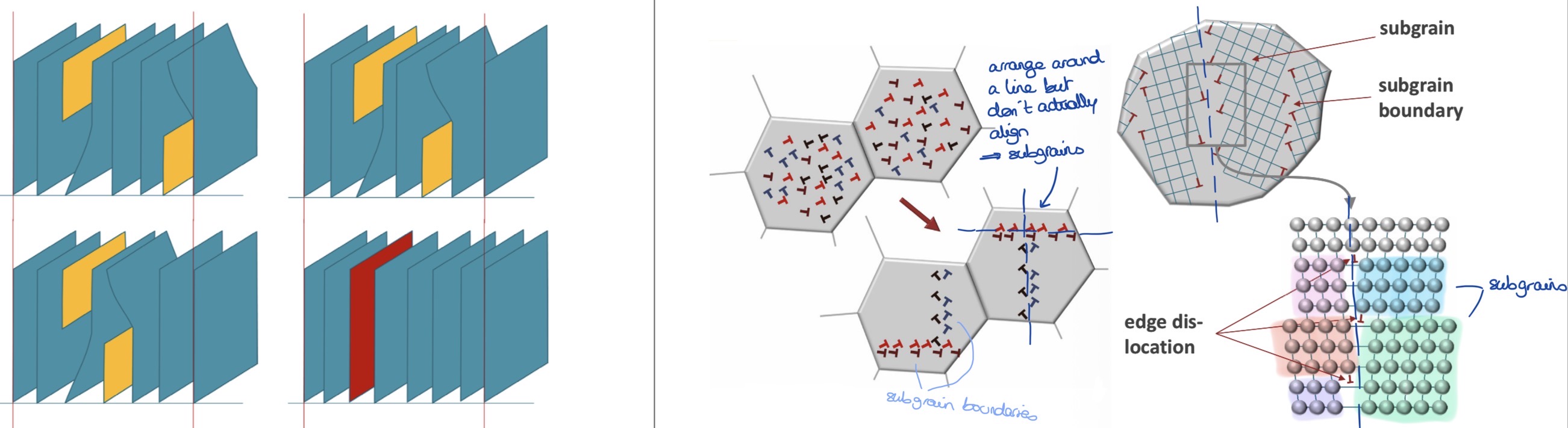
polygonisation
→ edge dislocations with the same sign arrange themselves into subgrain boundaries (small angle)
annihilation: small reduction of dislocation density
→ edge / screw dislocations with opposite signs cancel out
Scenario 1: edge dislocations with same dislocation line but different slip planes
→ atoms diffuse to region of tensions (in between the 2 edge dislocations) which cancels both of them, leading to a normal crystal lattice
Scenario 2: an edge dislocation encounters an obstacle on its path
→ the dislocation climbs up to another slip plane with diffusion
→ if it meets another dislocation with opposite sign on this slip plane, they cancel out
Scenario 3: a screw dislocation changes its slip plane by cross-slip
→ a screw dislocation goes onto another slip plane by cross-slip and can cancel out if it encounters another dislocation with opposite sign
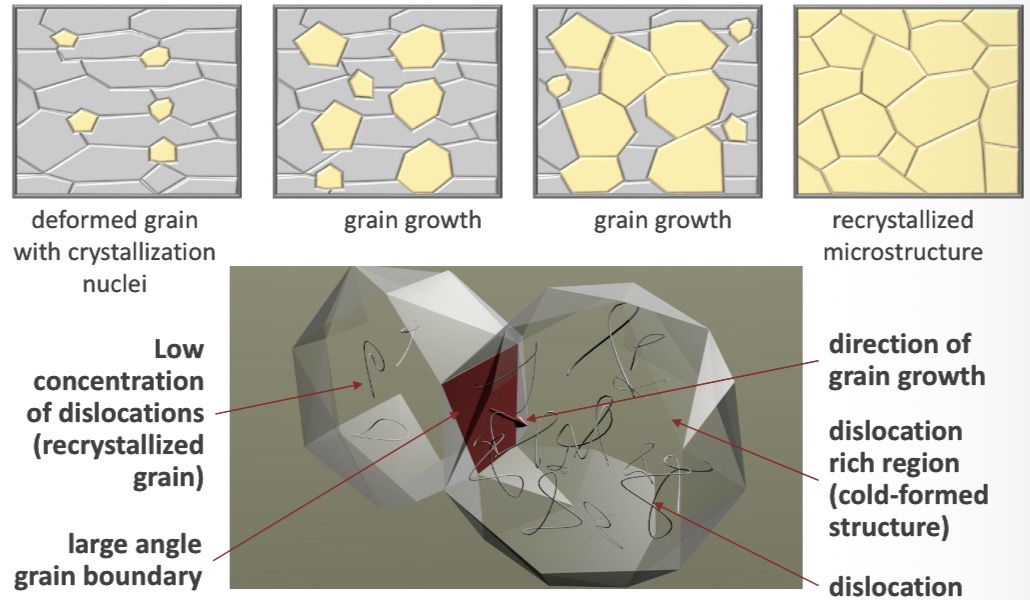
When and how does the recrystallisation occur?
Occurs at high temperatures
The initial structure contains deformed grains with high dislocation density → recrystallisation begins with the formation of nuclei (new, dislocation-free grains)
Grain growth: nuclei grow by consuming the surrounding deformed grains
When the deformed grains are fully consumed, the final recrystallised microstructure consists of large, dislocation-free grains (large-angle grain boundaries)