RC5 - Risk messages I (keyterms, mp + scenario questions)
0.0(0)
Studied by 1 person Call Kai
 Learn
Learn Practice Test
 Spaced Repetition
 Match
Match Flashcards
 Knowt Play
Card Sorting
1/35

There's no tags or description
Looks like no tags are added yet.
Last updated 2:52 PM on 5/29/26
Name | Mastery | Learn | Test | Matching | Spaced | Call with Kai |
|---|
No analytics yet
Send a link to your students to track their progress
36 Terms
1
New cards
What is traditional media?
Legacy media institutions that communicate with large audiences via one-way broadcast technologies such as print, radio, and television
2
New cards
What is new media?
Media that are digitally encoded, interactive, and networked, allowing users to both produce and consume content
3
New cards
What is gatekeeping in traditional media?
The process by which a small controlling group selects and filters which information reaches the public — not neutral, as it reflects the interests of those in control
4
New cards
What are news values?
The criteria media use to select stories — e.g., conflict, novelty, and negativity
5
New cards
What is media logic?
The way media format stories — e.g., short, visual, and dramatic — which shapes what gets covered and how
6
New cards
Why does media logic distort risk perception?
Rare and dramatic risks (e.g., terrorism, shark attacks) are overrepresented; slow and structural risks (e.g., heart disease, drowning) are underrepresented — leading audiences to perceive rare risks as more important
7
New cards
What are prosumers?
People who are simultaneously producers and consumers of content — a product of low barriers to participation in new media
8
New cards
How do algorithms shape risk perception?
They prioritize content based on virality, engagement, and emotional intensity; personalize feeds; and create echo chambers and filter bubbles — amplifying risks based on platform logic, not accuracy
9
New cards
What is an echo chamber?
A media environment where people are mainly exposed to information that confirms their existing beliefs, reinforced by algorithmic personalization
10
New cards
What are social media affordances?
The perceived, actual, or imagined possibilities for action that platforms provide, shaping user behavior through features like visibility, persistence, multimodality, and anonymity
11
New cards
What are the four key social media affordances?
1. Persistence (how long content stays — Facebook vs Snapchat) 2. Visibility/scalability (algorithmic reach — TikTok) 3. Multimodality (text vs image vs video) 4. Anonymity (4chan vs real-name platforms)
12
New cards
Why does platform choice matter for risk communication?
Different platforms have different affordances, leading to different forms, speeds, and scales of risk communication and amplification
13
New cards
How does SARF need to be updated for the social media era?
Social media blurs the boundary between mass and interpersonal communication; everyone becomes an amplification station; algorithms act as invisible amplifiers prioritizing engagement over accuracy; ripples spread globally within minutes
14
New cards
What is the key update SARF needs regarding algorithms?
Risk signals are selectively amplified based on platform logic (engagement, emotional intensity), not factual accuracy — making algorithmic curation a new and powerful amplification station
15
New cards
What are the four components of framing according to Entman (1993)?
1. Problem definition 2. Causal interpretation 3. Moral evaluation 4. Treatment recommendation (solution)
16
New cards
What is the Extended Parallel Process Model (EPPM)?
A model explaining how people respond to risk messages based on two assessments: 1. Threat (how dangerous is it?) and 2. Efficacy (can something be done about it? do we have control?)
17
New cards
What is danger control in EPPM?
The constructive response when both threat and efficacy are high — people are motivated to take protective action and support risk governance
18
New cards
What is fear control in EPPM?
The maladaptive response when threat is high but efficacy is low — people experience panic, denial, or reactance instead of taking protective action
19
New cards
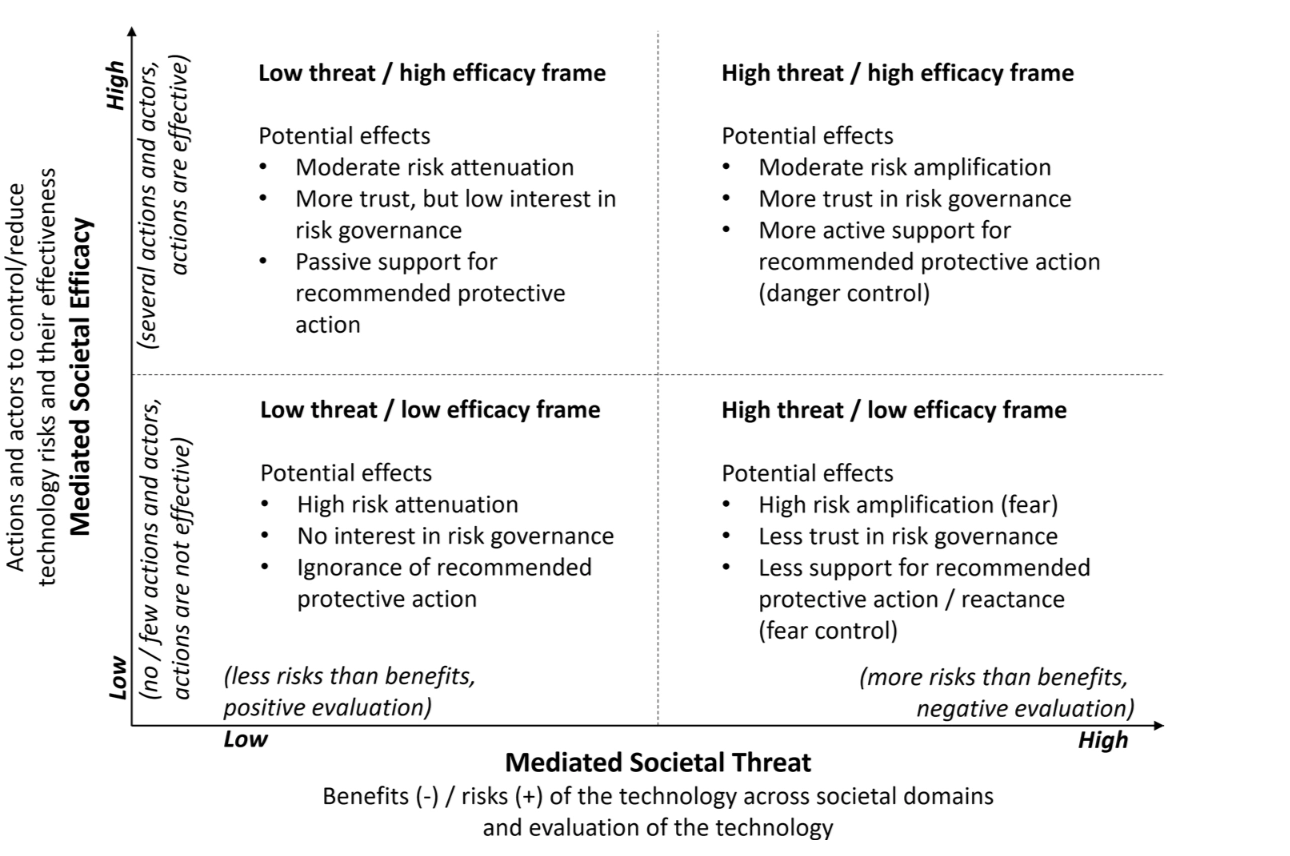
What is MASRisG?
Mediated Amplification of Societal Risk and Governance — a framework analyzing how media messages about technology amplify or attenuate societal risk based on the balance between perceived threat and perceived efficacy
20
New cards
What are the four frames identified in the MASRisG/YouTube AI study?
1. High threat / high efficacy (20.4%) 2. High threat / low efficacy (17.4%) 3. Low threat / no efficacy (30.9%) 4. No threat / no efficacy (31.3%)
21
New cards
What are the potential effects of a high threat / high efficacy frame?
Moderate risk amplification, more trust in risk governance, active support for protective action (danger control)
22
New cards
What are the potential effects of a high threat / low efficacy frame?
High risk amplification (fear), less trust in risk governance, less support for protective action — leads to fear control (reactance or denial)
23
New cards
What are the potential effects of a low threat / high efficacy frame?
Moderate risk attenuation, more trust but low interest in risk governance, passive support for protective action
24
New cards
What are the potential effects of a no threat / no efficacy frame?
High risk attenuation, no interest in risk governance, ignorance of recommended protective action
25
New cards
What did the MASRisG YouTube study find about which frames get the most engagement?
High-threat frames attracted significantly more views and comments than low-threat frames — even though 62% of videos used risk-attenuating frames. The high threat / low efficacy frame generated the most comments; high threat / high efficacy generated the most views
26
New cards
What were the dominant AI risks mentioned in high-threat frames?
Loss of control, AI singularity, lack of regulation, risks to work/labor, and public safety/policing
27
New cards
What was the role of ChatGPT's launch in the MASRisG study?
It acted as a risk-amplifying event — after November 2022, there was a significant increase in high-threat frames on YouTube, demonstrating that new technology launches can amplify online risk perception
28
New cards
What is the knowledge deficit model and why is it criticized?
The assumption that public risk misperceptions simply result from lack of information, and that better education will fix them. Criticized because it ignores sociocultural and political values that shape risk perception independent of knowledge
29
New cards
What is stigma in the context of SARF?
Persistent, strongly negative associations attached to a place, technology, or community following a risk event — leading to avoidance behavior and severe socioeconomic damage beyond the initial physical harm
30
New cards
What is social media logic?
The design rules of online platforms — personalized algorithms, echo chambers, and sharing features — that systematically reward extreme or emotionally charged content over accurate risk information
31
New cards
What is a systemic risk?
A highly complex, globally interconnected threat with unpredictable, non-linear causal relationships — making identification and management extremely challenging (e.g., climate change, pandemics)
32
New cards
Why are systemic risks prone to attenuation?
Their urgency is psychologically distant, ambiguous, and subject to polarization — causing people to unconsciously ignore or minimize them, especially when information becomes distorted in online echo chambers
33
New cards
What is the knowledge deficit model's key flaw according to the SARF new perspectives paper?
It falsely assumes that closing information gaps will align public risk perception with expert assessments — ignoring that sociocultural values, trust, and political identity fundamentally shape how people respond to risk information
34
New cards
How does AI shape risk perception through three mechanisms?
1. Selection: algorithms decide which risks you see based on predicted engagement 2. Amplification: emotional and threatening content is boosted by platform logic 3. Generation: generative AI summarizes and frames risks confidently, regardless of accuracy
35
New cards
What is emphasis framing?
A communication theory describing how senders shape public perception by selectively highlighting certain aspects of a risk (e.g., threats, actors) while structurally omitting others
36
New cards
What is effective risk communication according to the MASRisG paper?
Communication that acknowledges genuine threats AND presents credible solutions and capable actors — stimulating danger control rather than fear control or apathy