Marine ecology Lecture 14: Recruitment and dispersal
 Call Kai
 Learn
Learn Practice Test
 Spaced Repetition
 Match
Match Flashcards
 Knowt Play
1/10

There's no tags or description
Looks like no tags are added yet.
Name | Mastery | Learn | Test | Matching | Spaced | Call with Kai |
|---|
No analytics yet
Send a link to your students to track their progress
11 Terms
Concept of patterns
“Everything residing in the ocean that does not have the ability to outswim the current has to follow the flow”
The eggs, larvae, or juveniles of many, if not most marine animal species have a stage at which they can be transported in ocean currents
Dispersal
How far do larvae disperse?
What proportion of larvae stay local?
Scale matters: annual, ecological, decadal and evolutionary scales may yield different results
What is a metapopulation?
A group of spatially separated populations of the same species that interact through occasional dispersal, effectively creating a “population of populations
What is “open” and “closed”
The degrees to which particular population is “open” to recruitment from outside is fundamental to its ecology and conservation
but some populations are closed
Larval connectivity
Process of dispersing and then surviving to enter the adult reproductive population (=recruitment) at the destination location
Measures of Recruitment & Connectivity (migration)
Direct observations: Recruitment
Ecological time scale population dynamics
Population genetic: similarity
population structure: evolutionary time scale migration rates and metapopulation structure
Bio-physical models
predictions of all measures at all time scales
Major factors influencing larval dispersal, settlement, and recruitment
Reproductive effort Fecundity environment
Larval duration Hydrological conditions and geographic distance
Environment chemicals cue biotic interactions
Biotic interactions sedimentation environment (local scale)
Fecundity and overall larval production
Cases in which fecundity is depressed
bleached/ stressed colonies
young
over-grazed
Cases in which total production is depressed
disturbed populations (storms, bleaching, destructive fishing)
Young (recovering population)
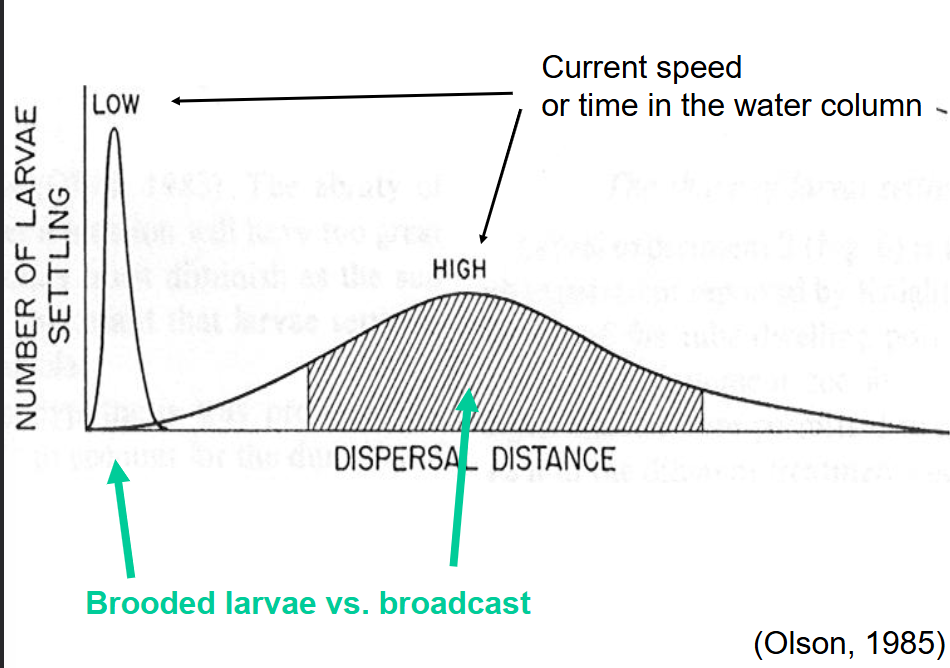
Larval duration Hydrological conditions, geographic distance
Brooded larvae will have a low number of settling and a low dispersal distance
Broadcast will have a high dispersal distance and high larval settling
Do dispersing larvae behave as passive particles?
No. ocean currents have a strong influence on where the larvae end up. They also have sensory cues responding to light, chemical signals. A major factor is habitat selection
Recruitment: Biotic interactions sedimentation environment
Most settlement in preferred locations, but some in others
Strong growth in fused colonies, greatest coral cover