cognitive attention brain
 Call Kai
 Learn
Learn Practice Test
 Spaced Repetition
 Match
Match Flashcards
 Knowt Play
1/33

There's no tags or description
Looks like no tags are added yet.
Name | Mastery | Learn | Test | Matching | Spaced | Call with Kai |
|---|
No analytics yet
Send a link to your students to track their progress
34 Terms
What is attention?
The process that selects some information for processing, at the expense of other information
Why do we have attention?
To avoid sensory/cognitive overload
Is attention focused on external or internal information?
Both, it can be external (e.g auditory, visual) or internal (memory, emotions)
What are the three divisions of attention?
Sustained attention, selective attention and divided attention
What are the two directions of attention processes?
Top down (voluntary internal goals, e.g scanning a crowd for a person) and bottom up (involuntary external stimuli that become relevant e.g a dropped glass)
How were endogenous cues used in Posner’s task testing attention?
A cue was briefly shown to indicate that a target left or right box would be selected, which was correct only 75% of the time.
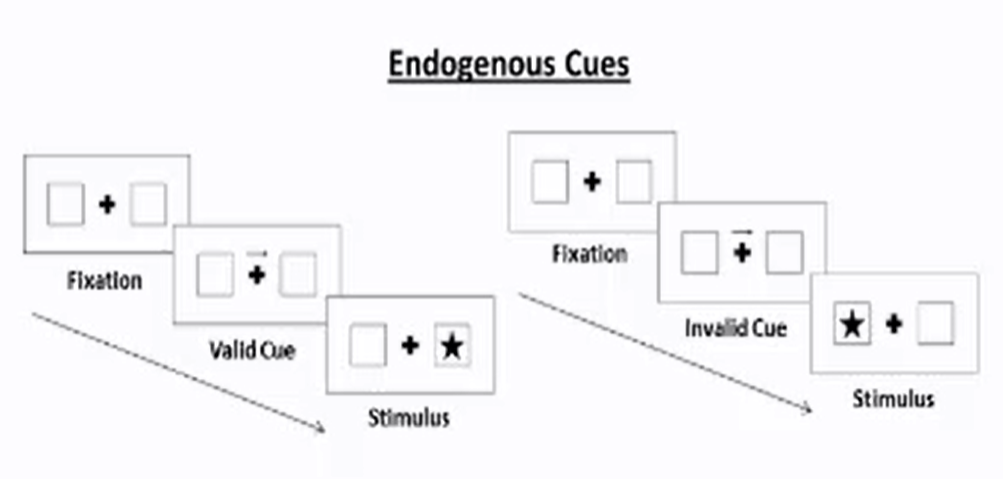
What did Posner find when testing attention using endogenous cues?
That participants responded faster to the selected box when there was a valid cue, indicating that we can voluntarily shift our attention.
How did Posner test attention using exogenous cues?
He highlighted either a left or right box, which would then show a stimuli that the participant would record. He found that participants reacted faster with a correct cue, indicating that attention could be involuntarily captured.
What is a psychomotor vigilance task?
A task used to test sustained attention, which displays a cue at random intervals and requires participants to react quickly to the cue.
What can visual attention be focused on?
Spatial locations, Individual object features, entire objects
What is a key limitation of spatial attention?
Change blindness - where we don’t notice something happening if it changes slowly over time
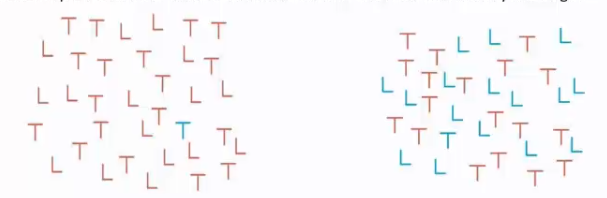
What is feature integration theory?
A theory of attention stating that if a target can be found from a single feature, the number of distractors (similar objects) is irrelevant. If there are a combination of similar targets to distractors, there is a linear relationship between number of distractors and time taken to find the target
What is biased competition theory?
A theory of attention suggesting that multiple visual stimuli compete for cognitive processing, but not all stimuli can be processed simultaneously - so attention is used to resolve this competition and make a behavioral decision. This also means attention is then biased towards task relevant information.
What is premotor theory?
A theory of attention proposing that there is a key link to the planning of motor actions.
How is divided attention tested?
Through dual task studies, cross modal tasks, and attentional blink tasks
What is the key principle of divided attention?
As we have limited attentional resources, when number of tasks increase, performance decreases.
How did Johnstone test divided attention in 2003?
By simulating driving while using a phone
What is automaticity in context to divided attention?
The idea that well practiced tasks require fewer resources
What is attentional blink?
The phenomenon that detecting an initial target in a list can impair detection of another target appearing shortly afterwards - e.g looking for the letter after a W in a fast-moving list is difficult, as the brain takes some time to process that it has seen the W, and by that time the next letter has passed.
What are the three key neural attentional networks?
AOE - Alerting, orienting and executive
What is the role of the Alerting attentional network?
To sustain general attention.
What is the role of the Orienting attentional network?
To select specific information
What is the role of the Executive attentional network?
To resolve conflicting information and decide on one focus point
What two states is the alerting network divided into?
Tonic alertness (long time period) and Phasic alertness (momentary changes)
What are the two networks within the Orienting network?
The dorsal (top down, internal goals and expectations) and ventral (bottom up, detection of relevant stimuli within an environment)
What are the functions of the executive network?
To select task relevant information, inhibit distractions, and to switch attentional strategies (and more)
Which attentional network does the Stroop test demonstrate?
The executive network
What is the default mode network (DMN)?
A set of brain regions which are active during resting periods, as they are used for internal directed tasks - such as thinking about the past, daydreaming etc. These areas are then deactivated during external goal oriented tasks which make use of working memory