Lecture Exam 2
 Call Kai
 Learn
Learn Practice Test
 Spaced Repetition
 Match
Match Flashcards
 Knowt Play
1/117

There's no tags or description
Looks like no tags are added yet.
Name | Mastery | Learn | Test | Matching | Spaced | Call with Kai | Chat |
|---|
No analytics yet
Send a link to your students to track their progress
118 Terms
A waxy cuticle prevents desiccation. What is the cost of this adaptation?
Reduce gas permeability
Survival on land for organisms is difficult because of the problem of
desiccation
Plant success on the terrestrial landscape is linked to the evolution of all of the following except
gas-filled air spaces
Why is a rhizoid not considered a true root?
Rhizoids lack xylem tissue
The aquatic ancestry of bryophytes is most clearly demonstrated by what character?
the use of flagellated motile sperm
The colorless rootlike projections of mosses, liverworts, and hornworts, which anchor them to the substrate are called
Rhizoids
The gametophyte is green and nutritionally independent in
mosses, liverworts, and ferns.
To reproduce sexually, bryophytes require
free water external to the plant.
Cooksonia is a genus of very early tracheophyte plants. Unlike modern tracheophytes they only grew to a few centimeters in height. What feature provides the best explanation for their diminutive size?
They consisted of only photosynthetic stems, not roots or leaves.
What is a 15 meter tall tree fern?
a sporophyte
Pollination and fertilization are essentially the same process. If pollination occurs, fertilization will follow quickly.
False
Pollen tubes
allow sperm to fertilize the egg.
What is the function of the generative cell in conifers?
Formation of the sperm
In tracheophyte plants, water and dissolved minerals are conducted away from roots by
xylem tubes. |
The dominant stage in the life cycle of tracheophyte plants is the
sporophyte generation.
Double fertilization occurs when
one sperm fuses with the egg and the other sperm fuses with both polar nuclei.
Which part of the seed is responsible for providing nutrition to the embryo?
Endosperm
Fruits derived from which structure?
ovaries
Are any of these vegetables actually fruit?
Corn
Fungi are currently classified into seven monophyletic groups based on characteristics of the cells undergoing meiosis.
False (6 mono)
In what way are bacteria and fungi similar?
Ecological Function
Ruminant animals have symbiotic fungi that
digest cellulose and lignin.
Which one of the following terms best applies to the fungus participant in a typical lichen?
Mutualist
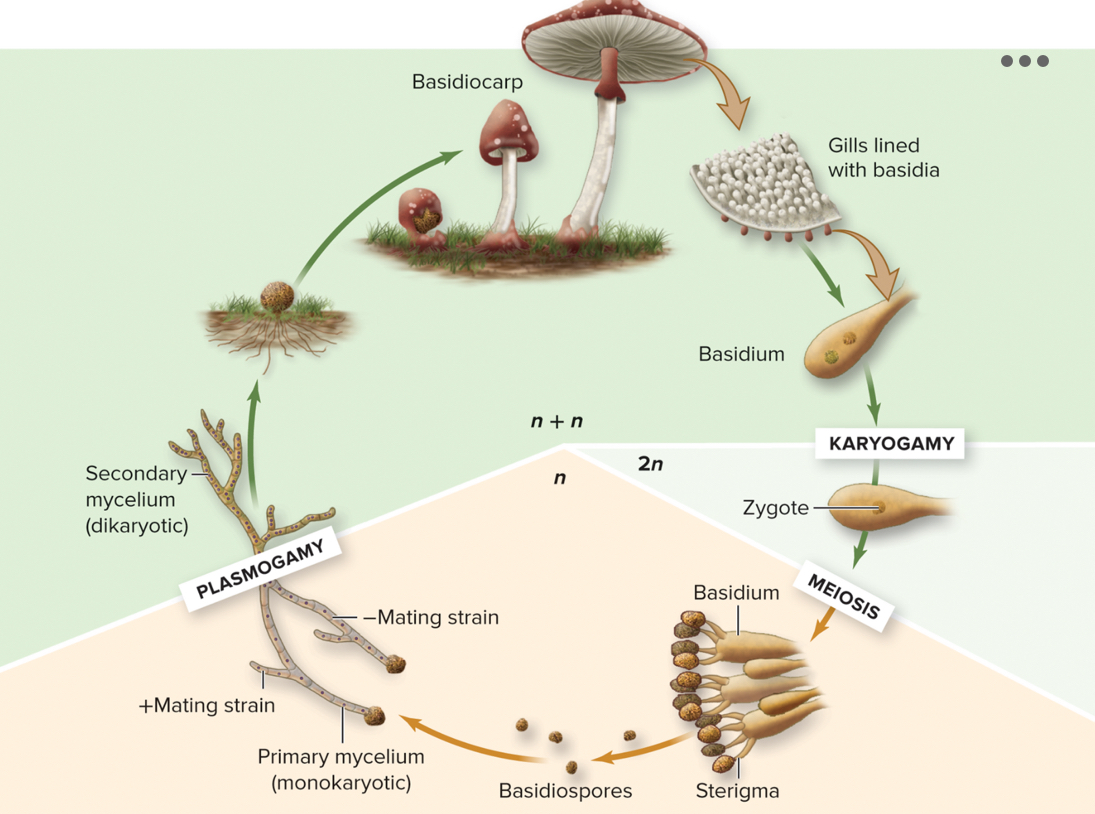
In basidiomycetes the _________ is diploid.
zygote
The most economically useful unicellular fungi are
yeasts
What type of fungi are obligate symbionts with plant roots and played a key role in the colonization of lands by plant?
glomeromycetes
In the life cycle of a zygomycete, after the zygospore is formed, the next event will be
meiosis
The fungal group that is most closely related to ancestral fungi are the
Chytridiomycota
Why are neocallimastigomycetes being studied for biofuel production?
They can release fermentable sugars from cellulose.
Primary growth in plants originates in
apical meristems
A stem that cannot increase in diameter is lacking what type of tissue?
vascular cambium
Which of these is not a function of the root cap?
rapid cell division
Of the following structures, which one is not a specialized cell of the epidermis?
sclereids
Parenchyma, collenchyma, and sclerenchyma are all types of cells derived from
ground tissue.
Suppose you have a plant stem tissue sample and need to determine whether it belongs to a monocot or eudicot. How would you approach this task?
Locate the vascular bundles and analyze their pattern.
Root hairs grow actively in which area of the developing roots?
zone of maturation
Various modifications in leaves can make plants better adapted to their habitats. Which of the following is not an evolutionary modification of leaves?
fruit-bearing leaves
Who are Tracheophytes (vascular plants)
Lycophytes, Pterophytes, gymnosperms, angiosperms
Who are bryophytes?
Liverworts, mosses, hornworts
In early development of tracheophytes (Cooksonia), why do you think that they were small? What structure(s) wasn't fully developed that prevented them from growinG really tall?
They did not have fully developed roots and leaves but they had photosynthetic.
What are the pros and cons of having a waxy cuticle?
Pro: protect from desiccation “drying out”
Cons: reduce gas permeability, take too much energy to produce
How are ferns and bryophytes similar? What type of sperm do they have?
Flagellated sperm that requires water
What characteristics do ferns have that bryophytes don't?
Fern have megaphylls (Fronds, fern leaves)
How was the development of tracheids beneficial to land plants?
Tracheids- vascular tissue: xylem & phloem
Grew taller due to more resource transport
What is the dominant life cycle for hornworts, mosses, fern, conifers?
Hornworts & mosses - gametophyte
Fern & Conifers - sporophyte
Advances in molecular systematics show that whisk ferns and horsetails are the closest living relatives of?
Ferns
In the life of ferns, are spores haploid?
Yes
Where are the sporangia of ferns found?
In clusters called sori in the back of fronds
How are gametes of ferns produced?
Through mitosis
Moss life cycle (haploid or diploid?)
Spore, Sperm, Spore mother cell, antheridium
Diploid- Spore Mother Cell
Haploid- spore, sperm, antheridium
Ferns: do the gametophytes have rhizomes?
No, they have Rhizoids
How do you differ Lycophytes from Bryophytes
Lycophytes has vascular tissue while Bryophytes do not.
Do all Tracheophytes have seeds?
No, Lycophytes and Ferns do not.
What plant structures move water and minerals?
Xylem
How are hornworts different from mosses and liverworts ?
Hornworts have a sporophyte generation that allows for photosynthesis
Which of the bryophytes contain distinct stemlike axis, small leaves, and rootlike rhizoids?
Moss
The gametophyte is green and nutritionally independent in which group??
Bryophytes, ferns
If we put beans in total darkness, they can still germinate. Why?
The endosperm “stored food” allows germination to continue
What disc being a gymnosperm mean? “Naked seeds” means that
Seeds are not surrounded by any tissue (exposed ovule)
Ex: pine cone
Which phylum in the plants is the most successful? Why?
Anthophyta are the most successful because of their flowers and fruit production
Where is Ephedrine obtained from? Phylum…
Gnetophyta from Ephedra
What is double fertilization?
-occurs only in angiosperms
-1st sperm + egg = zygote (2n)
-2nd sperm + 2 polar nuclei = endosperm (3n)
What does double fertilization produce?
Zygote (2n) and Endosperm (3n)
Where is pollen made?
Pollen is made in the anthers
Which phylum is often confused for a type of palm tree?
Cycadophyta
What happens to the generative cell in conifers?
The generative cell divides through mitosis as it goes down the pollen tube, leading to 2 sperm cells
What is the purposes of the pollen tube?
The pollen tube transports the generative call to the embryo sac.
What does dioecious mean?
Male and female reproductive structures are on separate organisms.
From what is fruit derived?
from the ovaries of a plant
What is the purpose of petals?
Attracting pollinators
The ____ in red maple fruit allows them to spin back to the ground
Pericarp
Where is the MATURE male sperm produced? (hint! Not anther).
As the pollen tube travels to the embryo, mature male sperm are produced.
What is the function of pine resin?
Pine resin deters insects and fungal attacks
Another word for seed coat.
Integument
What is primary growth? Where does it originate?
Apical meristem allows for growth in length (height)
What are meristem cells?
Meristem cells are undifferentiated cells that allow for growth
How are stem cross section of a monocot and eudicot different? What are you looking at?
-monocots: have vascular bundles that are scattered
-eudicots: have vascular tissue arranged into a ring
How are the root cross sections of a monocot and eydicot different?
Eudicots have their vascular tissue organized into a cross or “x”
Monocots have their vascular tissue arranged into a ring
The stalk that connects the leaf to the stem is called?
The petiole is the stalk that connects the leaf to the stem.
Do sieve cells help move materials through the body of the plant? What about tracheids? Sclerenchyma? Sieve tube members?
Sieve tubes + cells & tracheids move materials while the sclerenchyma are ground tissue.
What are some of the specialized structures found in xylem?
Tracheids & Vessels
What are some of the specialized structures found in Phloem?
-sieve cells: seedless, vascular, and gymnosperm
-sieve tube: angiosperm
What are names of the cells that are derived from ground tissue?
-Parenchyma: most common, storage, photosynthesis, secretion
-Collenchyma: support organs
-Sclerenchyma: support + protecting (lignin)
Why does removing the tip of a plant make it bushier?
Removal of terminal buds which promote axillary buds to grow
In order for a plant to increase in diameter, it must contain.....
-cork cambium
-vascular cambium
What is the purpose of the WER gene?What if it’s always on?
WER gene suppresses root hair development. If it was always on then no root hairs are produced which means a decrease in root surface and absorption of water/nutrients
What are the functions of trichomes?
Trichomes are hair-like growths that help keep cool and decrease evaporation. They also are glandular.
Which type of cells allow plants to bend without breaking?
Collenchyma
Which cells are the most common in plants?
Parenchyma
In which Zone are root hairs found?
Zone of maturation
What is the purpose of the root cap?
Protect apical meristems, release slimy lubricant, gravity perception, push away soil
How are annual rings in a tree created?
During certain parts of the year there is and increase in growth while other times experience little growth
What were some of the specialized structures that are found in epidermal tissue?
Guard cells, trichomes, oil glands, root hairs
Modified stems:
Lenticels, Bulbs, corms, rhizomes, runners, tubers, tendrils, cladophylls
Modified leaves?
Floral, spines, reproductive, window, shade, insectivorous
Define compound and simple leaves:
-compound: have blades that are divided into leaflets (fern looking ahh)
-simple: undivided leaves ( 🍁 lookin ahh)
What are axillary buds?
Axillary buds are buds that develop into branches with leaves or may form flowers.
Which fungi forms mutualistic relationships with ruminants?
Neocallimastigomycota
What is the difference between ectomycorrhizae and arbuscular mycorrhizae?
Ectomycorrhizae: surround and don’t penetrate root cells
Arbuscular mycorrhizae: penetrate root cell walls but not cell membranes
Which type of fungi form ectomycorrhizae?
Basidiomycota & Ascomycota