BSCI201 LAB PRACTICAL 3

0.0(0)
Studied by 0 people
call kaiCall Kai
learnLearn
examPractice Test
spaced repetitionSpaced Repetition
heart puzzleMatch
flashcardsFlashcards
GameKnowt Play
Card Sorting

1/54

encourage image

There's no tags or description

Looks like no tags are added yet.

Last updated 3:53 AM on 5/4/26
Name
Mastery
Learn
Test
Matching
Spaced
Call with Kai

No analytics yet

Send a link to your students to track their progress

55 Terms

1
New cards

Nervous System

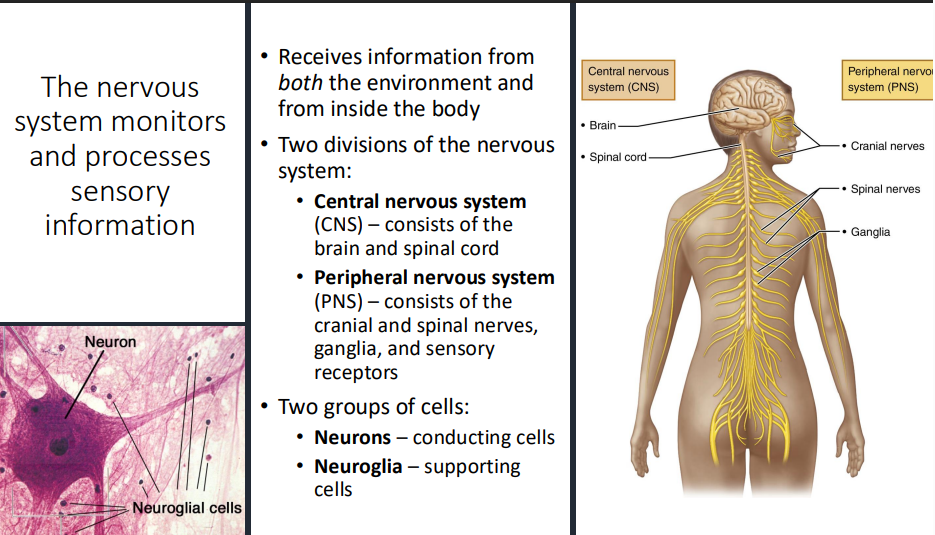
  • Function: Controls body, voluntary and involuntary control, initiates voluntary skeletal movements, moderates heart rate and breathing rate, processes sensory inputs, controls speech, etc

Monitors and Processes Sensory Information:

  • receives information from BOTH environment and inside body

  • Nervous system divisions:

    • Central Nervous System (CNS) → consists of brain and spinal cord

      • Spinal cord → receives information and processes lower level involuntary responses (reflexes)

      • Brain → more complex information, higher order processing (processing sound information, forming speech, response, etc)

    • Peripheral Nervous System (PNS) → consists of cranial and spinal nerves, ganglia, and sensory receptors

    • Types of Cells:

      • Neurons → conducting cells

        • send electrical and chemical signals that deal with communication

      • Neuroglia → supporting cells

        • support and protect neurons

<ul><li><p>Function: Controls body, voluntary and involuntary control, initiates voluntary skeletal movements, moderates heart rate and breathing rate, processes sensory inputs, controls speech, etc</p></li></ul><p></p><p>Monitors and Processes Sensory Information:</p><ul><li><p>receives information from BOTH environment and inside body</p></li><li><p>Nervous system divisions:</p><ul><li><p>Central Nervous System (CNS) → consists of brain and spinal cord</p><ul><li><p>Spinal cord  → receives information and processes lower level involuntary responses (reflexes)</p></li><li><p>Brain → more complex information, higher order processing (processing sound information, forming speech, response, etc) </p></li></ul></li><li><p>Peripheral Nervous System (PNS) → consists of cranial and spinal nerves, ganglia, and sensory receptors </p></li><li><p>Types of Cells:</p><ul><li><p>Neurons → conducting cells</p><ul><li><p>send electrical and chemical signals that deal with communication</p></li></ul></li><li><p>Neuroglia → supporting cells</p><ul><li><p>support and protect neurons</p></li></ul></li></ul></li></ul></li></ul><p></p>
2
New cards
<p>Types of Neuroglial Cells     </p>

Types of Neuroglial Cells

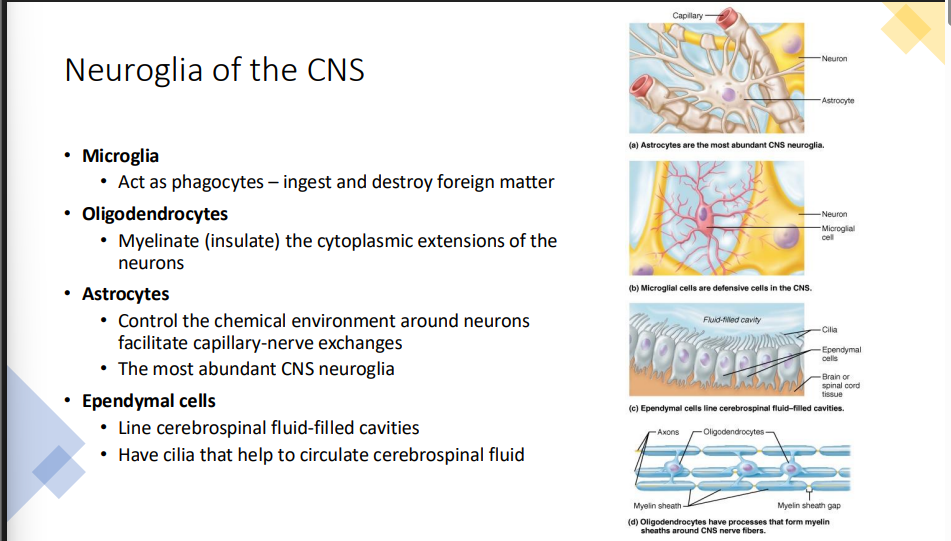
  • Means nerve glue; also known as glial cells

  • Functions: Brace, protect, and myelinate neurons

    • not capable of transmitting nerve impulses

  • Myelinating Cells → significantly high lipid content, making them appear white

  • CNS Supporting Cells:

    • Astrocytes → control chemical environment of CNS, create blood-brain barrier, have extensions that wrap around neurons and blood vessels, etc

    • Microglia → phagocytic cells, engulf and destroy pathogens and debris from dead cells, protects cells of brain and spinal cord, etc

    • Ependymal Cells → ciliated columnar cells that line cavities of CNS filled with cerebrospinal fluid, cilia are motile and can beat, moving fluid and circulating CSF through cavities, etc

    • Oligodendrocytes → wrap around neurons, speed electrical transmissions that pass through neurons, etc

      • extend multiple processes away from main cell body and each processes wrap around a neuronal process

      • one oligodendrocyte can myelinate multiple neuronal processes

  • PNS Supporting Cells:

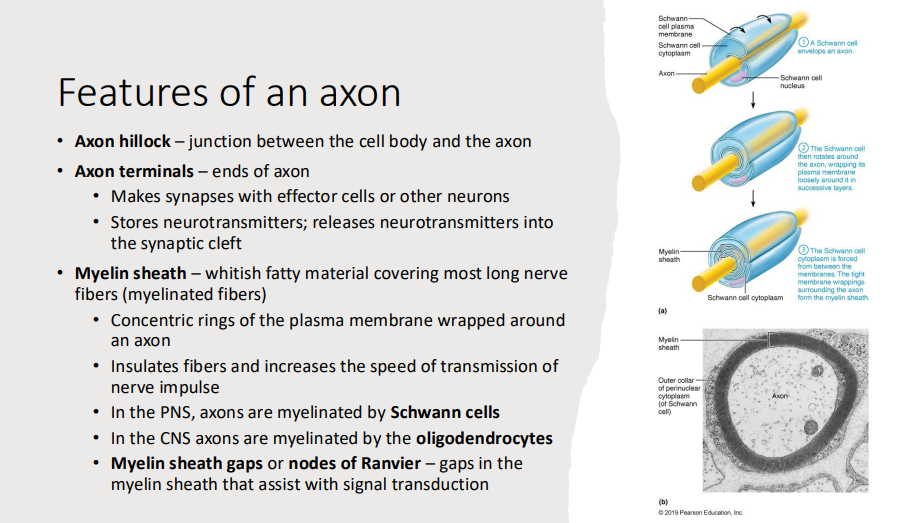
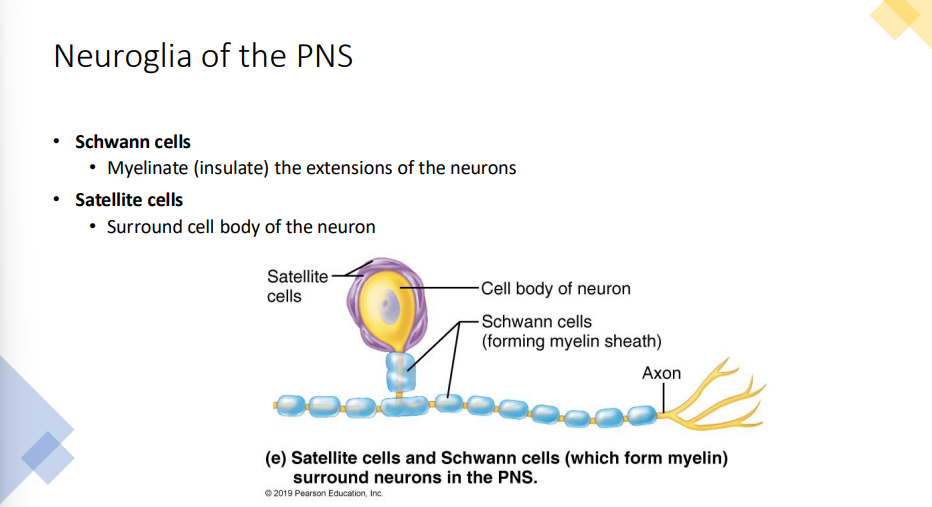
    • Schwann Cells → myelinating cells of PNS, myelinate neuronal processes to insulate them and speed up conduction of electrical signals, etc

      • entire schwann cell will flatten and wrap its entire body around a neuron

      • can only myelinate one neuron

    • Satellite Cells

      • wrap around neurons to control chemical environment the neuron is exposed to

      • multiple cells surround the cell body of the neuron
<ul><li><p>Means nerve glue; also known as glial cells</p></li><li><p>Functions: Brace, protect, and myelinate neurons</p><ul><li><p>not capable of transmitting nerve impulses</p></li></ul></li><li><p>Myelinating Cells → significantly high lipid content, making them appear white</p></li><li><p>CNS Supporting Cells:</p><ul><li><p>Astrocytes → control chemical environment of CNS, create blood-brain barrier, have extensions that wrap around neurons and blood vessels, etc</p></li><li><p>Microglia → phagocytic cells, engulf and destroy pathogens and debris from dead cells, protects cells of brain and spinal cord, etc</p></li><li><p>Ependymal Cells → ciliated columnar cells that line cavities of CNS filled with cerebrospinal fluid, cilia are motile and can beat, moving fluid and circulating CSF through cavities, etc</p></li><li><p>Oligodendrocytes → wrap around neurons, speed electrical transmissions that pass through neurons, etc</p><ul><li><p>extend multiple processes away from main cell body and each processes wrap around a neuronal process</p></li><li><p>one oligodendrocyte can myelinate multiple neuronal processes </p></li></ul></li></ul></li><li><p>PNS Supporting Cells:</p><ul><li><p>Schwann Cells → myelinating cells of PNS, myelinate neuronal processes to insulate them and speed up conduction of electrical signals, etc</p><ul><li><p>entire schwann cell will flatten and wrap its entire body around a neuron</p></li><li><p>can only myelinate one neuron</p></li></ul></li><li><p>Satellite Cells</p><ul><li><p>wrap around neurons to control chemical environment the neuron is exposed to</p></li><li><p>multiple cells surround the cell body of the neuron</p></li></ul></li></ul></li></ul><p></p>
3
New cards
<p>Neuron Anatomy</p>

Neuron Anatomy

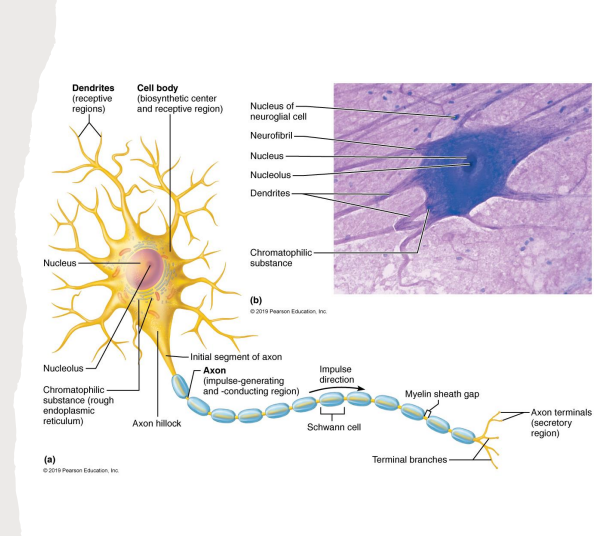
  • Cell Body → composed of large, round nucleus surrounded by cytoplasm, which contains:

    • Nucleus → large and round

    • Nucleolus → ribosome assembly

    • Neurofibrils → intermediate filaments of cytoskeleton

      • built from neurofilament proteins

      • form network throughout cytoplasm that allows cells to maintain shape

    • Chromatophilic substance → specialized rough ER of neurons

      • facilitates protein production and processing

    • main biosynthetic center of cell, where transcription and translation occur

    • receives information from various dendrites and processes information

    • sends signals via axon

  • Dendrites and Axons → processes that extend out from the cell body and transmit nerve impulses

    • Dendrites → receive signals and sends them towards the cell body

      • contains many dendrites

    • Axons → transmit action potentials to other cells

      • carry electrical signals (action potentials) away from cell body and towards axon terminal

      • one neuron has one axon, but there can be many branching axon terminals

      • axon hillock → place of origin of axon near cell body

      • axon terminals meet with other cells and neurons via synapses, where electrical signals are converted into chemical signals

      • myeline sheath gaps → gaps between myelinating cells on axon
<ul><li><p>Cell Body → composed of large, round nucleus surrounded by cytoplasm, which contains:</p><ul><li><p>Nucleus → large and round</p></li><li><p>Nucleolus → ribosome assembly</p></li><li><p>Neurofibrils → intermediate filaments of cytoskeleton</p><ul><li><p>built from neurofilament proteins</p></li><li><p>form network throughout cytoplasm that allows cells to maintain shape</p></li></ul></li><li><p>Chromatophilic substance → specialized rough ER of neurons </p><ul><li><p>facilitates protein production and processing </p></li></ul></li><li><p>main biosynthetic center of cell, where transcription and translation occur</p></li><li><p>receives information from various dendrites and processes information</p></li><li><p>sends signals via axon</p></li></ul></li><li><p>Dendrites and Axons → processes that extend out from the cell body and transmit nerve impulses </p><ul><li><p>Dendrites → receive signals and sends them towards the cell body </p><ul><li><p>contains many dendrites</p></li></ul></li><li><p>Axons → transmit action potentials to other cells</p><ul><li><p>carry electrical signals (action potentials) away from cell body and towards axon terminal </p></li><li><p>one neuron has one axon, but there can be many branching axon terminals </p></li><li><p>axon hillock → place of origin of axon near cell body </p></li><li><p>axon terminals meet with other cells and neurons via synapses, where electrical signals are converted into chemical signals </p></li><li><p>myeline sheath gaps → gaps between myelinating cells on axon </p></li></ul></li></ul></li></ul><p></p>
4
New cards

Structural Classification of Neurons

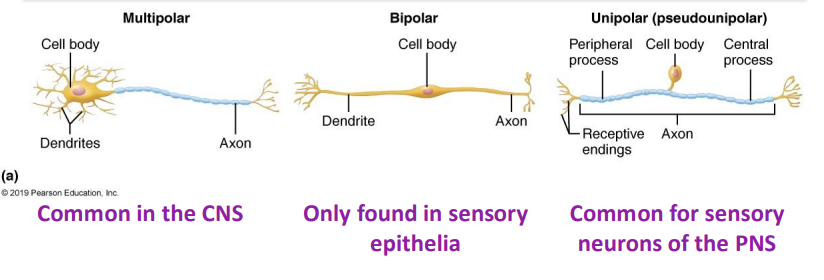
  • Based on how many processes extend from cell body

  • Multipolar: neurons have many dendrites and one axon

  • Bipolar: neurons have one axon and one dendrite

  • Unipolar (pseuounipolar): neurons have one process that branches; no dendrites

    • singular process is short and divides into proximal and distal branches

      • distal peripheral process → associated with sensory receptor

      • proximal central process → enter CNS and synapse onto neuron of CNS

    • unipolar neurons are derived from bipolar neurons
<ul><li><p>Based on how many processes extend from cell body</p></li><li><p>Multipolar: neurons have many dendrites and one axon</p></li><li><p>Bipolar: neurons have one axon and one dendrite</p></li><li><p>Unipolar (pseuounipolar): neurons have one process that branches; no dendrites</p><ul><li><p>singular process is short and divides into proximal and distal branches</p><ul><li><p>distal peripheral process → associated with sensory receptor</p></li><li><p>proximal central process → enter CNS and synapse onto neuron of CNS</p></li></ul></li><li><p>unipolar neurons are derived from bipolar neurons</p></li></ul></li></ul><p></p>
5
New cards

Functional Classification of Neurons

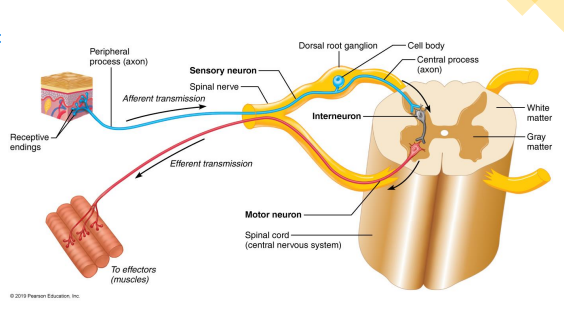
  • Based on the direction of impulse transmission in relation to CNS

  • Sensory (afferent) neurons → carry impulses from sensory receptors in skin, internal organs, muscles, and special sense organs TOWARDS CNS

  • Association neurons (interneurons) → conduct impulses within CNS

  • Motor (efferent) neurons: carry impulses AWAY from CNS to organs, muscles, and glands
<ul><li><p>Based on the direction of impulse transmission in relation to CNS</p></li><li><p>Sensory (afferent) neurons → carry impulses from sensory receptors in skin, internal organs, muscles, and special sense organs TOWARDS CNS</p></li><li><p>Association neurons (interneurons) → conduct impulses within CNS</p></li><li><p>Motor (efferent) neurons: carry impulses AWAY from CNS to organs, muscles, and glands</p></li></ul><p></p>
6
New cards

Neuron Properties

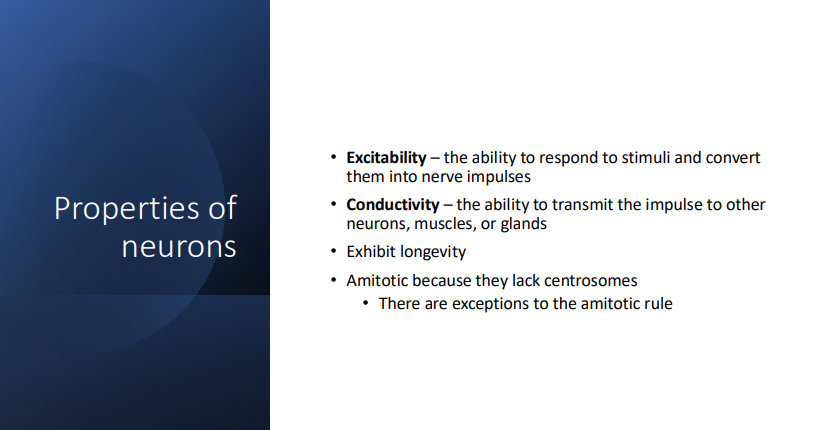
knowt flashcard image
7
New cards

Tracts and Nerves

  • Tract: bundle of axons in CNS supported only by neuroglia

  • Nerve: bundle of axons in PNS wrapped in CT

    • Sensory (afferent) nerves: contains only sensory processes

    • Motor (efferent) nerves: contain only motor processes

    • Mixed nerves: contain both sensory and motor neurons

  • Connective Tissue Sheathes of Nerves:

    • Endoneurium → encloses each axon and its myelin sheath

    • Perineurium → encloses groups of axons called fascicles

    • Epineurium → encloses nerve (group of fascicles)
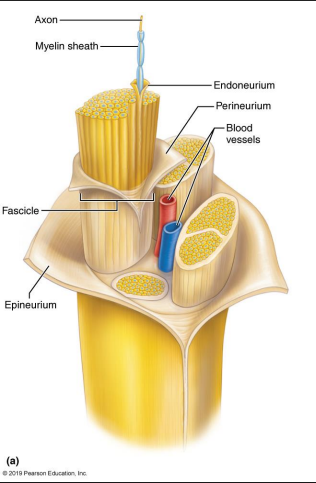
<ul><li><p>Tract: bundle of axons in CNS supported only by neuroglia</p></li><li><p>Nerve: bundle of axons in PNS wrapped in CT</p><ul><li><p>Sensory (afferent) nerves: contains only sensory processes</p></li><li><p>Motor (efferent) nerves: contain only motor processes</p></li><li><p>Mixed nerves: contain both sensory and motor neurons</p></li></ul></li><li><p>Connective Tissue Sheathes of Nerves: </p><ul><li><p>Endoneurium → encloses each axon and its myelin sheath</p></li><li><p>Perineurium → encloses groups of axons called fascicles</p></li><li><p>Epineurium → encloses nerve (group of fascicles) </p></li></ul></li></ul><p></p>
8
New cards

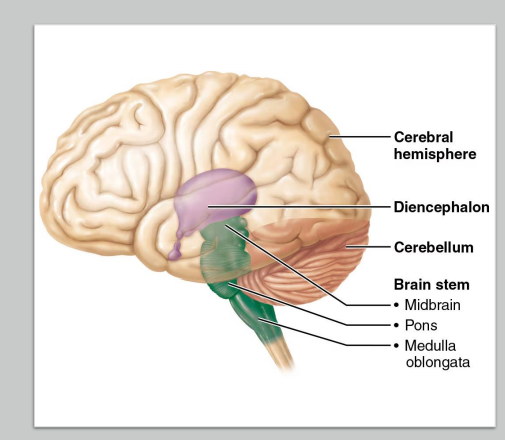
Human Brain Gross Anatomy

  • Weight: 3.5 lbs (1.6 kg)

  • Four Major Regions:

    • Cerebrum

    • Diencephalon

    • Brain Stem

    • Cerebellum

<ul><li><p>Weight: 3.5 lbs (1.6 kg)</p></li><li><p>Four Major Regions:</p><ul><li><p>Cerebrum</p></li><li><p>Diencephalon</p></li><li><p>Brain Stem</p></li><li><p>Cerebellum</p></li></ul></li></ul><p></p>
9
New cards

Anatomy of Cerebrum

  • composed of two cerebral hemispheres (left and right)

  • 83% of brain’s total mass

  • surface of cerebrum is marked by gyri (elevated ridges)

    • sulcus → furrow between gyri

    • fissure → deeper sulcus

  • each cerebral hemisphere is divided into five lobes
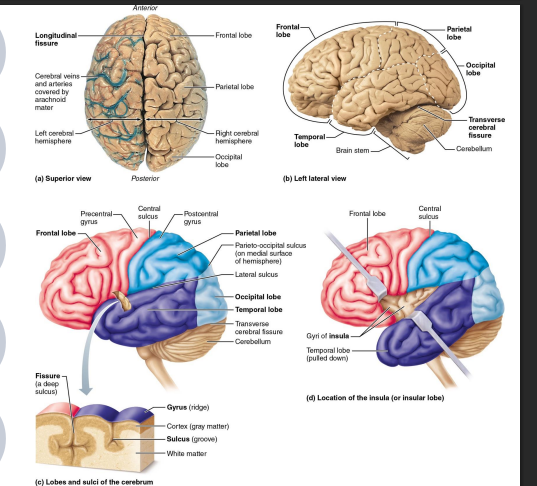
<ul><li><p>composed of two cerebral hemispheres (left and right)</p></li><li><p>83% of brain’s total mass</p></li><li><p>surface of cerebrum is marked by gyri (elevated ridges)</p><ul><li><p>sulcus → furrow between gyri</p></li><li><p>fissure → deeper sulcus</p></li></ul></li><li><p>each cerebral hemisphere is divided into five lobes</p></li></ul><p></p>
10
New cards

Cerebral Hemispheres

  • carries out higher mental functions (memory and reason)

  • separated by longitudinal fissure → median fissure dividing cerebrum into right and left hemispheres

  • held together medially by corpus callosum

  • lateral ventricles separated by membrane (septum pellucidum)
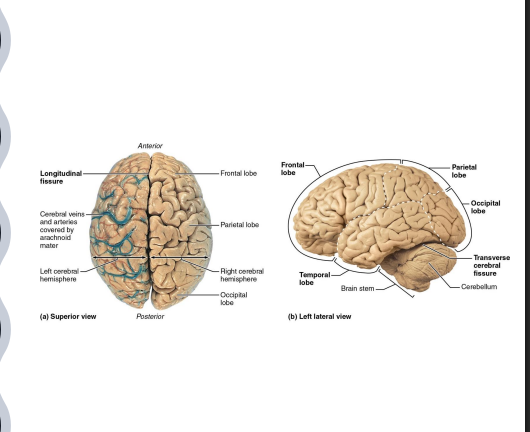
<ul><li><p>carries out higher mental functions (memory and reason)</p></li><li><p>separated by longitudinal fissure → median fissure dividing cerebrum into right and left hemispheres</p></li><li><p>held together medially by corpus callosum</p></li><li><p>lateral ventricles separated by membrane (septum pellucidum) </p></li></ul><p></p>
11
New cards

Cerebrum 5 Lobes

  • frontal, temporal, parietal, and occipital lobes:

    • can be viewed externally

    • named for the overlaying cranial bones

  • Insula

    • cannot be viewed externally

    • located deep to the lateral sulcus (covered by frontal, temporal, and parietal lobes)
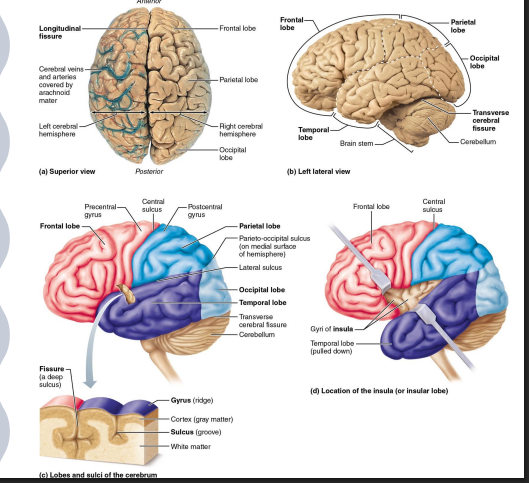
<ul><li><p>frontal, temporal, parietal, and occipital lobes:</p><ul><li><p>can be viewed externally</p></li><li><p>named for the overlaying cranial bones </p></li></ul></li><li><p>Insula</p><ul><li><p>cannot be viewed externally </p></li><li><p>located deep to the lateral sulcus (covered by frontal, temporal, and parietal lobes) </p></li></ul></li></ul><p></p>
12
New cards

Cerebrum Major Sulci

  • central sulcus → separates frontal and parietal lobes

    • precentral gyrus of frontal lobe contains primary motor cortex

    • postcentral gyrus of parietal lobe contains primary somatosensory cortex

  • lateral sulcus → separates temporal lobe from parietal and frontal lobes

  • parieto-occipital sulcus → separates parietal lobe from occipital lobe
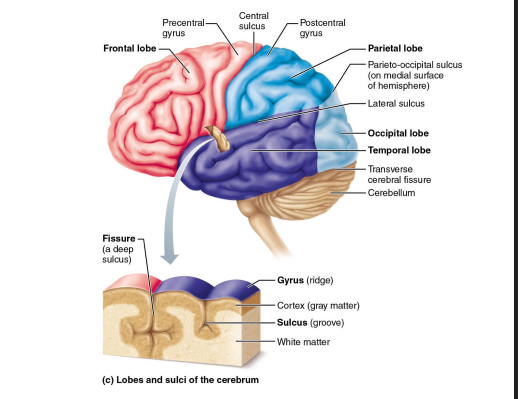
<ul><li><p>central sulcus → separates frontal and parietal lobes</p><ul><li><p>precentral gyrus of frontal lobe contains primary motor cortex</p></li><li><p>postcentral gyrus of parietal lobe contains primary somatosensory cortex </p></li></ul></li><li><p>lateral sulcus → separates temporal lobe from parietal and frontal lobes</p></li><li><p>parieto-occipital sulcus → separates parietal lobe from occipital lobe</p></li></ul><p></p>
13
New cards

Three Major Regions in Cerebral Hemispheres

  • cerebral cortex → composed of grey matter (cell bodies and dendrites)

    • highly convoluted

    • 2-4 mm thick

    • 40% of total brain mass

    • location of conscious mind

  • white matter → tracts with myelinated axons (appear white)

    • deep to cerebral cortex

  • basal nuclei → islands of cell bodies within cerebral white matter
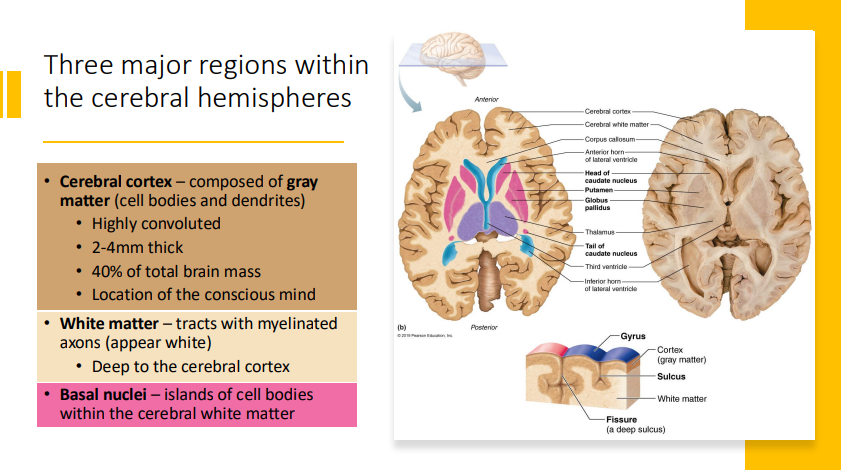
<ul><li><p>cerebral cortex → composed of grey matter (cell bodies and dendrites)</p><ul><li><p>highly convoluted</p></li><li><p>2-4 mm thick</p></li><li><p>40% of total brain mass</p></li><li><p>location of conscious mind</p></li></ul></li><li><p>white matter → tracts with myelinated axons (appear white)</p><ul><li><p>deep to cerebral cortex</p></li></ul></li><li><p>basal nuclei → islands of cell bodies within cerebral white matter</p></li></ul><p></p>
14
New cards

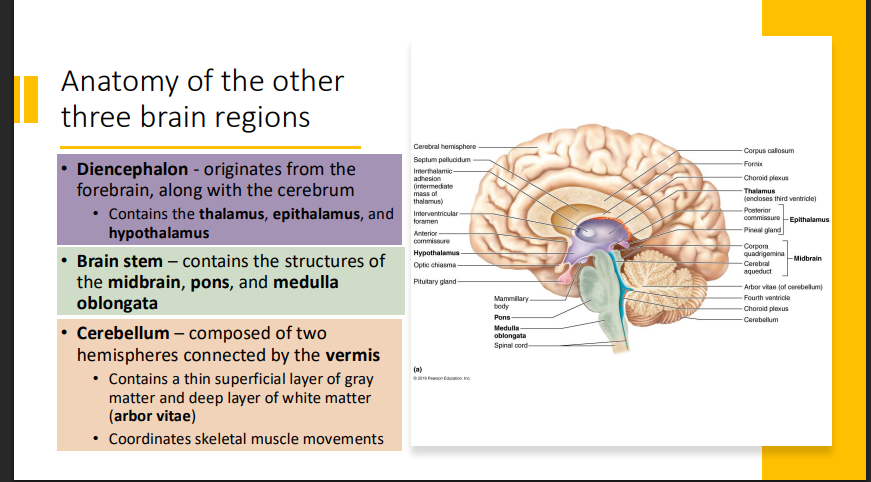
Anatomy of Other Brain Regions

  • Diencephalon → originates from forebrain, along with cerebrum

    • contains thalamus, epithalamus, and hypothalamus

  • Brain stem → contains structures of midbrain, pons, and medulla oblongata

  • Cerebellum → composed of two hemispheres connected by the vermis

    • contains thin superficial layer of gray matter and deep layer of white matter (arbor vitae)

    • coordinates skeletal muscle movements

<ul><li><p>Diencephalon → originates from forebrain, along with cerebrum</p><ul><li><p>contains thalamus, epithalamus, and hypothalamus</p></li></ul></li><li><p>Brain stem → contains structures of midbrain, pons, and medulla oblongata</p></li><li><p>Cerebellum → composed of two hemispheres connected by the vermis</p><ul><li><p>contains thin superficial layer of gray matter and deep layer of white matter (arbor vitae)</p></li><li><p>coordinates skeletal muscle movements</p></li></ul></li></ul><p></p>
15
New cards

Diencephalon

  • Thalamus → relay center for all sensory information (except smell) on its way to cerebral cortex

  • Hypothalamus → regulation of visceral activities and body functions, emotions, instincts, secretes hormones

  • Epithalamus → contains pineal gland, which secretes the hormone melanin
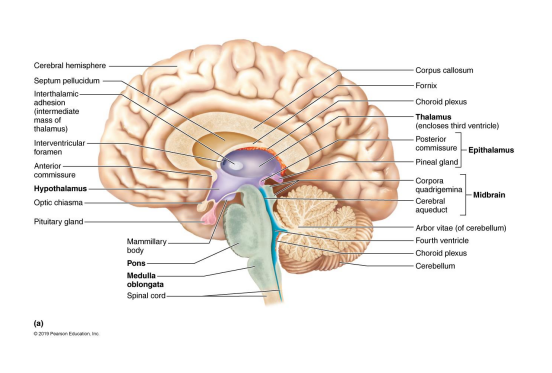
<ul><li><p>Thalamus → relay center for all sensory information (except smell) on its way to cerebral cortex</p></li><li><p>Hypothalamus → regulation of visceral activities and body functions, emotions, instincts, secretes hormones</p></li><li><p>Epithalamus → contains pineal gland, which secretes the hormone melanin</p></li></ul><p></p>
16
New cards

Brain Stem

  • Midbrain

    • corpora quadrigemina → pair of superior colliculi (visual reflex) and pair of inferior colliculi (auditory reflex)

    • cerebral peduncles → tracts in midbrain, connects pons to cerebrum

    • cerebral aqueduct → pathway for CSF

  • Pons → contains fiber tracts connecting cerebrum to cerebellum

  • Medulla oblongata → regulates autonomic functions (heart rate, blood pressure, breathing, etc) and it blends in with the spinal cord at the level of the foramen magnum
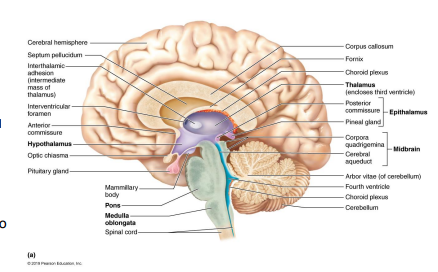
<ul><li><p>Midbrain </p><ul><li><p>corpora quadrigemina → pair of superior colliculi (visual reflex) and pair of inferior colliculi (auditory reflex)</p></li><li><p>cerebral peduncles → tracts in midbrain, connects pons to cerebrum</p></li><li><p>cerebral aqueduct → pathway for CSF</p></li></ul></li><li><p>Pons → contains fiber tracts connecting cerebrum to cerebellum</p></li><li><p>Medulla oblongata → regulates autonomic functions (heart rate, blood pressure, breathing, etc) and it blends in with the spinal cord at the level of the foramen magnum</p></li></ul><p></p>
17
New cards

Cerebellum

  • two hemispheres separated by a longitudinal fissure called the vermis

  • thin superficial layer of gray matter and deep layer of white matter (arbor vitae)

  • coordinates skeletal muscle contractions

    • specializes fine movements

    • helps lean new movements (walking)

    • brain region most affected by alcohol intoxication
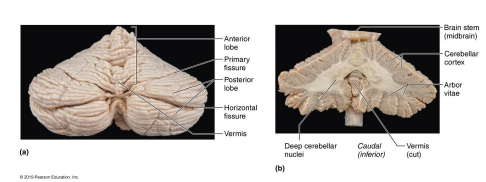
<ul><li><p>two hemispheres separated by a longitudinal fissure called the vermis</p></li><li><p>thin superficial layer of gray matter and deep layer of white matter (arbor vitae)</p></li><li><p>coordinates skeletal muscle contractions </p><ul><li><p>specializes fine movements </p></li><li><p>helps lean new movements (walking)</p></li><li><p>brain region most affected by alcohol intoxication</p></li></ul></li></ul><p></p>
18
New cards

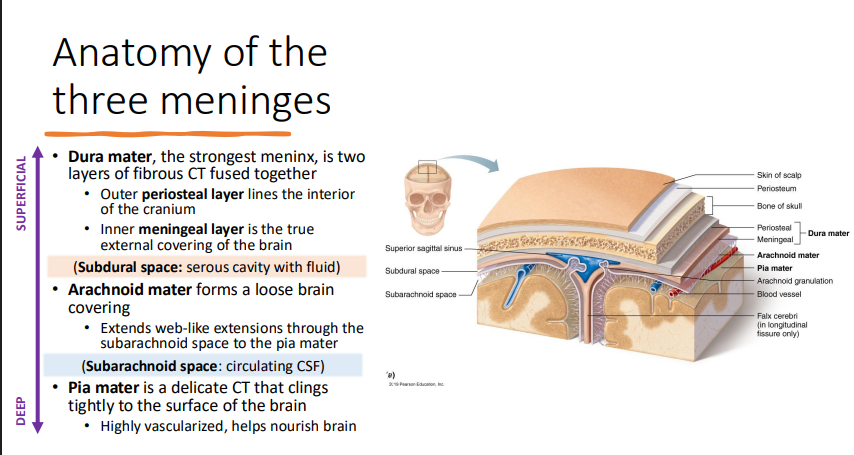
Structures Protecting Brain

  • cranium → body helmet composed of 8 cranial bones

  • Meninges → three CT membranes surrounding the brain

  • CSF → fluid cushion in the subarachnoid space and ventricles

  • Blood-brain barrier → selective barrier that prevents harmful substances in blood from crossing into the brain
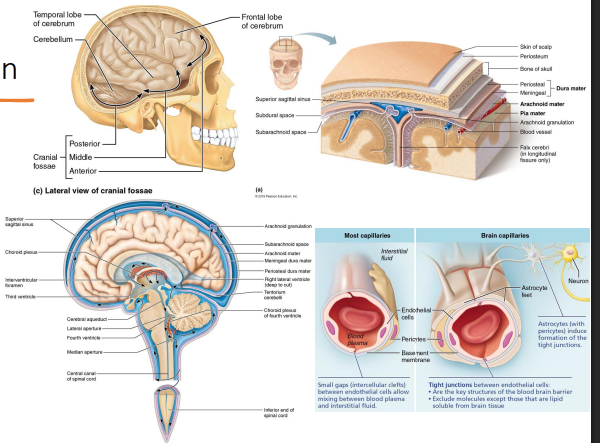
<ul><li><p>cranium → body helmet composed of 8 cranial bones</p></li><li><p>Meninges → three CT membranes surrounding the brain</p></li><li><p>CSF → fluid cushion in the subarachnoid space and ventricles</p></li><li><p>Blood-brain barrier → selective barrier that prevents harmful substances in blood from crossing into the brain</p></li></ul><p></p>
19
New cards

Meninges Anatomy

knowt flashcard image
20
New cards

Cerebrospinal Fluid

  • acts as fluid cushion, providing buoyancy

  • provides nutrients and removes metabolic wastes

  • filtered from blood by the choroid plexuses (small collections of capillaries in ventricles)

    • supported by astrocytes

  • circulating through ventricles and in subarachnoid space → CSF found inside and outside brain

    • circulation facilitated by ciliated ependymal cells
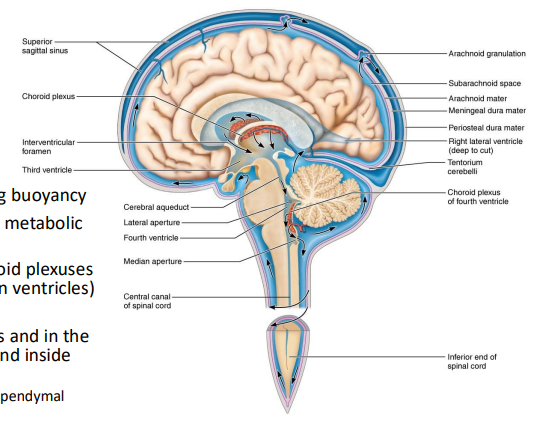
<ul><li><p>acts as fluid cushion, providing buoyancy </p></li><li><p>provides nutrients and removes metabolic wastes</p></li><li><p>filtered from blood by the choroid plexuses (small collections of capillaries in ventricles) </p><ul><li><p>supported by astrocytes</p></li></ul></li><li><p>circulating through ventricles and in subarachnoid space → CSF found inside and outside brain </p><ul><li><p>circulation facilitated by ciliated ependymal cells</p></li></ul></li></ul><p></p>
21
New cards

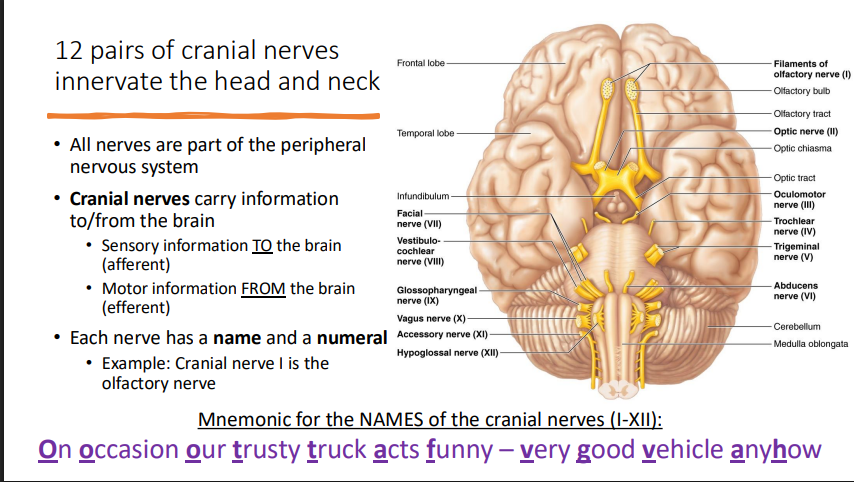
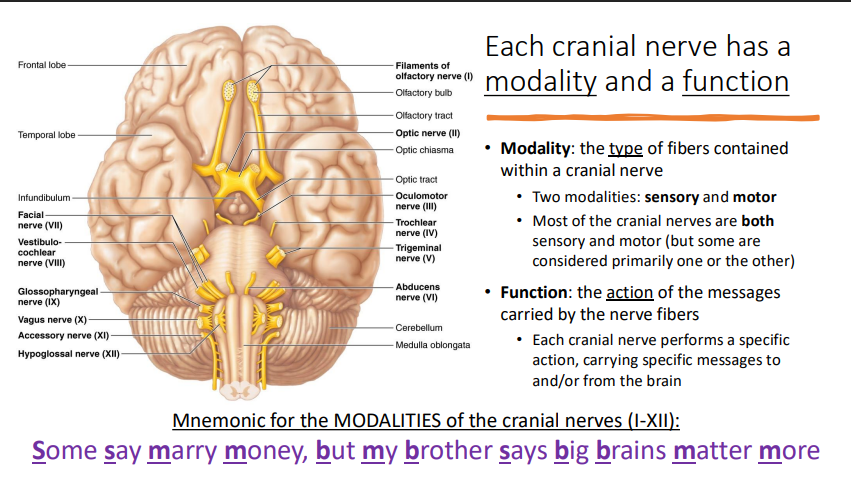
12 Pairs Cranial Nerves

knowt flashcard image
22
New cards
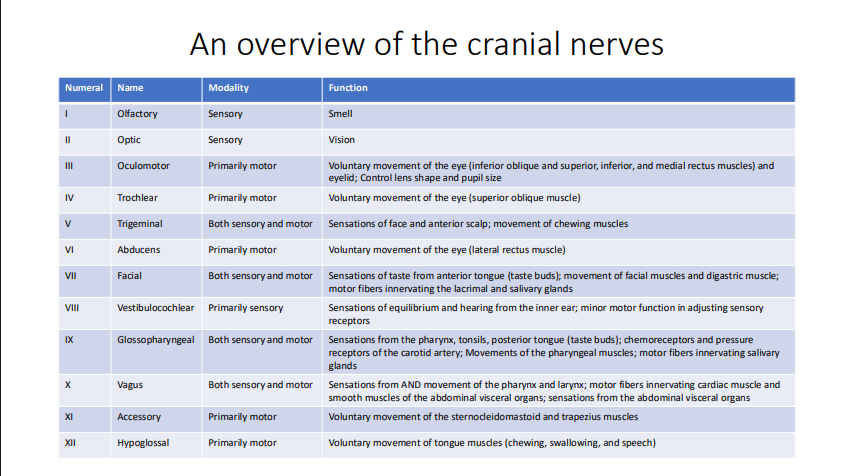
<p>Cranial Nerve Modality + Function </p>

Cranial Nerve Modality + Function

knowt flashcard image
23
New cards

Accessory Structures of Eye

  • palpebrae → eyelids

  • medial and lateral commissures

  • lacrimal caruncle → fleshy elevation at medial commissure

  • lacrimal apparatus → produces and drains tears to lubricate eye
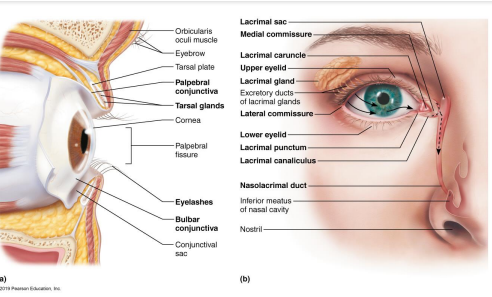
<ul><li><p>palpebrae → eyelids</p></li><li><p>medial and lateral commissures </p></li><li><p>lacrimal caruncle → fleshy elevation at medial commissure </p></li><li><p>lacrimal apparatus → produces and drains tears to lubricate eye</p></li></ul><p></p>
24
New cards

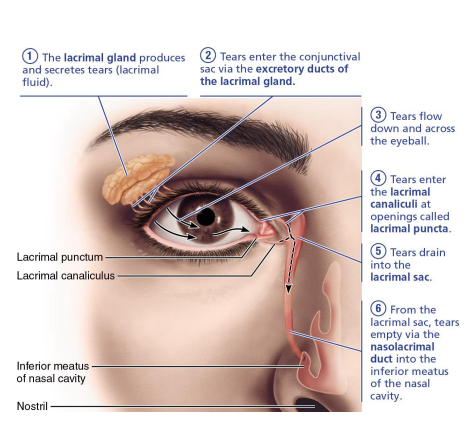
Lacrimal Apparatus

  • produces and drains lacrimal fluid (tears) to lubricate the eye

    • contains mucus, antibodies, lysozyme

  • lacrimal fluid is continuously released and flows across the eye:

    • lacrimal gland

    • lacrimal puncta

    • lacrimal canaliculi

    • lacrimal sac

    • nasolacrimal duct

<ul><li><p>produces and drains lacrimal fluid (tears) to lubricate the eye</p><ul><li><p>contains mucus, antibodies, lysozyme</p></li></ul></li><li><p>lacrimal fluid is continuously released and flows across the eye:</p><ul><li><p>lacrimal gland</p></li><li><p>lacrimal puncta</p></li><li><p>lacrimal canaliculi</p></li><li><p>lacrimal sac </p></li><li><p>nasolacrimal duct </p></li></ul></li></ul><p></p>
25
New cards

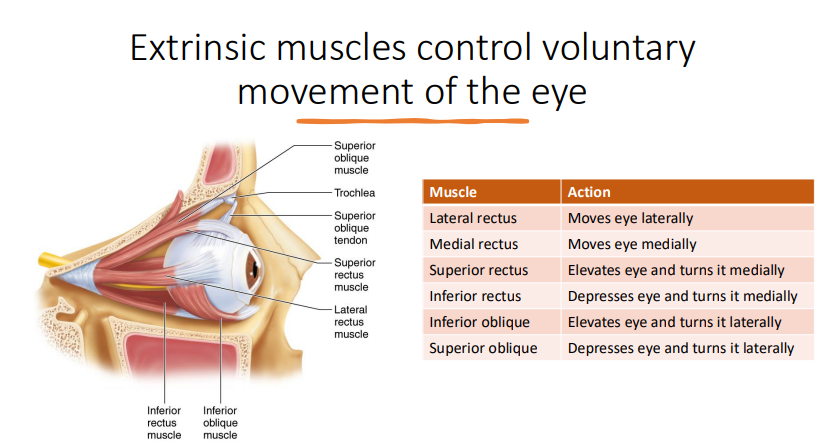
Extrinsic Muscles of Eye

knowt flashcard image
26
New cards

Eye Wall Layers

  • Fibrous Layer → composed of sclera and cornea

  • Vascular layer → contains choroid, ciliary body, and iris

  • Sensory layer → retina, composed of the pigmented and neural layers
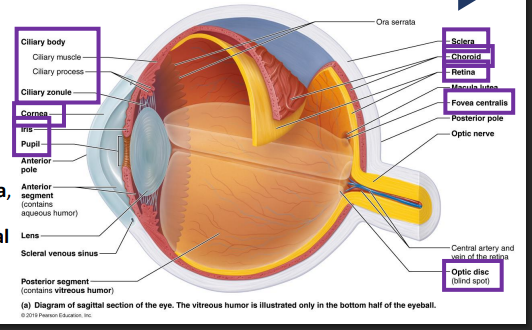
<ul><li><p>Fibrous Layer → composed of sclera and cornea </p></li><li><p>Vascular layer → contains choroid, ciliary body, and iris </p></li><li><p>Sensory layer → retina, composed of the pigmented and neural layers </p></li></ul><p></p>
27
New cards

Fibrous Layer (Outermost Eye Wall Layer)

  • composed of dense avascular connective tissue

  • sclera → opaque region occupying the posterior 5/6 of the fibrous layer

  • cornea → anterior transparent region, modified to let light in

    • major light-bending medium of eye (refracts light to focus on the retina)
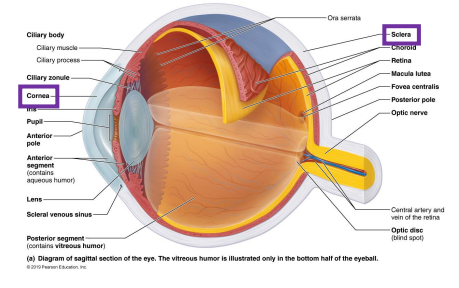
<ul><li><p>composed of dense avascular connective tissue </p></li><li><p>sclera → opaque region occupying the posterior 5/6  of the fibrous layer</p></li><li><p>cornea → anterior transparent region, modified to let light in </p><ul><li><p>major light-bending medium of eye (refracts light to focus on the retina) </p></li></ul></li></ul><p></p>
28
New cards

Vascular Layer (Middle Eye Wall Layer)

  • choroid → highly vascularized posterior region, contains melanin to prevent the scattering of light

  • ciliary body → encircles lens

    • ciliary muscle → intrinsic muscle that controls lens shape

    • ciliary processes → contain capillaries from which aqueous humor is filtered

    • zonules → fibers extended from ciliary process to hold the lens upright

  • Iris → pigmented smooth muscles that regulate diameter of pupil

    • sphincter pupillae → contract to constrict the pupil (close vision and bright light)

    • dilator pupillae → contracts to dilate the pupil (distant vision and dim light)
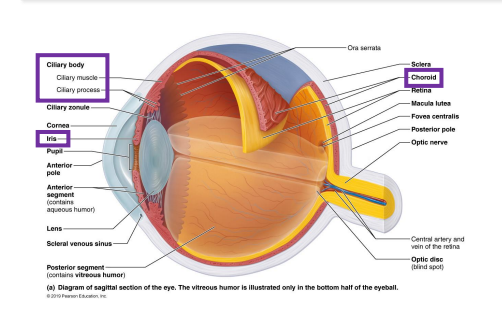
<ul><li><p>choroid → highly vascularized posterior region, contains melanin to prevent the scattering of light</p></li><li><p>ciliary body → encircles lens</p><ul><li><p>ciliary muscle → intrinsic muscle that controls lens shape</p></li><li><p>ciliary processes → contain capillaries from which aqueous humor is filtered</p></li><li><p>zonules → fibers extended from ciliary process to hold the lens upright</p></li></ul></li><li><p>Iris → pigmented smooth muscles that regulate diameter of pupil </p><ul><li><p>sphincter pupillae → contract to constrict the pupil (close vision and bright light) </p></li><li><p>dilator pupillae → contracts to dilate the pupil (distant vision and dim light) </p></li></ul></li></ul><p></p>
29
New cards

Retina (Innermost Eye Wall Layer)

  • pigmented layer (outer layer) → composed of melanocytes, absorbs light and prevents it from scattering

  • neural layer (transparent inner layer) → converts light energy into nerve impulses that then travel to brain via optic nerve

    • fovea centralis → area of neural layer that contains only cones

    • optic disc (blind spot) → region where optic nerve fibers exit the eye, lacks photoreceptors
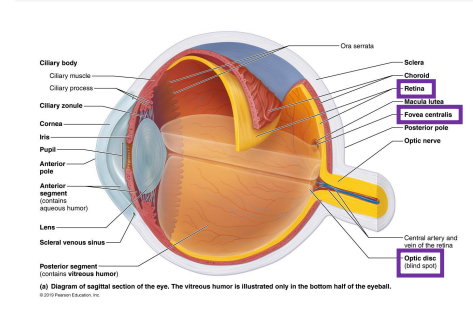
<ul><li><p>pigmented layer (outer layer) → composed of melanocytes, absorbs light and prevents it from scattering </p></li><li><p>neural layer (transparent inner layer) → converts light energy into nerve impulses that then travel to brain via optic nerve</p><ul><li><p>fovea centralis → area of neural layer that contains only cones </p></li><li><p>optic disc (blind spot) → region where optic nerve fibers exit the eye, lacks photoreceptors </p></li></ul></li></ul><p></p>
30
New cards

Cells of Neural Layer of Retina

  • Two types of photoreceptors sense light:

    • rods → dim light vision

    • cones → high light and color vision

  • Bipolar cells

  • Ganglion cells → axons leave the retina in the optic nerve
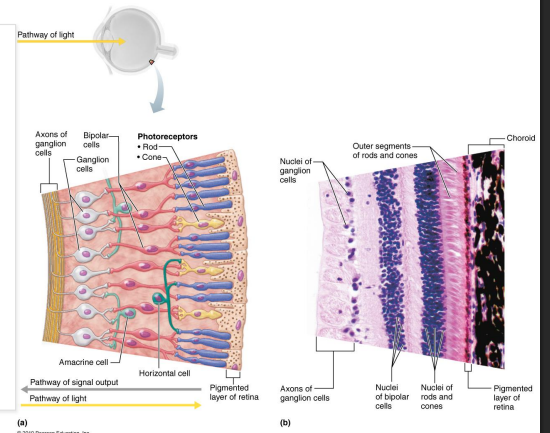
<ul><li><p>Two types of photoreceptors sense light:</p><ul><li><p>rods → dim light vision</p></li><li><p>cones → high light and color vision </p></li></ul></li><li><p>Bipolar cells </p></li><li><p>Ganglion cells → axons leave the retina in the optic nerve</p></li></ul><p></p>
31
New cards

Anterior vs Posterior Eye Segments

  • anterior segment → between cornea and lens (includes lens)

    • contains aqueous humor, fluid formed and drained throughout life

    • lens → biconvex structure that helps focus light on retina

  • posterior segment → everything posterior to lens

    • contains vitreous humor, a gel-like fluid formed during embryonic development that lasts a lifetime

  • like lens, aqueous humor and vitreous humor help refract light
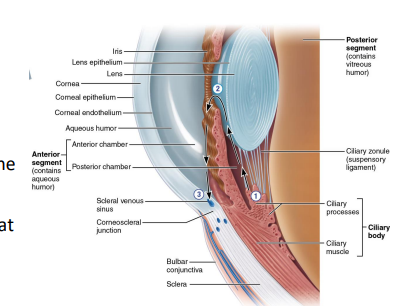
<ul><li><p>anterior segment → between cornea and lens (includes lens)</p><ul><li><p>contains aqueous humor, fluid formed and drained throughout life</p></li><li><p>lens → biconvex structure that helps focus light on retina </p></li></ul></li><li><p>posterior segment → everything posterior to lens </p><ul><li><p>contains vitreous humor, a gel-like fluid formed during embryonic development that lasts a lifetime </p></li></ul></li><li><p>like lens, aqueous humor and vitreous humor help refract light </p></li></ul><p></p>
32
New cards

External Ear

  • Pinna → elastic cartilage covered with skin

  • external acoustic meatus → canal in temporal bone, lined with ceruminous glands

  • tympanic membrane → vibrates in response to soundwaves; separates external and middle ear
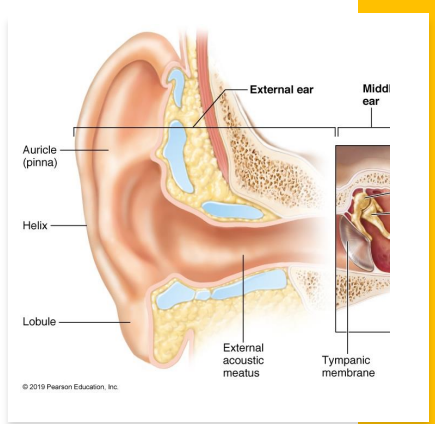
<ul><li><p>Pinna → elastic cartilage covered with skin</p></li><li><p>external acoustic meatus → canal in temporal bone, lined with ceruminous glands</p></li><li><p>tympanic membrane → vibrates in response to soundwaves; separates external and middle ear </p></li></ul><p></p>
33
New cards

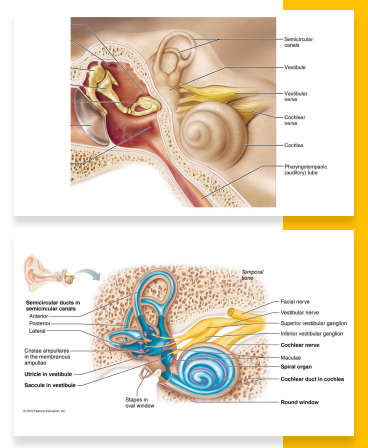
Middle Ear

  • three ossicles transmit and amplify vibrations

    • malleus → attached to tympanic membrane and incus

    • incus → articulates with malleus and stapes

    • stapes → articulates with incus and attaches to oval window

  • oval window → transmits vibrations from stapes to Scala vestibuli

  • pharyngotympanic tube → connects middle ear to throat
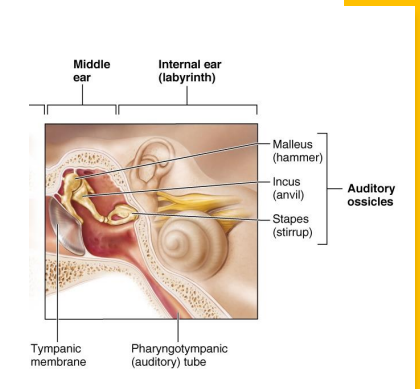
<ul><li><p>three ossicles transmit and amplify vibrations</p><ul><li><p>malleus → attached to tympanic membrane and incus</p></li><li><p>incus → articulates with malleus and stapes</p></li><li><p>stapes → articulates with incus and attaches to oval window </p></li></ul></li><li><p>oval window → transmits vibrations from stapes to Scala vestibuli </p></li><li><p>pharyngotympanic tube → connects middle ear to throat </p></li></ul><p></p>
34
New cards

Internal Ear

  • bony labyrinth → cavity in temporal bone, filled with perilymph

    • semicircular canals

    • vestibule

    • cochlea

  • membranous labyrinth → ducts and sacs within body labyrinth, filled with endolymph

    • Equilibrium:

      • semicircular ducts

      • saccule

      • utricle

    • Hearing

      • cochlear duct

<ul><li><p>bony labyrinth → cavity in temporal bone, filled with perilymph </p><ul><li><p>semicircular canals </p></li><li><p>vestibule </p></li><li><p>cochlea</p></li></ul></li><li><p>membranous labyrinth → ducts and sacs within body labyrinth, filled with endolymph </p><ul><li><p>Equilibrium:</p><ul><li><p>semicircular ducts</p></li><li><p>saccule </p></li><li><p>utricle </p></li></ul></li><li><p>Hearing</p><ul><li><p>cochlear duct </p></li></ul></li></ul></li></ul><p></p>
35
New cards

Spiral Organ - Responsible for Hearing

  • Spiral organ (organ of corti) is within cochlear duct

  • hair cells (auditory receptors) rest on basilar membrane and project stereocilia into tectorial membrane

  • movement of basilar membrane bends the stereocilia, depolarizing hair cell membrane, starting nerve impulse in the cochlear nerve
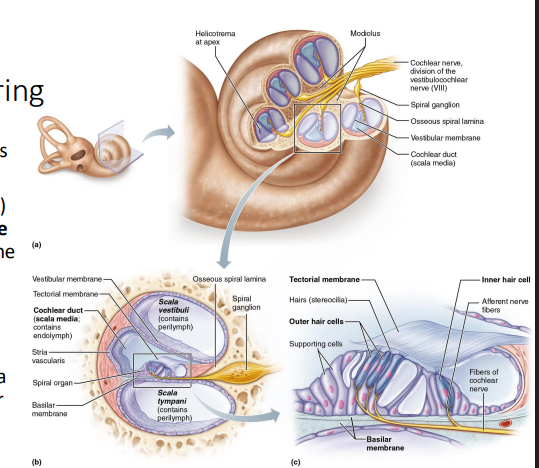
<ul><li><p>Spiral organ (organ of corti) is within cochlear duct</p></li><li><p>hair cells (auditory receptors) rest on basilar membrane and project stereocilia into tectorial membrane </p></li><li><p>movement of basilar membrane bends the stereocilia, depolarizing hair cell membrane, starting nerve impulse in the cochlear nerve </p></li></ul><p></p>
36
New cards

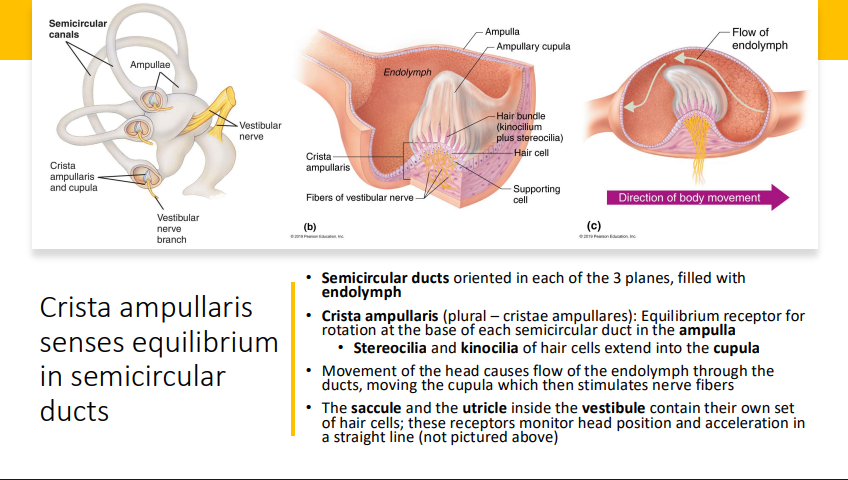
Crista Ampullaris

knowt flashcard image
37
New cards

Olfaction and Gustation

  • chemical senses

  • olfaction: sense of smell

  • gustation: sense of taste

  • receptors for olfaction and gustation are called chemoreceptors:

    • chemoreceptors respond to chemicals dissolved in aqueous solution

    • gustation chemoreceptors are divided into 5 subtypes that sense diff tastes

    • olfaction chemoreceptors are sensitive to wide range of chemical sensations

38
New cards

Olfaction + Olfactory Epithelium

  • cell types of olfactory epithelium:

    • olfactory sensory neurons → bipolar neurons with radiating olfactory cilia

      • bundles of axons of olfactory receptor cells form the filaments of olfactory nerve

      • replaced every 30-60 days by olfactory stem cells

    • supporting cells → surround and cushion the olfactory system neurons

    • olfactory stem cells → lie at the basal surface (superior side of epithelium) and divide to replace olfactory sensory neurons
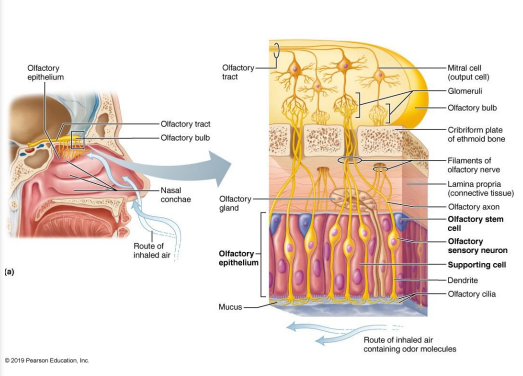
<ul><li><p>cell types of olfactory epithelium:</p><ul><li><p>olfactory sensory neurons → bipolar neurons with radiating olfactory cilia</p><ul><li><p>bundles of axons of olfactory receptor cells form the filaments of olfactory nerve</p></li><li><p>replaced every 30-60 days by olfactory stem cells</p></li></ul></li><li><p>supporting cells → surround and cushion the olfactory system neurons </p></li><li><p>olfactory stem cells → lie at the basal surface (superior side of epithelium) and divide to replace olfactory sensory neurons </p></li></ul></li></ul><p></p>
39
New cards

Sense of Taste

  • receptor organs are taste buds

    • most located on tongue in papillae

    • few found on soft palate, epiglottis, pharynx, and inner surface of cheeks

  • types of papillae:

    • fungiform → most numerous papillae, taste buds are on superior surface

    • foliate → on lateral edges of tongue, taste buds located in the side walls

    • vallate → large papillae in a V formation on posterior surface of tongue, taste buds are located in the side walls
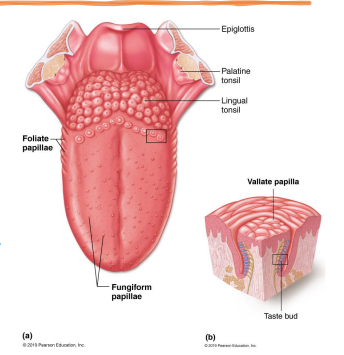
<ul><li><p>receptor organs are taste buds</p><ul><li><p>most located on tongue in papillae </p></li><li><p>few found on soft palate, epiglottis, pharynx, and inner surface of cheeks</p></li></ul></li><li><p>types of papillae:</p><ul><li><p>fungiform → most numerous papillae, taste buds are on superior surface </p></li><li><p>foliate → on lateral edges of tongue, taste buds located in the side walls</p></li><li><p>vallate → large papillae in a V formation on posterior surface of tongue, taste buds are located in the side walls </p></li></ul></li></ul><p></p>
40
New cards
<p>Taste Bud Structure + Chemicals </p>

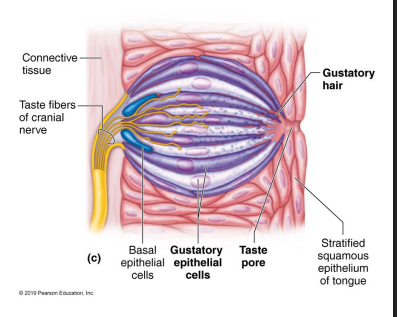
Taste Bud Structure + Chemicals

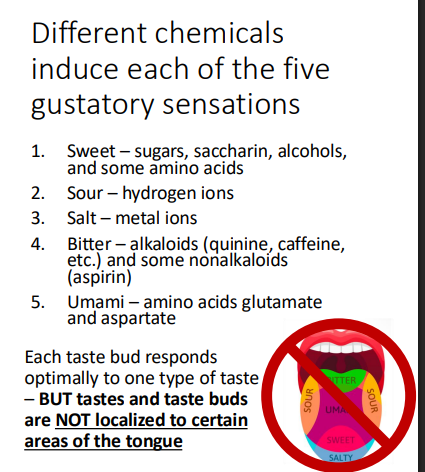
  • flask-shaped

  • all taste buds response to all 5 classes of chemical stimuli

    • each taste bud responds optimally to one type of taste

  • contain 50-100 epithelial cells

    • gustatory epithelial cells → receptor cells

      • microvilli (gustatory hairs) project through a taste pore to the surface of the epithelium bathed in saliva

    • basal epithelial cells → stem cells that replace the gustatory epithelial cells every 7 days
<ul><li><p>flask-shaped</p></li><li><p>all taste buds response to all 5 classes of chemical stimuli </p><ul><li><p>each taste bud responds optimally to one type of taste</p></li></ul></li><li><p>contain 50-100 epithelial cells</p><ul><li><p>gustatory epithelial cells → receptor cells</p><ul><li><p>microvilli (gustatory hairs) project through a taste pore to the surface of the epithelium bathed in saliva </p></li></ul></li><li><p>basal epithelial cells → stem cells that replace the gustatory epithelial cells every 7 days</p></li></ul></li></ul><p></p>
41
New cards

Endocrine System

  • endocrine glands → ductless glands that release chemical regulators called hormones directly into ECF (interstitial fluid and blood)

  • Endocrinology → study of biological effects of hormones released by endocrine glands and diseases caused by dysfunction

42
New cards

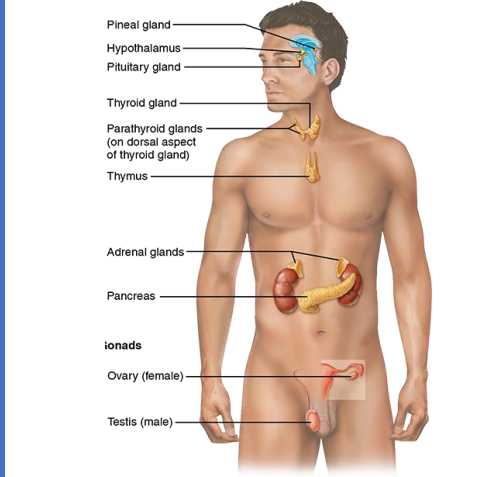
Major Endocrine Glands

knowt flashcard image
43
New cards

Hormone Release

  • released in response to homeostatic imbalances referred to as stimuli

  • hormones usually work via negative feedback to maintain homeostasis

    • biological effects of hormones negate/eliminate stimuli that caused release of hormones

    • exception: hormone prolactin stimulates milk production through positive feedback

44
New cards

Stimuli Types

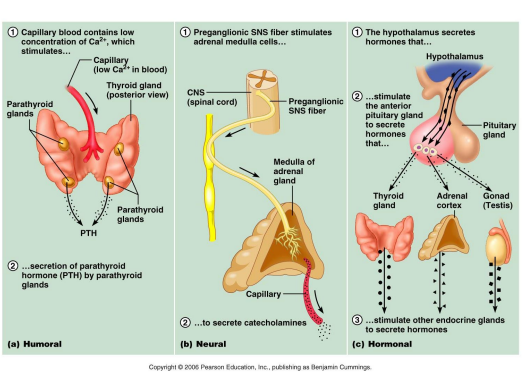
  • Humoral stimuli → changes in levels of chemicals in body’s humors (bodily fluids) stimulate endocrine glands to release hormones

  • Neural stimuli → activation of nervous system stimulates endocrine glands to release hormones

  • hormonal stimuli → released hormones stimulate endocrine glands to release other hormones
<ul><li><p>Humoral stimuli → changes in levels of chemicals in body’s humors (bodily fluids) stimulate endocrine glands to release hormones</p></li><li><p>Neural stimuli → activation of nervous system stimulates endocrine glands to release hormones </p></li><li><p>hormonal stimuli → released hormones stimulate endocrine glands to release other hormones </p></li></ul><p></p>
45
New cards

Hormone Nomenclature

  • organ of origin → endocrine gland releasing hormone

    • example: parathyroid hormone

  • function → major biological effect of hormone

    • example: follicle stimulating hormone

  • chemical structure → unique feature of chemical structure

    • example: triiodothyronine (t3)

46
New cards

Chemical Structure of Hormones Classes

  • biogenic amine hormones → derived from amino acid tyrosine

  • peptide/protein/glycoprotein hormones → composed of amino acid sequences

  • steroid hormones → derived from cholesterol

47
New cards

Target Cells/Tissues of Hormones

  • express accessible, functional receptors that hormones bind to

  • multiple hormones can target same cell

  • target cell can bind multiple hormones simultaneously
48
New cards
<p>Pituitary Gland (Hypophysis) </p>

Pituitary Gland (Hypophysis)

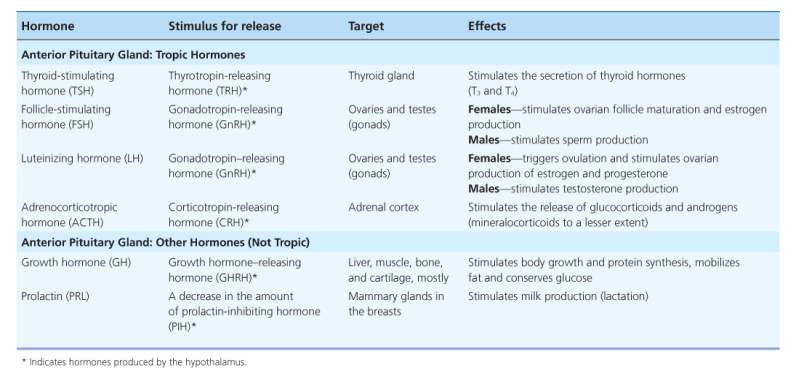
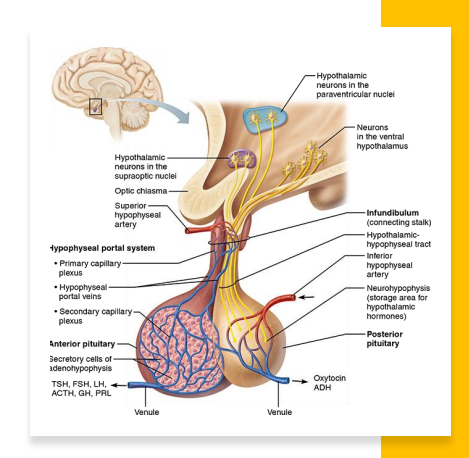
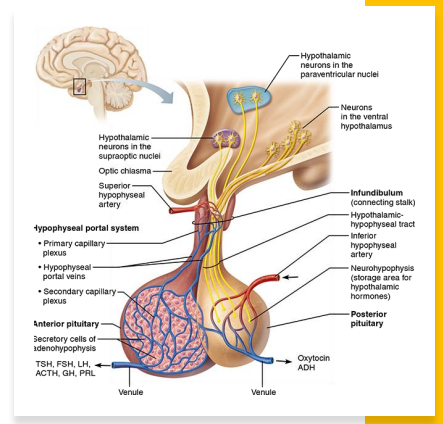
  • two functional lobes attached to the hypothalamus by infundibulum:

    • adenohypophysis (anterior)

      • controlled by neurosecretions produced by neurons of ventral hypothalamus then liberated into hypophyseal portal system and carried to cells of adenohypophysis where they control hormone release

        • produces 4 tropic hormones that stimulate target organs that are endocrine glands

        • produces 2 other main hormones not directly involved in regulation of other endocrine glands

    • neurohypophysis (posterior)

<ul><li><p>two functional lobes attached to the hypothalamus by infundibulum:</p><ul><li><p>adenohypophysis (anterior)</p><ul><li><p>controlled by neurosecretions produced by neurons of ventral hypothalamus then liberated into hypophyseal portal system and carried to cells of adenohypophysis where they control hormone release </p><ul><li><p>produces 4 tropic hormones that stimulate target organs that are endocrine glands </p></li><li><p>produces 2 other main hormones not directly involved in regulation of other endocrine glands</p></li></ul></li></ul></li><li><p>neurohypophysis (posterior) </p></li></ul></li></ul><p></p><p></p>
49
New cards
<p>Pituitary Gland (Hypophysis) </p>

Pituitary Gland (Hypophysis)

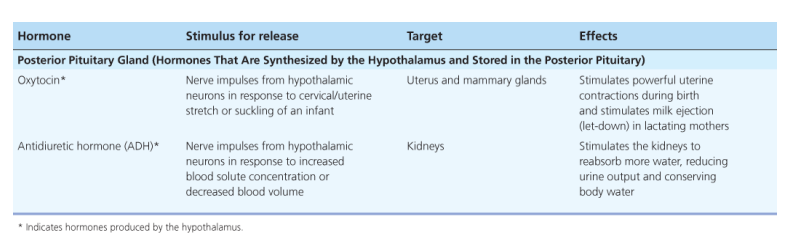
  • Neurohypophysis: not an endocrine gland but storage for 2 hormones transported to it via the axons of neurons in the paraventricular and supraoptic nuclei of the hypothalamus
<ul><li><p>Neurohypophysis: not an endocrine gland but storage for 2 hormones transported to it via the axons of neurons in the paraventricular and supraoptic nuclei of the hypothalamus</p></li></ul><p></p>
50
New cards

Thyroid Gland

  • located in throat just inferior to larynx

  • two lobes joined by central mass or isthmus
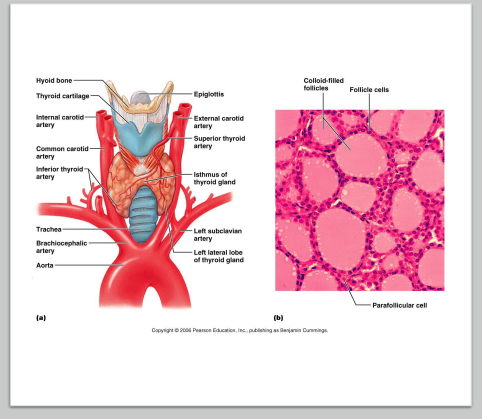
<ul><li><p>located in throat just inferior to larynx </p></li><li><p>two lobes joined by central mass or isthmus </p></li></ul><p></p>
51
New cards
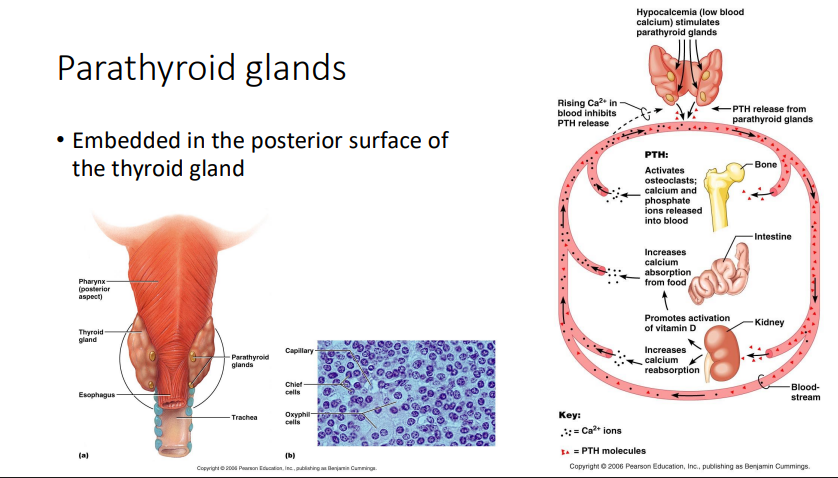
<p>Parathyroid Glands</p>

Parathyroid Glands

  • embedded in posterior surface of thyroid gland
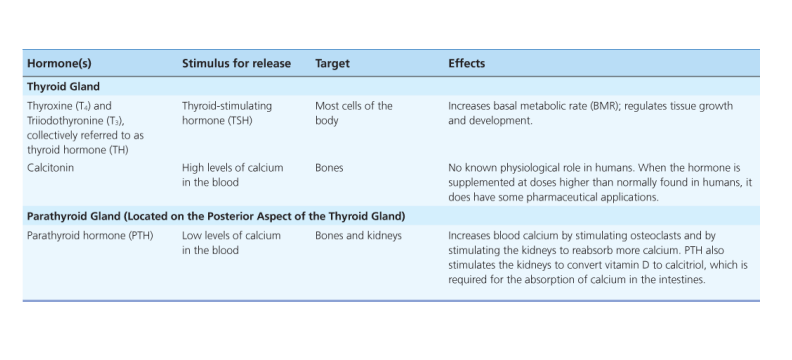
<ul><li><p>embedded in posterior surface of thyroid gland </p></li></ul><p></p>
52
New cards
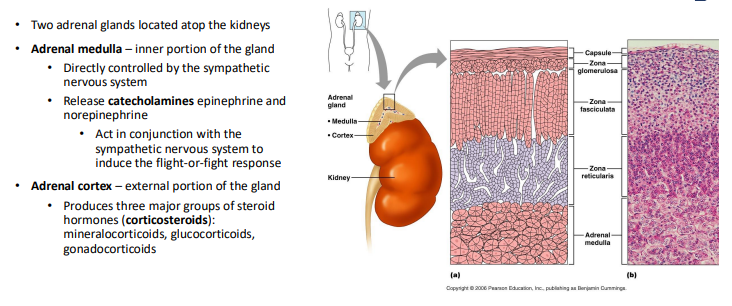
<p>Adrenal Glands</p>

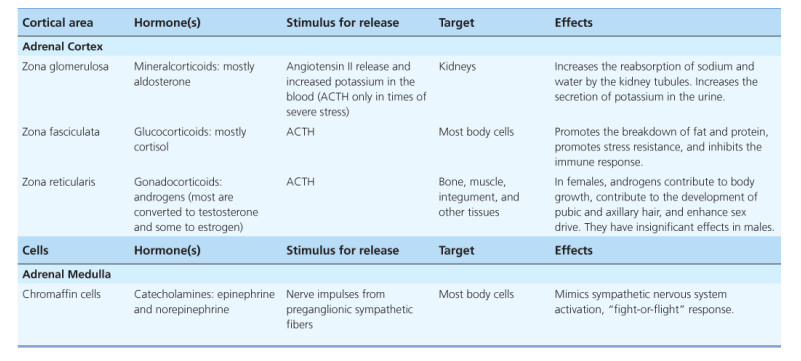
Adrenal Glands

knowt flashcard image
53
New cards

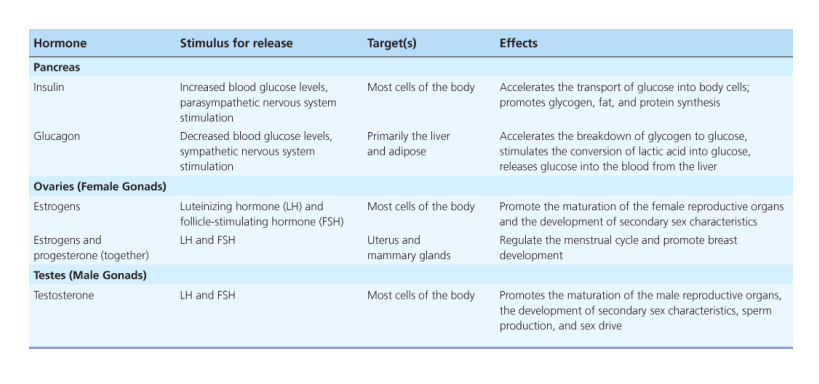
Pancreas

  • located behind stomach

  • functions as endocrine and exocrine gland

    • exocrine: produces digestive enzymes

    • endocrine: produces insulin and glucagon, hormones that act to regulate blood sugar levels
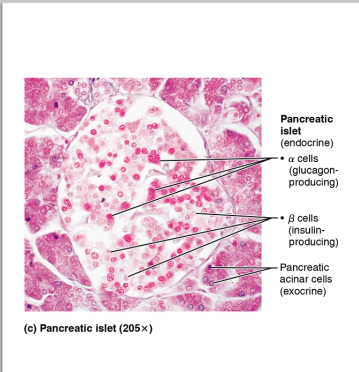
<ul><li><p>located behind stomach</p></li><li><p>functions as endocrine and exocrine gland</p><ul><li><p>exocrine: produces digestive enzymes</p></li><li><p>endocrine: produces insulin and glucagon, hormones that act to regulate blood sugar levels</p></li></ul></li></ul><p></p>
54
New cards

Gonads

  • two tropic hormones released by anterior pituitary induce the gonads to produce steroidal hormones

    • follicle stimulating hormone (FSH)

    • luteinizing hormone (LH)

  • Ovaries (females) produce estrogens and progesterone

  • Testes (males) produce testosterone

<ul><li><p>two tropic hormones released by anterior pituitary induce the gonads to produce steroidal hormones</p><ul><li><p>follicle stimulating hormone (FSH)</p></li><li><p>luteinizing hormone (LH)</p></li></ul></li><li><p>Ovaries (females) produce estrogens and progesterone </p></li><li><p>Testes (males) produce testosterone</p></li></ul><p></p>
55
New cards

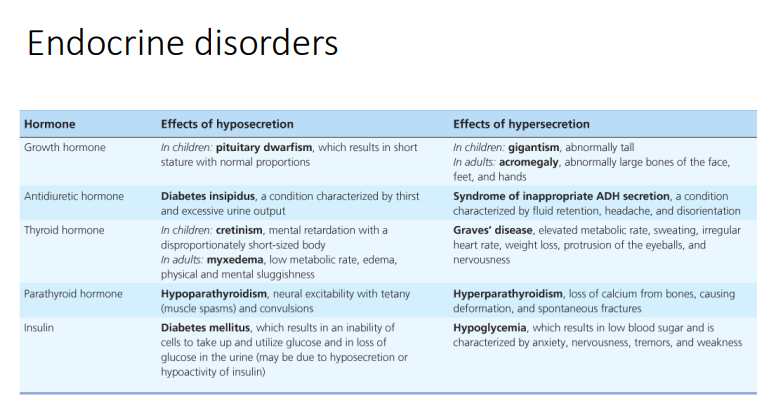
Endocrine Disorders

knowt flashcard image