operational amplifier (op amp)
 Call Kai
 Learn
Learn Practice Test
 Spaced Repetition
 Match
Match Flashcards
 Knowt Play
1/14

There's no tags or description
Looks like no tags are added yet.
Name | Mastery | Learn | Test | Matching | Spaced | Call with Kai |
|---|
No analytics yet
Send a link to your students to track their progress
15 Terms
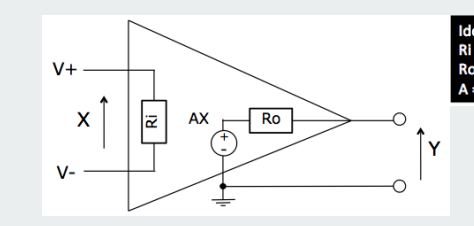
ideal op amp
circuit with two inputs and one output
Rin = infinity (should not draw current from the source)
Rout is zero
A is infinite asVo/Vi and we want an extremely small Vi to produce large Vo
equivalent circuit of op amp
V- and V+ on left, Y on right
Vload
Vsource - IRo, if Ro is zero, then Vload = Vsource which is ideal
real op amp
numbers labelled anticlockwise from notch when looking from above
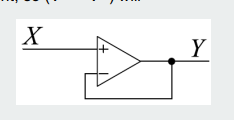
negative feedback
if output falls then V- will fall by the same amount so that V+ - V- will increase, this then causes Y to rise as Y = A(V+ - V-) = A(X-Y)
analyzing op amp circuits
1) check for negative feedback to ensure an increase in Y makes V+ - V- decrease, Y must be connected to V-
2) assume that V+ = V-, since it =Y xA, this is the same thing as assuming A = infinity
3) Assume zero input current
4) apply KCL at each node separately, with zero input current, do not apply at output as unknown
non-inverting amplifier
gain is positive, choose ratio R2/R1
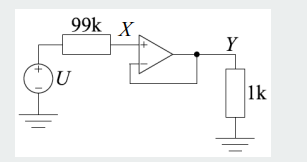
voltage follower
R1= infinity and R2 = 0
gain is (1+R2)/R1 = 1
voltage follower makes Y=U
op amp takes almost no current
output provides lots of current to the load
makes voltage easier to deliver
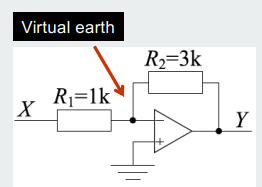
inverting amplifiers
1) V+ = 0, V- = 0
2) find that gain is negative so this is inverting amplifier
3) negative feedback holds V- close to V+
4) If V+ = 0, V- is called virtual ground
point of amplifier if gain is 1
isolate source from load
inverting summing amplifier
connects several input signals to inverting amplifier
as before, V- = 0 is virtual earth due to negative feedback (V+ is 0)
KCL at V- node, weight of Xi = Rf/Ri
Sum gain from final and each input resistor multiplied by input voltage to get final
differential amplifier
2 input circuit combining inverting and non-inverting amplifiers
Linearity is Z = aX + bY
choosing resistor values
behaviour of an op-amp circuit depends on the ratio of resistor values
Gain = - R2/R1, how do you choose between giga, kilo and Mega?
small resistors = large current
large resistors make current in no longer negligble
- so use 1-100k
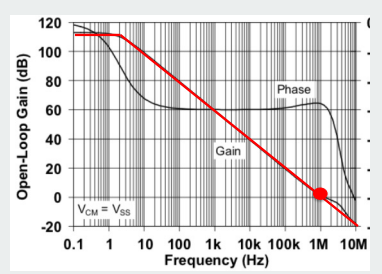
Bandwidth of real op amp
infinite gain at low frequency but decreases rapidly as signal frequency increases
op amps are characterised by frequency at which the gain becomes 1
this is unity gain bandwidth
1MHz for MCP6002
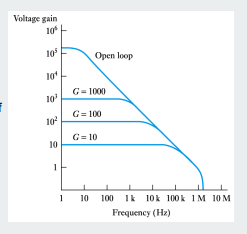
benefits of negative feedback
improves bandwidth
gain is reduced, bandwidth is increased due to negative feedback
gain x bandwidth = constant (gain-bandwidth product)