4.2 Electricity
 Call Kai
 Learn
Learn Practice Test
 Spaced Repetition
 Match
Match Flashcards
 Knowt Play
1/60

Earn XP
Description and Tags
Completed flashcard set
Name | Mastery | Learn | Test | Matching | Spaced | Call with Kai |
|---|
No analytics yet
Send a link to your students to track their progress
61 Terms
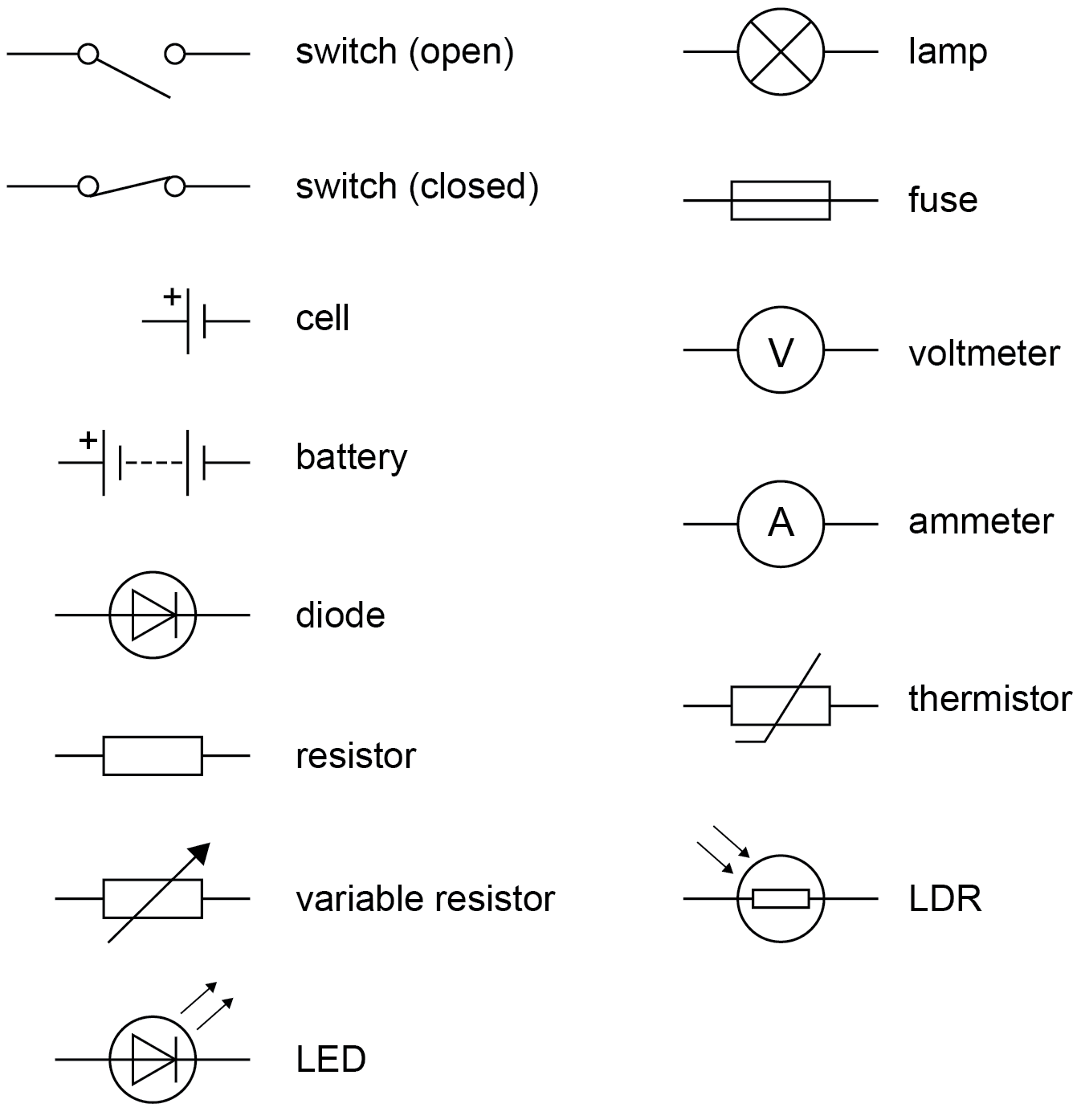
Draw the standard circuit symbols for:
Switch (open)
Switch (closed)
Cell
Battery
Diode
Resistor
Variable resistor
LED
Lamp
Fuse
Voltmeter
Ammeter
Thermistor
LDR
What are the conditions for electrical charge to flow through a circuit
The circuit must be closed
The circuit must have a source of potential difference
What is electric current?
A flow of electric charge
What is meant by the size of the current?
Rate of flow of electrical charge
Give the formula for the size of current
Size of current = rate of flow of electrical charge
charge flow = current x time
Q = I t
therefore, current = charge flow / time
I = Q/t
I - amperes, A
Q - coulombs, C
t - seconds, s
In a single closed loop, does the current have different values at different points?
No, in a single closed loop the current has the same value at any point
What is a coulomb?
A coulomb is a unit of electrical charge (measure of the amount of charge flowing through the circuit)
What do amperes (current) represent?
Amps represent the rate of electric charge passing through a point in a circuit
What does the current through a component depend on?
Current (I) is the rate of flow of charge passing through a point in a circuit; it depends on the potential difference (V) across the component and the resistance (R) of the component
The greater the resistance of the component, the smaller the current for a given potential difference across the component
What is potential difference?
Difference in the electric potential energy between two points; it is what makes charges move
It is the energy transferred per unit of charge as it moves between two points in a circuit
For cells/ batteries: the amount of energy transferred to the charges in the circuit
For components: amount of energy transferred to the components from the charges in the circuit
Give the formula that links current, potential difference and voltage
potential difference = current x resistance
V = I R
V - volts, V
I - amperes, A
R - ohms, Ω
How is voltage measured? How is it connected and why?
Using a voltmeter
The voltmeter is connected in parallel to measure the difference in energy before the component and after the component
Measured in volts, V
How is the current flowing through a component measured? How is it connected and why?
Using an ammeter
An ammeter must be connected in series (as it measures the rate of flow of electric charge passing through a point in a circuit)
Measured in amperes, A
What does resistance do in a circuit?
It slows down the rate of flow of electric charge
How is resistance of a component measured?
Resistance is measured by calculating the voltage across the component and the current flowing through the component and using the formula V = I R to calculate voltage
Measured in ohms, Ω
Explain the two types of resistors. Give their circuit symbols
Fixed resistors
Have a fixed/ constant resistance; it cannot be changed
Variable resistors
Resistance can change as the current changes

What type of resistors are components in a circuit (eg. lamps) and why?
Variable resistors
As their resistance will change depending on the current flowing through them
What is Ohm’s law?
What is the condition needed for this law to be true?
Ohm’s law states that the current through a component is directly proportional to the potential difference across the component as long as resistance is constant
Temperature must be constant because changes in temperature can lead to changes in resistance, and therefore there would no longer be a constant resistance
What is an Ohmic conductor?
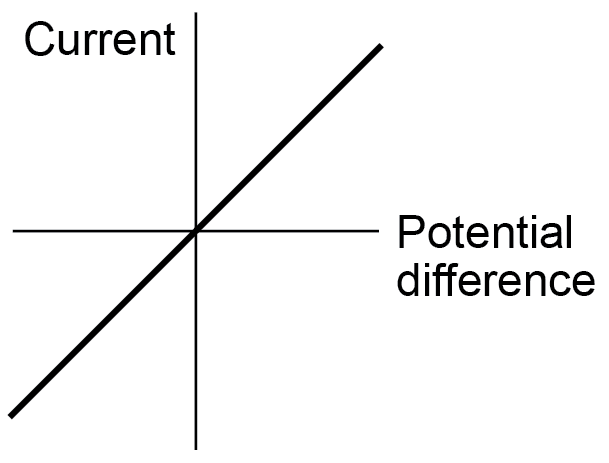
A material that obeys Ohm’s law; the current flowing through it is directly proportional to the potential difference across it, provided that temperature remains constant.
This means that the resistance remains constant as the current changes
Draw the current potential difference graph for an Ohmic conductor
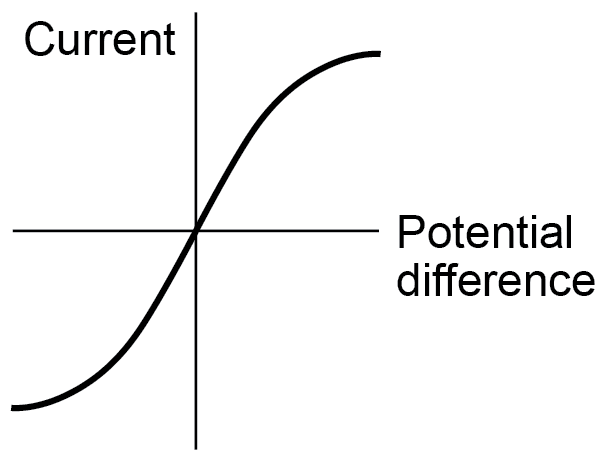
Draw and explain the current potential difference graph for a filament lamp
When an electrical charge flows through a filament lamp, it transfers some energy to the thermal energy store of the filament (which is designed to heat up)
As the current flowing through the lamp increases, the temperature of the filament also increases, which causes the resistance of the lamp to increase
This is because high temperatures cause the metal atoms to vibrate more, which increases the frequency of collisions between the metal atoms and the charge carriers (electrons) flowing through, which slows the rate of flow of charge, increasing resistance
This means that less current can flow per unit potential difference, so the graph gets shallower, hence the curve
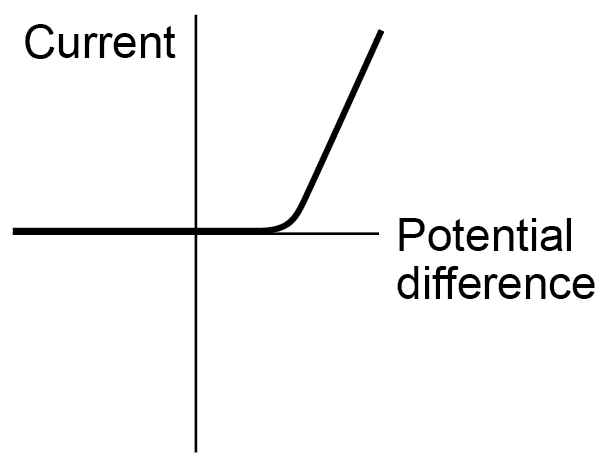
Draw and explain the current potential difference graph for a diode
The current through a diode only flows in one direction; it has a very high resistance in the reverse direction
What is a thermistor? Give its uses and its circuit symbol
A thermistor is a resistor that’s resistance is dependent on temperature
When temperature increases, resistance decreases
When temperature decreases, resistance increases
Uses:
Digital thermostats
Car engine temperature sensors
Replacement fuses
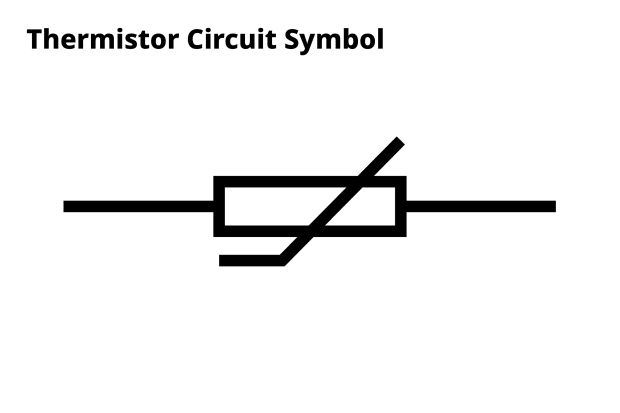
What is a LDR? Give its uses and its circuit symbol
A Light Dependent Resistor is a resistor that’s resistance is dependent on the intensity of light
When light intensity increases, resistance decreases
When light intensity decreases, resistance increases
Uses:
Automatic night lights
Outdoor lighting
Burglar detector (When light falls on the sensor, the resistance will decrease and can allow a signal or alarm to be triggered)

State the two ways of joining electrical circuits
Series
Parallel
What is a disadvantage of series circuits compared to parallel circuits?
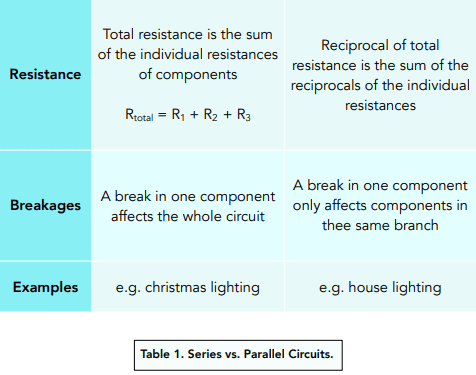
If one component breaks or is removed, the entire circuit is broken and electric charge will no longer flow
Whereas for parallel circuits, it will only affect that branch (and the branches that it leads to) as there are multiple routes for charge to flow
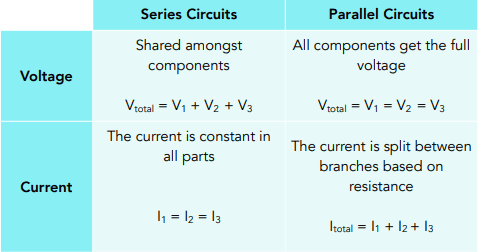
Describe the current, resistance and potential difference of components connected in series
For components connected in series:
there is the same current through each component (same rate of flow of charge)
the total potential difference of the power supply is shared between the components
the total resistance of a circuit is equal to the sum of the resistances of the individual components
Current is the same everywhere
Potential difference is shared
Resistance adds up
Describe the current, resistance and potential difference of components connected in parallel
For components connected in parallel:
the total current through the whole circuit is the sum of the currents through the separate components
the potential difference across each component is the same
the total resistance of two resistors is less than the resistance of the smallest individual resistor
Current is shared between branches
Potential difference is the same across all branches
Adding a resistor in parallel reduces the total resistance
What happens if you add a resistor in parallel? Why?
Adding a resistor in parallel reduces the overall resistance
This is because the potential difference across each branch is the same; the more resistors added in parallel, the more pathways the current has to flow, so it is easier for current to flow through the circuit
What happens if you add a resistor in series? Why?
Adding a resistor in series increases the overall resistance of the circuit
When resistors are added in series at a constant potential difference, it causes the current flowing through the resistor to decrease. As in a series circuit the current is the same at all points in a circuit, it causes the overall current of the circuit to decrease
Give a summary comparison of series vs parallel circuits
Describe the key features of the UK’s mains electricity
Alternating current supply
Frequency of 50Hz
230V
Describe the two types of electricity supplies
Alternating current (ac), the current is constantly changing direction. Alternating currents are produced by alternating voltages in which the positive and negative ends keep alternating
Direct current (dc), the current is always flowing in the same direction; created by direct voltage
Give an example of an alternating current supply and a direct current supply
Ac: mains electricity
Dc: cells and batteries (as the positive and negative ends cannot be switched)
How are most electrical appliances connected to the mains?
Using a three core cable; this means that they have three wires inside of them, each with a core of copper and a coloured plastic coating
Give the names of the three types of wire in a three-core cable and give their colours and potential differences
Live: brown (think living worms, in mud), 230V
Earth: green and yellow stripes (trees), 0V
Neutral: blue (water is neutral), 0V
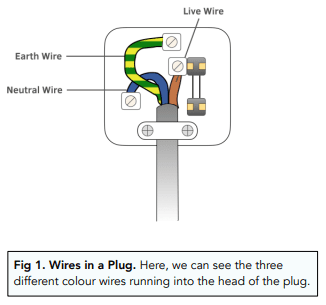
Give the purposes of the three types of wire in a three-core cable
Live wire - brown, 230V
The live wire carries the alternating potential difference from the mains supply; electricity flows in through this wire
Neutral wire - blue, 0V:
The neutral wire completes the circuit; electricity flows out back to the mains through this wire
Earth wire - green and yellow stripes, 0V:
The earth wire is a safety wire to stop the appliance becoming live by providing a low resistance pathway to the ground; it only carries a current if there is a fault
Why is the live wire dangerous?
The live wire has an alternating potential difference of 230V
The human body has a potential difference of 0V
This means that if a human touches the live wire, a large potential difference will be produced, causing a current to flow through the body, causing a large electric shock, which could kill or injure
Why is the live wire dangerous even when a switch in the mains circuit is open?
If a switch is open it means that a current is not flowing
However, the live wire still has an alternating potential difference of 230V
If you made contact with the live wire, your body would provide a link between the supply and the Earth, allowing the current to flow through your body and into the Earth
Why are there dangers of providing any connection between the live wire and Earth?
If the link creates a low resistance path to earth, a huge current will flow
This can cause large electric shocks (if touched by a human), or even fires
Explain how the the energy transferred by a device is related to the potential difference across it and the current through it
When an electric charge goes through a change in potential difference, energy is transferred
Energy is supplied to the charge at the power source to raise it’s potential energy
This charge transfers energy to components in the circuit, losing its potential energy
Therefore, the energy transferred by a device is equal to its potential difference (energy transferred by unit of charge) multiplied by current (rate of charge flow)
Explain how the power transfer in any circuit device is related to the potential difference across it and the current through it
Power = potential difference x current
P = V I
power = (current)² x resistance
P = I² R
P - watts, W
V - volts, V
I - amperes, A
R - ohms, Ω
Power = energy transferred / time
Potential difference = energy transferred per unit of charge
Current = charge flow / time
What does the amount of energy a device transfers depend on?
How long the appliance is switched on for
The power of the appliance
Describe how a kettle uses energy from the mains
Kettles transfer energy electrically from the mains ac supply
converting electrical energy
to the thermal energy of the heating element inside of the kettle
Describe how a handheld fan uses energy from batteries
Energy is transferred electrically from the chemical energy store of the battery of a handheld fan
converting electrical energy
to the kinetic energy of the fan’s motor
When is work done in a circuit?
Work is done when charge flows through a circuit
Give the two equations to calculate the amount of energy transferred by electrical work
energy transferred = power x time
E = P t
energy transferred = charge flow x potential difference
E = Q V
E - joules, J
P - watts, W
t - seconds, s
Q - coulombs, C
V - volts, v
What does the power rating of a device represent?
The maximum value that the device can be used at safely
It tells you the maximum amount of energy transferred between stores per second when the appliance is in use
Define the national grid
The national grid is a system of cables and transformers linking power stations to consumers
Electrical power is transferred from power stations to consumers on the national grid
What do transformers do?
Transformers change the voltage of the circuit using electromagnetic induction
Step up transformers are used to increase the potential difference from the power station to transmission cables
Step down transformers are used to decrease the potential difference to a much lower value for domestic use
Explain why the national grid is an efficient way to transfer energy
When transferring such large amounts of energy across the country, there is a huge risk of energy waste because power is so high
As soon as electricity leaves the power station, a step-up transformer increases the voltage
As resistance is constant, this decreases the current
When the current is low, this reduces energy losses via heat (as using high currents transfers energy to the thermal energy stores of the cables, which transfers the energy to the surroundings, wasting the energy)
When the electricity reaches its place of use, a step down transformer decreases the voltage and thus increases the current as resistance is constant
The electricity can now be used for domestic use; the current is high enough to give a good energy supply
How may materials become electrically charged?
When certain insulating materials are rubbed together, negatively charged electrons are rubbed off of one material and onto the other
The material that gains electrons becomes negatively charged
The material that loses electrons is left with an equal positive charge
What is static electricity?
The build up of an electrical charge on the surface of an object
What happens when two electrically charged objects are brought close to each other
They exert a force on each other
These forces can attract or repel and cause movement
What does a charged object create?
A charged object creates an electric field around itself; the electric field is strongest closest to the object and weakest further away from the object
What happens if a charged object is placed in the electric field of another charged object?
It will experience a force
Define electric field
The area around a charged object where other charged objects will experience an electrostatic force
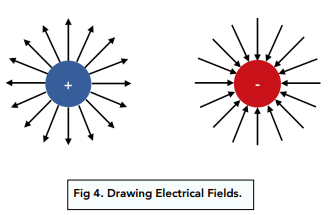
Draw the electric field pattern for an isolated charged sphere
Electric field lines always go from positive to negative (the movement of an electric charge)
Describe how sparking may occur due to electric fields
Sparks are caused when there is a high enough potential difference between a charged object and the earth/ an earthed object
A high potential difference creates a strong electric field between the charged object and the earthed object
When the two objects are brought closer, the strength of the electric field becomes stronger
When the electric field strength becomes high enough, it can cause electrons in air particles to be removed through the process of ionisation
Air is normally an insulator, but when it is ionised it is much more conductive, allowing a current to flow through it/ electrons to jump across the gap between the charged object and the earthed object
This leads to the production of a spark
Torch with an LED
When the batteries were put back in, they were put in the wrong way around
Why did the torch not work?
When the direction of the batteries are switched, the direction of the current is switched
A diode has a very high resistance in the reverse direction
So current will not flow through a diode in the reverse direction
Explain why adding resistors in parallel decreases the total resistance
Provides multiple pathways for charge to flow
Total current is the sum of the current in all the branches
Therefore, current increases (for the same potential difference when more resistors are added)