Mix of stress arousal anxiety
 Call Kai
 Learn
Learn Practice Test
 Spaced Repetition
 Match
Match Flashcards
 Knowt Play
1/64

There's no tags or description
Looks like no tags are added yet.
Name | Mastery | Learn | Test | Matching | Spaced | Call with Kai | Chat |
|---|
No analytics yet
Send a link to your students to track their progress
65 Terms
Define eustress
Good stress that motivates you to continue working
Define stress
A state of mental or emotional strain or tension resulting from adverse or demanding circumstances
Explain eustress
Stress can be a motivator + provide incentive to get the job done.
Define distress
bad stress when good stress becomes too much to bear or cope with
Explain distress
Tension builds
No fun in challenge
Leads to poor decision making
What are physiological symptoms of distress
Increased blood pressure
Rapid breathing
Generalised tension
What are behavioural symptoms of distress
Overeating
Loss of appetite
Drinking/smoking
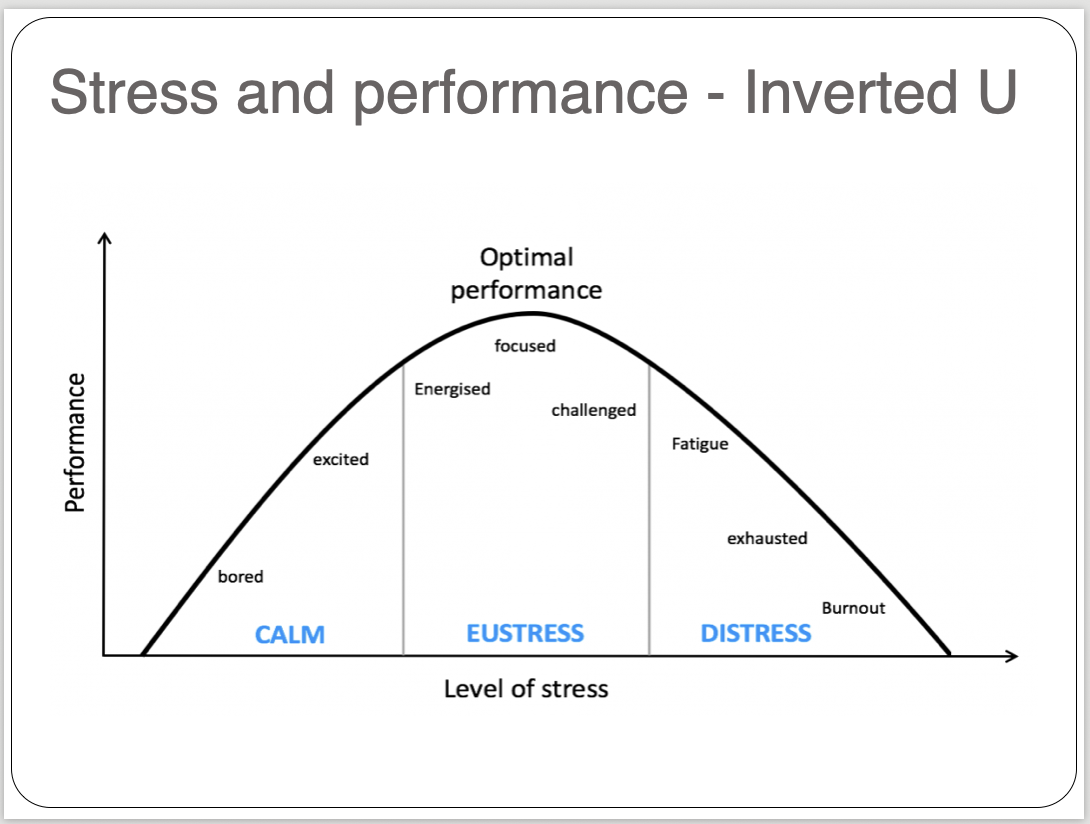
What graph can be used to show the impact of stress levels on performance
Inverted U
Define anxiety
Emotional state associated with physiological (somatic) and psychological (cognitive)arousal and with feelings of nervousness + apprehension
Define trait anxiety
The personality core - consistent worry regardless of situation
Define state anxiety
Changeable and varies depending on situation
Define Cognitive state
Knowledge + perceptions - anxiety
Define somatic state
Physiological changes due to perception of situation
When is high levels of cognitive anxiety beneficial
Accompanied by low somatic anxiety
Occurring days before the event
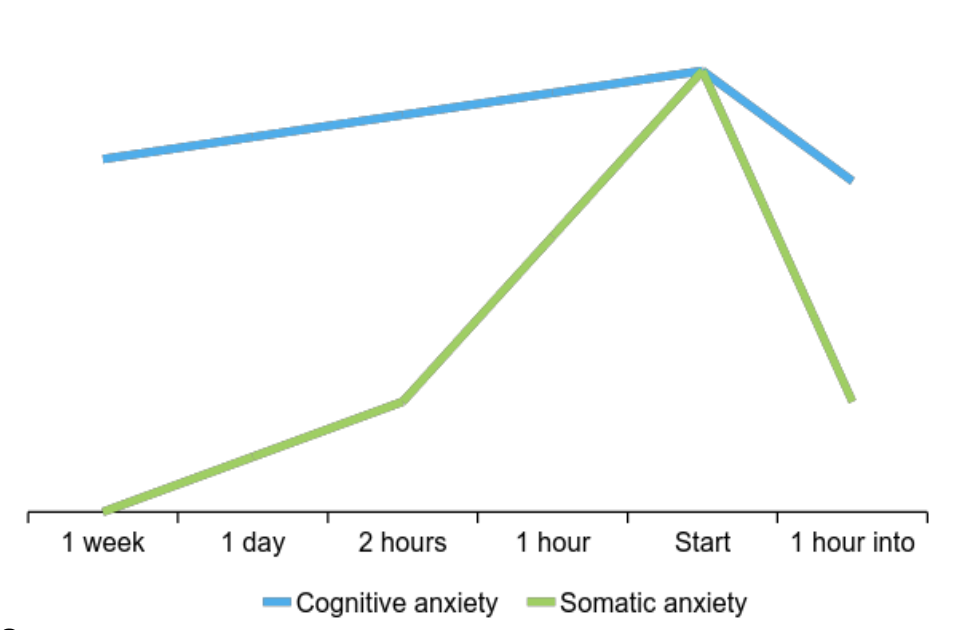
As the event gets nearer what should happen in regards to somatic anxiety
Somatic anxiety increases to a peak just before performance
This then declines when performance begins
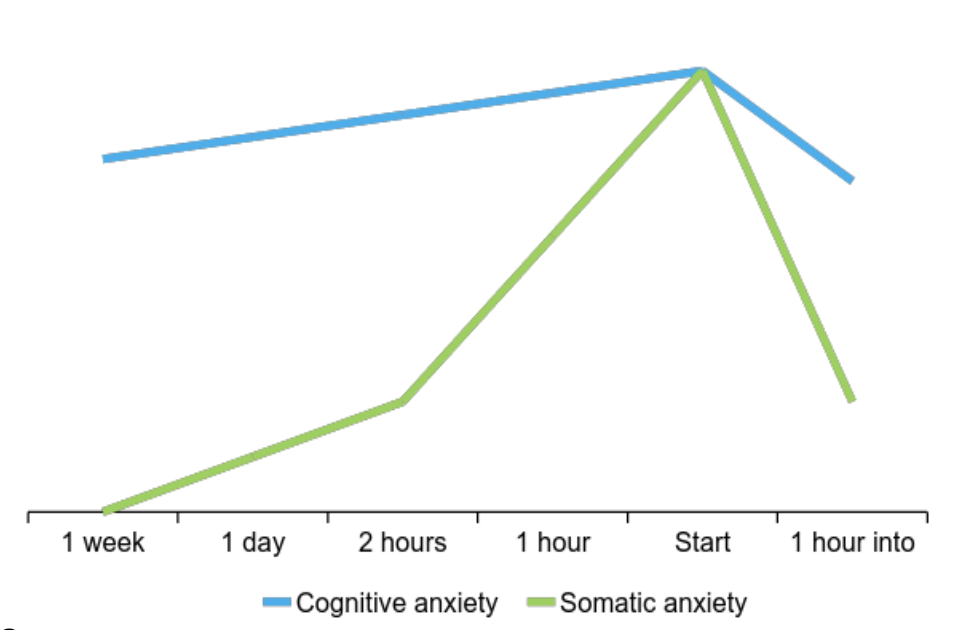
What happens if somatic anxiety doesn't decrease when performance starts
Catastrophe occurs
Define arousal
psychological state of alertness + anticipation that prepares the body for action
Explain drive theory
Linear relationship between arousal and performance
As arousal increases so will quality of performance
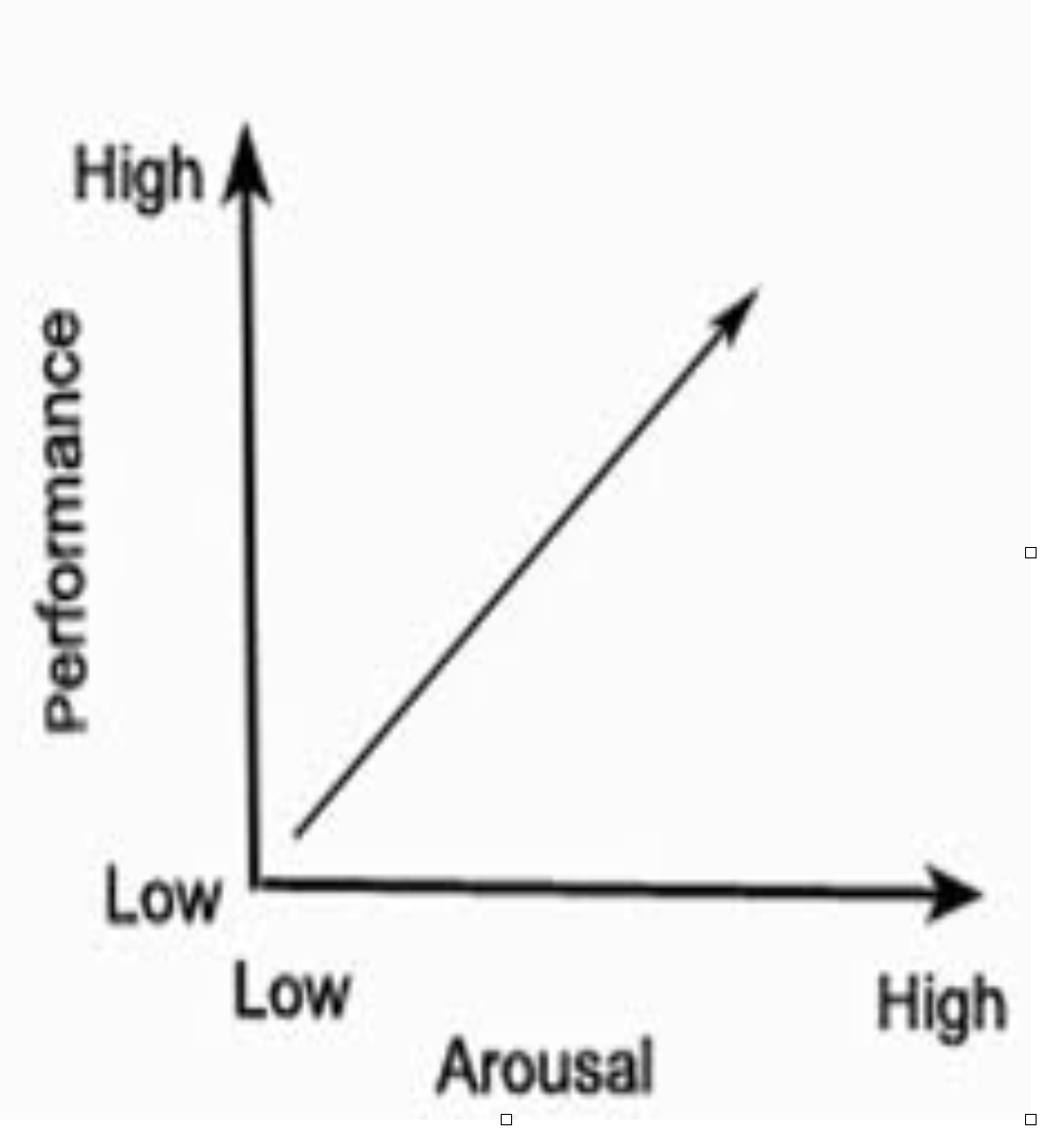
Relate drive theory (Hull) to performers
Higher levels of arousal would intensify the dominant response:
Elite performance likely to have the correct response
Beginners likely to have the incorrect response
Is Hull's Inverted U theory an adequate explanation for the link between arousal and performance
No because when arousal reaches a high enough point, performance will not improve
Who invented the inverted U hypothesis
Yerkes and Dobson
Explain the Inverted U theory (Yerkes and Dobson)
Suggests that performance increases to an optimum point and then decreases
Example of the Inverted U theory (Yerkes and Dobson )
Paul Gascoigne 1991 FA cup
How is the inverted U theory furthered
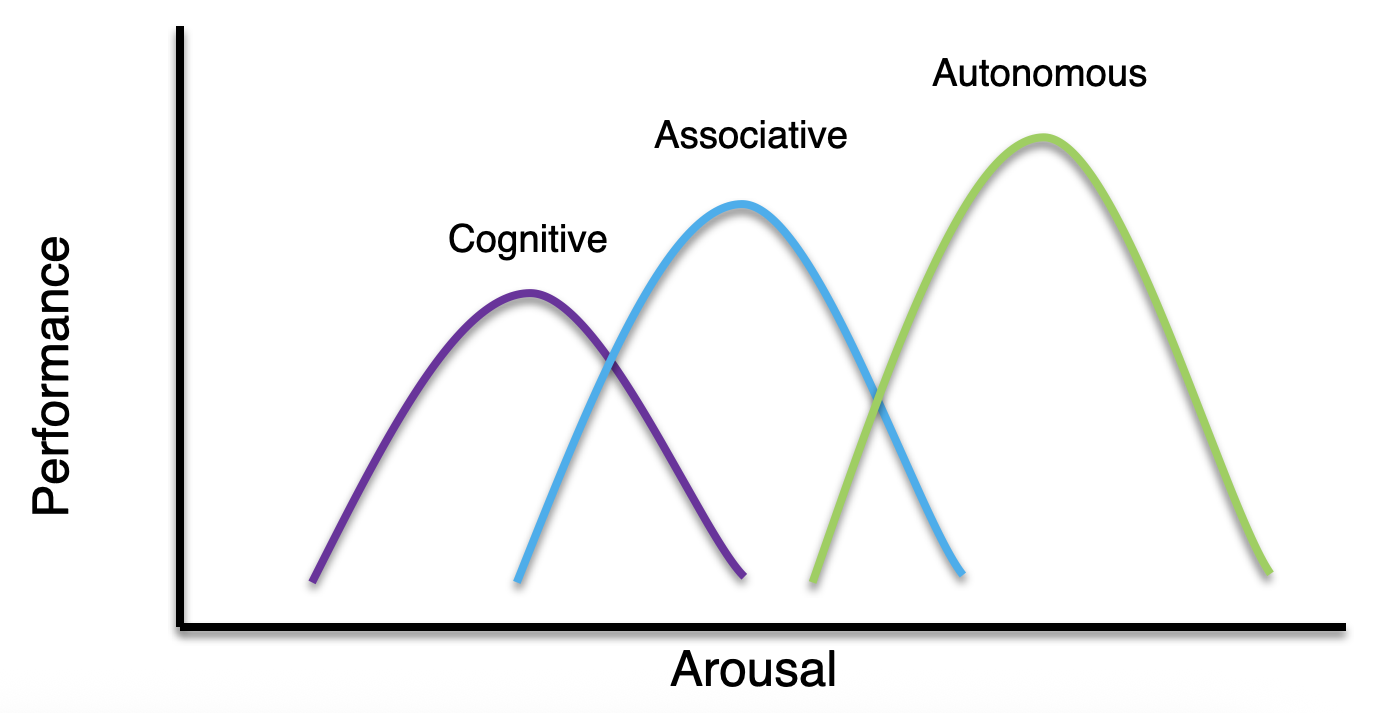
Applying the different phases of learning
Does the inverted U theory apply equally to the different phases of learning
Beginners find it more difficult to cope with arousal because it is less habitual
Beginner (cognitive) need to give more attention to he skills itself + arousal levels may take away that concentration
Rely heavily on environmental cues
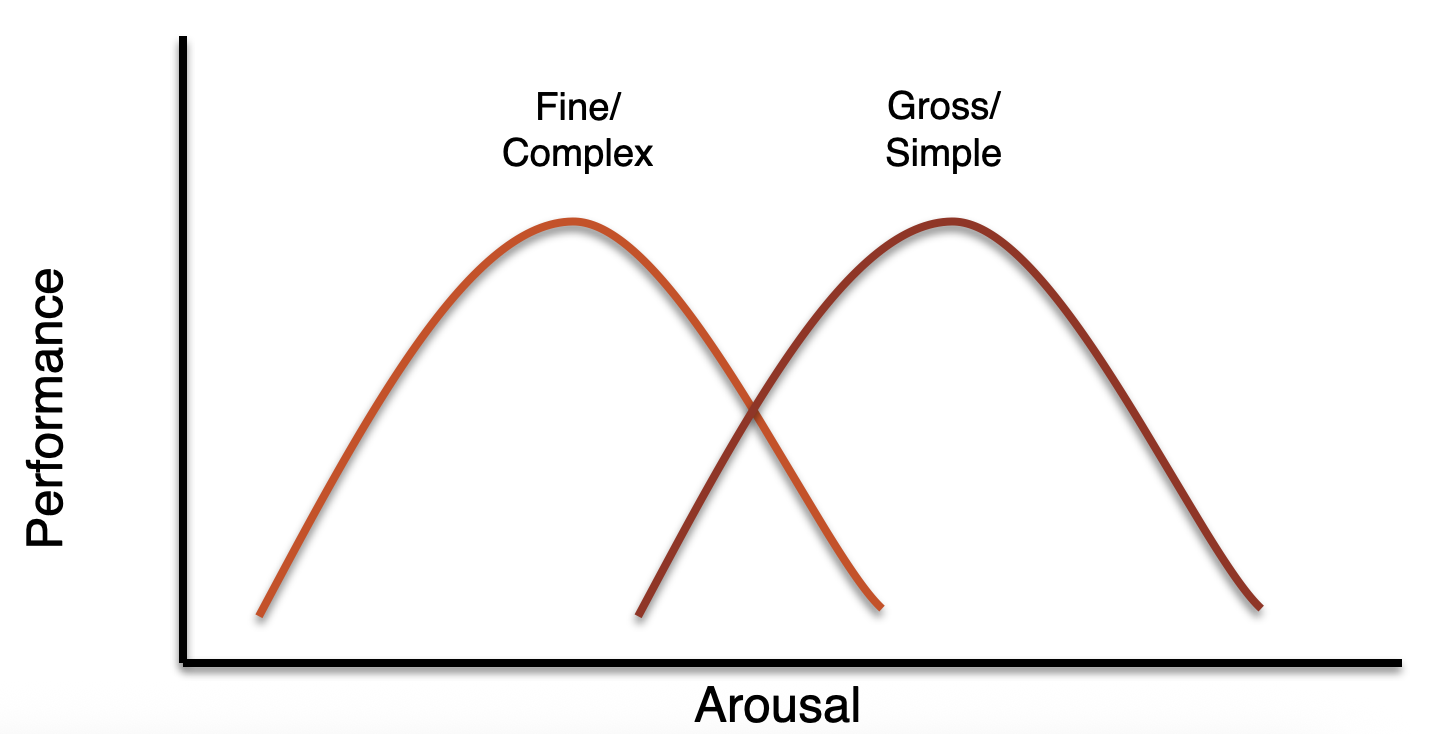
Does the Inverted U theory apply to all sports performance in the same way?
Can vary according to skill being performed
Gross skills benefit from higher levels of arousal than fine skills
Shot put v Archery
Can vary within a sport dependent upon role
Goalkeeper v midfielder
Where is maximum performance on the inverted u graph
Zone of optimal functioning
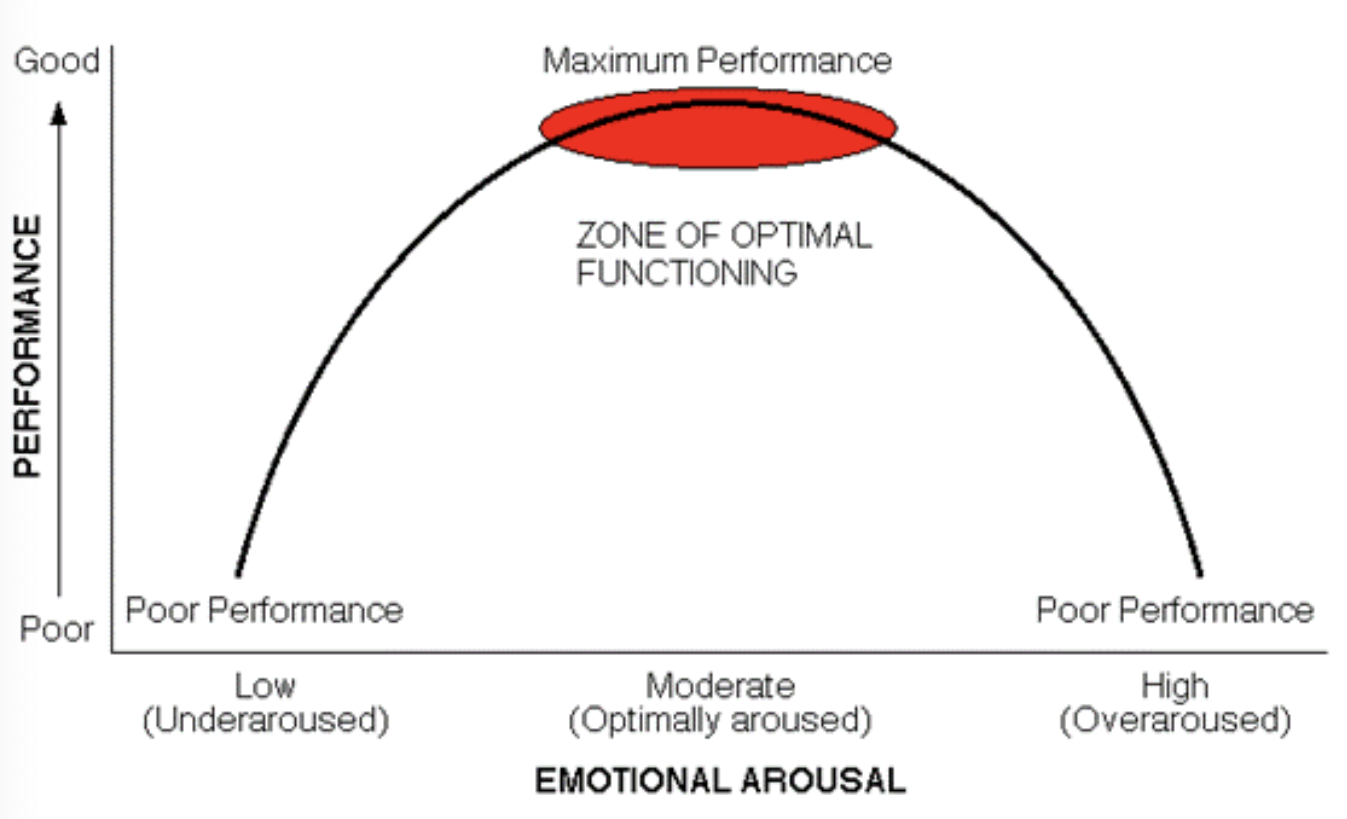
What are the characteristics of the zone of optimum functioning
Performing at optimal arousal
Completely calm
Fully concentrated on task
Completely confident
Performing smoothly and efficiently
What theory explains what happens during over arousal
Catastrophe Theory
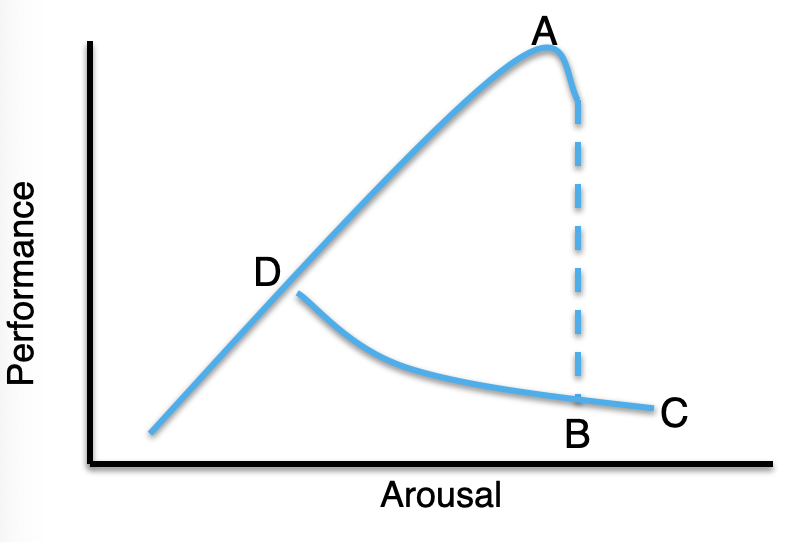
Explain Catastrophe Theory
Suggests much faster and more dramatic decline
It is more of a model than a theory as it attempts to predict human behaviour rather than explain it
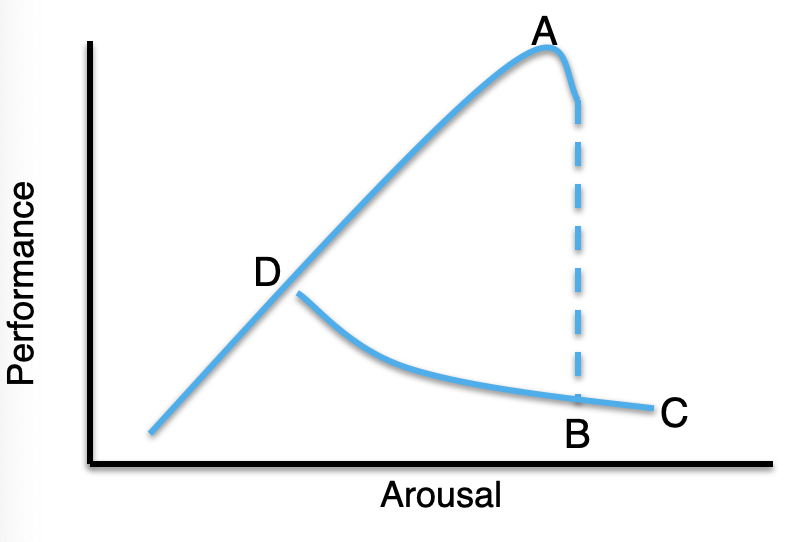
Explain point A of the Catastrophe Theory
Performer reaches optimum level of arousal
High cognitive anxiety but low somantic arousal
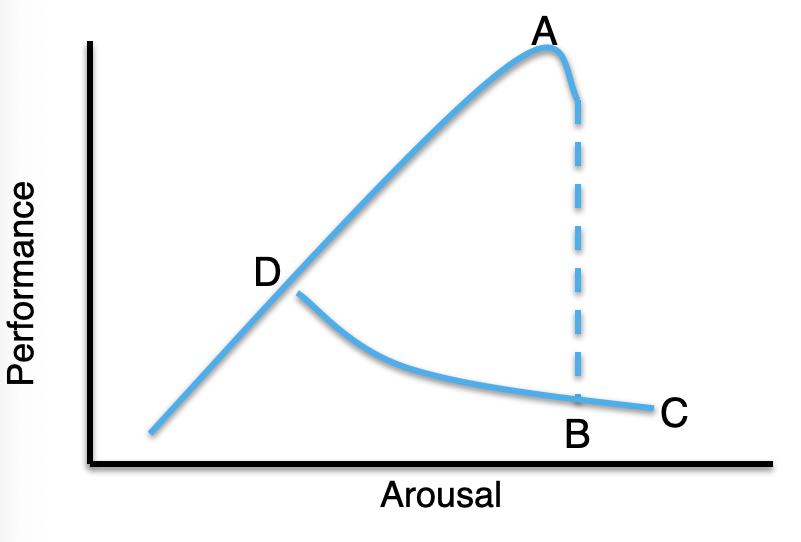
Explain point B of the Catastrophe Theory
performer has sudden reduction in performance
High cognitive + high somantic arousal
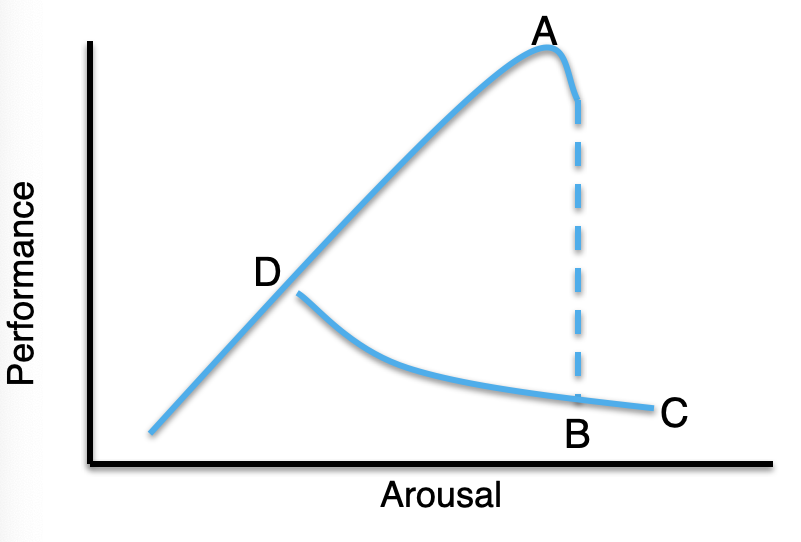
Explain point C of the Catastrophe Theory
Possible that performance will continue to deteriorate
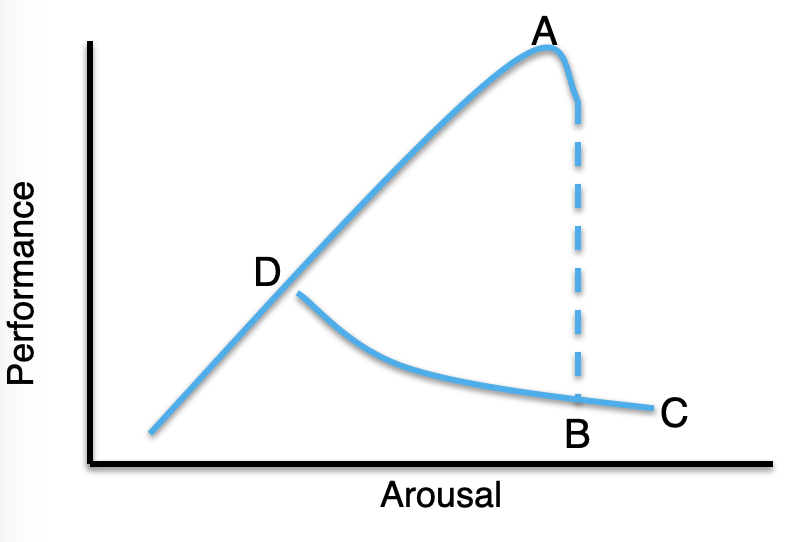
Explain point D of the Catastrophe Theory
Performer gradually regains control as arousal levels decrease
2 examples of questionnaires to measure anxiety
The sport Competition Anxiety Test
The Competitive State Anxiety Inventory
Criticisms of tests the measure anxiety
Physiological measure put the subject under extra anxiety, the situation itself creates anxiety
Observations are subjective + are also artificial environments causing extra anxiety
Questionnaires may not give a true reflection, but are popular as they are quick + cheap
What forms are formats are there to measure anxiety
Physiological measures of Somatic anxiety (HR, muscle tension + sweating)
Observation
Questionnaire
Somatic techniques to manage stress, anxiety and arousal
Breathing techniques
Slows HR + engages diaphragm to promote relocation by stimulation parasymphathetic NS
Progressive Muscular Relaxation
Systematically tensing + relaxing different muscle groups to help become more aware go the physical sensation
Cognitive techniques to manage stress, anxiety and arousal
Goal Setting
Provides direction, motivation + focus helping individual
Imagery
Mental rehearsal
Self talk
Define eustress
Good stress that motivates you to continue working
Define stress
A state of mental or emotional strain or tension resulting from adverse or demanding circumstances
Explain eustress
Stress can be a motivator + provide incentive to get the job done
Define distress
bad stress when good stress becomes too much to bear or cope with
Explain distress
Tension builds
No fun in challenge
Leads to poor decision making
What are physiological symptoms of distress
Increased blood pressure
Rapid breathing
Generalised tension
What are behavioural symptoms of distress
Overeating
Loss of appetite
Drinking/smoking
What graph can be used to show the impact of stress levels on performance
Inverted U
Define anxiety
Emotional state associated with physiological (somatic) and psychological (cognitive)arousal and with feelings of nervousness + apprehension
Define trait anxiety
The personality core - consistent worry regardless of situation
Define state anxiety
Changeable and varies depending on situation
Define Cognitive state
Knowledge + perceptions - anxiety
Define somatic state
Physiological changes due to perception of situation
When is high levels of cognitive anxiety beneficial
Accompanied by low somatic anxiety
Occurring days before the event
As the event gets nearer what should happen in regards to somatic anxiety
Somatic anxiety increases to a peak just before performance
This then declines when performance begins
What happens if somatic anxiety doesn't decrease when performance starts
Catastrophe occurs
Define arousal
psychological state of alertness + anticipation that prepares the body for action
Explain drive theory
Linear relationship between arousal and performance
As arousal increases so will quality of performance
Relate drive theory (Hull) to performers
Higher levels of arousal would intensify the dominant response:
Elite performance likely to have the correct response
Beginners likely to have the incorrect response
Is Hull's Drive theory an adequate explanation for the link between arousal and performance
No because when arousal reaches a high enough point, performance will not improve
Who invented the inverted U hypothesis
Yerkes and Dodson
Explain the Inverted U theory (Yerkes and Dodson)
Suggests that performance increases to an optimum point and then decreases
Example of the Inverted U theory (Yerkes and Dobson )
Paul Gascoigne 1991 FA cup
How is the inverted U theory furthered