Deck #2: Parasitic Infection
 Call Kai
 Learn
Learn Practice Test
 Spaced Repetition
 Match
Match Flashcards
 Knowt Play
1/39

There's no tags or description
Looks like no tags are added yet.
Name | Mastery | Learn | Test | Matching | Spaced | Call with Kai |
|---|
No analytics yet
Send a link to your students to track their progress
40 Terms
Define Zoonosis.
seen in vertebrate, but can transmit to humans
Define Zoonanthroponosis.
humans are an essential link to the organism’s life cycle
Define Anthroponosis.
Spreads b/w:
human to human
human to animal
List the common ways Parasitic infection are transmitted.
Ingestion (e.g., poorly cooked pork)
Transcutaneous (it poops and we push it in)
Bites (mosquitos + flies)
Waterborne (major cause in CL)
Blood
Eggs
What Ig are produced in general parasitic infections?
IgG & IgM
What Ig are produced in protozoa parasitic infections?
IgA
What Ig are produced in helminths parasitic infections?
IgE
List 4 ways how we show host immunity.
Agglutination of parasites by IgM
Opsonization
Antibody dependent cell mediated cytotoxicity
Neutralizing toxins & enzymes via antibodies
Why is the body not as effective in eradicating parasitic disease compared to bacterial?
since these are eukaryotic cells, any drugs we do use, CAN’T differentiate b/w us and parasites
Compare the 2 life cycles of Acanthamoeba.
1) Vegetative trophozoite
large
eat bacteria, algae & yeasts
replicate via binary fission
2) Dormant cyst
small
form “double-walled”cyst under harsh conditions
don’t replicate
List the virulence factors of Acanthamoeba.
Mannose BP
Laminin BP
Toxins
Proteases
Phospholipases
Cyst formation (Resistance to chemotherapy)
List how Acanthamoeba is transmitted.
Inhalation
Inoculation
CL wear
Corneal trauma + contaminated water
What is the major source of infection for Acanthoamoeba?
Contact lens
List the 4 different infections caused by Acanthoamoeba.
Granulomatous amebic encephalitis (GAE)
fatal
involves brain + spinal cord
Amebic keratitis (AK)
healthy pt that wear CL
Cutaneous
occurs with or without CNS disease
Disseminated infection
can attack any organ
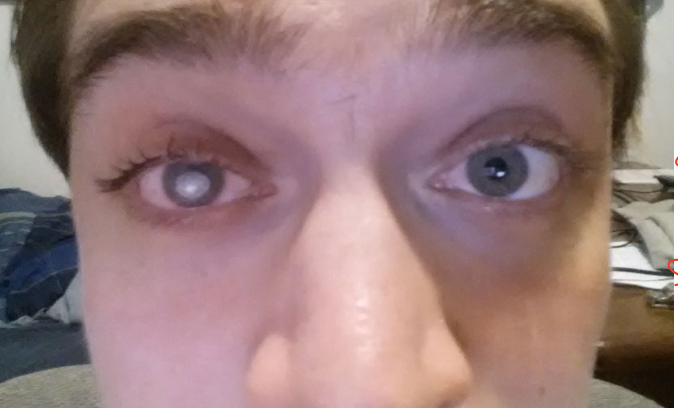
For Toxplasma gondii mention:
type of parasite
host (primary + intermediate)
tranmission
-Obligate intracellular
1er Host: Felidae (cats)
Intermediate: Humans
Transmission
Foodborne illness (improper pork, contaminated water)
Zoonotic
Contact with feces of infected animals (e.g., cat litter box)
Transplacental (e.g., preggy woman)
Life cycle of Toxoplasma gondii.
Organism invades cat intestinal cells
Gametocytes formation → oocyst formation (asexual)
Oocysts excreted in feces and become infective ~1-5 days later
Cats eat the poop (normal)
Abnormal
Intermediate hosts (humans) eat the cysts → infection
Acute phase: tachyzoites eplicate fast → bradyzoites replicate slow to form cysts
Chronic phase: cyst formation in SM, heart, brains & eyes
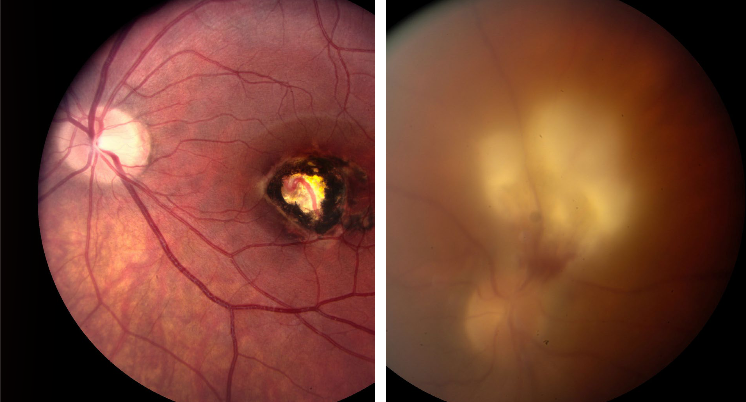
For Plasmodium mention:
type of parasite
host (primary + intermediate)
tranmission
Apicomplexan
1er host: Anophele mosquito (Africa, S. America, Asia)
Intermediate host: Primates
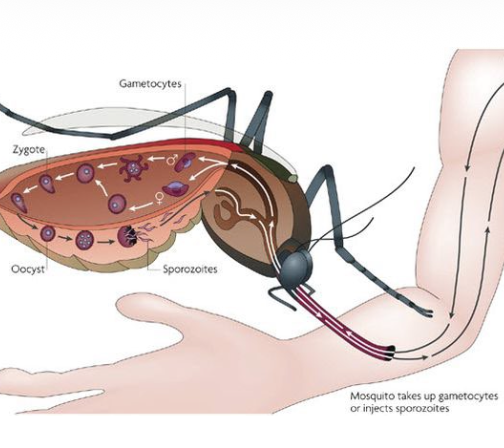
What is Mosquito phase of the Plasmodium life cycle?
Ingest merozoites from host → gametocytes → oocysts which form 100s of sporozoites
Oocyst ruptures releasing sporozoites into hemocoel of mosquito salivary glands → injected into veins of primate host
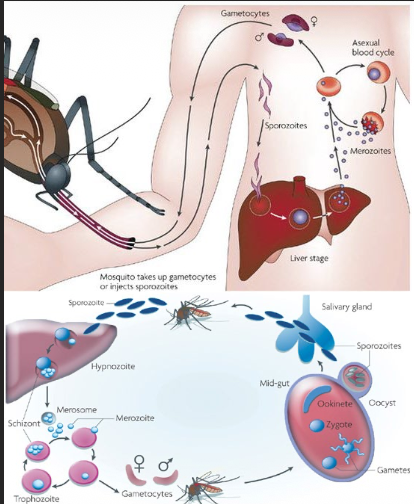
What is Human/primate phase of the Plasmodium life cycle?
1) Liver phase
Injected sporozoite cause infection in liver
Parasite matures in ~15 days
Lots of Merozoites produced in schizonts
2) Erythrocytic phase
Merozoites released from schizonts & invade RBC
Can be taken up by mosquito during feeding to start cycle over
What is #1 cause of parasitic induced death worldwide?
Malaria
How can Malaria manifest?
Cyclical non-specific flu-like symptoms
Cold stage
Hot stage
Sweating stage
Neurologic deficits
Muscle coordination & speech problems, delirium, deafness
Ocular manifestations: retinal changes, nystagmus, conjugate gaze palsies
Kidney disease
Splenomegaly
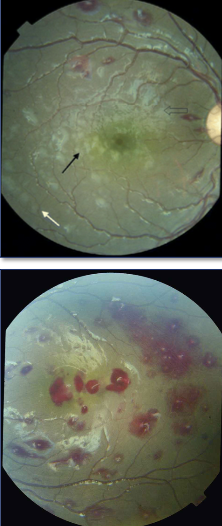
Fill in the blanks:
Trypanosoma cruzi is found in _____
Trypanosoma brucei gambiense is found in ______
Trypanosoma brucei rhodesiense is found in ______
Trypanosoma cruzi = USA
Trypanosoma brucei gambiense = Central + West Africa
Trypanosoma brucei rhodesiense = East Africa
For Trypanosoma mention:
type of parasite
host (primary + intermediate)
tranmission
Flagellate organism
Host:
Kissing bug – T. cruzi
Tsetse fly – T. brucei (don’t wanna test bruce)
Transmission
Kissing bug (reduviid/triatomine) bites or fecal exposure
Congenital
Blood transfusions, infected organ donation
Lab accidents
Ingestion of contaminated food &/or drinks
What is the life cycle of T.cruzi?
Kissing bug bites host
Trypomastigotes in bug’s feces is excreted on host skin
Parasite enters body via wound/intact mucous membranes
Convert into intracellular amastigotes → binary fusion → Trypomastigotes → enter circ
What is Chagas disease or America Trypanosomiasis?
Acute phase
Chagoma - localized swelling at site of parasite entry
Romana’s sign: eyelid swelling on side of face of bite or fecal inoculation
mild enlarge of liver, spleen or swollen glands
Chronic phase
Cardiac & intestinal complications
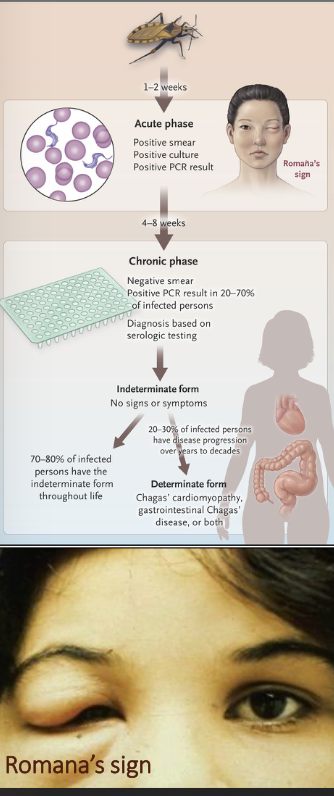
How is African sleeping sickness or African trypanosomiasis different from the American one?
Tsetse fly
Doesn’t enter “into” host cells, it stays as the “trypanomastigote stage”
Can cross BBB
For Toxocara mention:
type of parasite
host (primary + intermediate)
tranmission
Ascarid nematode (roundworm) found worldwide
Definitive host: dogs
Aberrant host: humans (esp children, sandboxes, grass)
Transmission
Ingestion of embryonated eggs
Transplacental infection
What is the life cycle of Toxocara?
→ Ingestion of embryonated eggs by host
Definitive host (dogs):
Eggs hatch to release larvae → penetrate small intestine → enter circulation → mature to adults (2-3 months) → mate → non-embryonated eggs excreted via defecation into environment → Embryonation occurs ~1 week after
prevalent during hot temps
Aberrant host (humans)
Same process BUT larvae never mature to adult forms + can’t replicate
Remain in host for months to yrs
What 2 infections occur due to Toxocara?
Visceral larval migrans (VLM)
affects major organs (fever, liver, spleen & lung)
<5yrs children
Ocular larval migrans (OLM)
eye & optic nerve
5-10 children
Unilateral vision loss + strab
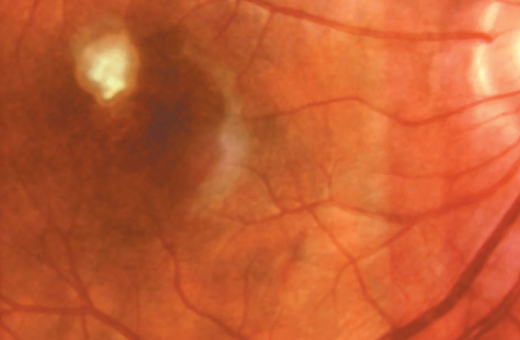
For Onchocerca volvulus mention:
type of parasite
host
transmission
→ infection is from roundworm
Transmission: Vector bite of black fly
Definitive host: Humans
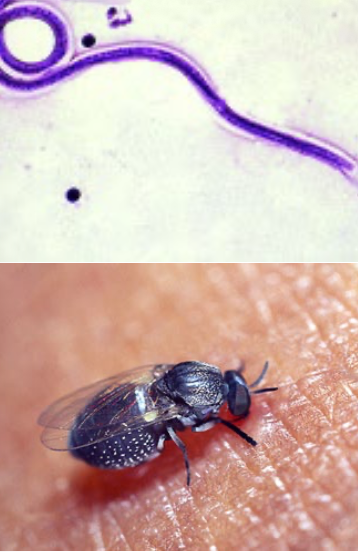
How is the Onchocerca transmitted?
Bite from blackfly transmits larvae to human host
Larvae invades cutaneous tissues to form nodules of adult nematodes
Travel in host via lymphatics (live for SO LONG)
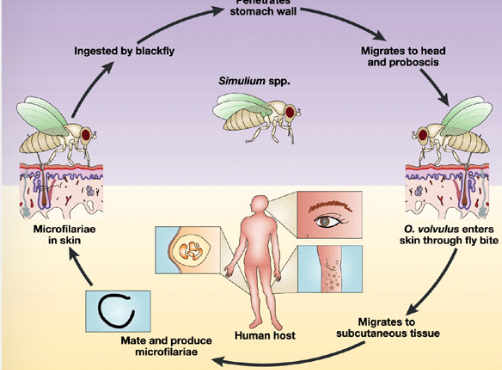
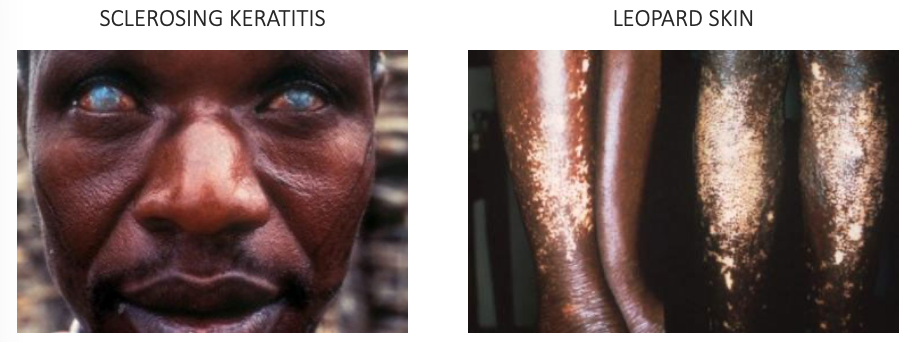
What infection does Onchocerca volvulus cause?
River blindness
round worm in eye
found in Africa (fast moving waters)
inflammation due to 1000s of dead/decaying roundworm
Cutaneous lesions
leopard/lizard skin
For Loa loa mention:
type of parasite
host
transmission
African eye worm
Transmission = Deer fly
Host: Humans
🌍 Africa, India
What is the life cycle of Loa Loa in the deer fly host vs human host?
Deerfly host
Deerfly ingests larvae from infected human host
Mature for 7-12 days → infect human host → move to mouthparts of fly
Fly bites another host & transmits disease
Human host
Larvae enter host & mature for ~5 months
Mature adults move to CT to reproduce (1000/day) → lymphatics → lungs
Live in host up to 17 yrs
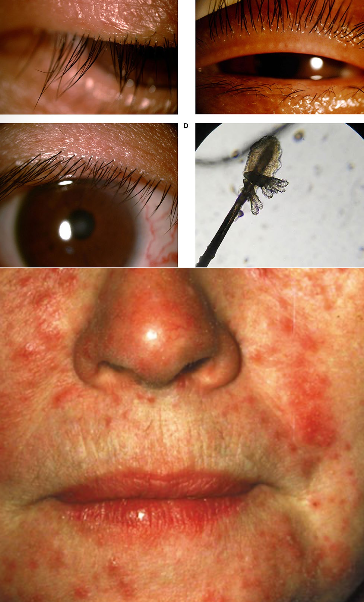
What are the characteristics of Demodex?
Mite that live in hair
part of normal microbiota → cause infestation when numerous
obligate human ecto-parasite
Transmission = close contact
What is the Demodex life cycle?
Sexual replication cycle
Female lays eggs in hair follicle + male leave hair at night
Larvae hatch ~3-4 days
Mature, take on adult form in ~7 days
Total life cycle ~14 days
List the infections Demodex can cause.
Blepharitis (in eyelash)
Rosacea
Alopecia
Non-specific dermatitis
What are the characteristics of Pediculosis?
Phthirus pubis (pubic lice)
Host = humans
Transmission = sex, fomites (bedding)
What is the Pediculosis life cycle?
Females produce ~25 ova/day
Nits incubate for ~1 week
Become nymphs – mature into adults in over 2 weeks
Live ~2 weeks
How are Pediculosis different from Demodex?
live longer
make more eggs