3.2 — Methods and Effects of Government Intervention
 Call Kai
 Learn
Learn Practice Test
 Spaced Repetition
 Match
Match Flashcards
 Knowt Play
1/48

There's no tags or description
Looks like no tags are added yet.
Name | Mastery | Learn | Test | Matching | Spaced | Call with Kai |
|---|
No analytics yet
Send a link to your students to track their progress
49 Terms
What are the 6 main methods of government intervention
Indirect taxes (specific & ad valorem)
2. Provision of subsidies
3. Direct provision of goods and services
4. Maximum and minimum prices
5. Buffer stock schemes
6. Provision of information
What is an indirect tax + what are the main 2 types
A tax levied on expenditure on goods and services, collected and paid to the government by producers but usually passed on to consumers via higher prices.
- Can be ad valorem or specific
What is a specific tax + example
A fixed amount of tax charged per unit of a good purchased/sold, e.g., £1 per pack of cigarettes or tax fuel (per litre)
What is an ad valorem tax + example
A tax charged as a proportion or percentage of the price of a good charged by the retailer, e.g., 20% VAT.
- Final price paid by consumers are inclusive on such taxes
- May be included in the published retail price or added on to the price at the final transaction stage e.g. GST (goods & services tax) in Canada
Why do governments use indirect taxes
To reduce production and consumption of demerit goods, raise government revenue, and correct negative externalities.
What is the effect of imposing a specific indirect tax on price and quantity (diagram + chain of reasoning (7)
Indirect tax imposed -> business requires a higher price -> supply shifts inwards by the amount of tax -> Consumers market price is now higher at P1 -> Quantity traded is less at Q1 -> Producer consumer P2 not P -> government revenue is generated.
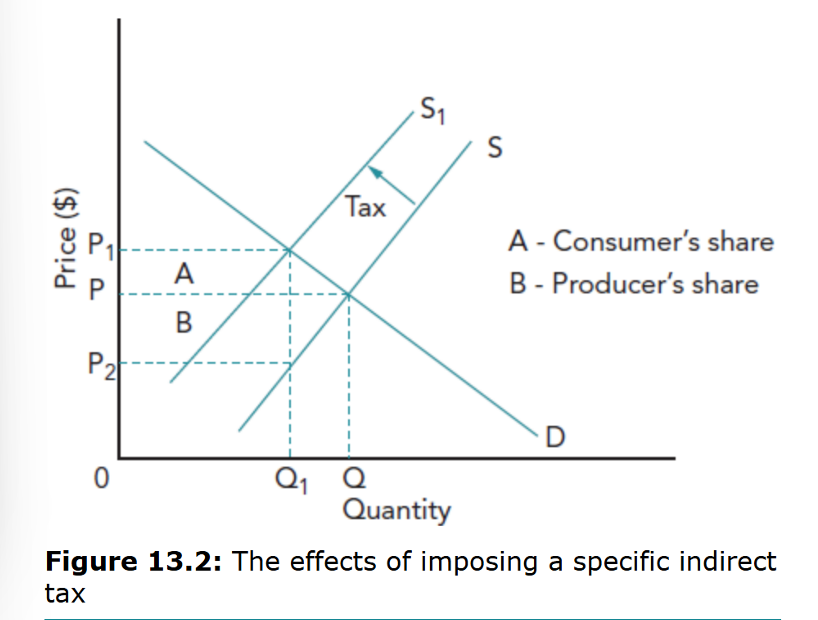
What is tax incidence + show on diagram
The division of the burden of a tax between consumers and producers.
- The extent to which the tax burden is borne by the producer or the consumer or both
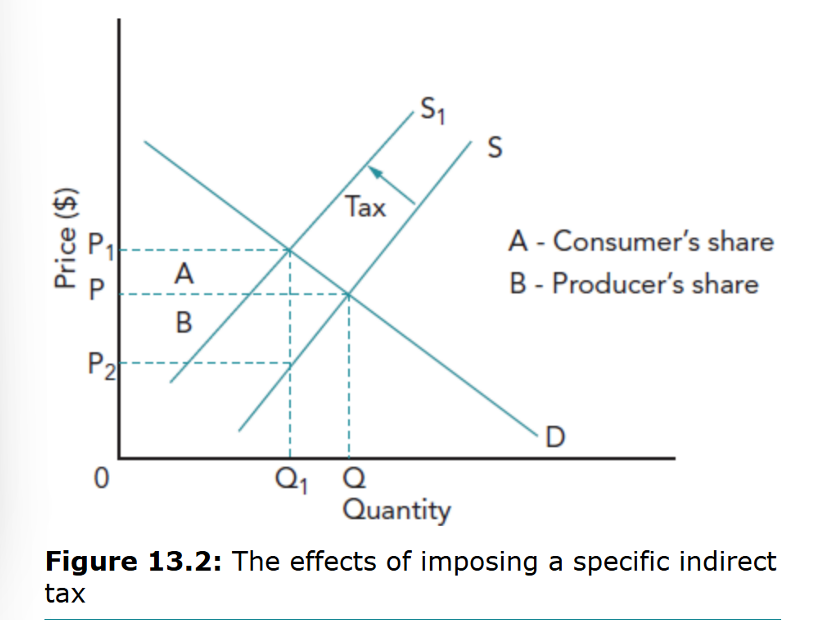
What affects the division of the burden of tax between consumers & producers
Price elasticity of demand
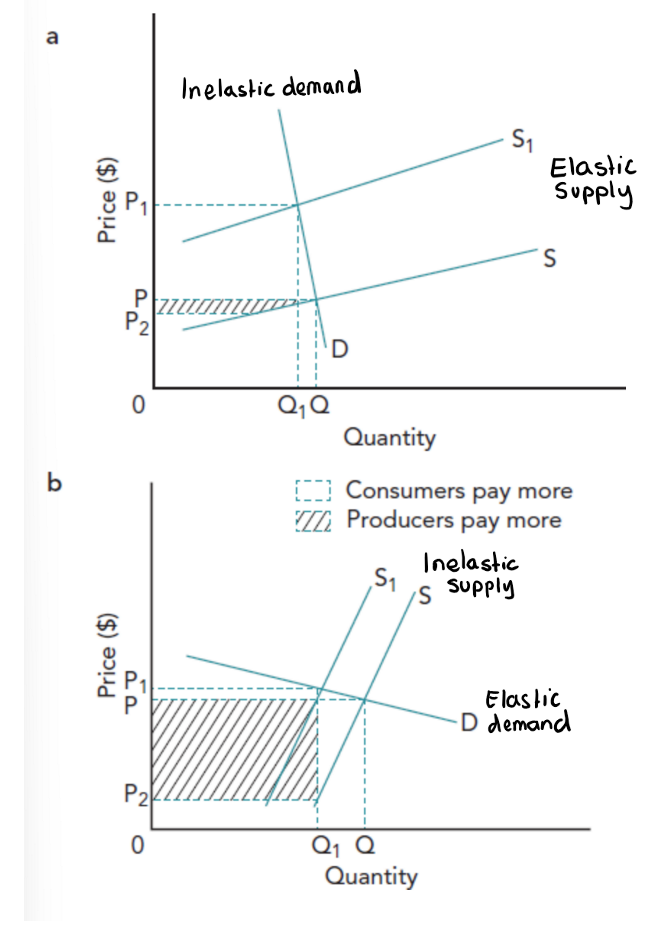
How does PED affect tax incidence + diagrams
• Inelastic demand → consumers bear more
• Elastic demand → producers bear more
How does tax collection differ between high-income countries and low/lower middle-income countries
High‑income countries collect taxes more effectively because most people submit tax returns and digital payment systems are well‑established.
In contrast, low and lower middle‑income countries struggle to collect taxes as large informal sectors, heavy use of cash, and very low tax‑return submission rates make enforcement difficult.
Why do emerging market governments rely more on indirect taxes
Because it is difficult to collect direct taxes in low and middle‑income economies—due to widespread cash use, informality, and poor tax‑return compliance—governments find indirect taxes easier to enforce as indirect taxes are collected at points of sale rather than from individuals, making them more reliable and administratively manageable in economies where direct tax collection is weak.
Give an example of government intervention where tax collection was low + explain (6).
• India struggled with low tax collection, with less than 1% of the working population submitting a tax return.
• The economy relied heavily on cash, making tax evasion easy and reducing the effectiveness of direct taxation.
• In 2016, the government carried out demonetisation, suddenly withdrawing the ₹500 and ₹1000 notes to reduce cash use.
• The aim was to force a shift toward digital payments, making transactions more traceable and improving tax compliance.
• The policy revealed many previously unregistered individuals and businesses, expanding the tax base.
• Overall success was mixed, but India’s tax take did improve, showing the impact of government intervention in a low‑compliance environment.
What is a subsidy
Financial assistance from the government to reduce production costs or lower prices for consumers.
Direct payments made by governments to the producers of goods and services
When paid to a producer, a subsidy has the opposite effect of an indirect tax
Why do governments use subsidies (7 reasons)
To keep down the market prices of essential goods
2. To encourage greater consumption of merit goods
3. To contribute a more equitable distribution of income
4. To provide services that found not be provided by the free market
5. To raise producers' income, especially in the case of farmers
6. To provide an opportunity for exporters to sell more goods
7. To reduce dependence on imports by paying subsidies to domestic producers of close substitutes
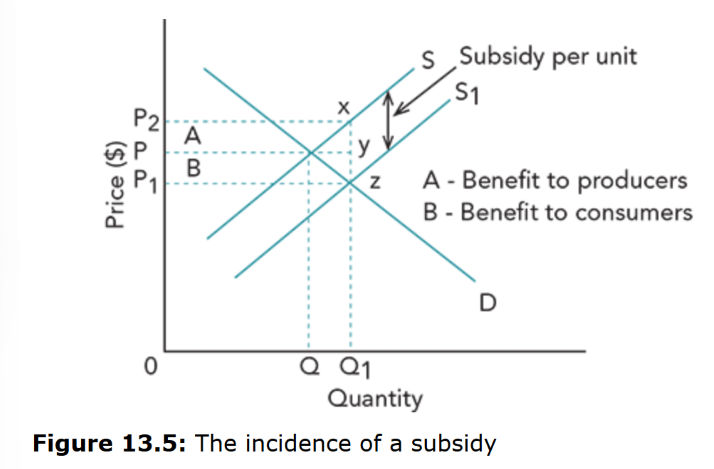
What is the effect of a subsidy on price and quantity (diagram + chain of reasoning (5))
Subsidy imposed -> (equivalent of a fall in costs for producer) -> outward shift in supply -> price fall from P to P1 (government bears the cost)-> increase in quantity traded Q to Q1
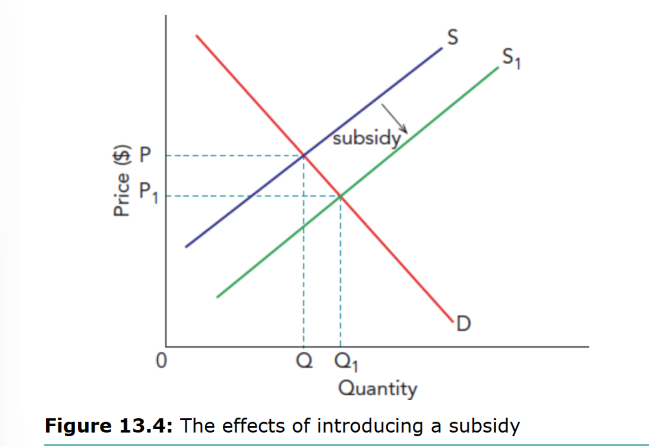
What is the incidence of a subsidy + diagram
The incidence of a subsidy is shared between consumers and producers
- Consumers benefit through a lower price P1 rather than P
- Producers benefit through receiving a higher price than they would selling an increased supply on the market
How does a subsidy affect allocative efficiency
It increases consumption of goods with positive externalities, aligning social benefit closer to social optimum.
Why is the allocation of subsides from limited government revenue a controversial issue
It interferes with the workings of the market mechanism but also has implications for opportunity cost (conflicting demands for tax revenue spending)
What are the problems with subsidies (5)
• They are costly for governments and strain public finances.
• Blanket subsidies benefit all groups equally, even those who can afford full prices.
• They can create shortages by increasing demand.
• Producers may become less efficient when supported artificially.
• Money may not always be used for its intended purpose.
What are two common examples of subsidies + why are they subsidised
Staple foods like rice, bread and cooking oil are subsidised (mainly in low and lower middle-income economies) to keep essential items affordable for low‑income households, especially when world food prices rise.
They aim to provide basic food security but may also benefit higher‑income groups since everyone pays the same subsidised price.
2. Public transport is heavily subsidised in all parts of the world to give low‑income earners access to jobs, improve mobility for older people, reduce road congestion, and lower environmental damage.
It provides wider social benefits by improving accessibility and reducing negative externalities from traffic.
What is direct provision of goods and services
When the government produces and supplies goods or services directly, usually funded by taxation.
- When the government provide certain important services free of charge at the point of use or consumption, financed through the tax system.
When is direct provision used
For public goods and merit goods that are under-consumed in a free market.
Give examples of direct provision.
Healthcare (NHS), public education, street lighting, law enforcement.
How does direct provision of goods and services reduce inequality
If these services are used equally by all citizens, then those on lowest incomes gain most as a percentage of their income, thereby lowering inequality.
What are the differences in the direct provision of goods and services between economies
Some countries (e.g., the UK) offer extensive free public services such as healthcare.
- Others (e.g., the USA) provide limited free services, relying more on private insurance.
- In many low‑income economies, most services require payment, with only basic provision free. Cuba is an exception, offering widespread free healthcare.
What is a criticism of direct provision
Public goods being provided by the government out of tax revenue is argued to be inefficient, with costs higher than what they would've been in the case of a competitive market.
The market overprovides especially where no direct charge is made
Resources are not allocated efficiency
It can also be argued that many consumers could afford to pay a charge, so reducing the tax burden or allocating the funds to alternative uses.
What is a maximum price
A legal upper limit on the price of a good or service, set by the government.
- A price that is fixed: the market price cannot exceed this price
- Sometimes called a price ceiling
- Seen as a way of assisting families on low incomes, reducing inequalities in income or recognising full social benefit is not being achieved.
What is the effect of a maximum price set below equilibrium (diagram + explanation)
Excess demand (shortage), potential black markets, and reduced supply or quality.
At the maximum price of P1, production is not sufficient to satisfy everyone who wants to buy the product. This is because the lower price makes it more affordable and Q2 is now demanded.
Shortage = Q2 - Q1
Governments use legislation to enforce maximum prices for: (5 examples)
Staple food items such as rice or cooking oil
2. Petrol and diesel fuel
3. Rents in certain types of housing
4. Services provided by utilities, such as water, gas and electricity
5. Transport fares, especially where a subsidy is being paid
What are the consequences of a maximum price as the price cannot rise (3)
Queuing
Since there isn’t enough supply, people must wait in long queues to get the product.
Instead of paying more money, consumers “pay” with their time.Rationing schemes
Governments sometimes use rationing (e.g., giving each person a fixed allowance).
But rationing often leads to frustration because people still want more than they’re allowed.Underground / black markets
Because many people cannot get the good at the controlled price, unofficial sellers emerge. In black markets, the product is sold at much higher prices than even the original equilibrium price.
This happens because:
• Demand is unmet.
• People are willing to pay more to avoid queues or shortages.
• Sellers exploit scarcity.
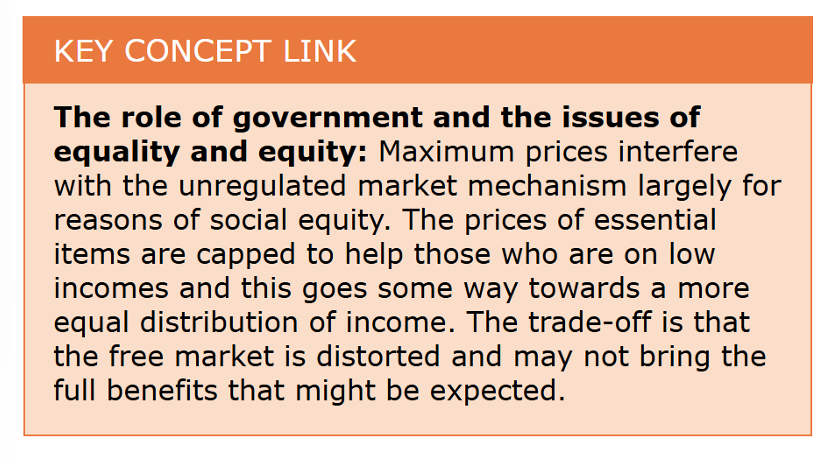
Key concept link
What is a minimum price
A legal lower limit below which the price of a good cannot fall.
- A price that is fixed: the market price must not go below this price
- Sometimes called a price floor
- Not as common as maximum pricing
- Only valid where the minimum price is set above the equilibrium price
What is the effect of a minimum price set above equilibrium
Excess supply (surplus), government stockpiling, higher costs for consumers.
- The minimum price of P1 reduces demand from Q to Q1 while also increasing supply from Q to Q2, resulting in excess supply of Q2 -Q1
- As price cannot fall, supply is restricted to Q1 as this is all consumers can afford to buy
- A lower quantity is traded tan would've occurred at equilibrium price
What are the consequences (2) of a maximum price + why:
Producers may become inefficient - firms with high costs have little incentive to reduce costs since the high minimum price protects them from lower‑cost competitors.
Shortages can lead to black markets where goods are sold illegally at higher prices - High taxes or regulated prices make these markets even more attractive to buyers seeking lower‑priced alternatives.
What is the difference with minimum prices in agriculture:
Set to ensure farmers earn a living income. If surplus occurs, the government buys the excess at the minimum price.
Governments use legislation to enforce minimum prices for (4 examples):
demerit goods such as high-sugar sports drinks
agricultural products, particularly in middle and in high-income countries
wages in certain occupations, usually low skilled, to avoid employers exploiting their employees
certain types of imported goods where close substitutes produced by domestic producers are available.
What is a buffer stock scheme
Government buys and stores surplus commodities when prices are low and releases stock when prices are high to stabilise markets.
- A type of commodity agreement designed to limit price fluctuations
Why are buffer stock schemes used
To stabilise farmer incomes and reduce price volatility for essential goods.
- To reduce price volatility in agricultural markets caused by unpredictable supply changes.
How does a buffer stock scheme use a minimum price
If the market price drops below the minimum, the agency buys surplus products and stores them, raising the price by reducing supply.
How does a buffer stock scheme use a maximum price
If the price rises above the maximum, the agency releases stored stocks into the market to increase supply and bring the price down.
Example of a real buffer stock scheme
The EU’s Common Agricultural Policy (CAP), which bought surplus produce to support farmers' incomes.
What are the limitations of buffer stock schemes
High storage costs, risk of spoilage, and inefficiency if prices consistently deviate from target. + encourage overproduction that must be bought by the government.
What is the provision of information
Government provides accurate information to consumers and producers to improve decision-making.
When is provision of information most commonly used
Most commonly used when information failure results in the underconsumption of merit goods and over consumption of demerit goods
How does provision of information correct market failure
By correcting imperfect knowledge, it helps consumers make better decisions, aligning private and social costs or benefits.
Give examples of government provision of information.
Health warnings on cigarettes, nutritional and allergy labelling, public awareness campaigns e.g. about health, advice on non-prescription medicines.
What is the difference between tax and subsidy effects
• Tax → reduces production/consumption, raises revenue, corrects negative externalities
• Subsidy → increases production/consumption, costs government, corrects positive externalities
Why can price controls lead to government failure
They may distort market signals, create shortages or surpluses, and reduce allocative efficiency.
What is government failure
When government intervention leads to a worse outcome than leaving the market alone.