T-cell immunity
 Call Kai
 Learn
Learn Practice Test
 Spaced Repetition
 Match
Match Flashcards
 Knowt Play
1/22

There's no tags or description
Looks like no tags are added yet.
Name | Mastery | Learn | Test | Matching | Spaced | Call with Kai |
|---|
No analytics yet
Send a link to your students to track their progress
23 Terms
What are the kinetics of T-cells?
naiive T-cells → not seen their antigen and cannot induce immunity
effector T-cells → have seen their antigen and can induce immunity
memory T-cells → long lived, have seen their antigen and can respond faster upon re-infection
Dendritic Cells
bridge between innate and adaptive immune system
activate naive + cells to become cones of eflector T-cells
reside in tissues where they take up pathogens upon encounter with their dendrites
when they detect dnanger they go to the secondary lymphoid organs and activate T/B cells
they use pattern recognition receptors to sense self and non-self
What are the 3 signals given to naive T cells to become effector cells?
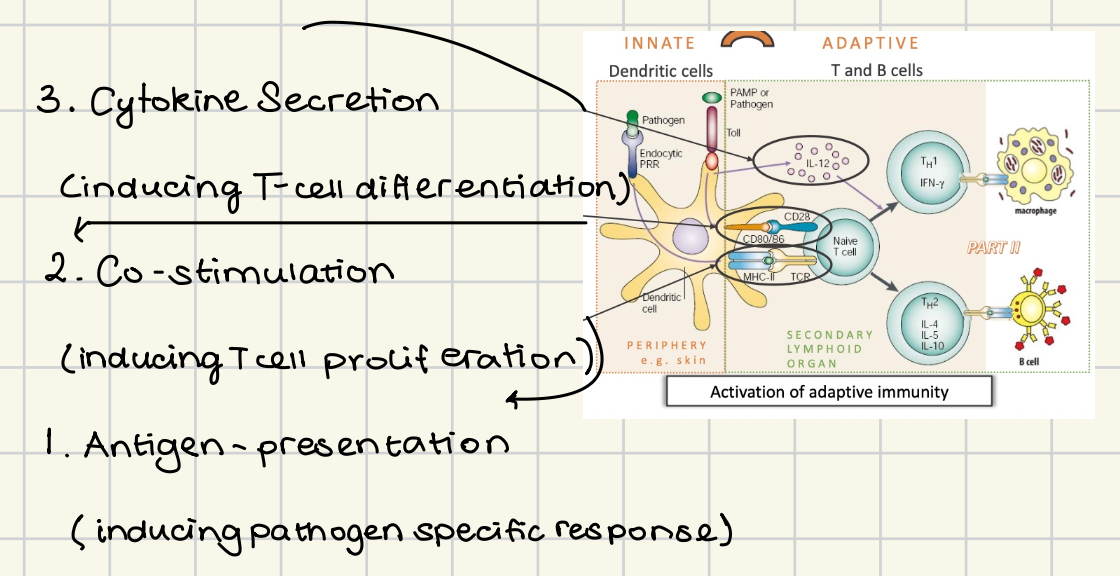
Where are dendritic cells mature/immature?
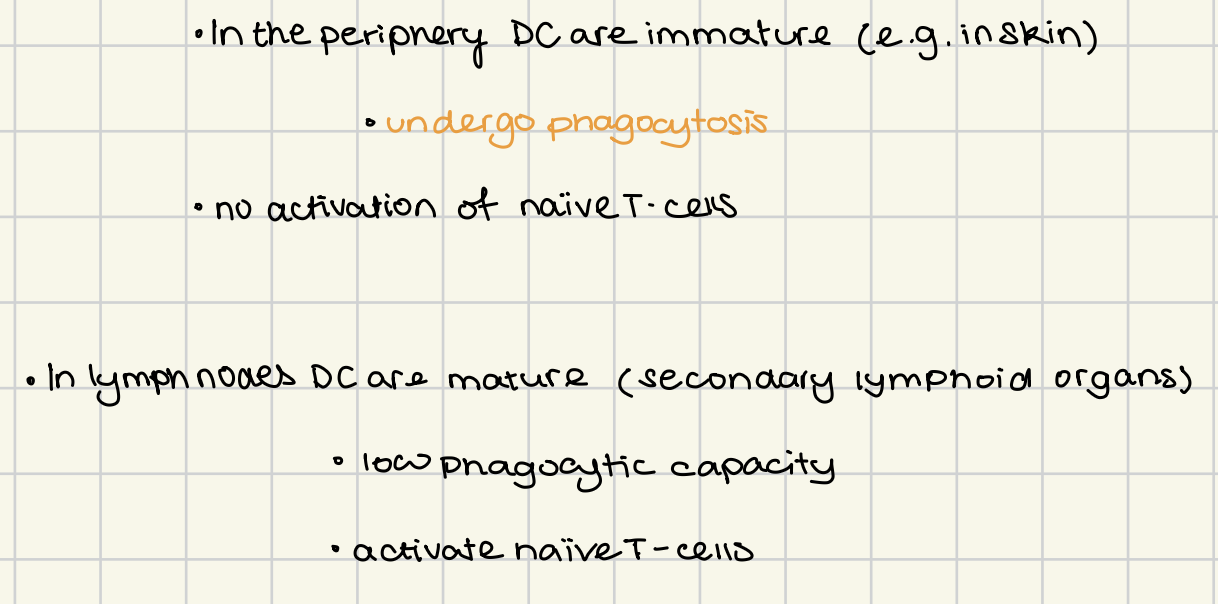
How do dendritic cells migrate?
they migrate via the lymphatics system and mature during maturation and in the lymph nodes they are highly structured
How do DCs enter the lymph nodes?
via the afferant lymphatics: teh arrival of dendritic cells is chemokine mediated and they can no longer exit them
How do naive T-cells enter the lymph nodes?
arrival of naive T-cell
chemokine mediated
adhesion molecules
search for specific antigen
How do T-cells leave the lymph nodes?
if antigens are not presented by MHC molecules then T-cells can leave via the efferent lymphatics
When are co-stimulatory molecules expressed and why does this matter?
Only expressed by mature DCs upon TLR stimulation during infection — ensures T cells are only activated during real threats, not harmless antigens
What happens when a naïve T cell receives signal 1 without signal 2?
Anergy — permanent state of unresponsiveness. No way of reactivating an anergic T cell. This is a peripheral tolerance mechanism.
What happens after B7-CD28 (signal 2 - costimulation) interaction in T cell activation?
T cell upregulates high-affinity IL-2 receptor → secretes IL-2 → IL-2 drives proliferation of antigen-specific T cells
What determines which Th subset a CD4 T cell differentiates into?
The cytokine cocktail (signal 3) secreted by DCs — combination determines subset identity and function
What does Th1 do and what cytokines does it need/produce?
function: instruct macrophages to enhance elimination of phagocytosed pathogens
interaction between macrophage and Th1: recognition of antigen by MHC II, expression of activating ligands CD40, secretion of cytokines (IFNgamma)
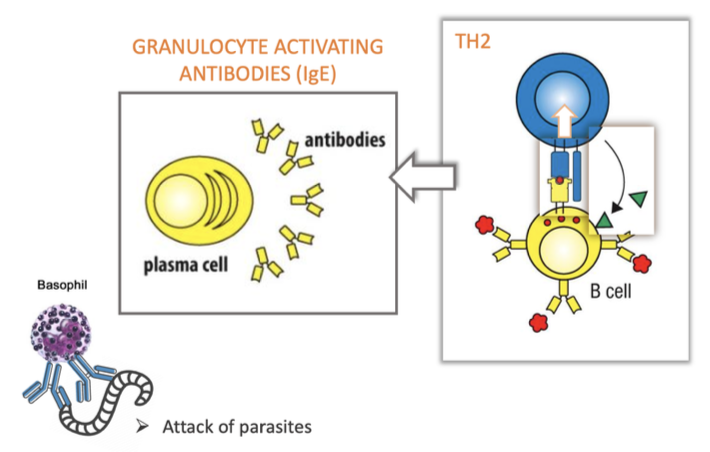
What does Th2 do and what does it target?
Driven by IL-4 → instructs B cells to produce IgE (granulocyte-activating antibodies) → mobilises granulocytes → eliminates parasites
What is the difference in signals for effectors and naive T cells?
effector only signal 1 → antigen presentation
naive t-cells → 1-3 signals
What do T follicular helper cells do?
Driven by IL-6 → guided toward B cell follicles by chemokines → interacts with naïve B cells → provides stimulatory signals (cytokines + activating ligands) → B cells undergo affinity maturation and isotype switching in germinal centres
What do regulatory T-cells do and how?
inhibit other T-cells and DC functions
mechanisms: depriving other T cells of cytokines (IL2 for proliferation), secretion of anti-inflammatory cytokines (TGFbeta & IL10), incudcing cytolysis, supressing DC function
What are killer T cells (CD8+ T-cells)?
selective mass killers
Focused Rilling through local release of cytotoxins in synapse with target cell.
How do CD8+ T-cells become cytotoxic T lymphocytes, which secrete cytotoxins?
By receiving signal 1, 2 (antigen presentation and co-stimulation)
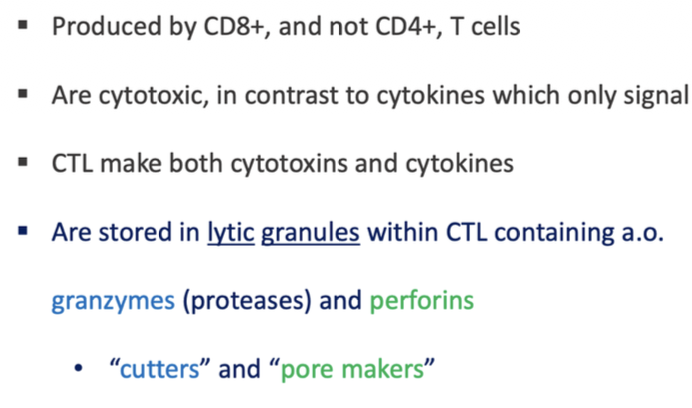
What are cytotoxins?
How do cytotoxic lymphocytes kill multiple cells together?
start by receiving signal 1
cytotoxins found in lyic granules
perforins perforate membrane of the target cell (make membrane pores)
granzyme cut inside the cell and activate nucleases
target cell nucleases degrade DNA
apoptosis of target cells
clerance by macrophages via phagocytosis.
CTLs can produce cytotoxic compounds and …
cytokines for signal
What makes CTLs so dangerous?
they can keep killing target cells until exhausion