FOREST 3
 Call Kai
 Learn
Learn Practice Test
 Spaced Repetition
 Match
Match Flashcards
 Knowt Play
1/167

There's no tags or description
Looks like no tags are added yet.
Name | Mastery | Learn | Test | Matching | Spaced | Call with Kai |
|---|
No analytics yet
Send a link to your students to track their progress
168 Terms
Plants contribute extensively to the water cycle?
Vegetation type both depends on and affects water availability (locally and regionally)
Evapotranspiration cools land surface: deforestation = warming
Plants keep water from flowing downstream, produce transpiration
Anthropogenic land cover change affects water cycle?
US Geological Survey
2022 water cycle diagram
Includes humans for the first time
Human influence is a major factor – find all components
most limiting abiotic factor to plant growth and productivity?
water
What can be some differences between different environmental systems?
Precipitation
soil water content
vapor pressure deficit
leaf area index
stomatal conductance
rooting depth
duration of water availability after rain
Temperature (affects ET, depends on specific heat (buffering capacity) of land cover
Atmospheric Demand (Sink)?
Humidity
Vapor pressure deficit (VPD) = Dryness
Holding of moisture in the air cause of saturation
Increases with temperature
Soil moisture (source)?
Water falling into soil cause of gravity
Only certain levels of thickness in soil can keep water
Saturatin
Field capacity
wilting point
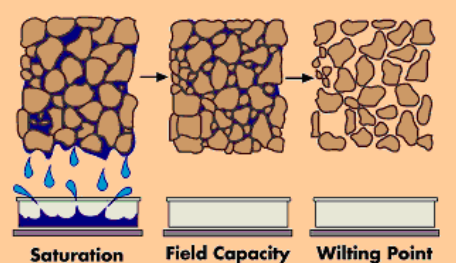
Saturation?
all pares are full of water
Gravitational water is lost
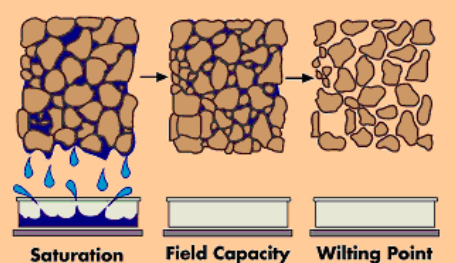
Field Capacity?
Immidietly after rain fall
Available water for plant growth
Held by gravity
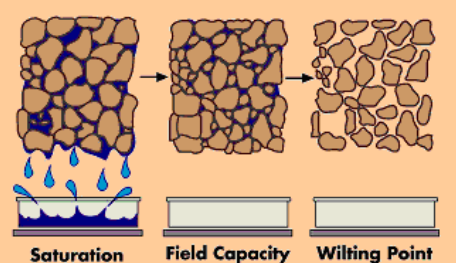
Wilting point?
No more water is available to plants
“Soil-plant-atmosphere continuum”?
Once water falls, its taken up through the roots and then released into the air from the leaves
Roots→plant→leaves→atmosphere
Capillary pores move to where it is negative, have the most pull
Pulling water against gravity
Trees move water at incredibly negative pressures (tension)?
Water up
-1 to -10 MPa (MegaPascals)
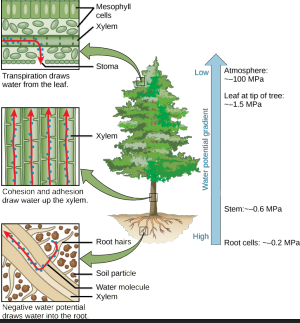
-1 to -10 MPa (MegaPascals)?
This is really negative
1MPa ~ 9.8 atmospheres
A human can suck through a straw at about -25 kPa, or 0.025 Mpa
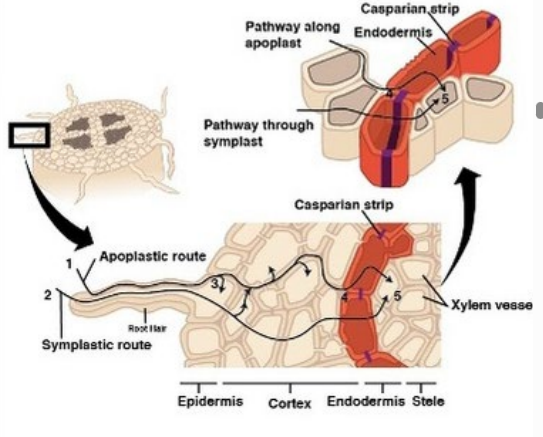
Water transport structures?
Guard cells, intercellular spaces
Apoplastic route – in cell walls
Symplastic route – through live cells
Casparian strip – a suberized band in the endodermis cell walls, serving as a barrier for all apoplastic transport. Protects roots from pathogens through dense fibers
Properties of Water?
Cohesion
Adhesion
“Bipolar” molecule – negative charge on the oxygen atom and positive on the hydrogen.
Thus, they are held together by hydrogen bonds. Charged particles also make them attracted to different surfaces
Forced used to fight against gravity
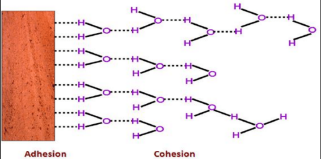
Cohesion?
water is attracted to water
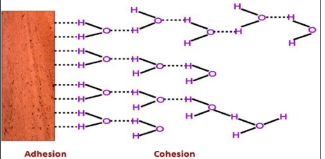
Adhesion?
water is attracted to other substancess
Adhesion of water molecules to xylem walls is like Alex Honnold clinging to a rock face on El Capitan
Cohesion -tension theory?
Cohesion of water molecules to each other
Adhesion of water to conduit walls
Drawn up in a “continuous” columns
Tension is the force needed to overcome the downward force from gravity (negative pressure)
Tension?
force needed to overcome downward force from gravity (negative pressure)
Capillary rise is proportional to vessel diameter?
Capillary rise occurs due to adhesion to tube walls
In xylem cells (diameter 20-200 µm) capillary forces can lift water about 1m Capillary rise is proportional to vessel diameter
𝐾 (capillary) = − (𝜋r^4/8n)
Vessel size affects pressure drop, helps work against gravity?
The larger the vessel, the less pressure needed
What is the ultimate driving force behind water movement in the xylem?
the sun
heat from the sun evaporates the water which drives the pulling force of water
According to Domec, how does water availabilty related to tree height?
The tension-driven makes the pit aperture diameter of tracheids decrease steadily with height,
Conductive tissues?
Xylem conducts water, carries resources from soil to leaves
The larger the diameter, the lower the resistance, and the greater the risk of cavitation
As cells get older, minerals begin to plug up pores and reduce the abilities of xylems
Becomes hardwood
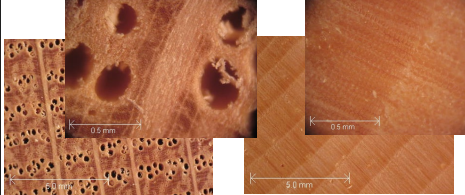
Vessels vs. Tracheids (Tracheary elements of the xylem) Angiosperms vs Gymnosperms?
Variation in the size of pores.
Angiosperms have larger holes with smaller amounts of cell walls
Size is dependent on the amount of water available and the strength of the water column
Xylem structure?
Not all conduits are the same
Vessels
Tracheids
Vessels?
Found in angiosperms
Length 1-1000+cm
Diameter 15-500 µm (0.015-0.5 mm) – large size range
Faster maximum transport rate • Greater vulnerability to cavitation
Tracheids?
Found in gymnosperms (conifers)
Length 0.1 – 1.0cm
Diameter 5-80 µm – narrow size range
Lower maximum flow rate – the conductance of the hydraulic system of the plant may limit leaf water availability
Xylem structure influences plant hydraulics?
primarily two kinds of resistance
Pit resistance and Lumen resistance
Longer vessels could increase lumen resistance but decrease pit resistance, due to fewer end wall-crossings
DaVinci’s “rule of trees”?
The cross-sectional area of branches adds up to the cross-sectional area of the trunk
DaVinci’s a=2
Murray’s Law – a=3, for blood flow
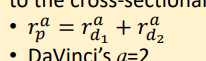
Sopp & Valbuena’s clarification?
The cumulative hydraulic resistance remains constant
Diameter decreases with height to counter gravity
Also associated with a mechanical support function (greater decline of radius in gymnosperms, similar to Murray’s Law in ring-porous angiosperms)
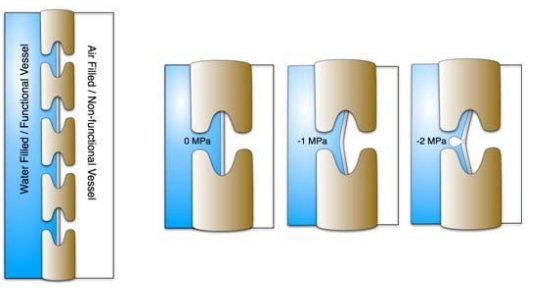
Embolism or cavitation?
A critical point where the tension exceeds that required to pull air from an empty conduit to a filled conduit across a pit membrane — this aspiration is known as air seeding
An air seed creates a void in the water, and the tension causes the void to expand and break the continuous column.
Air seeding thresholds are set by the maximum pore diameter found in the pit membranes of a given conduit.
Caused by excessive water potential gradient, and affected by evaporative demand, flow rate and gravity
Embolism or cavitation 2?
There are billions and trillions of conduits in trees (so cavitation of a million of them isn’t necessarily fatal)
Trees can isolate embolized conduits
Redundant pathways
How can trees recover from embolism?
Divert water around embolized conduits
Grow new xylem
Some plants can refill embolized conduits, but the mechanism is not fully understood.
Some cannot recover from embolism.
Torus?
specialized thickening in the pit membranes of conifer xylem, acting as a valve to prevent air embolism
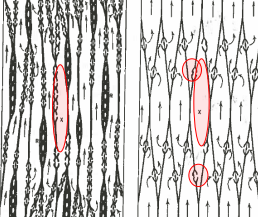
Injured vessels are often isolated by suberization of the cell walls next to the injury.?
Illustration of coniferous tracheids’ sealing mechanism;
Torus is displaced when tension exceeds a threshold
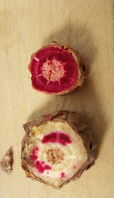
Another example of xylem staining?
Top sample was freshly cut from the tree and stored in water to prevent drying
Bottom sample was left out to dry for two days
Only the functioning (water - filled) xylem get stained; non -functional (air -filled) xylem do not get stained
Isohydric plants?
maintain their internal water potential relatively constant across a range of environmental water availabilities
E.g. cherry
More conservative
Last better in a drought
Anisohydric plants?
leaf water potential changes more in response to environmental water availability
E.g. oaks, ash
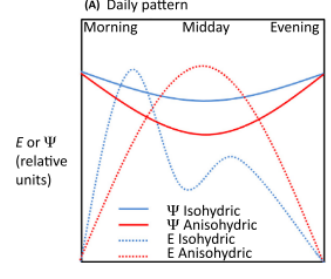
Isohydric vs anisohydric species?
Continuous spectrum, some species can vary
E = transpiration, ψ = leaf water potential
Cavitation events can also be detected acoustically?
breaking of water column
Ultrasonic acoustic emissions sensors
Can detect sounds beyond the range of human hearing
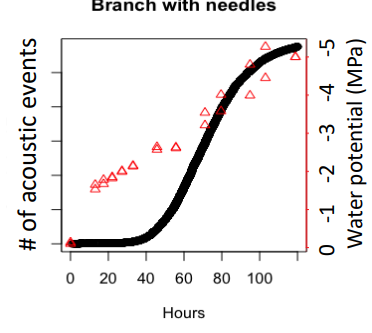
Cavitation curves: water potential & acoustic events?
Number of acoustic emissions increases as the branch dries out
Water potential in the branch gets more and more negative as the tension on the water column increases (as the branch dries out)
Measuring transpiration using sap flux probes?
Temperature difference is logged as trees transpire water
Temperature difference is highest when there is no flow and lowest when there is high flow
Why do cavitation limits vary within plants?
Trade-off between large, efficient conduits and increased vulnerability to cavitation
Year-round growing patterns
Need a good temperature
Evolution of xylem tissues?
Tracheids were the only highly specialized elements in the first upright land plants (about 300 million years ago)
With flowering plants, xylem tissues evolved into separating for water conduction and mechanical support
Fibers – cells which specialized for ‘support’ function
Vessel elements – water-conducting cells
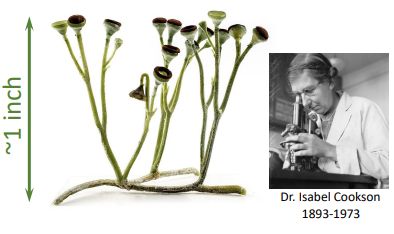
Earliest vascular plants?
Cooksonia – the earliest known vascular plant (Silurian period – 430 to 400 MYA)
All plant growth begins with energy from the sun?
Primary producers
Primary producers?
Plant photosynthesis
Scales from individual leaf process to whole ecosystem processes
Light is the necessary ingredient for most Life?
photosynthesis
light-use efficiency
Photosynthesis?
The light-driven process of carbon uptake and assimilation in green plants.
Light-use efficiency?
Only 3-6% of absorbed light is converted into chemical energy by leaves.
Phototropism?
growing toward light
Happens cause of phototropins
Phototropin?
protein that changes in response to blue light (shade)
Differential growth on the sun vs shade side
Genetic control still unclear?
heliotropism (turning toward Sun) does not respond to same triggers as phototropism (other light source)
Light absorption by foliage?
Chlorophyll absorbs light in blue and red wavebands
Not all the energy from light is absorbed
More leaves/foliage means more light/energy absorbed
Light is also?
Absorbed by non-photosynthetic material
Transmitted
Reflected
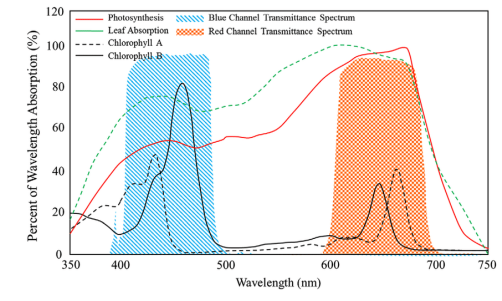
Chl vs leaf absorption spectrum?
Non-photosynthetic absorption
Reflectance
Definitions for leaf photosynthesis?
Gross photosynthesis (PG)
Respiration (R)
Net photosynthesis (PN = PG – R)
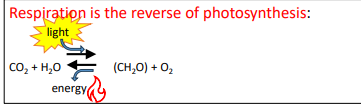
Respiration (R)?
CO2 lost to atmosphere through consumption of carbohydrates (in leaves and all living tissues)
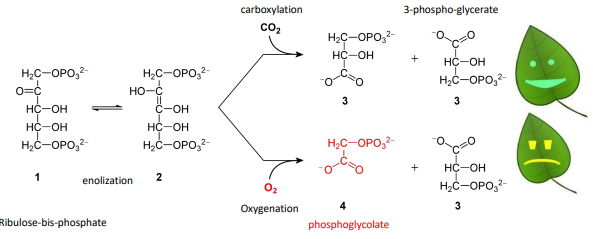
Photosynthesis and photorespiration?
Add phosphate to create energy
Can now collect oxygen through CO2
Create a 6 carbon sugar, broken up into 3 carbon sugar
Gross photosynthesis (PG)?
Total amount of CO2 assimilated through the process of photosynthesis (in leaves)
Net photosynthesis (PN = PG – R)?
Net CO2 gain (the starting point for carbon allocation and growth)
Metabolic hubs?
Photosynthesis occurs in the chloroplasts; key enzyme Rubisco
Respiration occurs in mitochondria (same as us!); ATP synthesis
Steps in photosynthesis?
Energy capture & conversion to chemical form = light reactions (light dependent)
CO2 absorption and conversion of chemical energy to new biomass = dark reactions
Light independent (does not require either light or darkness)
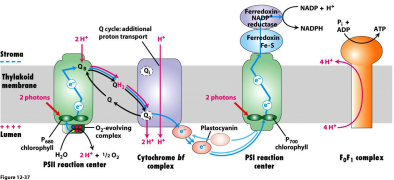
Light reactions of photosynthesis?
Absorbed quanta excite electrons in chlorophyll, which get transferred to other molecules – electron transport chain
Electrons are replenished by splitting water
Electron transport across the membrane drive proton transport and proton gradient, which …
… drives ATP synthesis (create O2)
occur in thylakoid membranes
Have a barrier
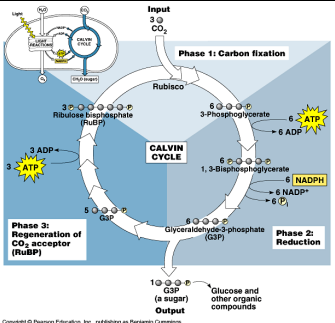
Dark reactions of photosynthesis?
Rubisco enzyme combines CO2 with 5-carbon RuBP, forming
2 3-carbon sugars
Phosphate groups are added to increase the reactivity (ATP)
2 3-carbon sugars combine to make glucose
RuBP is regenerated with additional investment of ATP
5x3C sugars—>3x 5C sugars
Dark reactions occur in the chloroplast stroma
Recipient molecule recreated
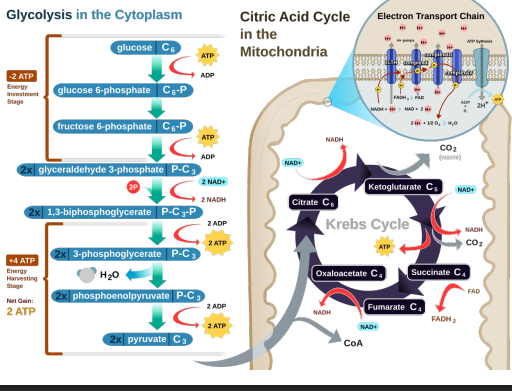
Respiration – energy production?
Glycolysis and citric acid cycle (or Krebs cycle) break down glucose and harness the chemical energy in energy carrier molecules (ATP, NADH and FADH2)
The reducing power (NADH, FADH2) gets converted to ATP (1-to-3)
Bribing other reactions with ATP to break bonds and create energy
Factors affecting photosynthesis?
Light
Water availability in soil and air
Temperature
Nutrients (N, P, K, …)
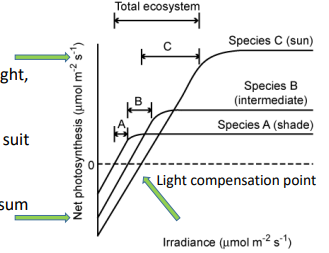
Growth-limiting factors: #1. Light?
Light saturation of photosynthesis
Photosynthesis increases with light, up to a point
Leaves have grown to optimally suit their light environment
Canopy response to light is the sum total of sun and shade leaves
Sun vs. shade leaves?
Inhabit different light microenvironments
Have different responses to light
Plateaus represent higher competition
Sun leaves?
In full sun
Higher photosynthetic rates but also higher rates of respiration.
Higher leaf angle (seem to avoid light during hottest part of day).
Shade leaves?
In the shade of others
Lower rates of photosynthesis per unit mass but larger display area and lower respiration.
Lower leaf angle (capture more light).
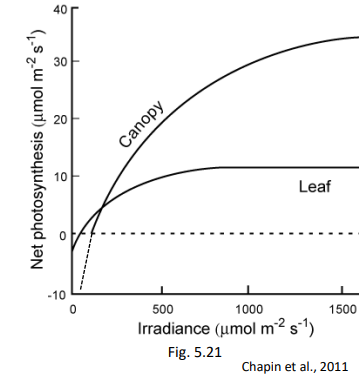
Canopy response to light?
greater than leaf response
more linear over a broader light range than for any one leaf
Impact of shade
Growth-limiting factors: #2. Temperature?
Enzymes that control the rates of photosynthesis and respiration have different sensitivities to temperature.
Warmer temperatures increase photosynthesis up to an optimum temperature.
Respiration increases exponentially with a linear increase in temperature
Gross photosynthesis is lowest at temperature extremes and thus carbohydrate gain is limited
Respiration increases exponentially with a linear increase in temperature?
Microbial respiration – enzymatically controlled, based on cell’s energy needs
At extreme temps – cellular degradation, constant repair
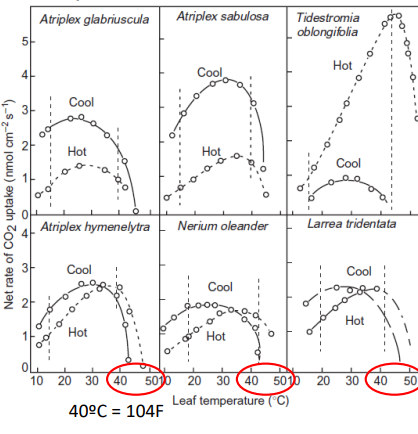
Net photosynthesis increases with temperature but then decreases with very high temperature?
Net PS declines at supraoptimal temperature:
Enzymes denature (lose function) at high temperature, and free electrons damage membranes
Constant repair = high respiration cost
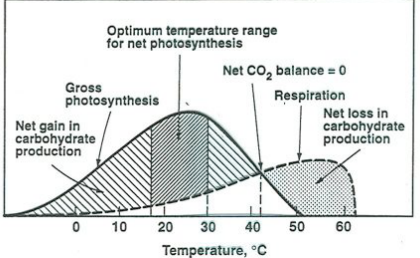
Net photosynthesis?
Gross photosynthesis - respiration
Respiration is the loss of CO2 from plants as mitochondria use carbohydrates to produce energy
Balance between carbon gained and carbon loss
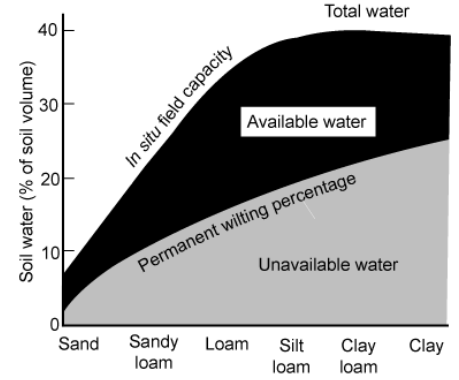
Growth-limiting factors: #3. Water availability?
Affects photosynthesis by causing plants to open or close stomata, and CO2 diffusion
Water availability depends on soil texture, on pore size
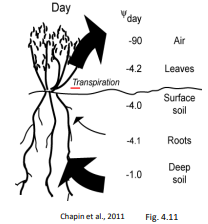
Water potential gradient as the driving force of T (transpiration)?
Water evaporating at leaf surface and adhesion and cohesion of water creates upward pull of water
Water needed to move solutes within plant
Decoupling between photosynthesis and growth?
Canopy photosynthesis has longer seasonality than radial growth
Especially in conditions of limited sink strength
GPP versus annual ring-width correlation with climate factors
Growth controlled by CHO availability, environmental resources, genetics
Conditions of limited sink strength?
Higher leaf area
Drought
Low temperature
GPP versus annual ring-width correlation with climate factors?
They disagree
Radial growth actually has negative correlation with radiation
Radial growth actually has negative correlation with radiation?
—>sink limitation of growth – other resources are limiting (water, nutrients)
—>water needed to transport carbohydrates
There is a lag between GPP & growth
Drought and other stresses suppress cambial activity before they affect GPP
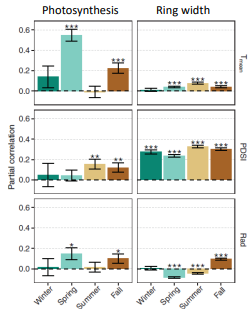
Decoupling between photosynthesis and growth 2?
Correlation between environmental conditions (T, PDSI, Radiation) and gross photosynthesis (left) and tree ring width growth (right)
1.GPP and ring width growth differ
2. sensitivity to different factors varies by season
3. different factors affect GPP & RW differently
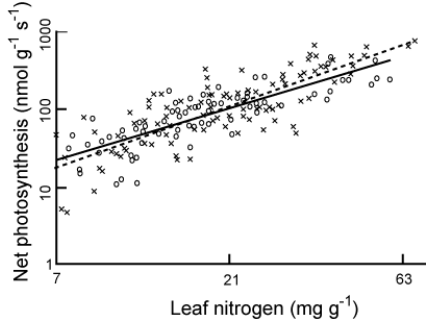
Growth-limiting factors: #4. Nutrients?
Nitrogen is especially important to photosynthesis because RuBisCO, the primary enzyme involved in fixing carbon, requires lots of nitrogen
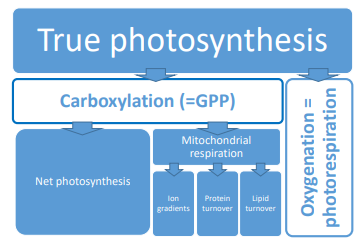
Photosynthesis vs net carbon gain (True Photosynthesis=source)?
Carboxylation (GPP),
binds CO2
Oxygenation=photorespiration,
binds Oxygen
Carboxylation (=GPP)?
Net photosynthesis
Mitochondrial respiration
Mitochondrial respiration?
Ion gradients
Protein turnover
Lipid turnover
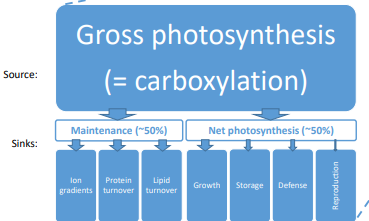
Carbon use?
Gross photosynthesis (= carboxylation) as source
Two sinks
carboxylation sinks?
Maintenance (~50%)
Net photosynthesis (~50%)
Maintenance (~50%) sink?
Ion gradients
Protein turnover
Lipid turnover
Net photosynthesis (~50%) sink?
Growth
Storage
Defense
Reproduction
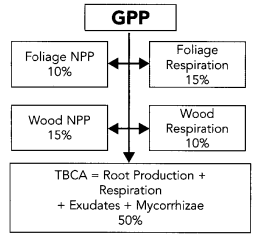
Carbon allocation: Where a plant puts the photosynthate (carbon)?
TBCA = total belowground carbon allocation
In areas with higher nutrient levels, plants put less C toward roots and belowground biomass and more toward leaves and wood.
Human appropriation of NPP?
NASA Goddard Space Center: human appropriation of NPP has increased from ~20% to 25% of NPP
Ceiling of usable NPP is NOT 100%. It is much lower, but we do not know where. 33%? 40%???!
Current human appropriation of NPP?
crops for food and fiber
timber for wood products and paper
livestock grazing (Gough 2011)
Limits to human appropriation of NPP?
Rancher David Daigle telling ESSM 319 silviculture class that he cannot let cattle graze more than 25-30% of growth
Milk-carton analogy:
1/3 cream
1/3 water
1/3 carton
Norman Borlaug & agricultural revolution?
“The father of the Green Revolution”, forester, plant pathologist and geneticist by training
Nobel Peace Prize in 1970 & government honors
Developed disease-resistant & high-yield wheat varieties in Mexico
These varieties saved a billion people from starvation
Wheat yields doubled in 5 years in India and Pakistan
Costs of agricultural revolution?
Wide-spread monocultures
Intensive cultivation methods (benefitting agrobusiness more than the people)
High pesticide use
Nutritional limitations of individual crops
Growing food supply has increased global population
Essential Elements?
Carbon, Oxygen, Hydrogen
Make up 90% of tree’s dry mass
Obtained from atmosphere & water
Remaining elements come from soil
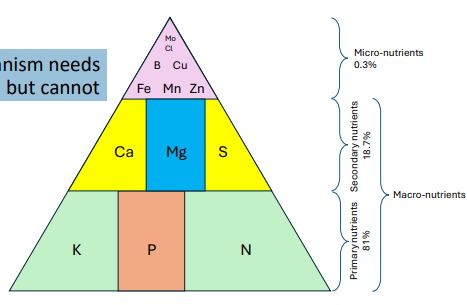
What are nutrients?
Substances that an organism needs for growth and survival, but cannot make itself
Essential elements?
building blocks of organic molecules (>90% of dry weight)
Hydrogen (H), carbon (C), oxygen (O)