Private pilot Checkride oral flashcards set 1
 Call Kai
 Learn
Learn Practice Test
 Spaced Repetition
 Match
Match Flashcards
 Knowt Play
1/96

There's no tags or description
Looks like no tags are added yet.
Name | Mastery | Learn | Test | Matching | Spaced | Call with Kai |
|---|
No analytics yet
Send a link to your students to track their progress
97 Terms
What three documents must you have in your personal possession to act as pilot in command of an aircraft? (61.3)
"A pilot certificate, a current medical certificate, and a valid government-issued photo ID."
"For a pilot under 40 years old, how long are the privileges of a First Class medical valid? (61.23)"
"First class privileges are valid for 12 calendar months, after which it reverts to third class privileges for the remaining 48 calendar months."
"For a pilot aged 40 or over, how long are the privileges of a Third Class medical valid? (61.23)"
Third class privileges are valid for 24 calendar months.
What is the currency requirement to act as Pilot in Command? (61.56)
You must have completed a flight review within the preceding 24 calendar months.
What are the currency requirements to carry passengers during the day? (61.57)
"You must have made at least 3 takeoffs and 3 landings within the preceding 90 days in an aircraft of the same category, class, and type."
What are the currency requirements to carry passengers at night? (61.57)
"You must have made at least 3 takeoffs and 3 landings to a full stop within the preceding 90 days, during the period from 1 hour after sunset to 1 hour before sunrise."
"What documents must be on board an aircraft for it to be considered airworthy? (91.203, 91.9)"
"Use the acronym ARROW: Airworthiness Certificate, Registration Certificate, Radio Station License (for international), Operating Limitations (POH/AFM), and Weight and Balance data."
Does an aircraft's Airworthiness Certificate expire?
"No, it remains valid as long as the aircraft is maintained and operated in accordance with FAA regulations."
How long is an aircraft's Registration Certificate valid for?
It must be renewed every 7 years. (Once was 3 years)
"What are the required inspections for an aircraft? (91.409, 91.171, 91.411, 91.413, 91.207)"
"Use the acronym AAV1ATES: Annual, Airworthiness Directives, VOR (IFR only), 100-hour (for hire), Altimeter/Pitot-Static (IFR only), Transponder, ELT, and Service Bulletins."
What is the required interval for an Annual inspection? (91.409)
Every 12 calendar months.
Under what circumstances is a 100-hour inspection required?
When the aircraft is used for flight instruction or operated for hire.
How often must the aircraft's transponder be inspected? (91.413)
Every 24 calendar months.
What are the two conditions that require an ELT battery to be replaced? (91.207)
When the ELT has been in use for one cumulative hour or when 50% of its battery's useful life has expired.
What is an Airworthiness Directive (AD)?
"A mandatory regulation issued by the FAA to correct an unsafe condition found in a product (aircraft, engine, propeller, or appliance)."
"As a private pilot, what is your primary limitation regarding compensation for flying? (61.113)"
"You may not fly for compensation or hire, but you may share the operating expenses (pro-rata share) with passengers."
What is the acronym for the required VFR day equipment? (91.205)
ATOMATOFLAMES.
What does ATOMATOFLAMES stand for? (91.205)
"Airspeed indicator, Tachometer, Oil pressure gauge, Manifold pressure gauge, Altimeter, Temperature gauge (liquid-cooled), Oil temperature gauge (air-cooled), Fuel gauge, Landing gear position indicator, Anti-collision lights, Magnetic compass, ELT, Seatbelts."
What additional equipment is required for VFR flight at night? (91.205)
"Use the acronym FLAPS: Fuses (or circuit breakers), Landing light (if for hire), Anti-collision lights, Position lights, Source of electricity."
What is the procedure for determining if you can fly with inoperative equipment without a MEL? (91.213)
"Check if it's required by 91.205, the POH/KOEL, TCDS, or an AD
A _ occurs when an airplane exceeds its critical angle of attack.
stall
What are the two conditions required for a spin to occur?
The aircraft must be stalled and in uncoordinated flight (yawing).
What is the standard spin recovery procedure?
"Use the acronym PARE: Power to idle, Ailerons neutral, Rudder full opposite the direction of rotation, and Elevator forward to break the stall."
When can you expect fog to form in relation to temperature and dew point?
"When the temperature and dew point are within 3-5 degrees Celsius of each other, indicating high humidity."
"What is a TAF, and what is its area of coverage?"
"A Terminal Aerodrome Forecast is a weather forecast valid for a 24-30 hour period, covering the area within 5 statute miles of an airport."
What are the four flight categories defined by ceiling and visibility?
"LIFR (Low IFR), IFR, MVFR (Marginal VFR), and VFR."
Under what two conditions will an airport beacon be operating during the day?
"When the airport is reporting IFR conditions (ceiling less than 1,000 feet AGL or visibility less than 3 statute miles)."
What weather information does an AIRMET Tango provide?
"It advises of moderate turbulence, sustained surface winds of 30 knots or greater, and/or nonconvective low-level wind shear."
What weather information does an AIRMET Sierra provide?
It advises of IFR conditions and/or extensive mountain obscuration.
What weather information does an AIRMET Zulu provide?
It advises of moderate icing and provides freezing level heights.
What is a SIGMET issued for?
"Weather potentially hazardous to all aircraft, such as severe icing, severe turbulence, dust storms, sandstorms, or volcanic ash."
What are the three necessary ingredients for a thunderstorm to form?
"Moisture, an unstable air mass, and a lifting action."
What are the three stages of a thunderstorm?
"The cumulus stage (updrafts), the mature stage (updrafts and downdrafts, precipitation begins), and the dissipating stage (downdrafts)."
What conditions are necessary for structural icing to form?
The aircraft must be flying through visible moisture (like clouds or rain) and the temperature at the point of moisture strike must be 0° Celsius or below.
How should you adjust your takeoff and landing to avoid wake turbulence from a large aircraft?
"When taking off, rotate prior to the preceding aircraft's rotation point
What transponder code should you squawk for a lost communications emergency?
7600.
"What is the VFR cruising altitude rule for flights above 3,000' AGL? (91.159)"
"On an easterly heading (0-179°), fly at odd thousands + 500 feet
What are the VFR fuel requirements for a flight during the day? (91.151)
Enough fuel to fly to the first point of intended landing and then for at least an additional 30 minutes at normal cruise speed.
What are the VFR fuel requirements for a flight at night? (91.151)
Enough fuel to fly to the first point of intended landing and then for at least an additional 45 minutes at normal cruise speed.
How does a forward Center of Gravity (CG) affect an aircraft's stability and stall recovery?
"A forward CG increases longitudinal stability and makes stall recovery easier, but increases stall speed."
How does an aft Center of Gravity (CG) affect an aircraft's performance and stability?
"An aft CG decreases stability, making stall recovery more difficult, but it increases cruise speed and range."
What is density altitude?
"It is pressure altitude corrected for nonstandard temperature
How does high density altitude affect aircraft performance?
"It degrades performance by reducing lift, decreasing engine power output, and increasing takeoff and landing distances."
What is the difference between true airspeed (TAS) and groundspeed (GS)?
"TAS is the speed of the aircraft through the air, while GS is its actual speed over the ground, corrected for wind."
Explain the compass turning errors from turning to north or south headings
"When turning from a northerly heading, the compass will initially indicate a turn in the opposite direction and lag. When turning from a southerly heading, it will lead the turn. (Undershoot North, Overshoot South)."
When flying east/west heading, what compass errors might occur?
"When on an east or west heading, acceleration causes the compass to indicate a turn to the north, and deceleration causes it to indicate a turn to the south. (Accelerate North, Decelerate South)."
What are the four types of hypoxia?
"Hypoxic (insufficient oxygen in the air), Hypemic (blood can't carry oxygen), Stagnant (poor blood circulation), and Histotoxic (cells can't use oxygen)."
What is the most common cause of Hypemic hypoxia in general aviation?
Carbon monoxide poisoning from a faulty cabin heater that uses exhaust manifold heat.
"What are the supplemental oxygen requirements for the flight crew above 12,500' MSL? (91.211)"
"From 12,500' up to and including 14,000' MSL, oxygen must be used for any part of the flight at those altitudes that is of more than 30 minutes duration."
At what altitude is supplemental oxygen required for the flight crew at all times? (91.211)
"Above 14,000' MSL."
What is P-Factor?
"An aerodynamic effect where the descending propeller blade on the right side has a greater angle of attack than the ascending blade, creating more thrust on the right side and causing a yaw to the left."
What causes the turning tendency known as spiraling slipstream?
"The propeller wash strikes the left side of the vertical stabilizer, pushing the tail to the right and causing the aircraft's nose to yaw to the left."
What is the antidote for the hazardous attitude of 'Anti-Authority'?
Follow the rules. They are usually right.
What is the antidote for the hazardous attitude of 'Invulnerability'?
It could happen to me.
What is the antidote for the hazardous attitude of 'Macho'?
Taking chances is foolish.
What does the risk management acronym PAVE stand for?
"Pilot, Aircraft, enVironment, External pressures."
What does the preflight self-assessment acronym IMSAFE stand for?
"Illness, Medication, Stress, Alcohol, Fatigue, Eating/Emotion."
What are the FAA's regulations regarding alcohol consumption before flying? (91.17)
"You must wait at least 8 hours between consuming alcohol and flying, and your blood alcohol content must be less than 0.04%."
"With respect to airmen certification, what is 'category'?"
"A broad classification of aircraft such as Airplane, Rotorcraft, Glider, or Lighter-Than-Air."
"With respect to airmen certification, what is 'class'?"
"A classification of aircraft within a category having similar operating characteristics, such as Single-Engine Land, Multi-Engine Sea."
"If you change your permanent mailing address, how long do you have to notify the FAA of this change? (61.60)"
30 days.
Who is primarily responsible for ensuring an aircraft is maintained in an airworthy condition? (91.403)
The owner or operator of the aircraft.
What are the VFR weather minimums for Class B airspace?
3 statute miles visibility and clear of clouds.
What are the VFR weather minimums for Class C and D airspace?
"3 statute miles visibility, 1,000 feet above, 500 feet below, and 2,000 feet horizontal from clouds."
"What are the VFR weather minimums for Class E airspace below 10,000' MSL?"
"3 statute miles visibility, 1,000 feet above, 500 feet below, and 2,000 feet horizontal from clouds."
"What are the VFR weather minimums for Class E and G airspace at or above 10,000' MSL?"
"5 statute miles visibility, 1,000 feet above, 1,000 feet below, and 1 statute mile horizontal from clouds."
"What are the VFR weather minimums for Class G airspace below 1,200' AGL during the day?"
1 statute mile visibility and clear of clouds.
"What are the VFR weather minimums for Class G airspace below 10,000' MSL but above 1,200' AGL at night?"
"3 statute miles visibility, 1,000 feet above, 500 feet below, and 2,000 feet horizontal from clouds."
What is a Prohibited Area?
An area of airspace where flight is prohibited for reasons of national security or welfare.
What is a Restricted Area?
"Airspace with unusual, often invisible, hazards to aircraft (e.g., artillery firing). Flight is not wholly prohibited, but is subject to restrictions and requires permission from the controlling agency to enter."
What is a Military Operations Area (MOA)?
Airspace established to separate certain military training activities from IFR traffic
"What is the maximum airspeed permitted below 10,000' MSL? (91.117)"
250 knots indicated airspeed.
What is the minimum safe altitude over a congested area? (91.119)
"1,000 feet above the highest obstacle within a horizontal radius of 2,000 feet of the aircraft."
What is the minimum safe altitude over a non-congested area? (91.119)
"500 feet above the surface, except over open water or sparsely populated areas, where you must remain 500 feet away from any person, vessel, vehicle, or structure."
What does a steady green light gun signal from ATC mean to an aircraft in flight?
Cleared to land.
What does a flashing red light gun signal from ATC mean to an aircraft on the ground?
Taxi clear of the runway in use.
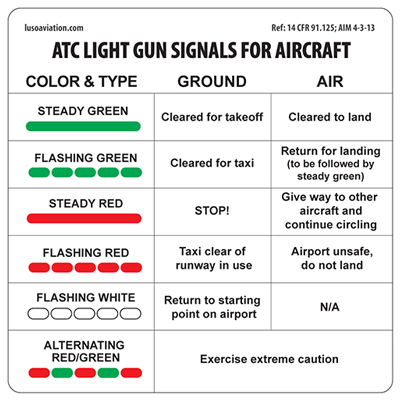
What does an alternating red and green light gun signal from ATC mean?
Exercise extreme caution.
What is the difference between pilotage and dead reckoning?
"Pilotage is navigation by reference to visible landmarks, while dead reckoning is navigation by computing direction and distance from a known position."
The _ illusion occurs when an abrupt change from climb to straight-and-level flight creates the feeling of tumbling backwards.
inversion
"The _ illusion occurs when a rapid acceleration pushes the pilot back in their seat, creating the sensation of being in a nose-up attitude."
somatogravic
What is hyperventilation and how can it be treated?
"It is an abnormal increase in breathing rate that leads to a deficiency of carbon dioxide
How is lift created? (phak3-4)
Newtons 3rd law, Bernoulli’s Principle
How does Newtons 3rd Law create lift
Airfoils accelerate airflow downward. The equal and opposite reaction forces the airfoil upwards.
How does Bernoulli’s Principle create lift?
As the velocity of a fluid or gas increases the pressure decreases. High speed air over the upper surface creates low pressure area while comparatively lower speed air beneath the wing creates high pressure which produces an upwards force that contributes to the total lift.
Types of drag
Parasite Drag (Form, skin friction, interference) and Induced Drag
Coriolis Illusion
Sudden head movement (after your body has gotten used to one motion ) makes you feel like your tumbling in all sorts of directions. Keep head movements slow and steady during turns
Elevator Illusion
Plane hits updraft, it feels like your in a climb when your not. Trust the instruments before taking corrective action
False Horizon
Occurs when real horizon not visible, can cause you to put incorrect control inputs based on the false horizon. Rely on instruments when you have no visual reference to horizon.
Leans Illusion
Feels like your leaning/banking to one side when you’re straight and level. Can occur from super gradual turns. Trust instruments and avoid slow gradual turns
Autokinesis Illusion
At night, stationary lights can look like they’re moving when you focus directly on them. Dont focus on single points at night, look off center and keep scanning
What does steady green light signal mean to aircraft on ground?
Cleared for takeoff
What does flashing green light signal mean to aircraft on ground?
Cleared to taxi
What does flashing green light signal mean to aircraft in flight?
Return for landing,(to be followed by steady green)
What does steady red light signal mean to aircraft in flight?
Give way to other aircraft, continue circling
What does steady red light signal mean to aircraft on ground?
STOP!
What does flashing red light signal mean to aircraft in flight?
Airport unsafe, do not land