Science 10.3 - Physics/ Kinematics
 Call Kai
 Learn
 Practice Test
 Spaced Repetition
 Match
 Flashcards
 Knowt Play
1/54

Earn XP
Description and Tags
55 Terms
What is a scalar vs vector quantity?
Scalar - a quantity that has magnitude (size/extent).
Vector - a quantity with both direction and magnitude.

What does the area under an acceleration time graph indicate?
Change in velocity
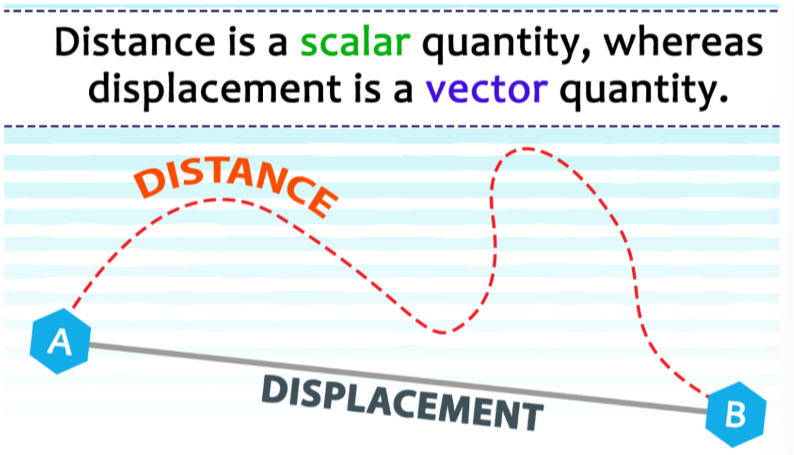
Distance vs Displacement
Distance (d) is how far an object or body has travelled (scalar). Total distance travelled.
Displacement (s) is how far an object or body is from its point of origin (vector). Shortest route between two points.
Both are measured in meters
How is displacement calculated
Displacement = X2-X1 where displacement is the difference between the final (X2) and initial (X1) position.
Speed vs Velocity
Speed (v) is how fast an object or body is travelling (scalar)
Velocity (v with a direction attached to the measurement) is how fast an object or body is travelling with a direction (vector
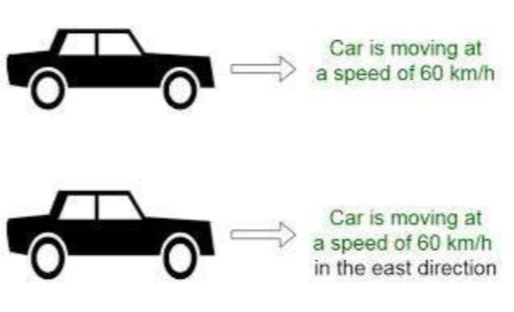
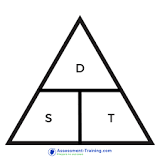
How are speed and velocity calculated? How is average speed or velocity calculated?
s = d/t where distance is meters and time is seconds.
velocity = displacement/time
Vav = total distance travelled (d)/total time taken (t)
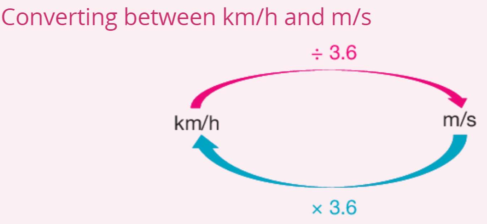
How do you convert km/h to m/s and vice versa.
km/h is divided by 3.6 to convert to m/s. m/s is multiplied by 3.6 to convert to km/h.
Compare instantaneous and average velocity of an object.
Average - overall speed covering A to B - (does )
Instantaneous - how fast a body is travelling at a particular point in time
How is total distance calculated using a velocity/time graph.
The total distance is the total area under the graph.
(displacement) = velocity (v-->) x the change in time
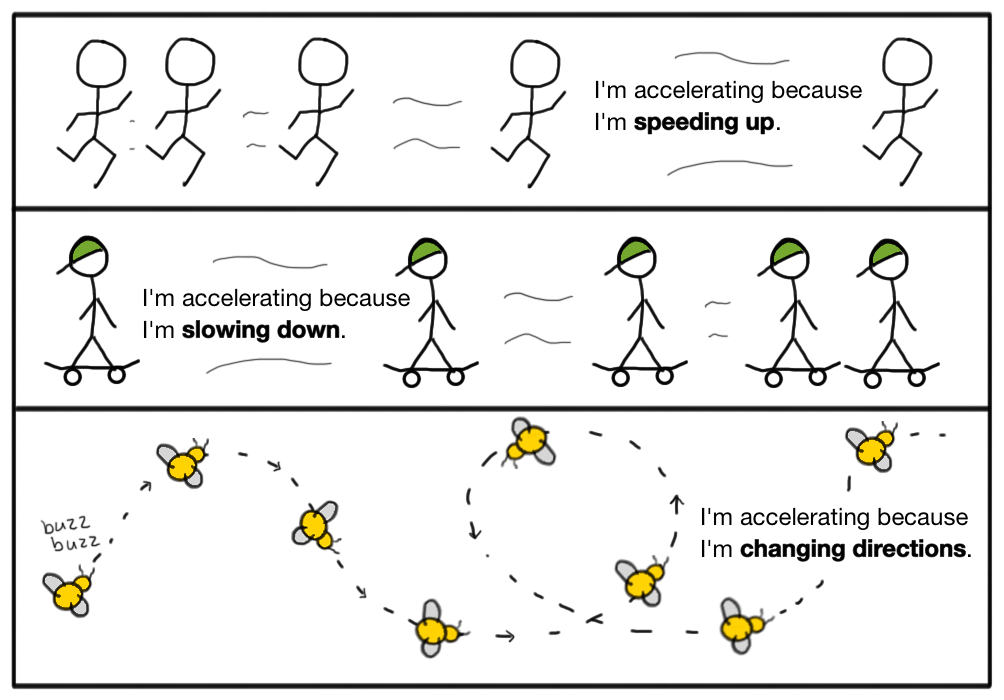
What is acceleration?
Acceleration is a rate of change in velocity (speed and direction) (how fast something CHANGES). Can be +ve or -ve (deacceleration). It is a vector quantity and is a name given to a change in any element of velocity, speed or direction.
What does the area under an acceleration time graph represent? What does the area under a velocity time graph represent? What does the gradient represent?
The area under an acceleration graph represents the change in velocity. In other words, the area under the acceleration graph for a certain time interval is equal to the change in velocity during that time interval.
The area enclosed under the velocity-time graph gives distance/displacement. The slope of the line gives acceleration.
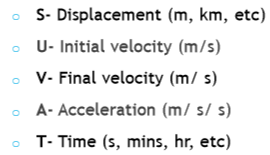
What are the meanings and units for the variables SUVAT
s - distance, u - initial velocity, v - velocity at time t , a - acceleration and t - time.
Define inertia
The property of objects that makes them resist changes in their motion. The greater the mass, the greater the inertia.
Inertia is an objects resistance to a change in its motion
Inertia is caused because objects have mass
The more mass an object has the more inertia
Define Force
a push, pull or twist applied to one object by another. It is a vector which means it requires a magnitude and a direction to describe it. Unit is the newton (N).
What is Newtons First law of motion?
If an object is at rest, it tends to stay at rest unless an unbalanced (outside) force acts on it.
If an object is in motion, it tends to stay in motion unless an unbalance (outside) force acts on it.
In other words - an object will remain at rest or will not change its speed or direction, unless its acted upon by an outside, unbalanced force.
What is Newton’s second law of motion?
The acceleration of an object depends on the size of the net (total or resultant) force and the mass of the object
The greater the mass = greater inertia = more force needed
What is the formula for Newton’s second Law
F = ma where F = force (N), m = mass (kg), a = acceleration (m/s/s)
What is Newton’s third law of motion
For ever action there is an equal and opposite reaction.
E.g. rockets take off because of a force downwards from the bottom makes them accelerate in the opposite direction.
Every time there is an action force, there is also a reaction force that is equal in size and acts in opposite direction. States that forces must ALWAYS occur in pairs (2).
Define potential energy
Potential energy is energy stored in an object due to its position, arrangement or state. When these factors change the energy will be released.
E.g. rock on a hill, has the potential to roll down. Energy is stored in the rock through mass and height.
Define kinetic energy
Kinetic energy is energy of an object due to its movement - its motion/
E.g. rubber band flying through the air, ball rolling down a hill.
Gravitational potential energy
Gravitational potential energy - location is above the earth which has a gravitational force downwards, potential to move towards the earth.
Chemical potential energy
The energy stored in the bonds between atoms and molecules, when these bonds are broken in a chemical reaction these bonds are broken and stored energy is released. i.e. in food (sugar from photosynthesis in plants release when we digest giving us glucose for energy), in coal.
Elastic
Potential energy when compressed, deformed or stretched (i.e. the large the stretch the more potential energy there is). The energy that is stored in elastic materials.
E.g. spring, rubber band is stretched, potential to return to original unstretched position upon release. When stretched it has potential energy. (the kinetic energy used to stretch or compress is converted into potential energy in the object)
Electrical kinetic energy
Energy - movement of billions of fast moving electrons e.g. solar, vehicle
Radiant kinetic energy
movement or travelling of electromagnetic energy - electromagnetic spectrum e.g. visible light, x-rays, solar radiation used for photosynthesis
Thermal kinetic energy
Heat due to faster movement of particles
Sound kinetic energy
The vibration of particles, movement
Distinguish between kinetic and potential energy
Potential energy is stored and when released is converted into kinetic energy.
Potential energy regards position, arrangement and state.
Kinetic energy regards motion.
As one of these increases the other decreases, together they are total mechanical energy
Define weight
Weight is another word for the force of gravity acting on an object. Weight is the vertical force exerted by a mass as a result of gravity. - the strength of gravitational pull, how heavy is it
The Earth pulls all object with a force of gravity downward toward Earth. Units are (N) because weight is a force
Define mass
Mass is denoted by (m) and refers to how much matter is in an object. Mass is the property of a body that causes it to have weight in a gravitational field.
The more mass a person has the greater the pull of gravity on them. E.g. a person with a mass of 120kg has weighs more than someone of 60kg
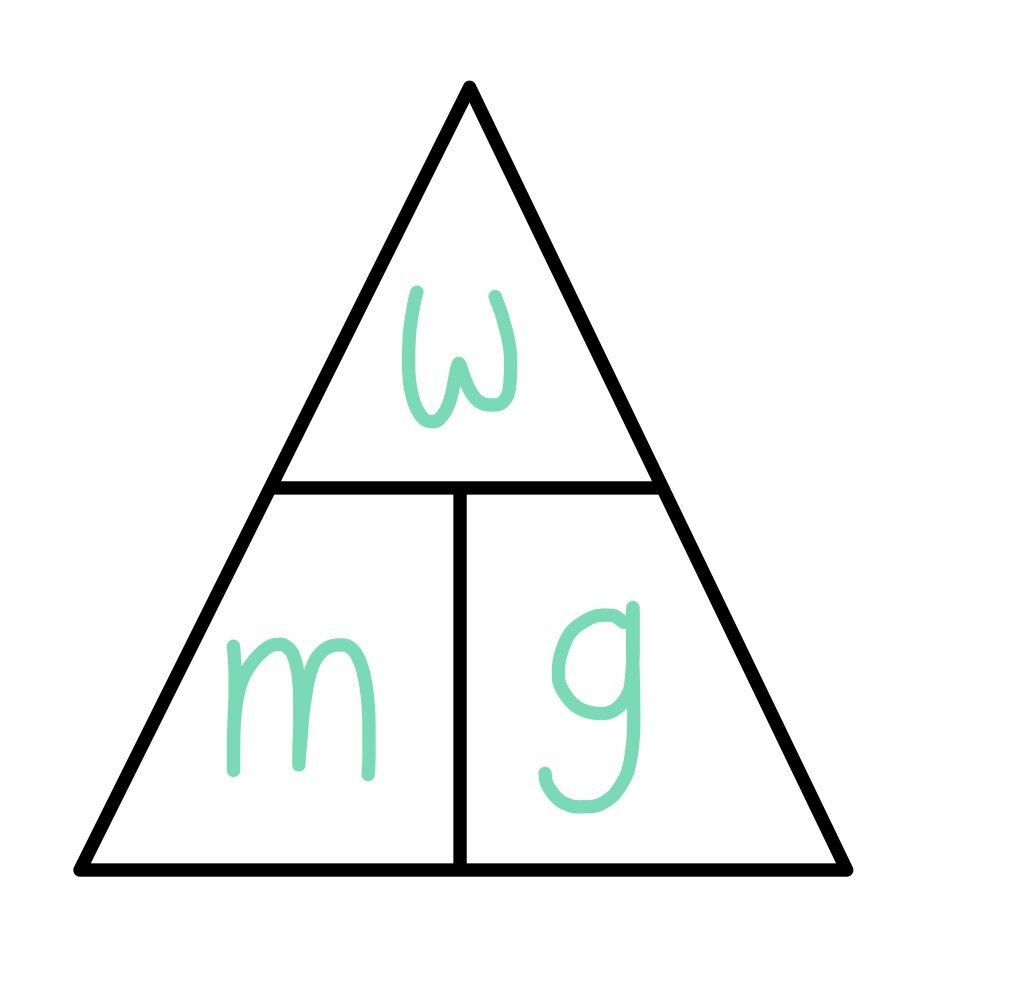
How do you calculate weight?
A variation of F = ma
W = mx g
W = weight of the object
m = mass of the object
g = acceleration due to gravity
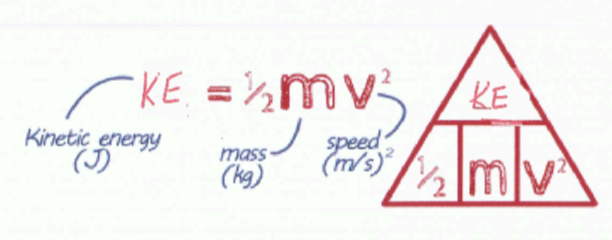
What is KE measured in and what formula can be used to calculate it?
Joules (J)
What factors affect GPE (gravitational potential energy)
GPE is directly proportional to mass and height
mass refers to how much matter is in the object.
height refers to the distance above the ground
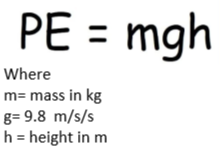
What formula can be used to calculate the GPE of an object
GPE = mgh
Define work
Work done is the energy transferred when a force is used to move an object. The change in energy of an object.
Under what two conditions does work increase?
If it is moved further
If the object is heavier (more force is needed to move an object with greater inertia)
What formula can be used to calculate work done?
Work done = force x displacement/distance
What does a negative/positive slop on a position vs time graph indicate about the objects direction of motion.
Positive slope = right moving
Negative slope = left moving
What does a straight line on a position vs time graph represent? What does a horizontal line on a position vs time graph represent? How about a curved line?
Straight = constant velocity
Horizontal = stationary
Curved = changing speed
What does the steepness of a line on a position vs time graph represent.
Steepness = speed
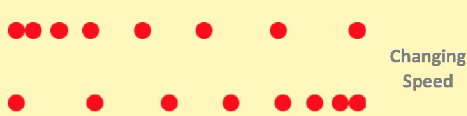
On a dot motion diagram, is an object moving faster or slower when the dots are further apart?
Faster. Note: evenly spaced dots mean that the object is moving at a constant speed.
See the image: top option is accelerating from a constant speed.
Law of Energy Conservation
The law of conservation of energy states that energy can neither be created nor be destroyed. Although, it may be transformed from one form to another. If you take all forms of energy into account, the total energy of an isolated system always remains constant.
What is energy efficiency?
Energy efficiency (physics), the ratio between the useful output and input of an energy conversion process. Electrical efficiency, useful power output per electrical power consumed.

What is useful vs wasted output energy?
All energy transfers and transformations involve some waste energy
Useful output energy – Energy put to its intended use. Amount of useful energy produced by a device.
Wasted energy – Energy not put to its intended use Amount of energy that is not used for the required output, converted to another form of energy (heat, sound or light).
e.g. The production of heat and light is useful output energy for a laptop as it energy here is put to his intended use. However, outputted heat energy is considered waste.
How is percentage energy efficiency calculated?
Efficiency = useful output energy/total input energy x 100%

Explain the relationship between a displacement-time graph and a velocity-time graph
Displacement-Time & Velocity-Time:
Slope of displacement-time graph gives velocity.
Area under velocity-time graph gives displacement.
Constant velocity results in a straight line on a displacement-time graph.
Explain the relationship between a velocity-time graph and an acceleration-time graph
Velocity-Time & Acceleration-Time:
Slope of velocity-time graph gives acceleration.
Area under acceleration-time graph gives change in velocity.
Constant acceleration results in a straight line on a velocity-time graph.
What forces act on a vehicle in a straight line motion on a horizontal surface
Resistance forces, normal force, thrust or driving forces
What are resistant forces?
Forces applied to prevent or oppose motion between surfaces in contact e.g. friction
What are normal forces?
The reaction or support force exerted by a surface at right angles (perpendicular) to an object resting on it. e.g. push into your hand from a surface (maybe shown as an upward arrow on force diagrams)
What are thrust or driving forces
Cause an object to accelerate forward e.g. an oar through the water
Define contact forces, give examples
Forces that require physical contact between objects e.g. friction, normal force, tension
Define non-contact forces, give examples
Forces that act over a distance without physical contact. e.g. gravitational force, electromagnetic force, magnetic force
What is resultant/ net force
The resultant force is the force that would have the same effect on the object as multiple forces combined. It is the sum of the forces acting on an object.
e.g. If two people are pulling on a rope in opposite directions, the resultant force is the difference between the two.