Periodic Motion
 Call Kai
 Learn
Learn Practice Test
 Spaced Repetition
 Match
Match Flashcards
 Knowt Play
1/4

There's no tags or description
Looks like no tags are added yet.
Name | Mastery | Learn | Test | Matching | Spaced | Call with Kai | Chat |
|---|
No analytics yet
Send a link to your students to track their progress
5 Terms
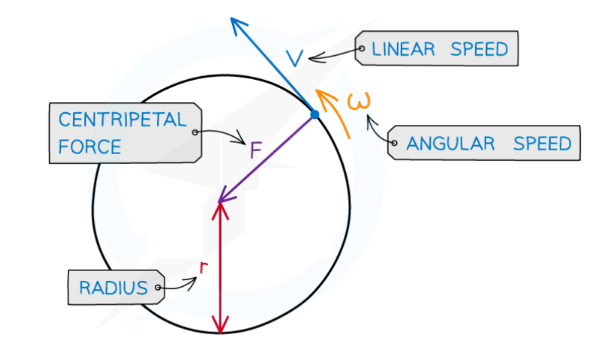
What is Circular Motion?
The motion of an object in a circular path at constant speed with a constantly changing velocity. This means that the object is constantly accelerating which must be due to a force being applied, newton’s first law.
What is Centripetal Force and Centripetal Acceleration?
Centripetal Force - The resultant force on an object that moves along a circular path. F = mv² / r = mω²r
Centripetal Acceleration - The acceleration experienced by an object moving in uniform circular motion. a = v² / r = ω²r
What is Angular Speed?
The angle an object moves through per unit time/The rate at which an object rotates around an axis. ω = v / r = 2πf = 2π / T
It is measured with the units rad s-1.
Examples of Circular Motion on a road:
On a Hill:
Consider a vehicle of mass m moving at speed v on a hill.
At the top, the support force S from the road opposes the weight mg.
The resultant force is the difference between S and mg acting towards the centre.
Equation: mg - S = mv² / r
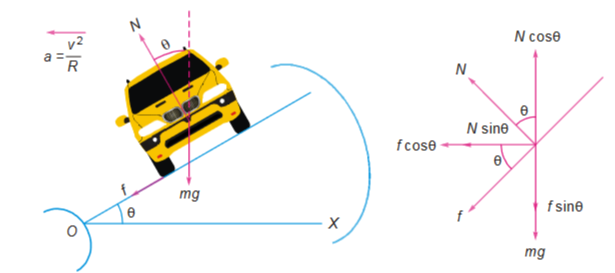
On a Banked Track
Consider a vehicle of mass m moving on a banked track with angle θ.
The force acting on it will be weight mg and the support force N acting outwards.
By resolving forces you can prove that for speeds there is not sideways friction
Examples of Circular Motion at a fairground:
The Big Dipper:
At the bottom of the ride, the support force S acts vertically upwards against mg.
Therefore for a speed v at the bottom of radius r, S - mg = mv² / r.
This means that the extra force you experience due to circular motion is mv² / r.
The Long Swing:
On a ride with person of mass m, with swing length L released from height h, the maximum speed occurs during the lowest point.
You can find this speed by equating kinetic energy to the loss of gravitational potential, and rearrange to get equation v² = 2gh
At the lowest point, the support force S acts up the rope opposite to mg.
Therefore S - mg = mv² / L = 2mgh / L
As a result the extra support force the person experiences is 2mgh / L
The Big Wheel:
At a maximum height, the reaction force R from the wheel on each person acts downwards, making the reaction force equal to mg + R
Therefore the total force mg + R = mv² / R
This results in the reaction force R = mv² / r - mg