Chem 241 Exam UNC Tiani
 Call Kai
 Learn
Learn Practice Test
 Spaced Repetition
 Match
Match Flashcards
 Knowt Play
1/158

There's no tags or description
Looks like no tags are added yet.
Name | Mastery | Learn | Test | Matching | Spaced | Call with Kai |
|---|
No analytics yet
Send a link to your students to track their progress
159 Terms
Extraction
the physical transfer of a solute from one phase to another
some goals of a separation
100% recovery: product from a synthesis
100% purity: diff. forms of same compound (enantiomers)
Separations involve phase transfers:
1. analyte out of sample matrix
2. other compounds out besides analyte
precipitation
liquid to solid
solvent-solvent extraction
solvent 1 to solvent 2
distillation
liquid to gas
sublimation
gas to solid
distribution constant (Kd)
organic over aq, characters of the analyte, organic phase, and aq phase
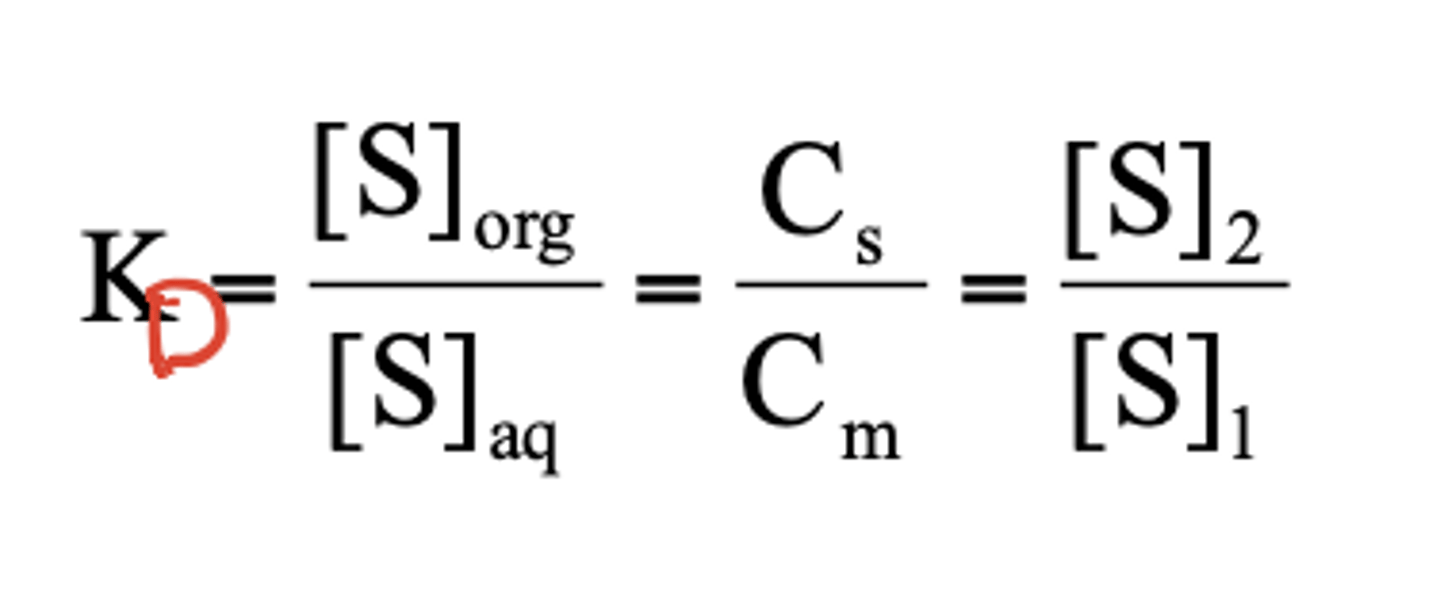
A solute in an aq solution is to be extracted using 150 mL of organic solvent. What method will extract the maximum amount of solute?
many extractions with smaller volumes of organic solvent
What is important to remember about extractions number?
ROUND UP
what is q?
fraction left behind in the water/aq phase
In a solvent-solvent extraction, charged acid-base species (e.g. BH+ and A-), as compared to neutral species (e.g. HA and B) are...
more soluble in the aqueous phase than the organic phase
What is the impact of the extraction of a weak acid (HA) into an organic solvent as the pH of the aq phase increases?
As pH increases, the value of D decreases and the percentage of the weak acid left in the aq phase increases.
pH effects in solvent-solvent extraction
HA - D decreases as pH increases
B - D increases as pH increase
When trying to calculate the fraction of weak base in the form B, extracted from a buffered solution into an organic solvent, what is the distribution coefficient you would use?
Kd partical fraction A-
You are trying to develop an extraction scheme to separate a neutral, non-acid-base organic compound (N) from a weak acid (HA, pka = 4.5). Both species are present in an aqueous solution. What strong species do you add first before adding organic solvent?
NaOH bc the charges of the analyte and other compound need to be diff. for their to be an extraction
What would happen to the peak profile if the flow were stopped and the column were allowed to sit?
It would broaden and diminish in height bc of diffusion
Affinity chromatography
specific groups are attached to the stationary phase to attract the solute
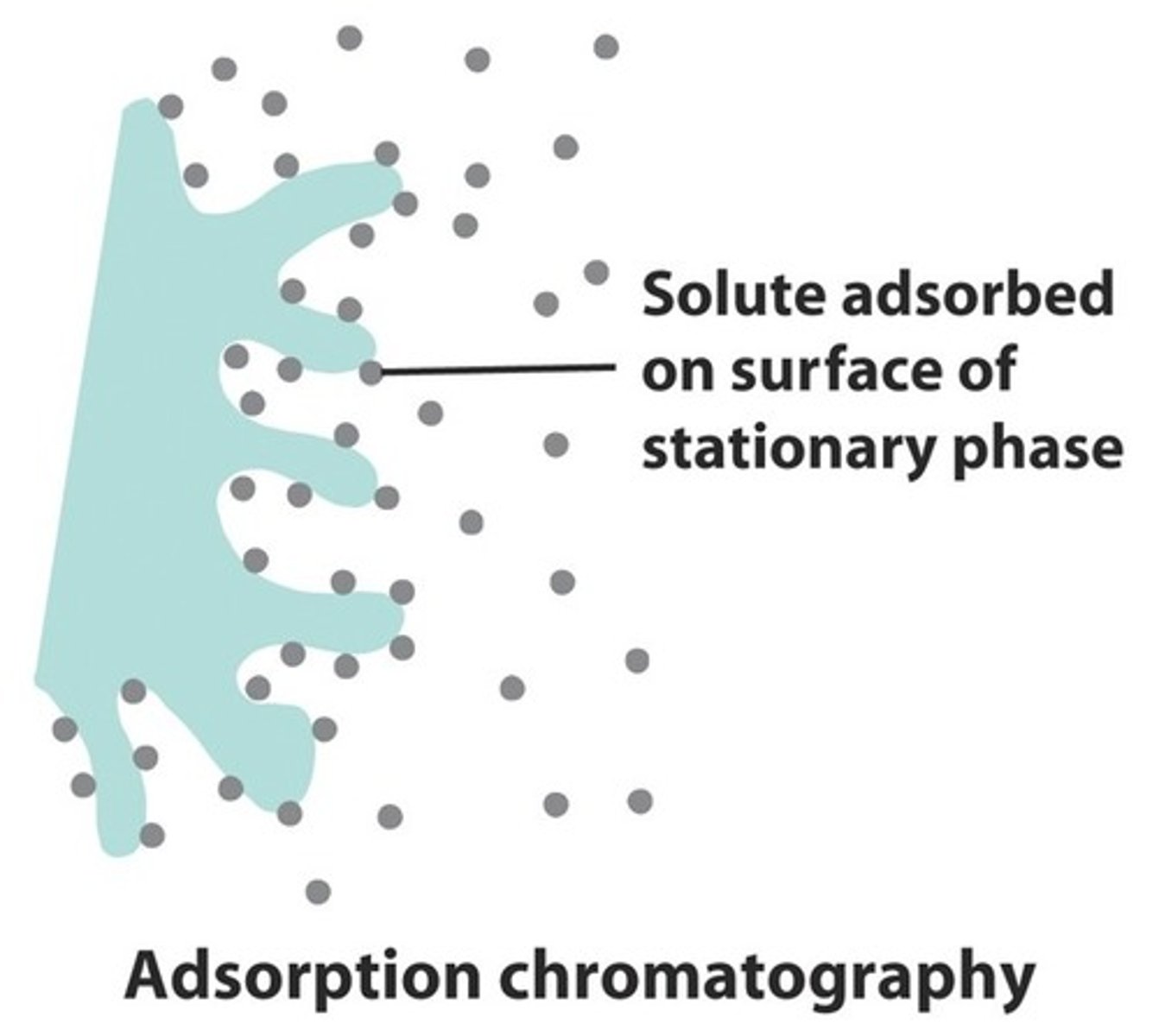
adsorption chromatography
solute molecules equilibrate btwn the mobile phase and the surface of the stationary phase
gas-solid adsorption chromatography
Semi Permanent retention of active or polar analytes
Not very common
Non-linear adsorption resulting in peak tailing
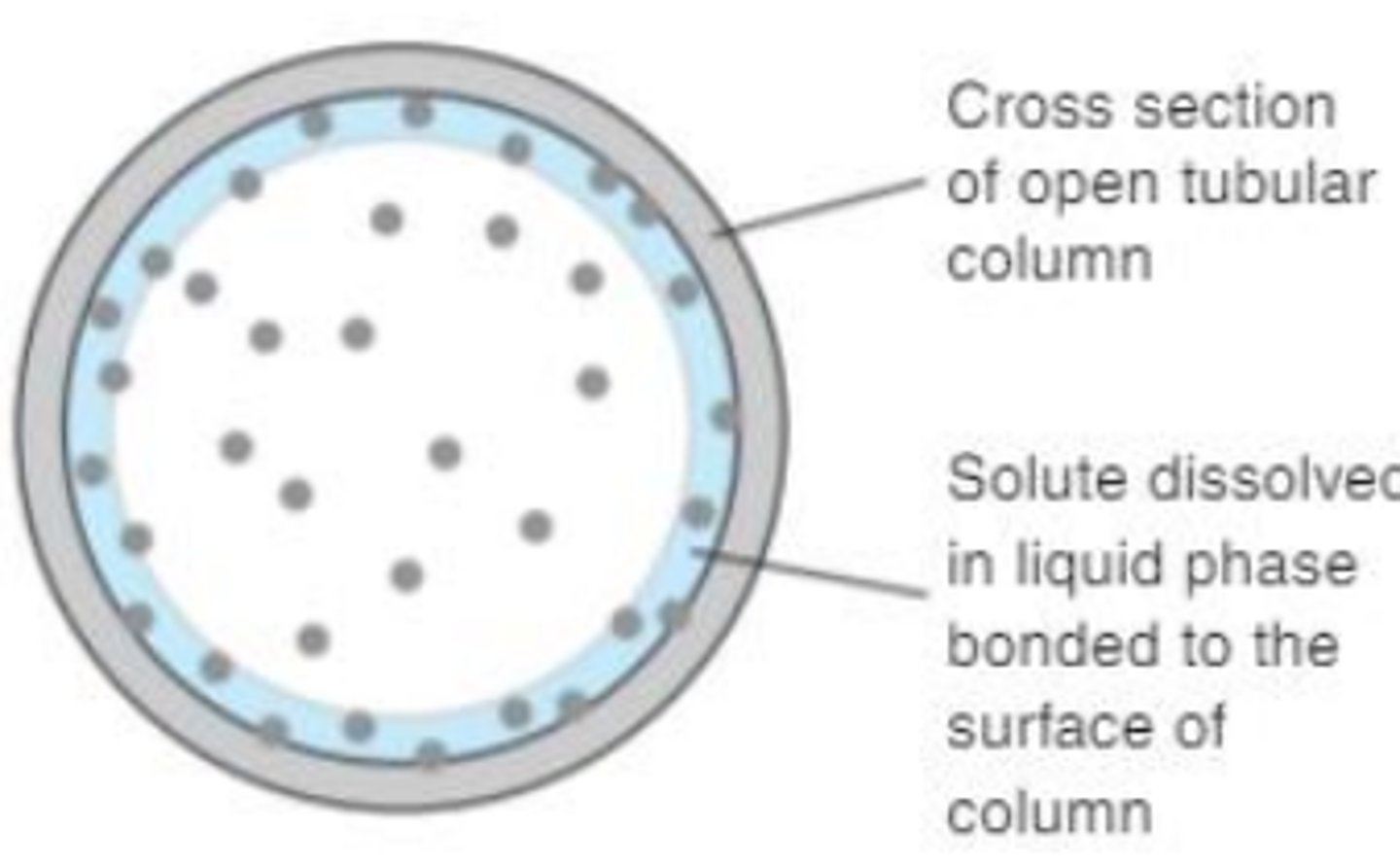
partition chromatography
solute dissolved in liquid phase bonded to the surface of the column
size exclusion chromatography
large molecules are not retained
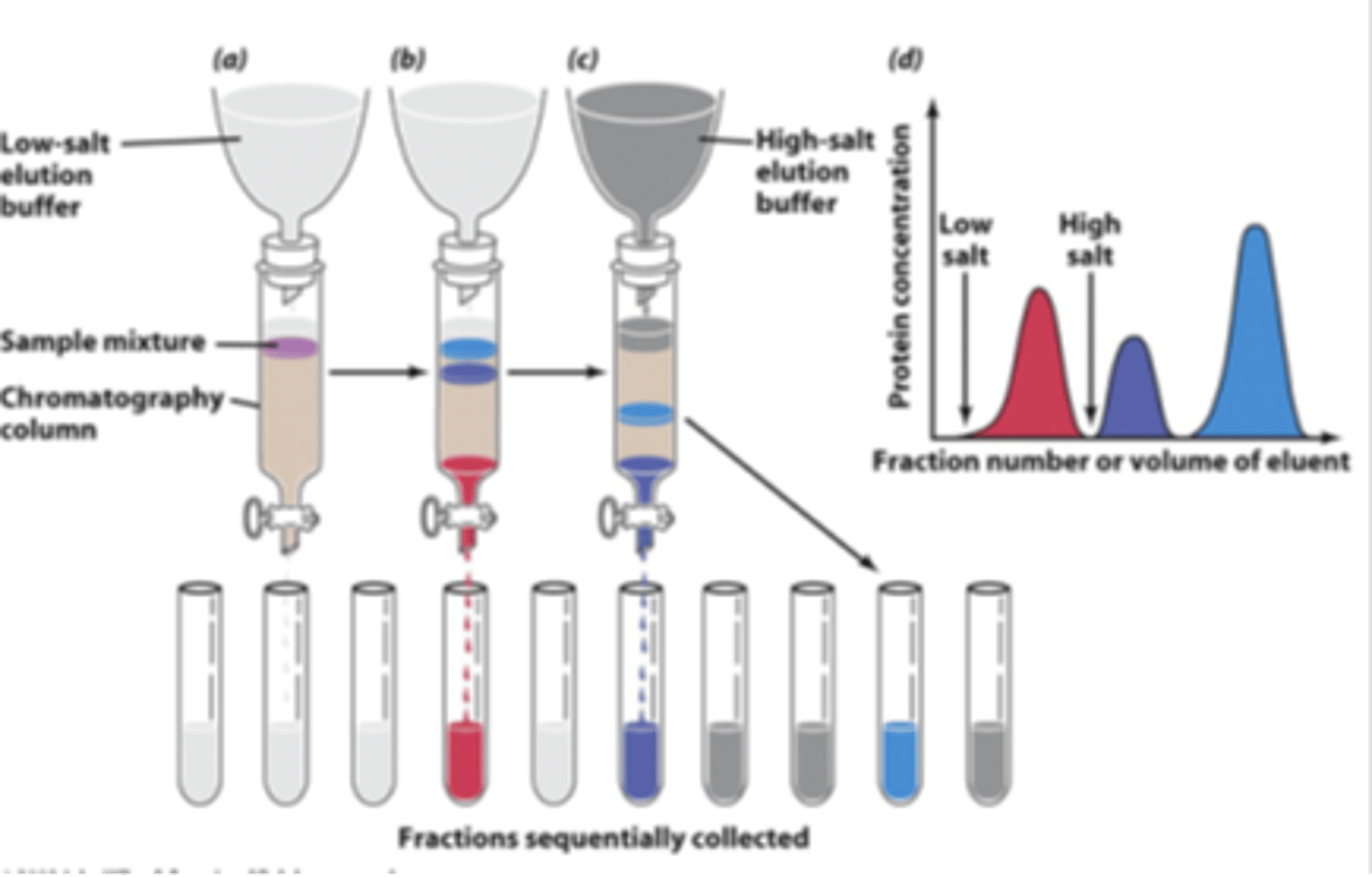
ion exchange chromatography
1. mobile anions held near cations that are covalent attached to stationary phase
2. anion-exchange resin; only anions can be attracted to it
What is usually tm in GC?
CH4 and air bc they are known not to be retained, but you will still see a peak
What is the peak area under a chromatogram from a liquid chromatography exp. proportional to?
concentration
What it the expression for the retention factor/capacity factor (k)?
tr-tm/tm
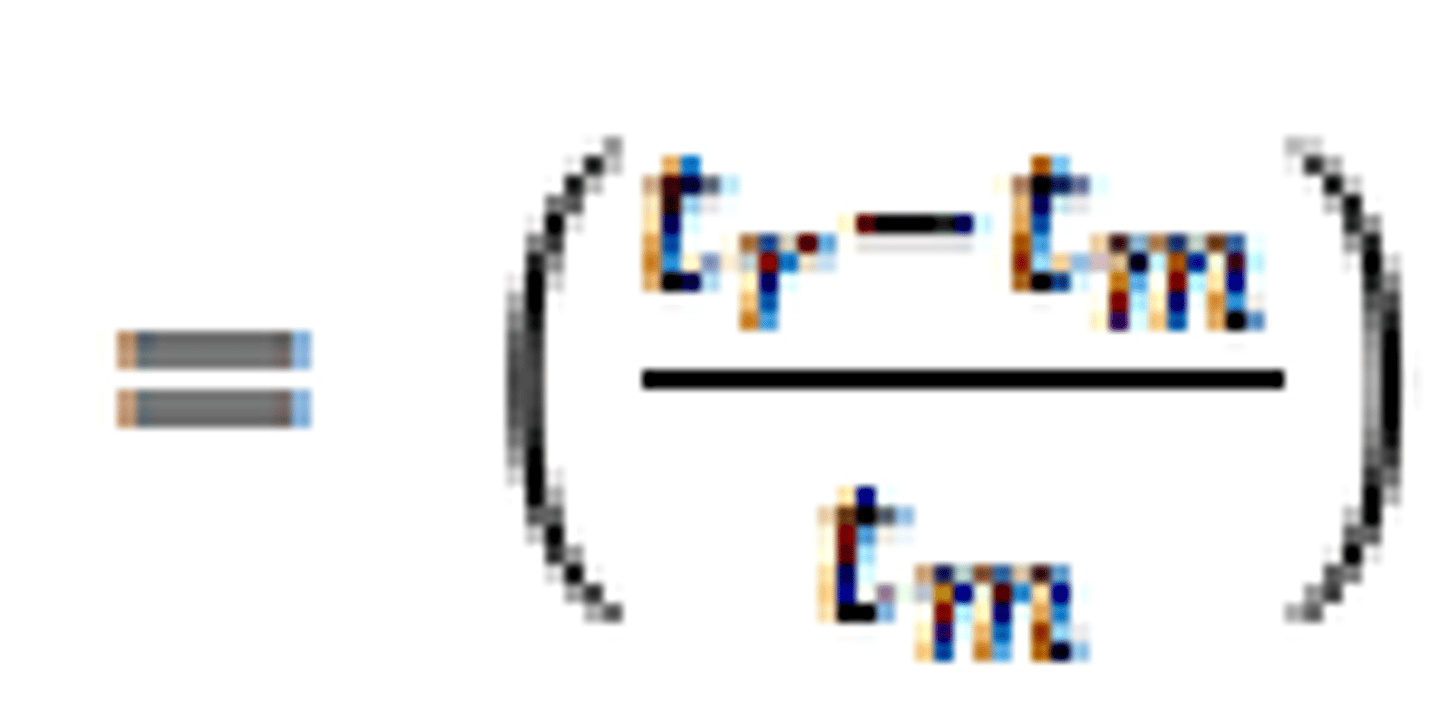
What is true if K is very large? >30
1. the solute may not elute from the column bc it is strongly retained
2. the solute spends majority of time in the stationary phase
What is the separation factor/relative retention/selectivity coefficient?
t'r2/t'r1 --- always greater than 1
What will an increase in the separation factor do to a chromatogram?
increase separation btwn peaks
What will an increase in retention factor do to a chromatogram?
Shift it to the right, peaks broaden
What will an increase in N do to a chromatogram?
Increase peak height, narrow peaks
We want plate height to be --- so that we have ---- in our chromatogram and thus achieve --- separations.
small; narrower peaks; more efficient
What variables measure separation efficiency?
N, H, and R
In chromatography, you can increase column efficiency by (H, L, N)
increasing N and L (L to a point) & decreasing H
Why can we only increase L to a point to increase separation efficiency?
bc increasing L will increase the diffusion coefficient bc it increases the time on the column
What resolution do you want?
greater than 1.5 bc 1.5 is baseline
T/F: resolution is proportional to the number of plates on the column.
FALSE: R ~ square root N ~ square root L
How do you change resolution in GC?
vary column temperature
How do you change resolution in LC/HPLC?
change MP composition
How do you change resolution in GC or LC/HPLC?
change SP composition
What layer are charged species soluble in?
aqueous MP, not in organic SP
What layer are neutral species soluble in?
partition btwn MP and SP
What are the 3 primary modes of band broadening that we need to consider in chromatography?
multiple solute paths in column, longitudinal diffusion, and mass transport issues
Multiple path term (A) depends on what
quality of packing and stationary phase particle diameter
What is the van Diameter equation for GC exp. w/ an open tubular column
H = B/ux +Cux
open tubular vs packed columns
OTC: higher resolution, shorter analysis time, increased sensitivity, lower sample capacity
GC vs. LC/HPLC
GC:
-OTC- very common
-packed columns
-no guard column
LC/HPLC:
-packed columns only
-guard columns used often
-shorter columns
-large column diameters
Mass transfer (Cux)
depends on diameter of particles (packed column) or column diameter if OT, diffusion coefficient of solute in the MP or SP, and thickness of SP
Higher mass transfer (C):
particle diameter
increase diameter of particles (packed column) or column diameter if OT
Lower mass transfer (C):
particle diameter
decrease diameter of particles (packed column)or column diameter if OT
Higher mass transfer (C):
diffusion coefficient
decrease diffusion coefficient
Lower mass transfer (C):
diffusion coefficient
increase diffusion coefficient
Higher mass transfer (C):
SP thickness
increase thickness of SP
Lower mass transfer (C):
SP thickness
decrease thickness of SP
What part of the curve is governed by mass transport?
right
What part of the curve is governed by longitudinal diffusion?
left
What part of the curve is governed by multiple paths (eddy diffusion)?
middle (up or down)
What does overloading in GC cause?
fronting
Overloading
solute moves through column more slowly at higher concentrations
Fronting
gradual increase at front end of peak and normal gaussian shape at back end of peak
liquid SP film is saturated w/ solute so SP looks like solute
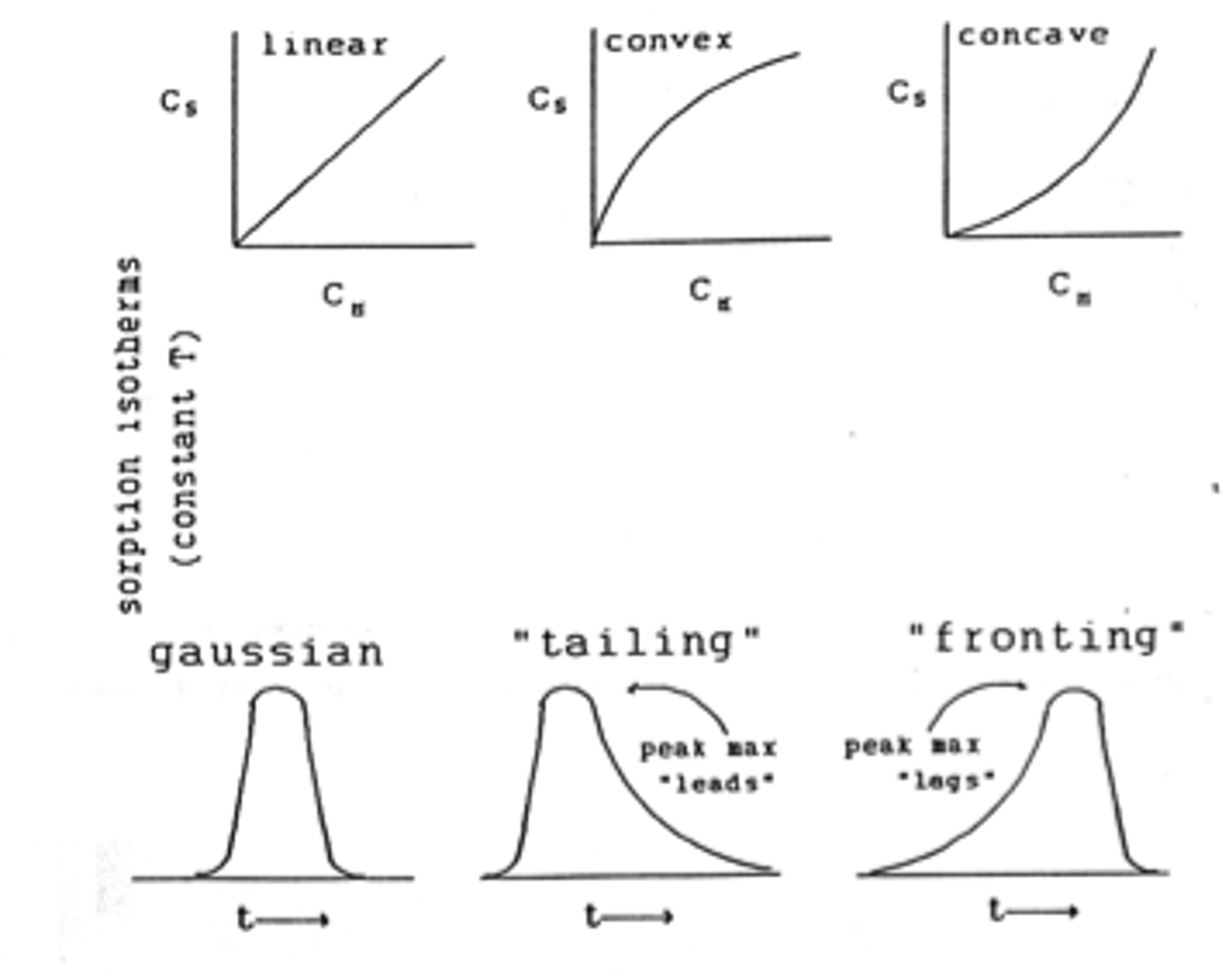
Fronting does what to Kd
increases it
tailing does what to Kd
decreases it
What does overloading in LC/HPLC cause?
tailing
What does "hot spots" cause?
tailing
tailing
limited retention capacity. at high solute conc's, solute saturates a significant portion of SP sites leaving fewer sites available for retention
Overall, retention of solute reduced
Tailing and hot spots
Si-O-H sites from silica surface "hot spots" - provide site of possible secondary interaction w/ solute
Silanization
solves tailing issue by capping the hot spot
GC MP
carrier gas, has no polarity, just comes simply through column
GC SP
liquid (partition) or solid (adsorption)
What samples can be analyzed in GC?
volatile liquids or gas samples
What temp must T-injector and T-detector be above?
~ 50 degrees C above least volatile compound
GC has ---- flow rates than LC/HPLC
faster bc OTC
GC has ---- column (capillary) lengths than LC/HPLC
longer
GC has ---- inner column (capillary) diameters than LC/HPLC
smaller
As the temperature of a GC increases, the vapor pressure of the analytes -----, the retention time -----, and the peak shapes ----
increases, decreases, sharpen
What compound will elute first in GC?
lowest boiling point
OTC for GC. Increasing the thickness of the stationary phase film affects which terms and how?
increase C and thus H, and increases the retention factor
Large diameter packed column
large sample capacity
greater surface area
higher pressure
smaller length
Full van equation
Narrow capillary GC OTC
lower sample capacity
higher resolution/
reduced plate height
smaller diameters
larger length
no A term
Gas-liquid partition chromatography
high BP liquid SP or solid support particles coated w/ a thin film
SPME
Sample preparation method where a stationary phase coated on a needle is exposed to sample for collection of analyte prior to analysis
0.32 mm inner diameter and 0.25 mm diameter OTC, the ---- column has better resolution
smaller
Butanol was found to elute later than octane despite having a lower BP on a GC w/ polar SP. Why?
Butanol is polar and can interact more strongly w/ the stationary phase
Requirements for GC stationary phase
high BP (non-volatile) bc "column bleeding" which is the decomposition and evaporation of SP at elevated column temperatures
Polar columns are good for ---- analytes
polar
non-polar columns are good for --- analytes
non-polar
GC non polar SP is based typically on ---
Boiling points
GC polar SP is based
polarity
When analyzing a mixture of samples by GC, all with a range of boiling points, what is used to obtain the most efficient separation?
temperature programing
Temperature programming should go from ----- bc
low to high bc otherwise all the compounds would elute at the start
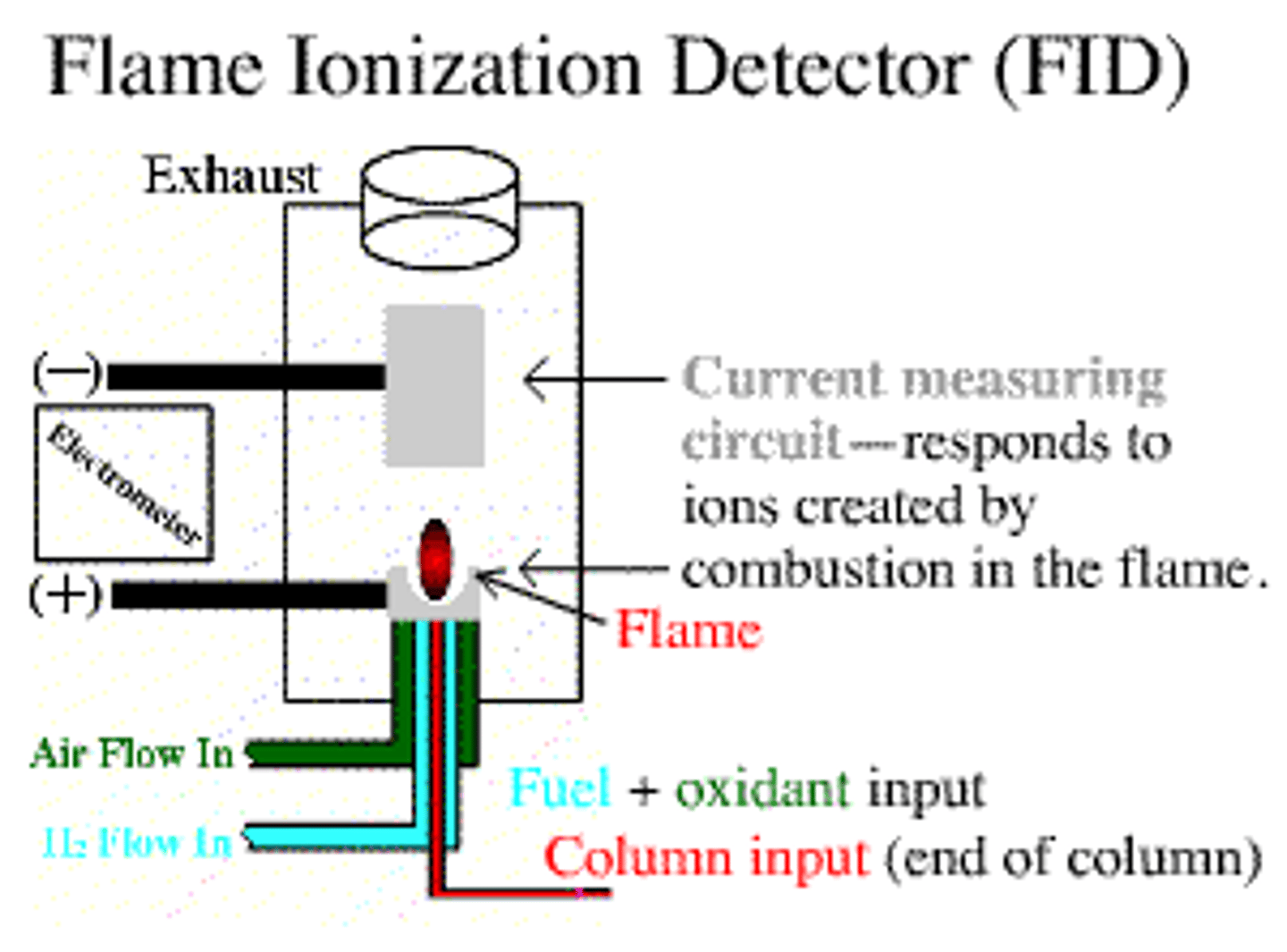
The GC detector most common for organic compounds is...
Flame ionization
Flame Ionization Detectors (FID)
mass detectors w/ peak area proportional to # of susceptible carbon atoms
The GC detector particularly sensitive to halogen containing molecules is...
electron capture
What are the destructive GC detectors?
Flame ionization and mass spectrometry
What are the nondestructive GC detectors?
thermal conductivity and electron capture
What does thermal conductivity detector measure?
voltage
What does electron capture detector measure?
current
What does flame ionization detector measure?
current
What does mass spectrometry measure?
intensity (abundance) vs. m/z
What type of device is thermal conductivity detector?
concentration sensitive (peak area ~ con.)