21-AEBI212- Birds and Migration
 Call Kai
 Learn
Learn Practice Test
 Spaced Repetition
 Match
Match Flashcards
 Knowt Play
1/42

There's no tags or description
Looks like no tags are added yet.
Name | Mastery | Learn | Test | Matching | Spaced | Call with Kai |
|---|
No analytics yet
Send a link to your students to track their progress
43 Terms
Characteristics of Birds (Class aves!)
Feathers
Forelimbs modified into wings
Hind limbs for walkings, swimming, or perching
Keratinized beaks and feathers
oviparous
What are two groups of living birds?
Paleognathae (ancient+ jaw) and Neognathae (new + jaw)
Paleognathae
Large, flightless birds
Flat sternum with poorly developed pectortal muscle
(Ostrich, Kiwi)
Neognathae
All other birds
Keeled sternum with powerful flight muscles
Nearly all fly (except penguins, they ‘fly” underwater)
Arboreal theory for flight evolution
Ancestors climbed to high places (trees) and glided down
Cursorial Theory for flight evolution
Ancestors flapped their wings to launch into air from ground (cursorial=adapted for running)
Adaptations for flight
wings for lift and propulsion
bones light + rigid
Efficient respiratory system (intense metabolic demands)
Rapid and efficient digestive system
Energy-rich diet
High-pressure circulatory system
What do feathers play a role in?
Mating, Territorial Dominance, Body temp regulation (insulation+ waterproofing), Camoflage, fight
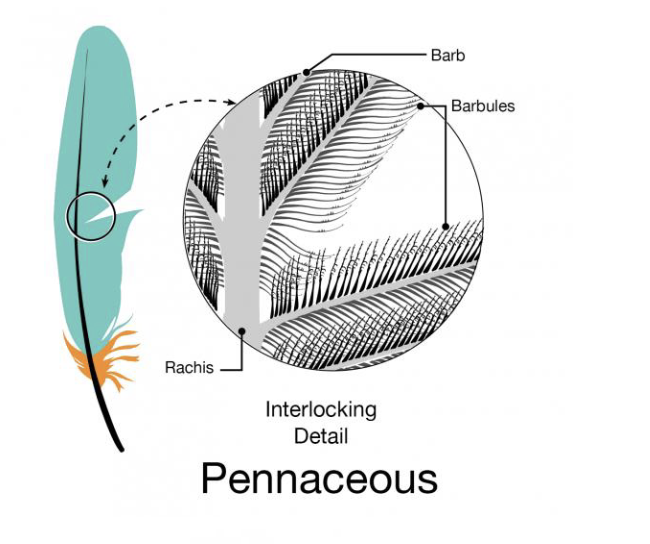
Shaft
made up of calamus and rachis
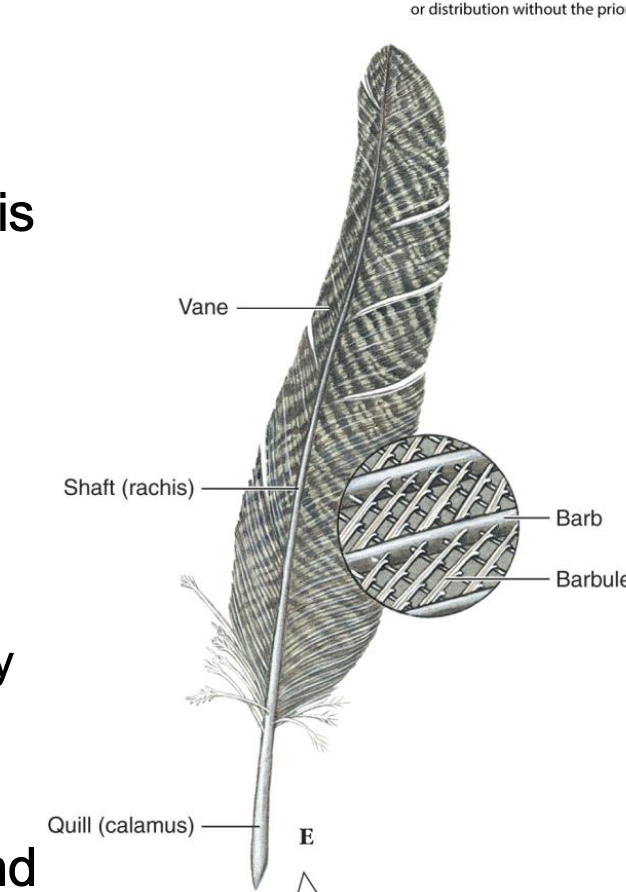
Vanes:
soft surfaces of the feather on either side of the rachis
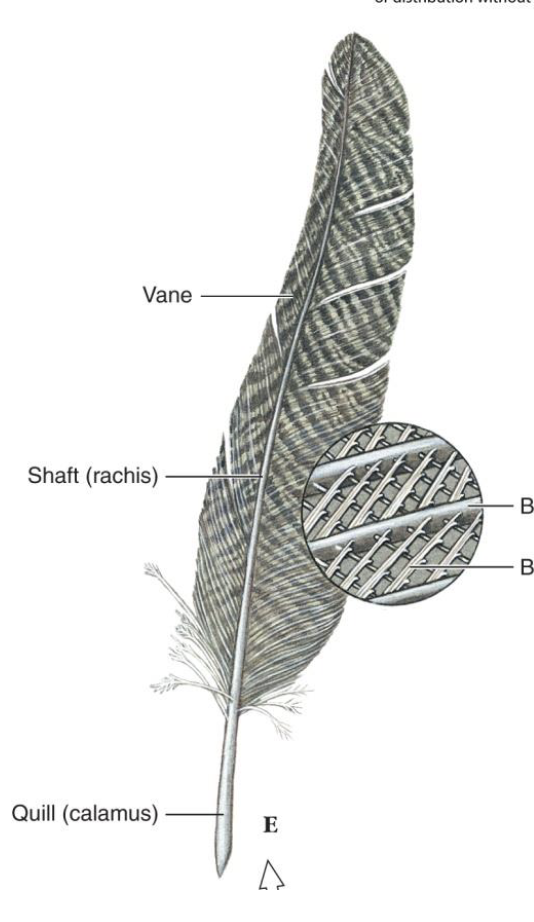
Barbs
Emerge from rachis(upper shaft): arranged in parallel and spread diagonally outwards
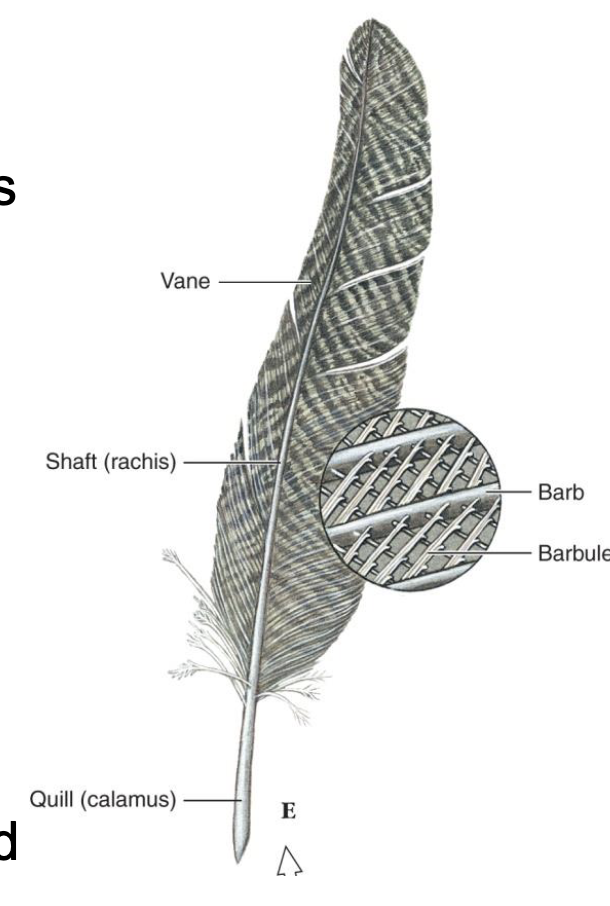
Barbules
Emerge from each barb and can the barbs together
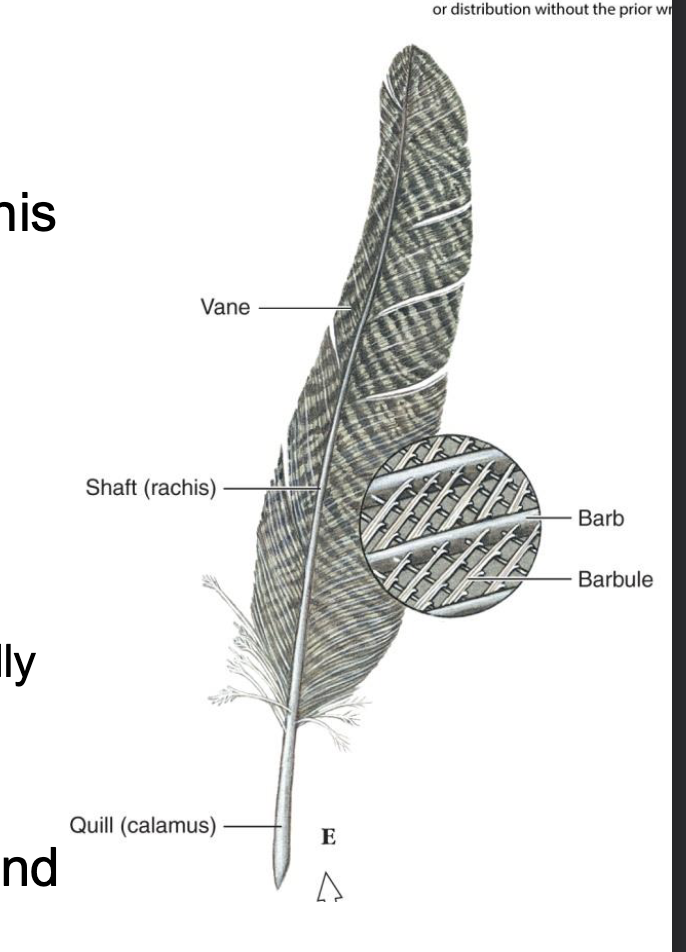
Pennaceous feathers
Interlocking barbules: stiff, flat, waterproof
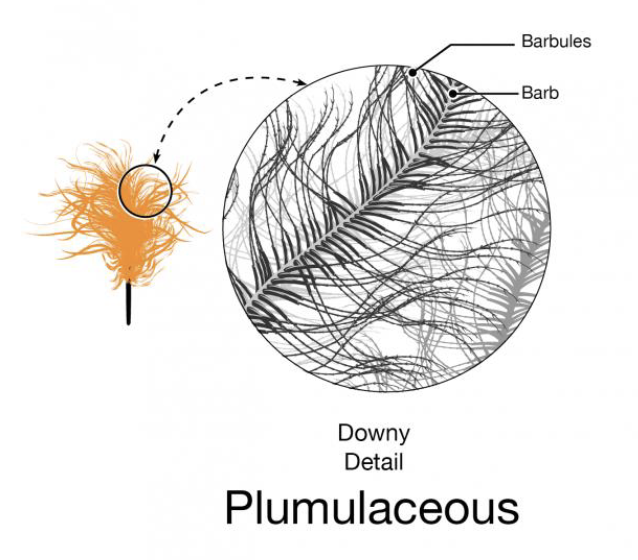
Plumaceous Feathers
Loosely arranged barbules: fluffy, downy, warm
Can feathers have both pennaceous and plumaceous regions?
Yes!
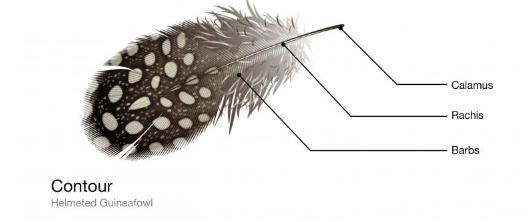
Contour feathers
The outermost feathers: gives bird its form. Incl: Wing feathers, tail feathers, and coverts
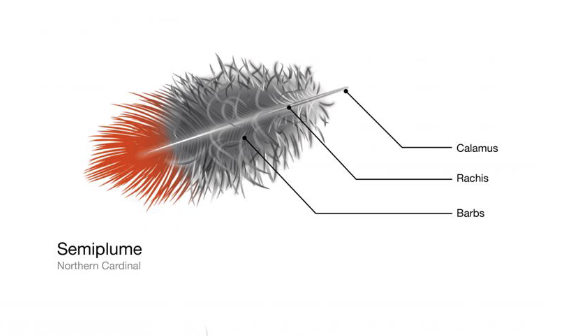
Semiplumes
beneath contour feathers: developed rachis, BUT no hooks on barbules
Down
beneath contour feathers: soft tufts without a rachis
Contour feathers- Remiges
Wing feathers
Asymmetrical vanes
Attached by ligaments or directly to the bone
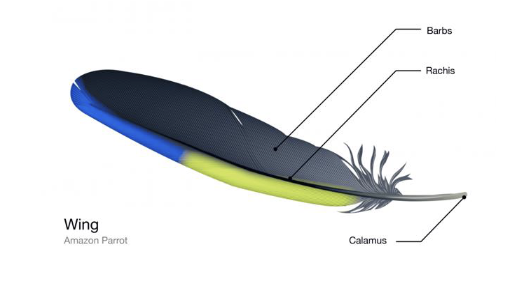
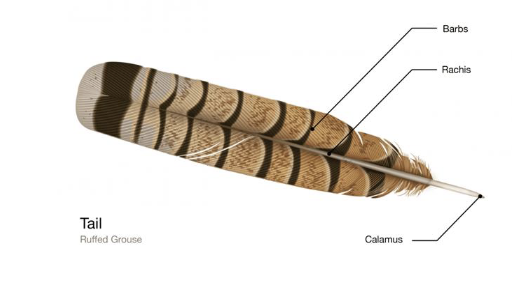
Contour feathers- Rectrices
Tail feathers
Symmetrical vanes
Attached to each other by ligaments
Only innermost are attached to tailbone
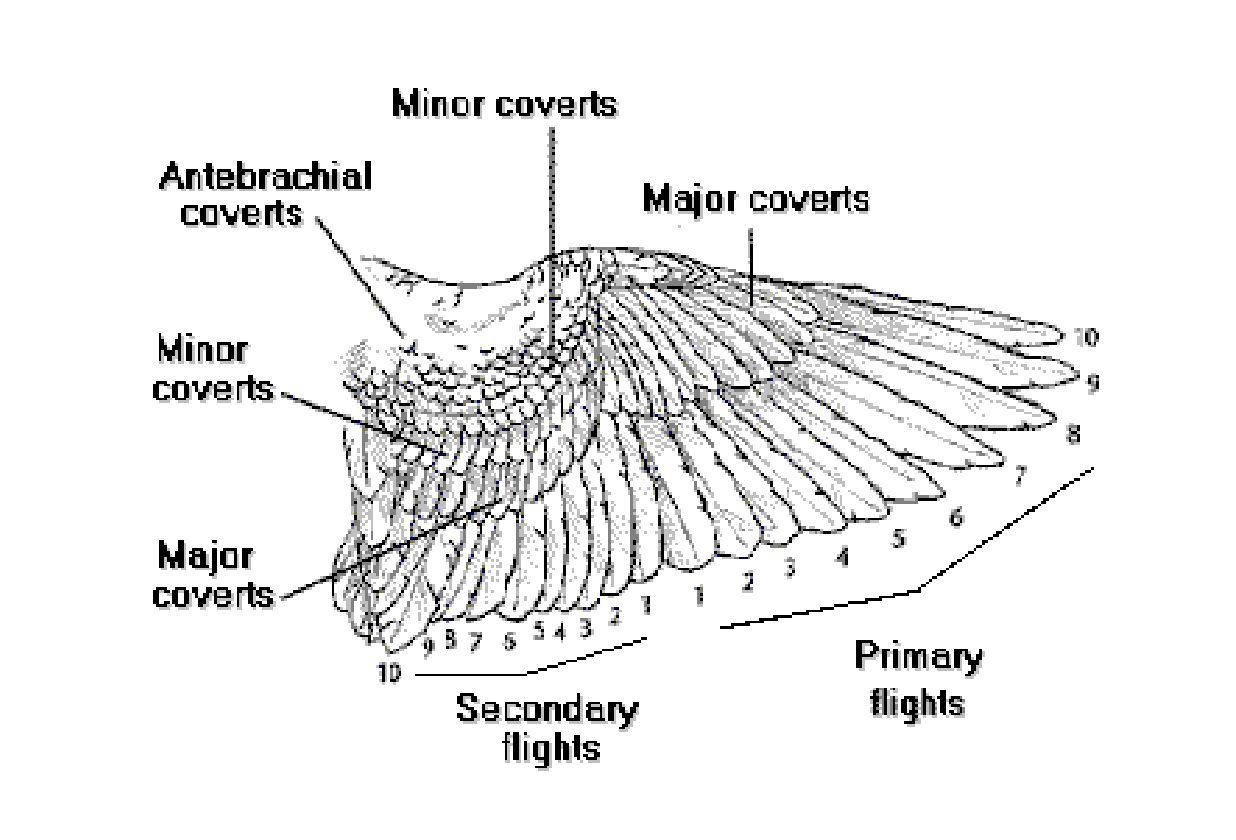
Contour feathers- Coverts
Small contour feathers that cover and border remiges and retrices
Help shape the wing & give insulation
Molting in Birds
Most birds can fly unimpaired during molting (remiges and rectrices molted in pairs for balance)
Water birds lose all primary feathers at same time, can’t fly
Why is timing critical for molting in birds?
It takes a lot of energy
Usually druing periods with lower energy demands (eg. after nesting, season with abundance of food)
How does plumage change with molt?
Winter (nonbreeding) plumage
Summer (breeding) plumage
Juvenile/adult plumage
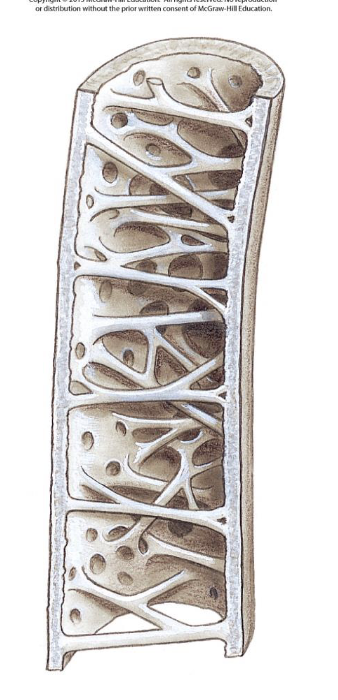
Why are bird skeletons light and delicate but sturdy?
many bones are pneumatized (hollow), laced with air cavities
skull
light, mostly fused into one piece. Less bones than other tetrapod skulls
Jaw
light, lacks teeth (grinding like a gizzard)
Keratinous beak
molded around jaw- jaw mobility allows for wide gape
Which is heavier, bird skeleton or similarly sized mammal skeleton?
Neither! Similar weight, different distribution
How is weight distributed in birds?
skull and wings= light, legs= heavy. Lower center of gravity= good aerodynamic stability
What are skeletal adaptations for flight?
Vertebrae (except neck) fused together
Sternum having large thin keel (reduced in flightless birds)
Bones of forelimbs reduced in number and fused together
What is the point of bird sternum having large thin keel
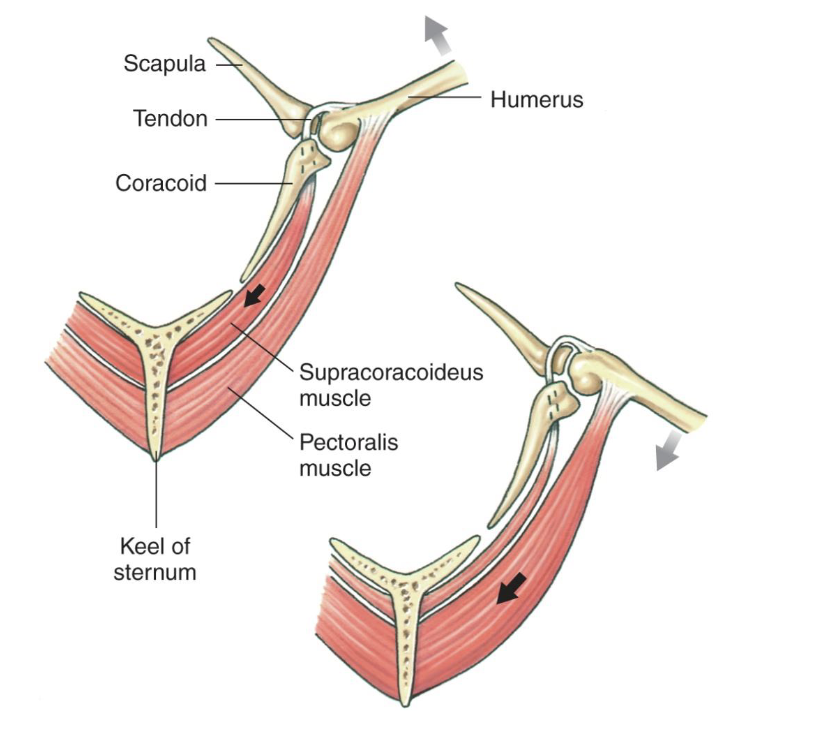
Functions as point of attachment for powerful flight muscles
What are the pectoralis and supracoracoideus muscle attached to? How big are they compared to other muscles?
The keel of the sternum. These locomotor muscles are way bigger than other muscles
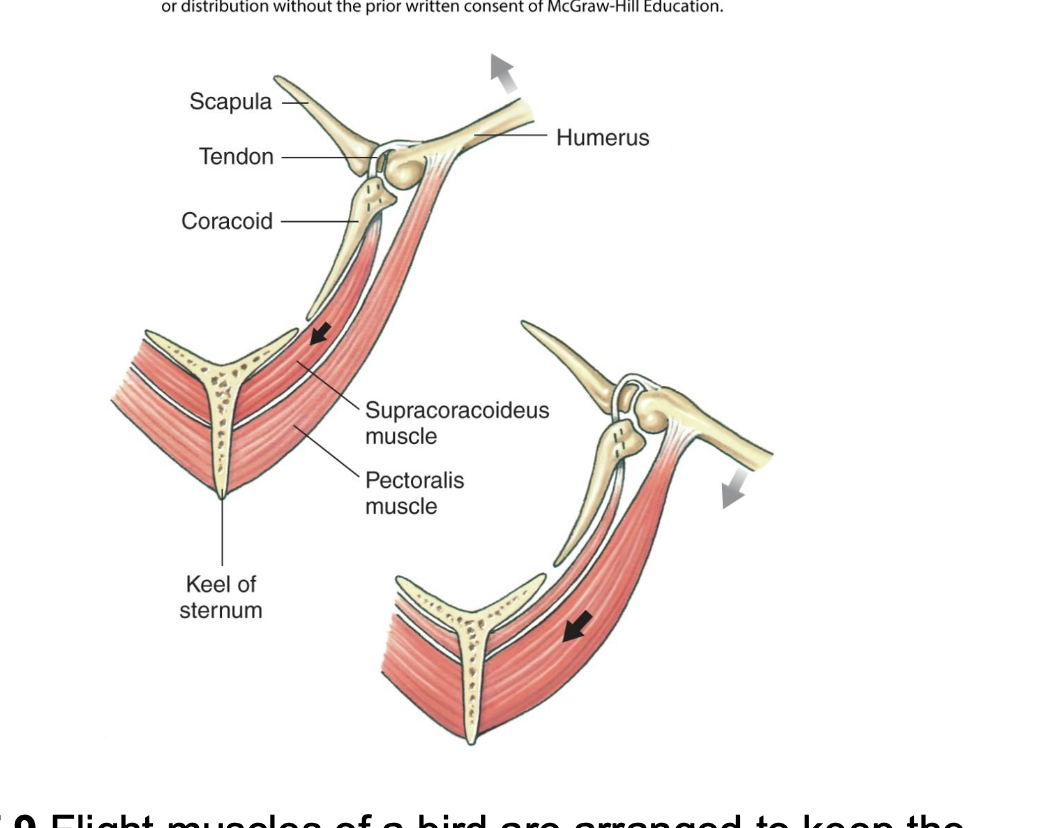
What does the pectoralis muscle do? How big is it?
Depresses the wings in flight. Largest muscle
What does the supracoideus muscle do? Where is it located
it raises the wing through “rope and pulley” arrangement. Located between pectoralis and the sternum and also attached to humerus by a tendon.
What is the most efficient respiratory system of any terrestrial vertebrate?
That of the birds!
Where are the air sacs in a bird? What are they connected to?
Throughout thorax and abdomen, inside bones. Connected to the lungs
Describe continuous flow
Continuous flow of oxygen through lungs. 2 cycles for single reath to pass through system
Alveoli
small sacs surrounded by capillaries, site of gas exchange in mammals
Parabronchi
tubelike structure in birds homologous to alveoli in mammals