T5 - IE1 - Pulmonology - Ostrom + Munjy - Integrated Anatomy & Physiology
 Call Kai
 Learn
Learn Practice Test
 Spaced Repetition
 Match
Match Flashcards
 Knowt Play
1/88

There's no tags or description
Looks like no tags are added yet.
Name | Mastery | Learn | Test | Matching | Spaced | Call with Kai |
|---|
No analytics yet
Send a link to your students to track their progress
89 Terms
Functions of the respiratory system
Air distributor
Gas exchanger
Filters, warms, and humidifies air
Influences speech
Allows for sense of smell
Divisions of the respiratory system: upper respiratory tract (outside thorax)
Nose
Nasal cavity
Sinuses
Pharynx
Larynx
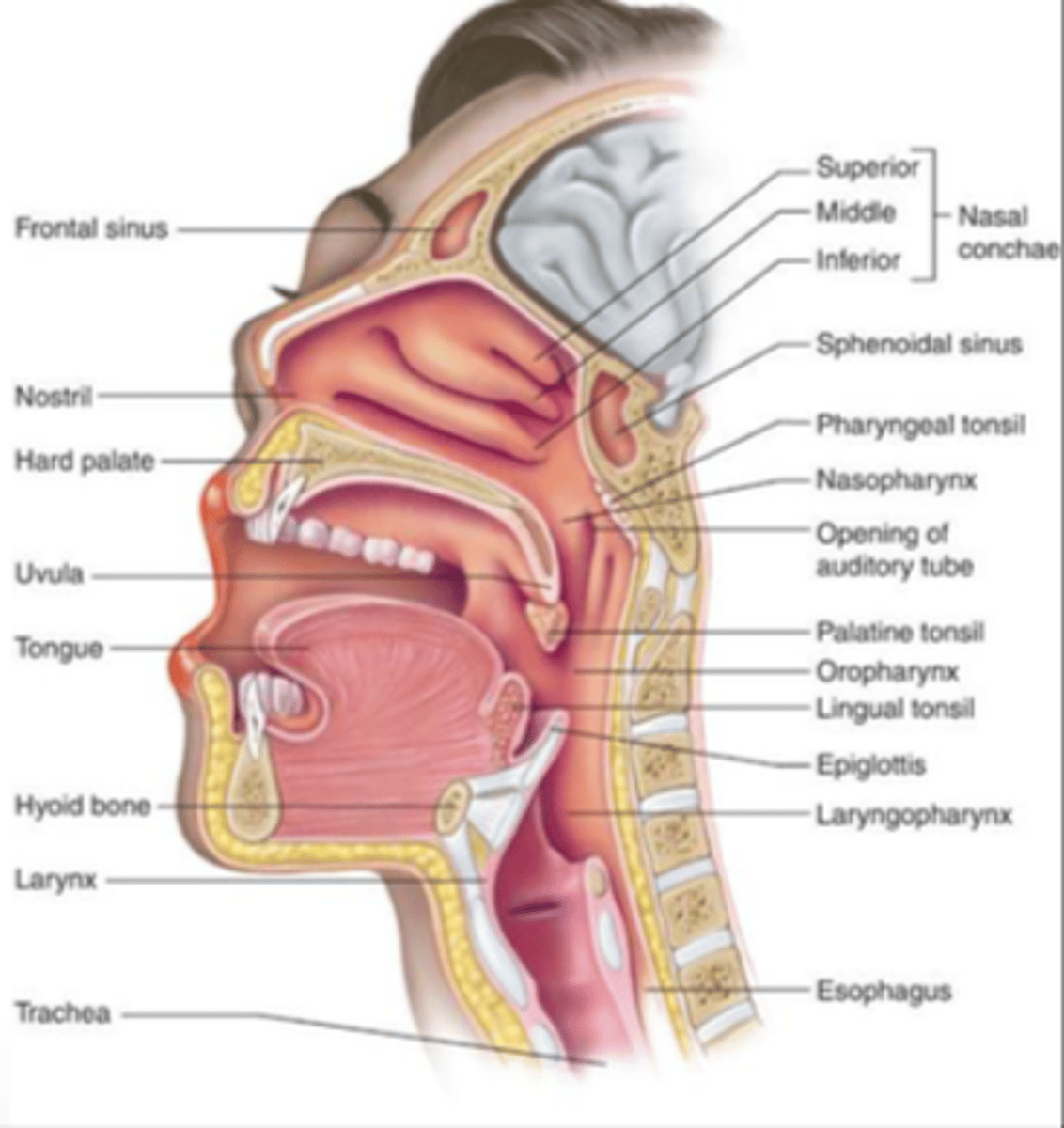
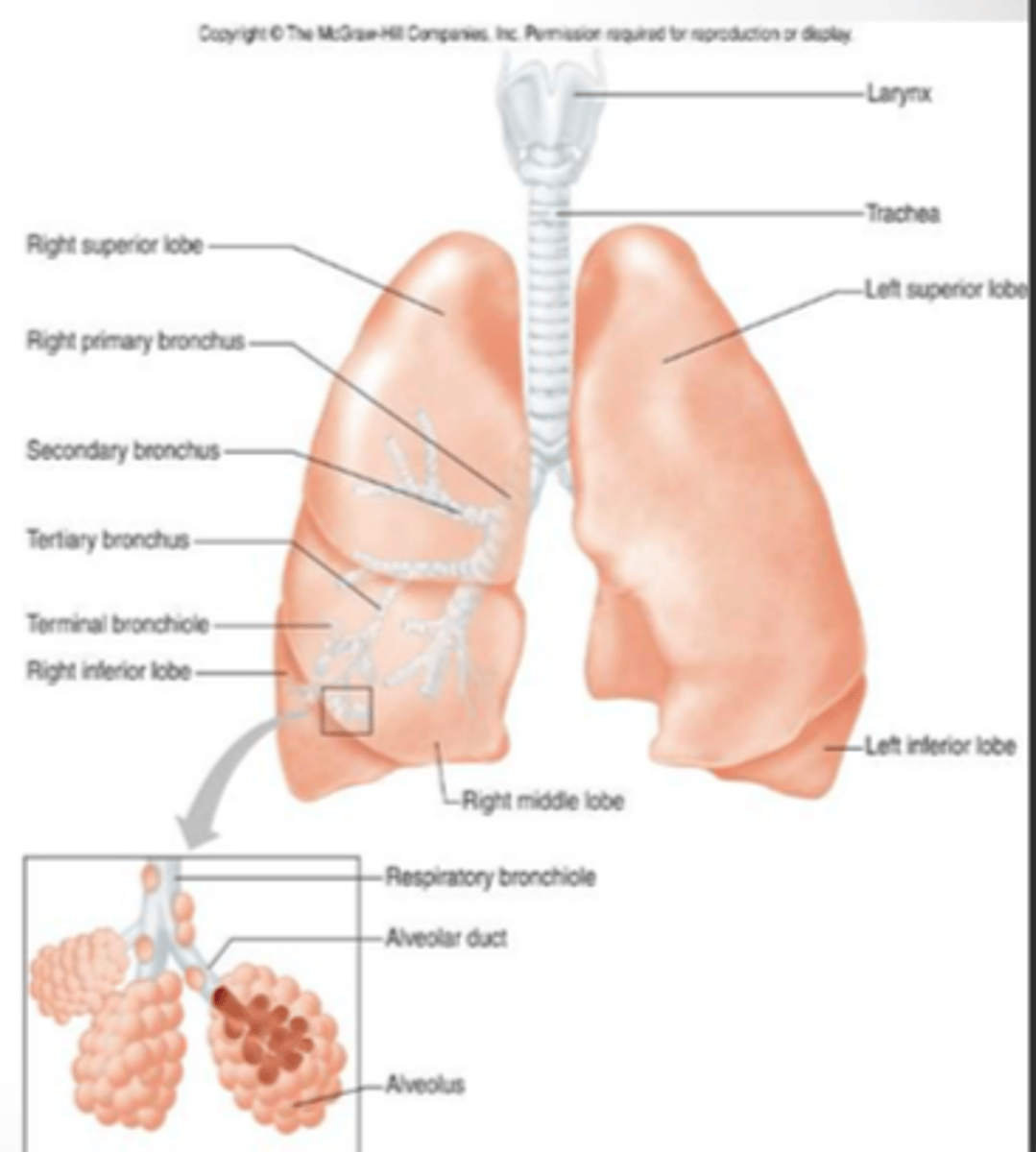
Divisions of the respiratory system: lower respiratory tract (within thorax)
Trachea
Bronchial tree
Lungs
Upper respiratory tract is ____________ ___________
- outside thorax
Lower respiratory tract is ___________ _______
- within thorax
Bronchi are tubes that ________ ________ trachea and enter into lungs
- branch off (trachea and enter into lungs)
Bronchi are ciliated and branched
Bronchi are tubes that branch off _________ and enter into __________
- trachea
- (enter into) lungs
Bronchi are __________ and _________
- ciliated
- branched
Branches: primary bronchi, secondary bronchi, tertiary bronchi and bronchioles
Bronchioles branch into ___________ ________ ______ and terminate into ________
- microscopic alveolar ducts
- (terminate into) alveoli
Gas exchange with blood occurs in alveoli
Structures of Lower Respiratory Tract
trachea
primary bronchi
secondary bronchi
tertiary bronchi
bronchioles
alveolar ducts
alveoli
Gas exchange with blood occurs in ___________
- (occurs in) alveoli
Weibel model of airways
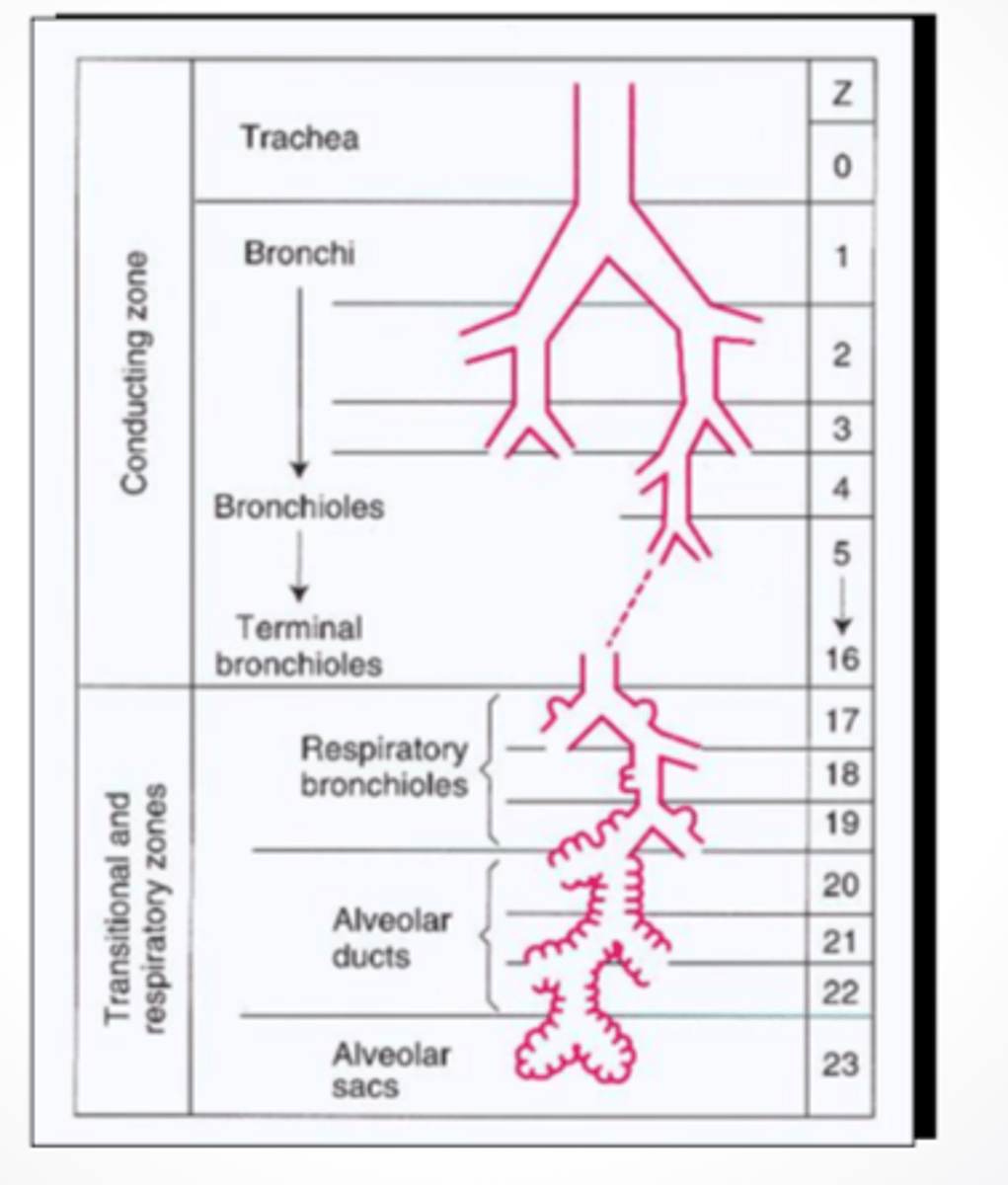
Pulmonary ventilation
breathing
Respiratory physiology: mechanism
Movement of gases through a pressure gradient - high to low
When atmospheric pressure (760 mm Hg) is greater than lung pressure, air flows in and thus inspiration
When lung pressure is greater than atmospheric pressure, air flows out and thus expiration
Respiratory physiology: mechanism - movement of gases through a ___________ _______ from high to low
- pressure gradient (from high to low)
Respiratory physiology: mechanism - movement of gases through a pressure gradient from ______ to _____
- high
- low
I.e., pressure and air flows from areas of high atmospheric pressure to areas of lower atmospheric pressure
Respiratory physiology: mechanism - when atmospheric pressure (_____ mm Hg) is ________ than lung pressure, air flows in and thus inspiration
- 760 (mm Hg)
- greater (than lung pressure)
When lung pressure is greater than atmospheric pressure, air flows out and thus expiration
Respiratory physiology: mechanism - when atmospheric pressure (760 mm Hg) is greater than lung pressure, air flows ___ and thus __________
- in
- (and thus) inspiration
When lung pressure is greater than atmospheric pressure, air flows out and thus expiration
Respiratory physiology: mechanism - when lung pressure is _________ than atmospheric pressure, air flows out and thus _____________
- greater (than atmospheric pressure)
- expiration
Respiratory physiology: mechanism - when _____ ________ is greater than atmospheric pressure, air flows ____ and thus expiration
- lung pressure (is greater)
- out (and thus expiration)
Pressure gradients are established by changes in thoracic cavity
Pressure gradients are established by __________ in ________ cavity
- (established by) changes
- thoracic (cavity)
Increase size in thorax = a decrease in pressure thus air moves in
Decrease size in thorax = an increase in pressure thus air moves out
Brain is the most sensitive organ to PO2 because...
The brain is the highest metabolic consumer of energy, thus highly sensitive to changes in oxygen.
i.e., oxygen is need for cellular respiration (glycolysis, Krebs cycle (citric acid cycle), electron transport chain)
Respiratory physiology: Increase size in thorax = a ___________ in pressure thus air moves ___
- decrease (in pressure)
- (air moves) in
i.e., the pressure of the lungs is lower than the atmosphere, and air travels via pressure gradient from high to low
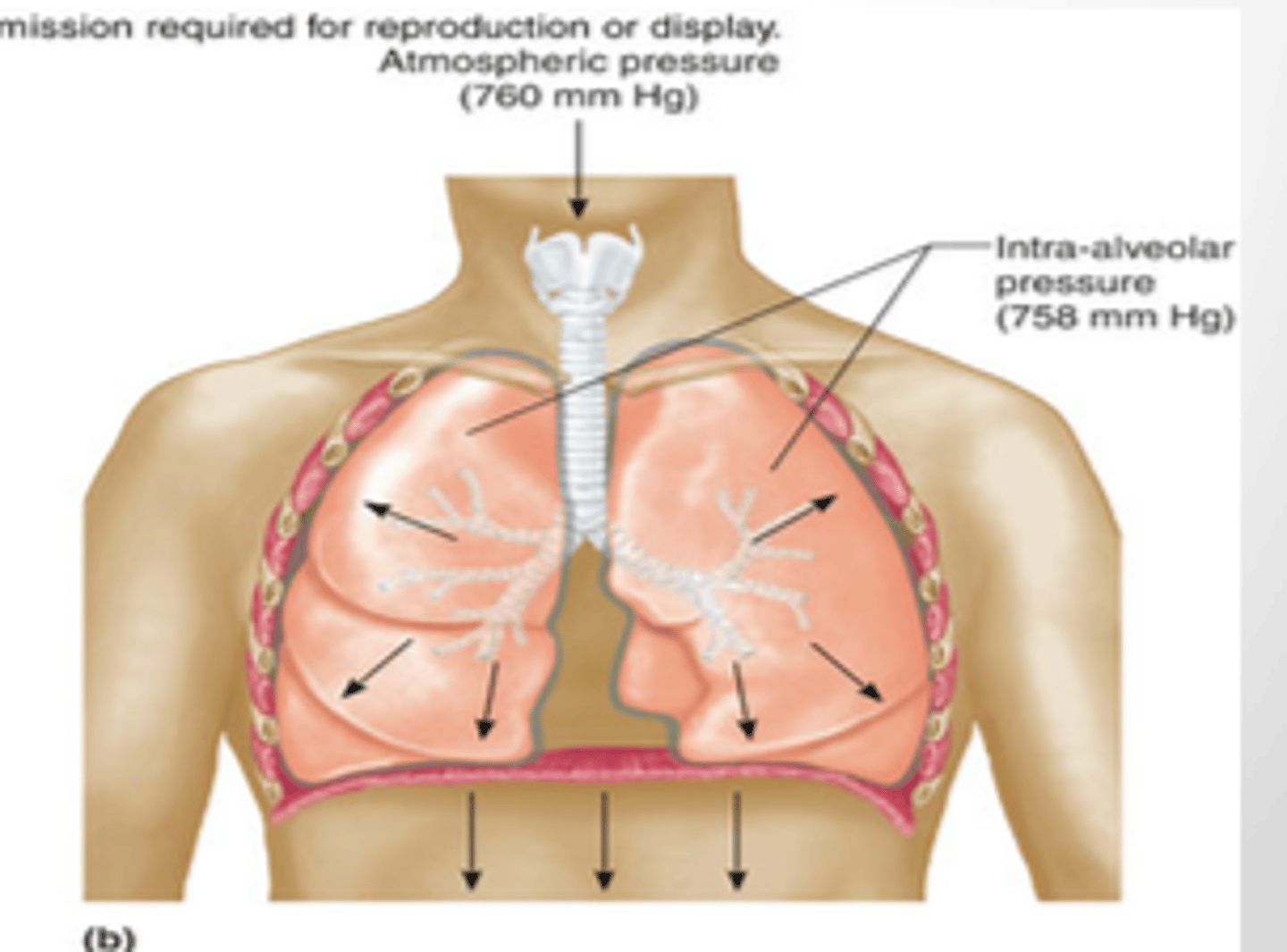
Respiratory physiology: __________ size in thorax = a decrease in _________ thus air moves in
- increase (size in thorax)
- (a decrease in) pressure
i.e., the pressure of the lungs is lower than the atmosphere, and air travels via pressure gradient from high to low
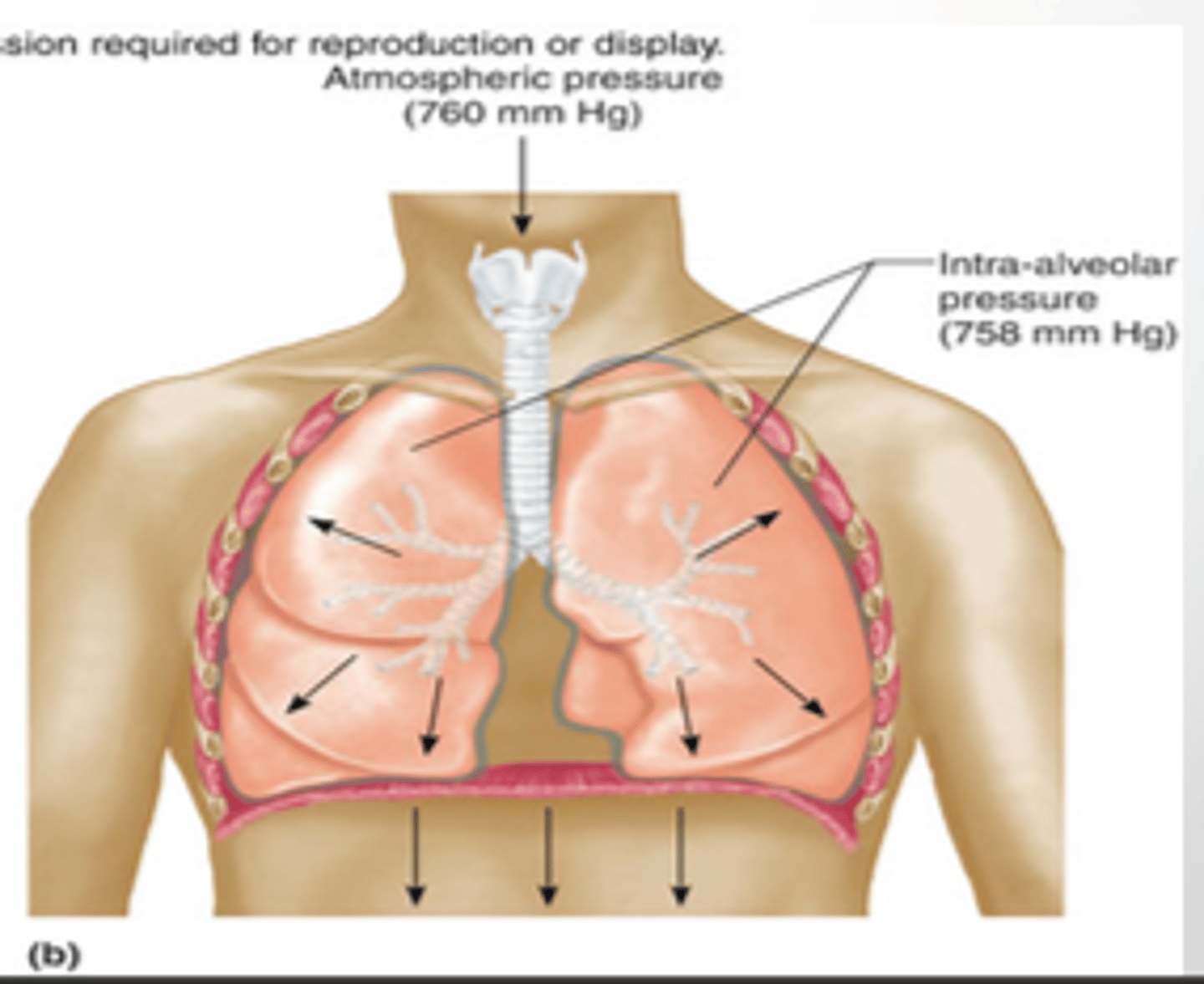
Respiratory physiology: decrease size in thorax = _________ in pressure thus air moves _______
- increase (in pressure)
- (air moves) out
i.e., the pressure of the lungs are higher in a more compact space, air moves out
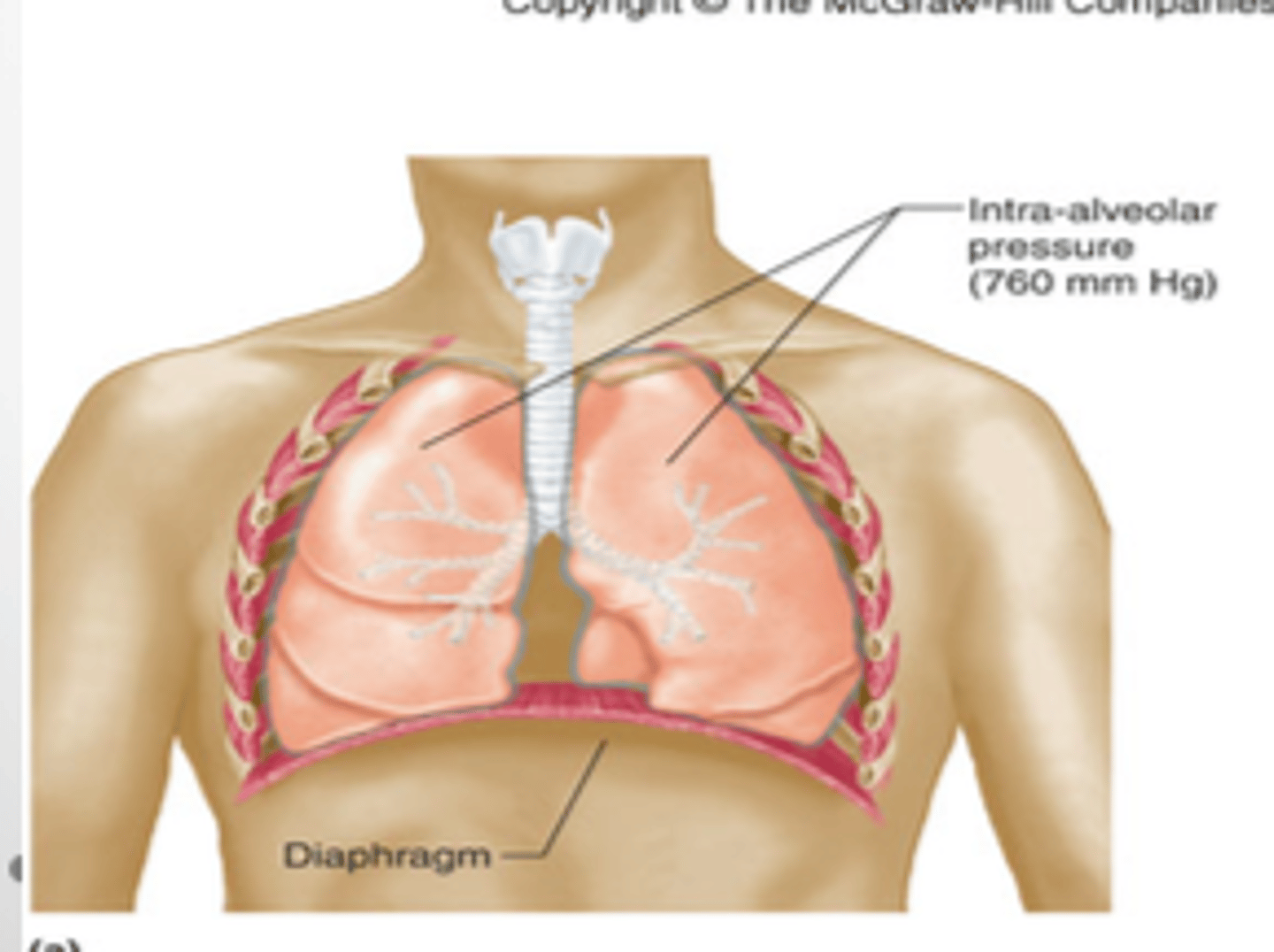
Respiratory physiology: _________ size in thorax = increase in _________ thus air moves out
- decrease (size in thorax)
- (increase in) pressure
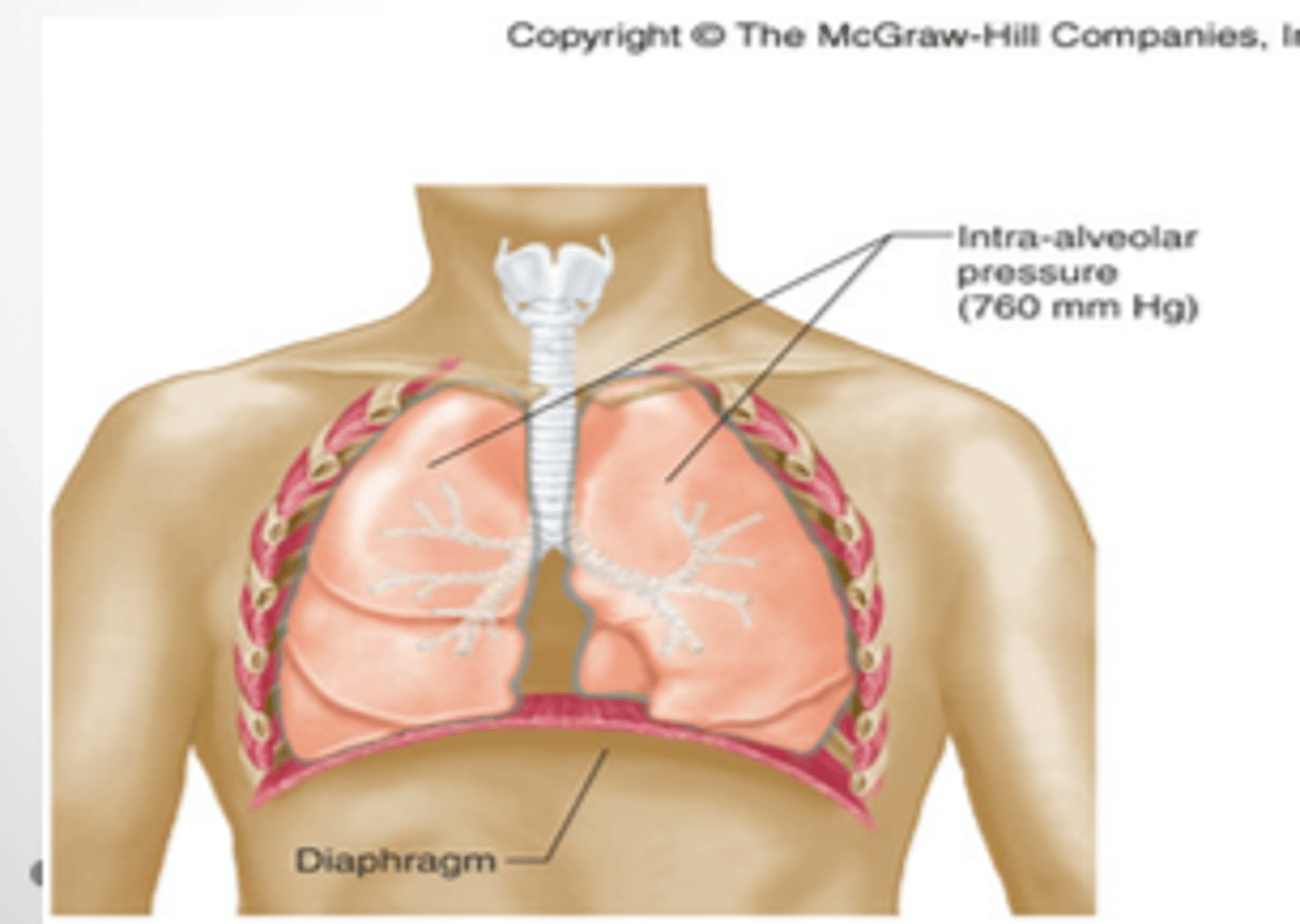
Breathing figure
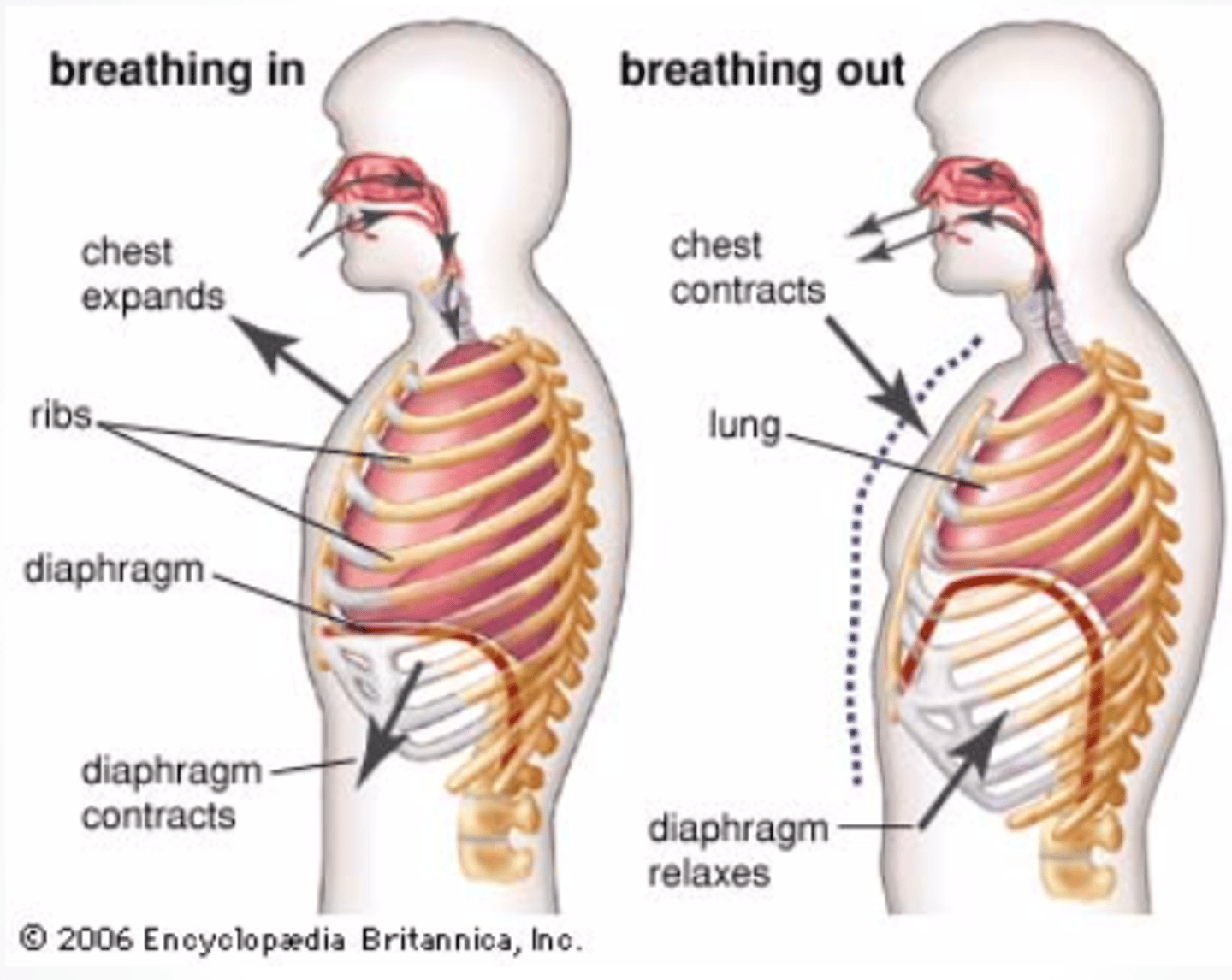
Anatomical mechanism of breathing in
Chest expands (the rib bones expand)
Intercostal and diaphragm muscle contracts
Diaphragm contracts by pulling down, causing thorax to become enlarged
Enlarged thorax allows for breath to move in because the larger size decreases the pressure within the lungs to below the atmospheric pressure
Anatomical mechanism of breathing out
Chest contracts
Diaphragm relaxes
Causes less physical space of the lungs, this increases the pressures within the lung. Pressure in the lung is greater than atmospheric pressure
Breath is release / exhaled, air wants to travel out to the regions of lower pressure (i.e,. the atmosphere)
Inspiration involves the contraction of the _________ and ________ ________ muscles and the relaxation of the _______ _________ muscles
- diphragm
- external intercostal (muscles)
- (relaxation of the) internal intercostal (muscles)
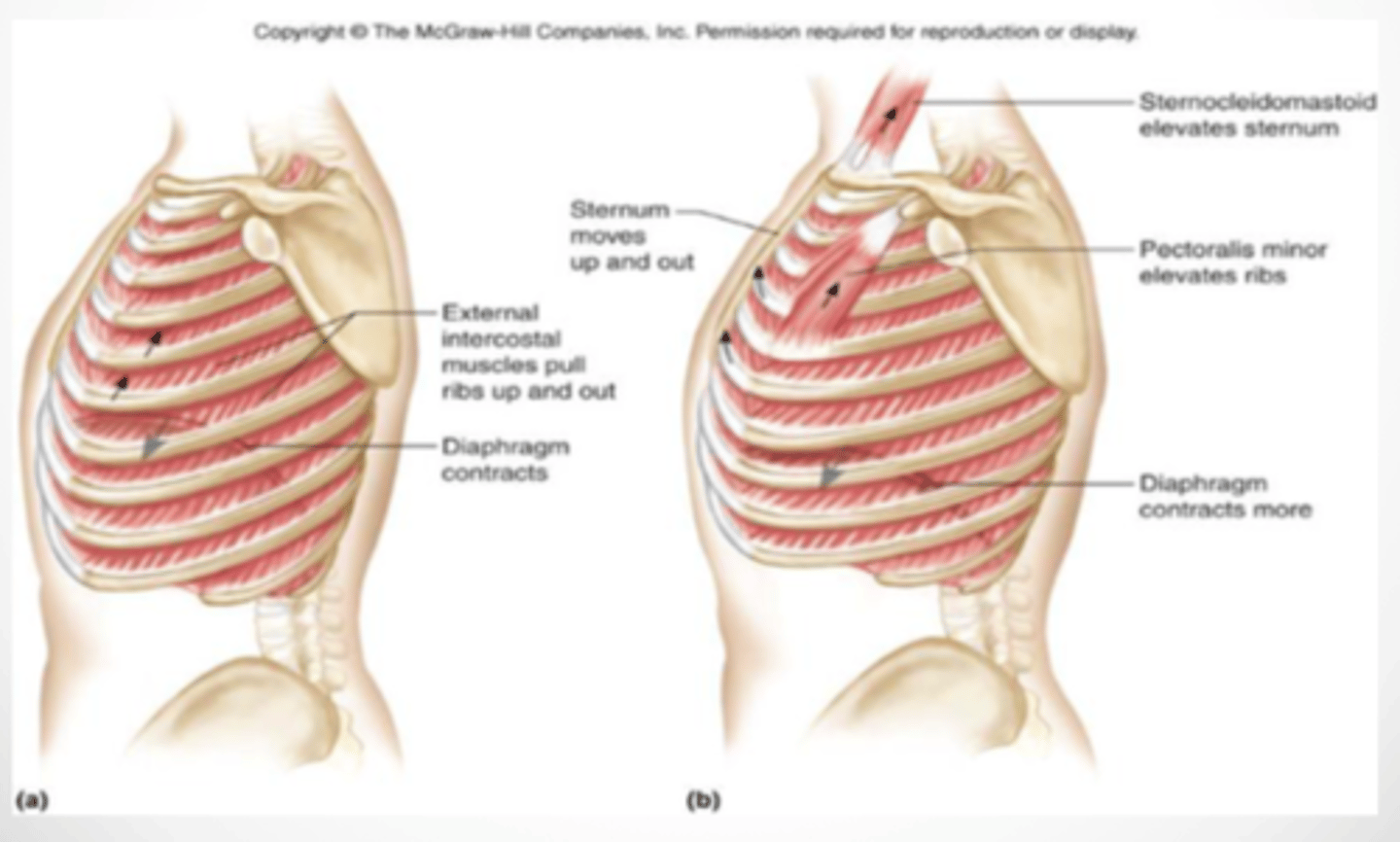
Inspiration involves the ______________ of the diaphragm and external intercostal muscles and the __________ of the internal intercostal muscles
- contraction (of the diaphragm)
- relaxation (of the internal intercostal muscles)
Expiration involves the relaxation of the ___________ and _________ ________ ________ and contraction of the _________ ________ _________
- (relaxation of the) diaphragm
- external intercostal muscles
- (contraction of the) internal intercostal muscles
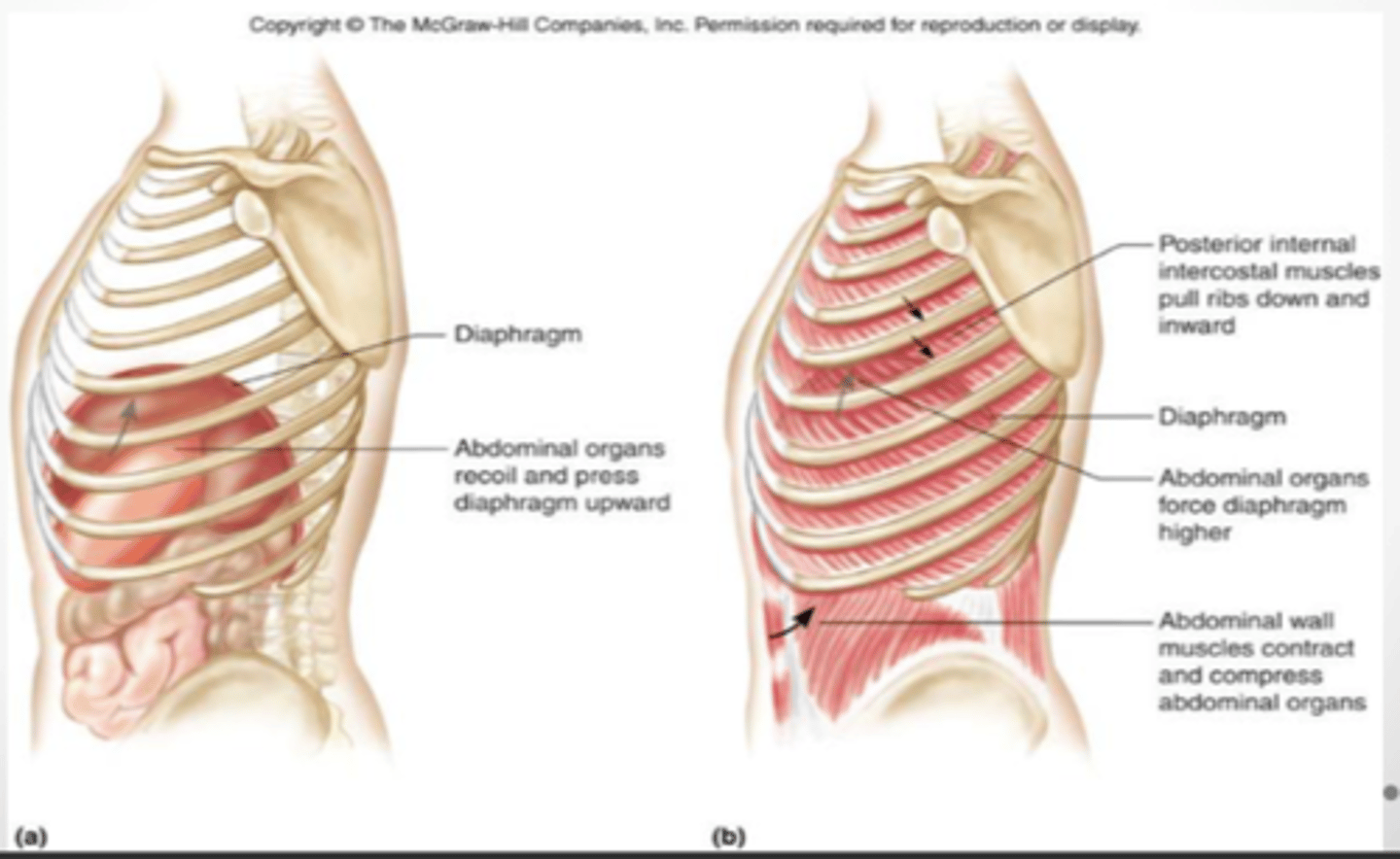
Expiration involves the ___________ of the diaphragm and external intercostal muscle and __________ of the internal intercostal muscles
- (involves the) relaxation
- contraction (of the internal intercostal muscles)
Tidal volume
amount of air exhaled normally after a typical inspiration
Normal tidal volume
500 mL
Tidal volume: amount of air _________ _______ after a ____ inspiration
- (amount of air) exhaled normally
- typical (inspiration)
Normal tidal volume = 500 mL
Expiratory reserve volume
additional amount of air forcibly expired after tidal expiration
Normal expiratory reserver volume
1000 - 1200 mL
Expiratory reserve volume: additional amount of air __________ __________ after tidal expiration
- forcibly expired (after tidal expiration)
~ 1000 - 1200 mL
Inspiratory reserve volume
deep breath, amount of air that can be forcibly INHALED over and above normal
TV
tidal volume
IRV
inspiratory reserve volume
ERV
expiratory reserve volume
Inspiratory reserve volume: ______ breath, amount of air that can be _______ ________ over and above normal
- deep (breath)
- forcibly INHALED
Residual volume
amount of air that stays trapped in the alveoli (~1.2 liters)
Normal residual volume
1.2 L
Vital capacity
the largest volume of air an individual can move in and out of the lungs
Vital capacity formula
ERV + IRV + TV
Vital capacity is dependent on...
size of thoracic cavity
posture
volume of blood in lungs -> congestive heart failure, ephysema, disease
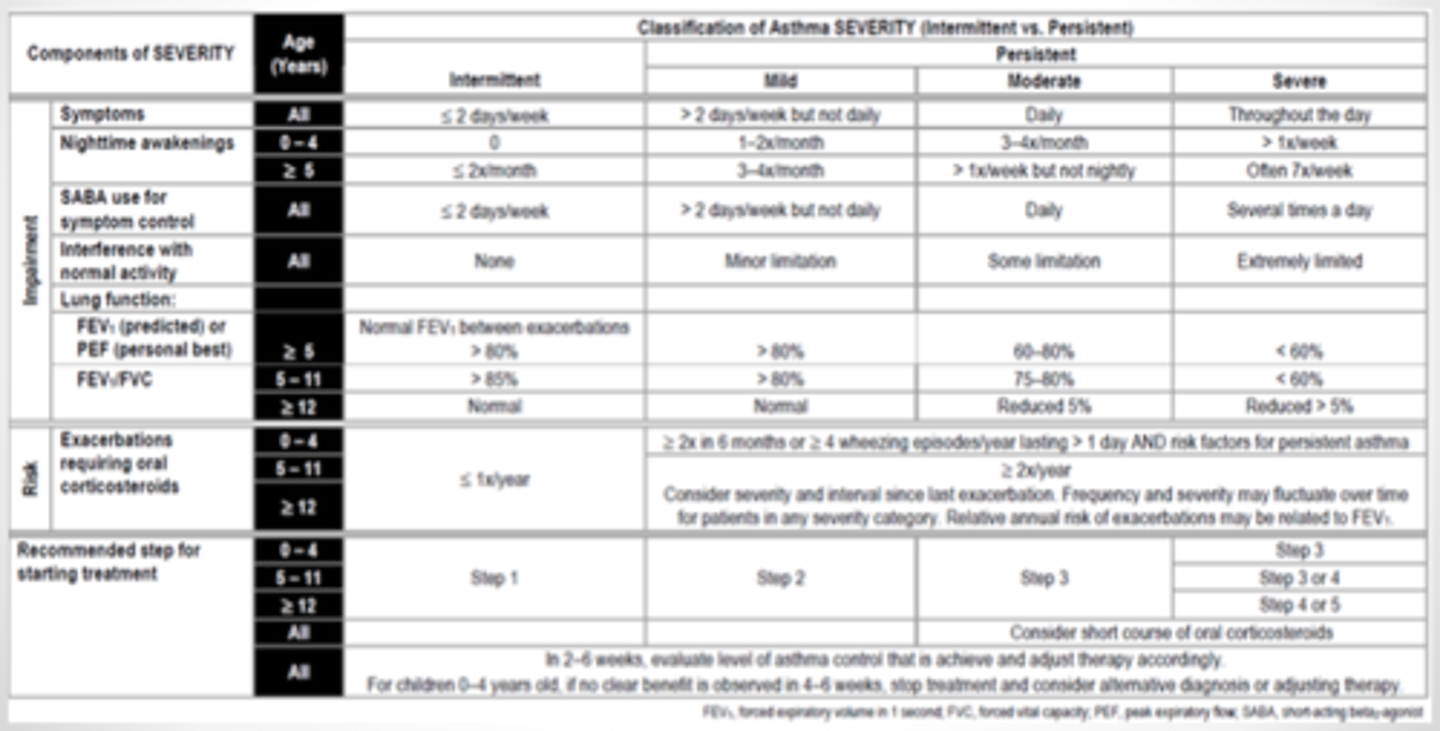
Assessing asthma symptoms chart
Air flow measurements: efficient air exchange between the lungs and the atmosphere requires...
lungs be able to change volume effectively
air can pass through the respiratory passages with relative ease
Air flow measurements: efficient air exchange between the lungs and the atmosphere requires - lungs be able to __________ volume _________
- change (volume)
- effectively
Air flow measurements: efficient air exchange between the lungs and the atmosphere requires - air can pass through the respiratory passages with _________ ______
- (through the respiratory passages with) relative ease
The ability of a person's lungs to change in volume is reflected in their _____ ___________ measurement— individuals with larger _______ __________ can change the volume of their lungs more than can those with smaller vital capacities.
- (their) vital capacity (measurement)
- (larger) vital capacities
The ability of a person's lungs to change in volume is reflected in their vital capacity measurement— individuals with _________ vital capacities can change the volume of their lungs _______ than can those with smaller vital capacities.
- larger (vital capacities)
- (of their lungs) more
Spirometry
measuring lung volumes
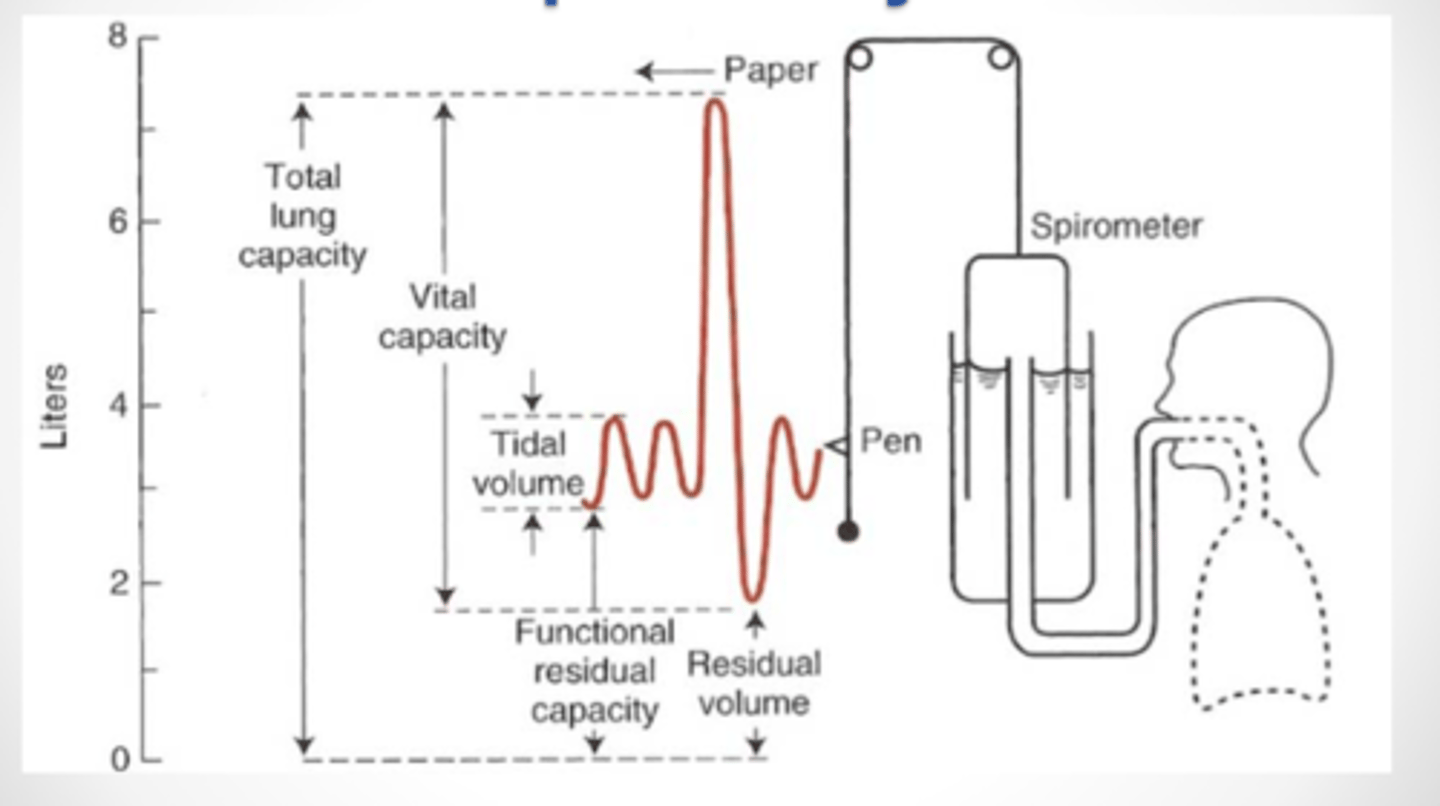
Spirometry: ability of air to flow through the respiratory passage is related in a measurement called the ________ ________ _______, ___ ________ (______); which is the percentage of the vital capacity that, after a maximal inspiration, can be forcibly expired in 1 second
- forced expiratory volume 1 second (FEV1)
Spirometry: ability of air to ________ through the respiratory passage is related in a ___________ called the forced expiratory volume 1 second (FEV1); which is the percentage of the vital capacity that, after a maximal inspiration, can be forcibly expired in 1 second
- flow (through)
- measurement (called)
Spirometry: ability of air to flow through the respiratory passage is related in a measurement called the forced expiratory volume 1 second (FEV1); which is the ______________ of the vital capacity that, after a __________ inspiration, can be __________ _________ in 1 second
- percentage
- maximal (inspiration)
- forcibly expired (in 1 second)
FEV1 is expressed as the ________ of the volume of air forcibly expired in 1 second (V1) ___________ by the vital capacity (VC) and covered into a percentage
- ratio (of the volume of air)
- divided (by the vital capacity)
FEV1 formula
V1/VC * 100%
The FEV1 can be compared to a predicted value to diagnose _______ and ________ and to stage _______
- (diagnose) asthma
- COPD
- (to stage) COPD
Fick's law of diffusion
The rate of gas transfer (V gas) is proportional to the tissue area, the diffusion coefficient of the gas, and the difference in the partial pressure of the gas on the two sides of the tissue, and inversely proportional to the thickness.
Fick's law of diffusion essentially states that the rate of diffusion of a gas across a permeable membrane is determined by...
chemical nature of the membrane itself
surface are of the membrane
partial pressure gradient of the gas across the membrane
thickness of the membrane
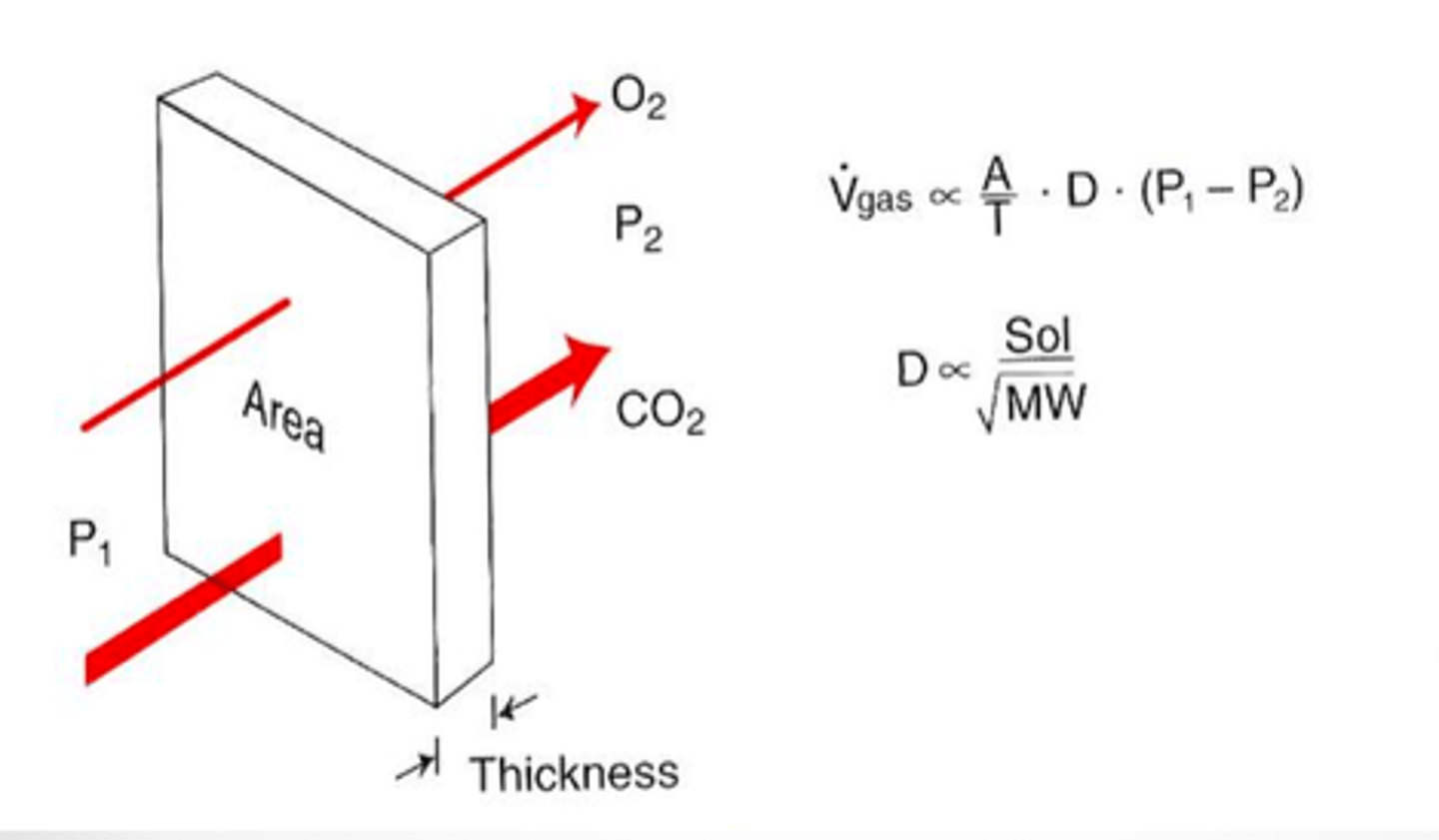
Gas exchange occurs via _________. We inspire air consisting of a mixture of gases including ___ and _____
- (via) diffusion
- O2
- CO2
Gas exchange occurs via diffusion. We inspire air consisting of a mixture of gases including O2 and CO2.
These gases each have a pressure related to their __________ within the gas mixture (_______ __________)
- pressures (within their gas mixture)
- partial pressures
Differences in the partial pressures between the gases in the alveoli and blood create a pressure gradient across the respiratory membrane
Differences in the partial pressures between the gases in the _________ and _______ create a pressure gradient across the respiratory membrane
- alveoli
- blood (create a pressure gradient)
______________ in the partial pressures between the gases in the alveoli and blood create a __________ ________ across the respiratory membrane
- Differences (in the partial pressures)
- pressure gradient (across the respiratory membrane)
If the pressure on each side of the membrane were the same there would be no exchange of gas and no movement of O2 and CO2. Where the partial pressures of O2 and CO2 are different, gas exchange occurs.
If the pressure on each side of the membrane were the same there would be _____ ___________ of gas and ___ _________ of O2 and CO2. Where the partial pressures of O2 and CO2 are different, gas exchange occurs.
- no exchange (of gas)
- no movement (of O2 and CO2)
If the pressure on each side of the membrane were the ______ there would be no exchange of gas and no movement of O2 and CO2.
Where the partial pressures of O2 and CO2 are _______, gas exchange occurs.
- (were the) same
- (are) different
Gases move from an area of high concentration (high pressure) to an area of low concentration (low pressure).
Gases move from an area of ________ concentration (________ pressure) to an area of ______ concentration (_____ pressure).
- high (concentration)
- high (pressure)
- low (concentration)
- low (pressure)
Freshly inspired air in the alveoli is high in _____, the ____ diffuses across the respiratory membrane into the blood where the concentration of _____ is low
- (high in) O2
- O2 (diffuses)
- O2 (is low)
This blood is now 'oxygenated' and is sent to the tissues of the body for use.
Freshly inspired air in the alveoli is ________ in O2, the O2 _________ across the respiratory membrane into the blood where the concentration of O2 is ______. This blood is now __________ and is sent to the tissues of the body for use.
- high (in O2)
- (O2) diffuses
- (O2 is) low
- 'oxygenated'
The blood that has come from the tissues of the body to the alveoli is high in CO2. The CO2 in this 'deoxygenated' blood diffuses across the respiratory membrane into the alveoli to an area of low CO2 concentration, and is subsequently expired (breathed out) from the lungs.
The blood that has come from the tissues of the body to the alveoli is high in _______. The ______ in this __________ blood diffuses across the respiratory membrane into the alveoli to an area of low ______ concentration, and is subsequently expired (breathed out) from the lungs.
- (high in) CO2
- CO2
- 'deoxygenated' (blood)
- (low) CO2
The blood that has come from the _________ of the body to the alveoli is high in CO2. The CO2 in this 'deoxygenated' blood diffuses across the respiratory membrane into the alveoli to an area of _______ CO2 concentration, and is subsequently ________ (___________ ______) from the lungs.
- tissues (of the body)
- low (CO2 concentration)
- expired (breathed out)
In order for O2 to be ____________ into the blood it binds to hemoglobin (Hb) which is a compound that sits on our ______ ________ _______.
- absorbed (into the blood)
- red blood cells
In order for O2 to be absorbed into the blood it binds to ___________ (____) which is a compound that sits on our red blood cells.
- hemoglobin (Hb)
Structures of the lower respiratory tract figure
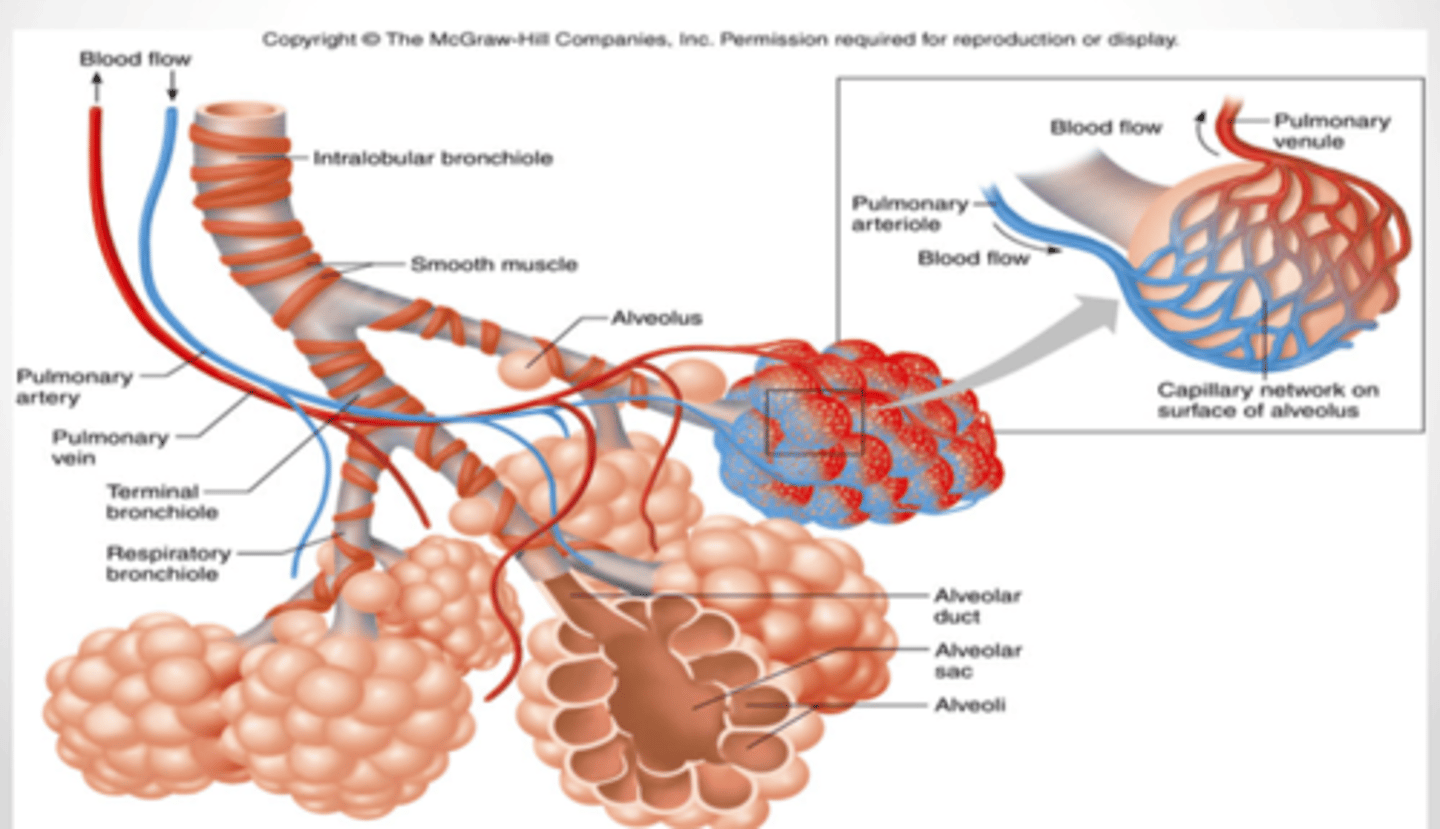
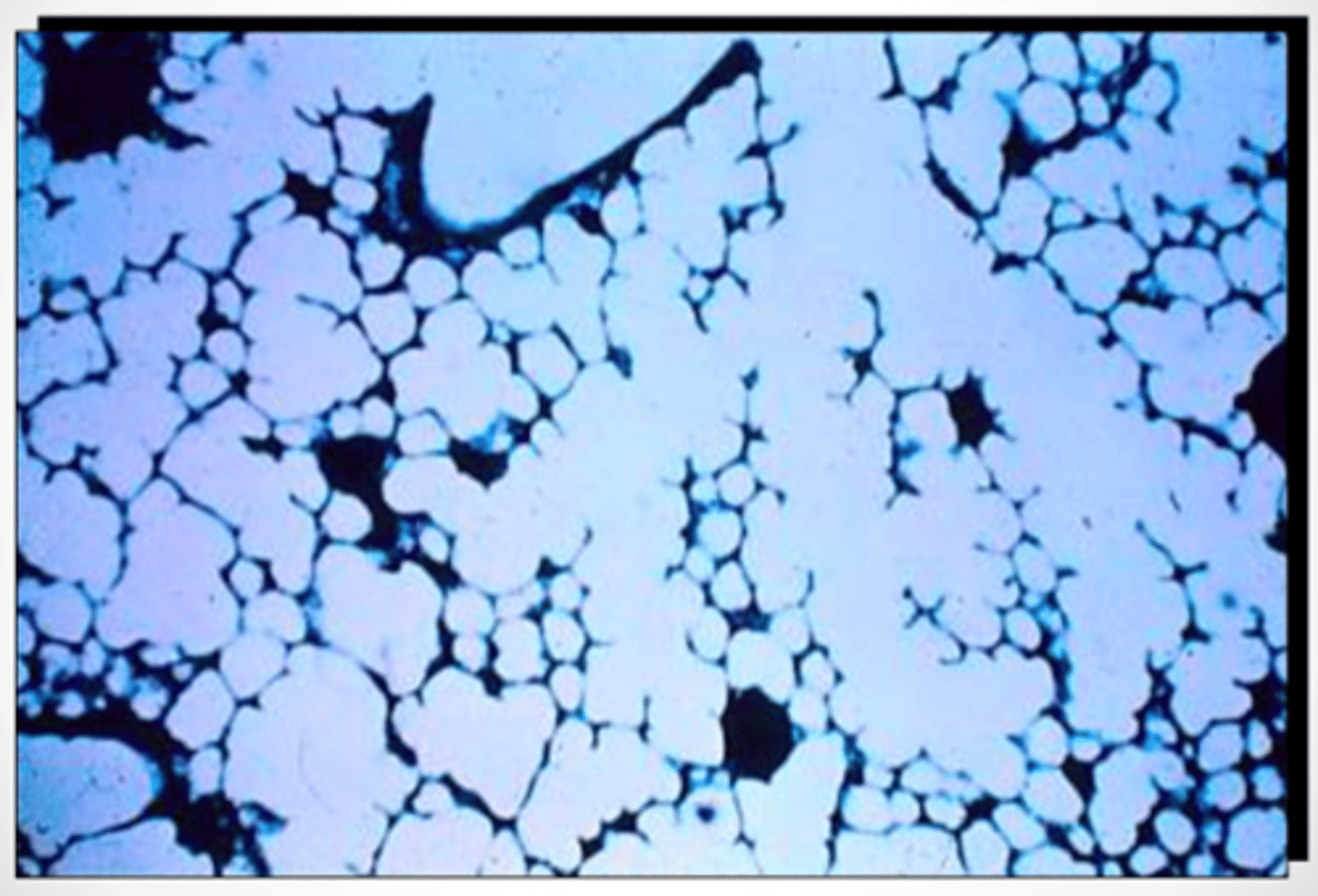
Alvolar sacs and alveoli histology figure
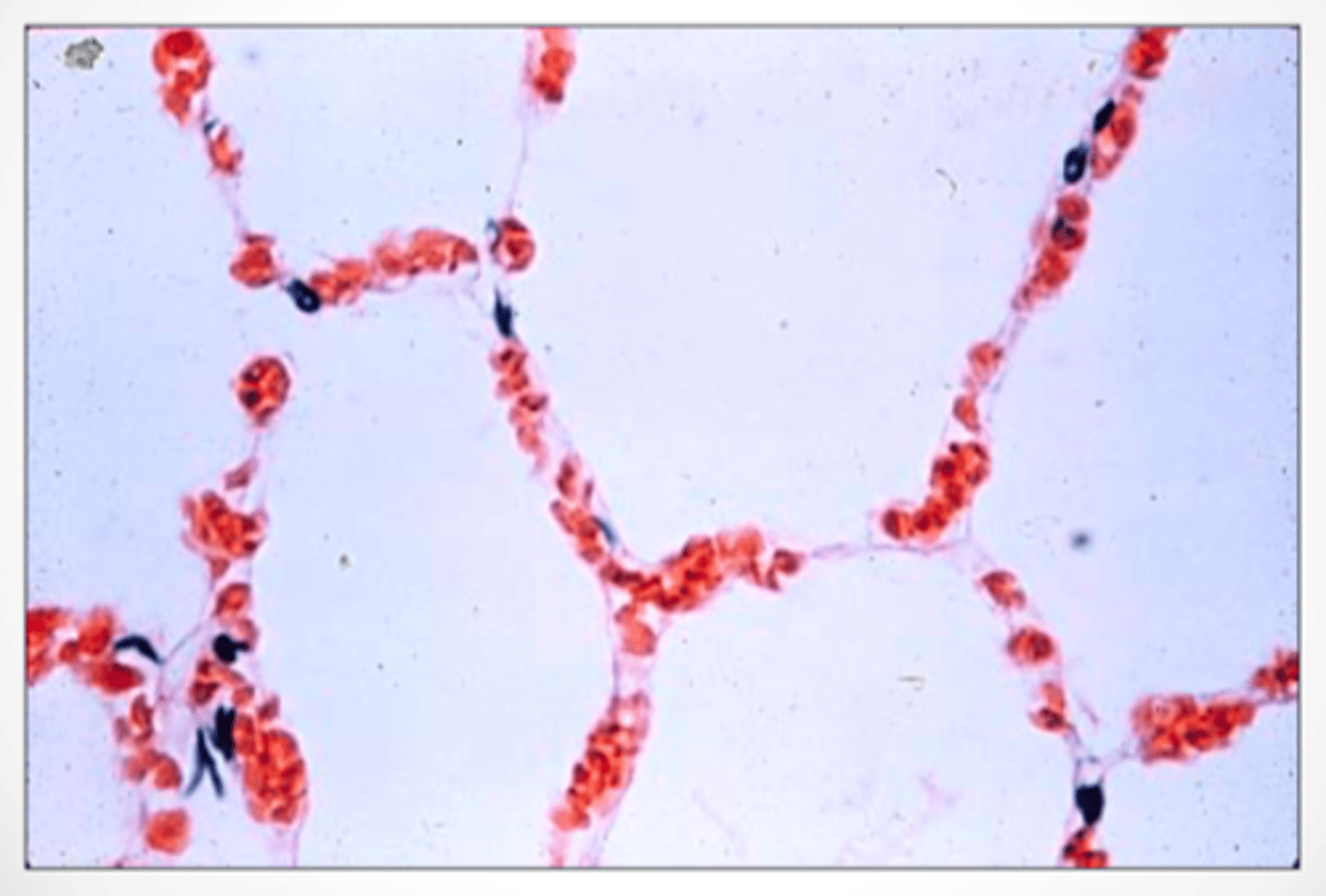
Alveoli with capillaries figure
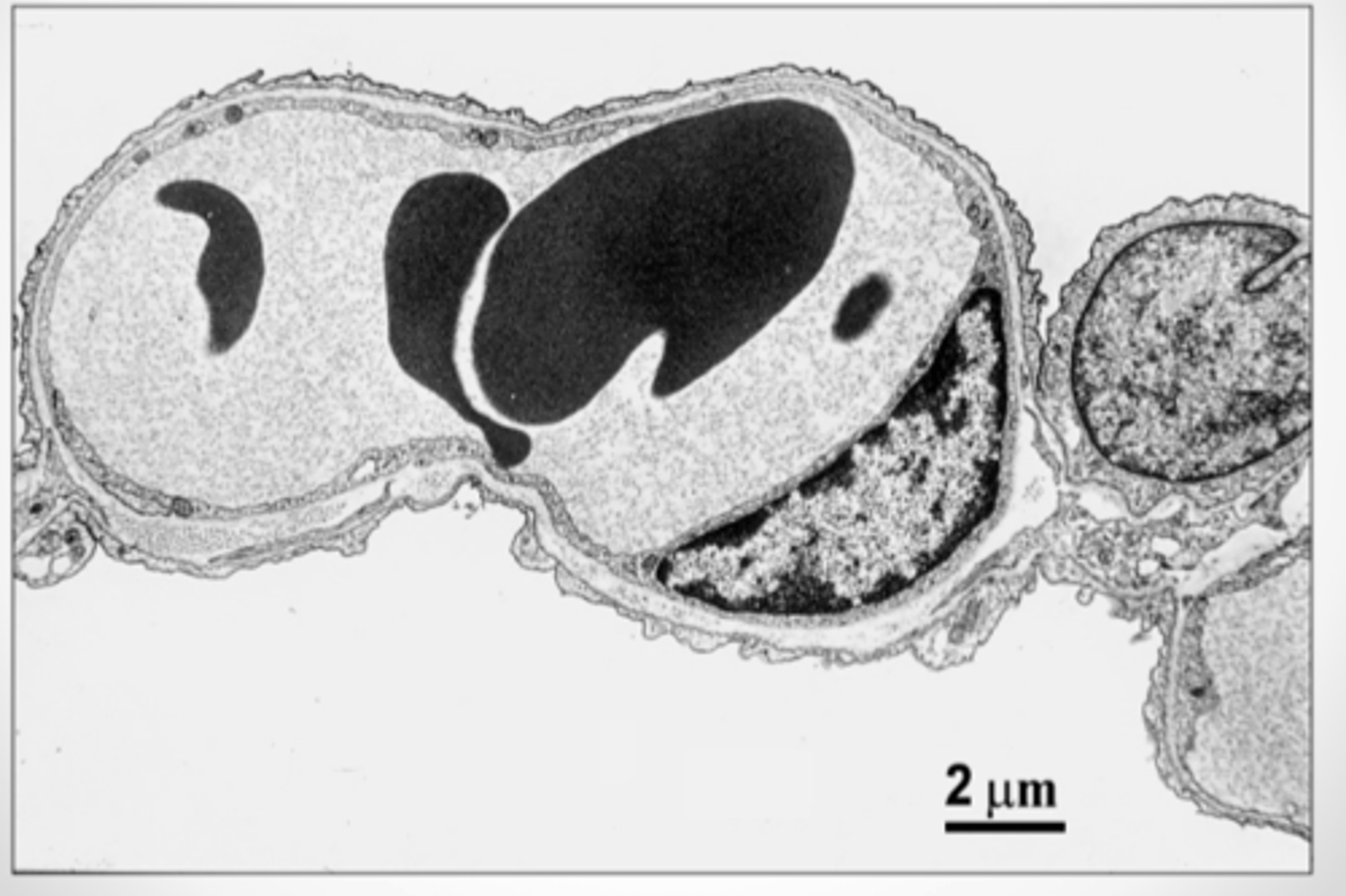
Note that some parts of the capillaries only fit 1 red blood cell in diameter
Electron micrograph of pulmonary capillary figure
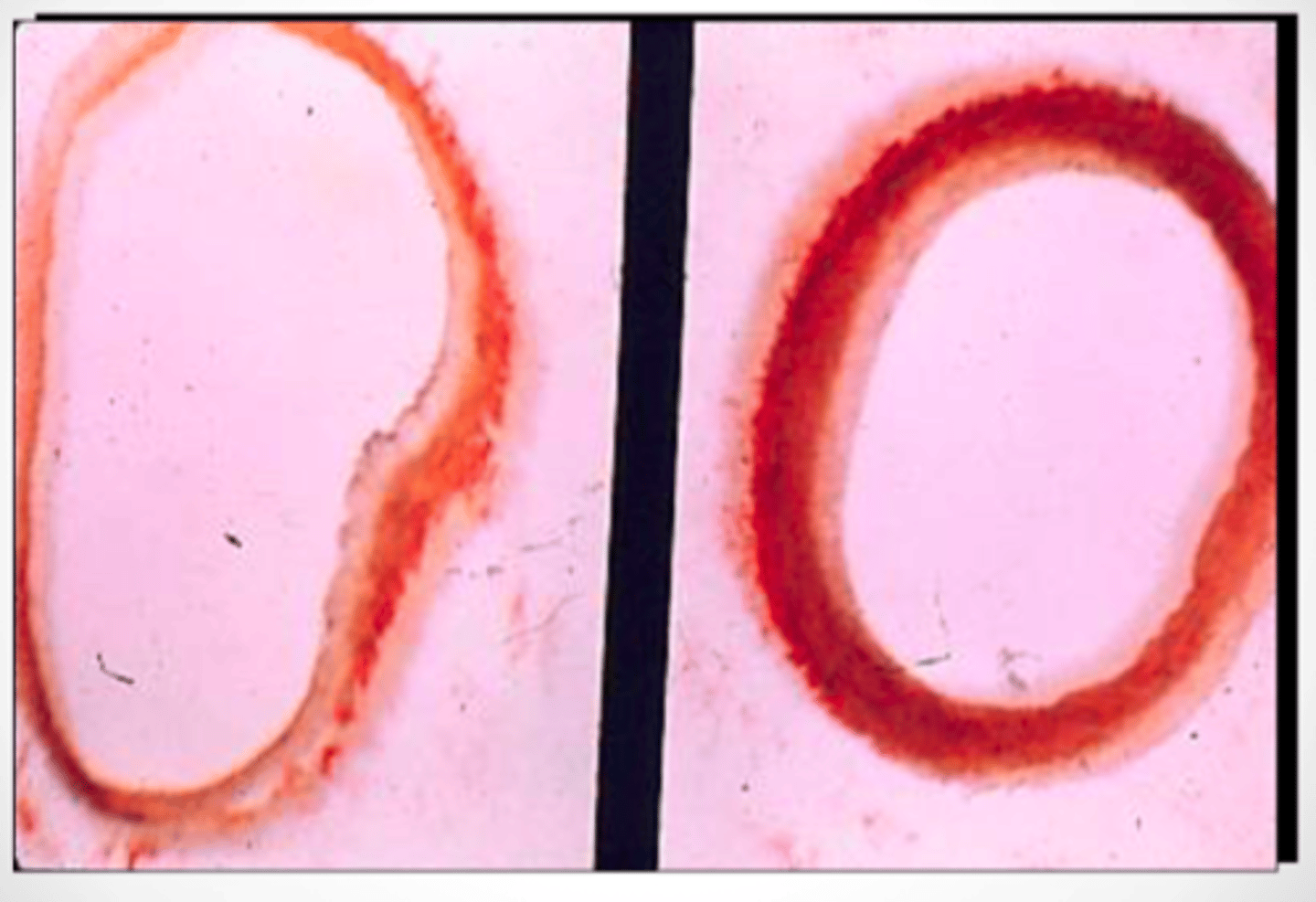
Pulmonary artery vs. systemic artery
Eupnea
normal quiet breathing
Normal respiratory rate
12 - 20 breaths per minute
But 17 is more closer to normal
Hyperpnea
increase in breathing to meet an increased demand by body for oxygen
Hyperventilation
increase in pulmonary ventilation in excess of the need for oxygen
Someone hysterical; exertion -> breathe into paper bag
Hypoventilation
decrease in pulmonary ventilation
Apnea
temporary cessation of breathing at the end of normal expiration
Still learning (12)
You've started learning these terms. Keep it up!