Djedji AB Calculus Limits
 Call Kai
 Learn
Learn Practice Test
 Spaced Repetition
 Match
Match Flashcards
 Knowt Play
1/26

There's no tags or description
Looks like no tags are added yet.
Name | Mastery | Learn | Test | Matching | Spaced | Call with Kai |
|---|
No analytics yet
Send a link to your students to track their progress
27 Terms
One sided Limits
lim f(x)
x→?-
or
lim f(x)
x→?+
lim f(x)
x→?-
limit when x approaches ? from the smaller numbers / left of the number line
lim f(x)
x→?+
limit when x approaches ? from the larger numbers / right of the number line
Two Sided Limits
lim f(x)
x→?
lim f(x)
x→?
limit when x approaches ?+ and ?- is the same
Plugging in Limits
plug in numbers for x that are slightly above and below ? and look for a pattern, if they both approach the same number, that is the limit
Infinite Limits
Positive Infinity: The function's output grows infinitely large as x approaches a value
Negative Infinity: The function's output grows infinitely small as x approaches a value
Means the Limit DNE but expressing it as infinite is more accurate
Limite DNE if
lim f(x) /=/ lim f(x)
____x→ ?- ___x→ ?+
lim f(x) = ± infinity
____x→ ?
f(x) oscillates between fixed values of x
example: 1, -1, 1, -1, 1, -1 …
Properties of Limits
Constant Function
Identity Function
Power Function
Root Function
Constant Function
if f(x) = b
then
lim b = b
x→ ?
Identity Function
if f(x) = x
then
lim x = ?
x→ ?
Power Function
if f(x) = x^n
then
lim x^n = ?^n
x→ ?
Root Function
if f(x) = n√x
then
lim n√x = n√?
x→ ?
it doesn’t work if n is even and x<0
Operations with Limits
assume
lim f(x) = L
x→ ?
lim g(x) = K
x→ ?
Constant Multiple Rule
lim b*f(x) = bL
x→ ?
Sum and Difference Rule
lim f(x) ± g(x) = L ± K
x→ ?
Product Rule
lim f(x)*g(x) = L*K
x→ ?
Quotient Rule
lim f(x)/ g(x) = L/ K
x→ ?
if
lim g(x) /=/ 0
x→ ?
Techniques to calculate limits
direct substitution
factor and divide out
rationalize
simplify complex fractions
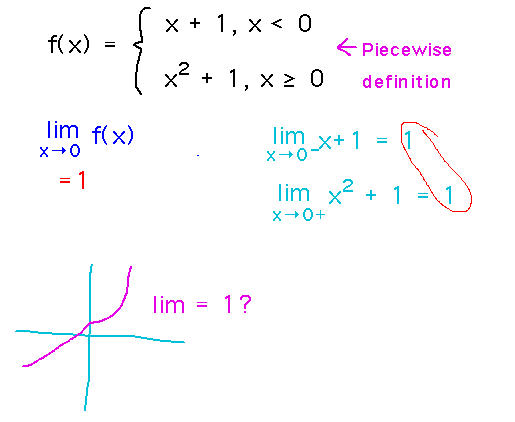
one sided limits (Piecewise Function)
squeeze theorem
trigonometric theorems
Simplify a sum of cubes
A³+B³=(A+B)(A²-AB+B²)
A³-B³=(A-B)(A²+AB+B²)
Use SOAP (Same, Opposite, Always Positive)
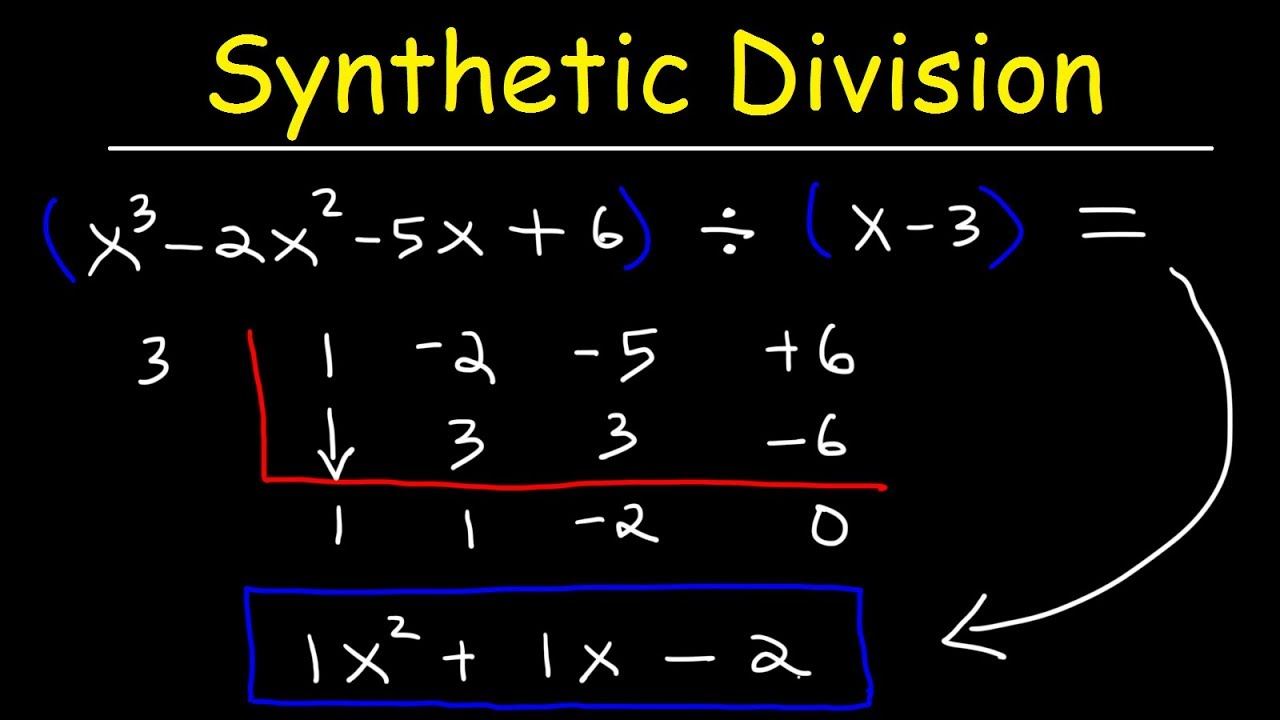
Synthetic Division
One Sided Limit Piecewise Function
Squeeze Theorem
if
lim g(x) = L
x→ ?
and
lim h(x) = L
x→ ?
and
g(x) <= f(x) <= h(x)
then
lim f(x) = L
x→ ?
Trigonometric Theorems
lim sin(x)/x = 1
x→ 0
and
lim sin(ax)/ax = 1
x→ 0
and
lim 1-cos(x)/x = 0
x→ 0
Limits of rational functions at infinity
if
f(x) = anxn+ … + a1*x+a0 / bm*xm+ … + b1*x+b0
then
lim f(x) = ____lim an*xn / bm*xm
x → ± infinity _x → ± infinity
3 cases
if
n>m
then
im f(x) = ____ ± infinity
x → ± infinity
if
n = m
then
im f(x) = ____ an/bm
x → ± infinity
if
n<m
then
im f(x) = ____ 0
x → ± infinity
Limits of irrational functions at infinity
√x² = |x| = -x (x<0) (negative) or x ( x>= 0) (positive)
if x → -infinity then √x² = -x
if x → infinity then √x² = x
Justify End Behaviour
look at the leading term, find if its degree is positive or negative, and see if the leading coefficient is positive or negative
example: degree is even, leading coefficient is negative
goes down to negative infinity as x approaches infinity and negative infinity