Membrane Potential + Action Potential
 Call Kai
 Learn
Learn Practice Test
 Spaced Repetition
 Match
Match Flashcards
 Knowt Play
1/62

There's no tags or description
Looks like no tags are added yet.
Name | Mastery | Learn | Test | Matching | Spaced | Call with Kai |
|---|
No analytics yet
Send a link to your students to track their progress
63 Terms
Depolarize
An increase in extracellular K+ concentration reduces the K+ concentration difference
between inside (high K+) and outside (low K+) of the cell. As a result, less K+ leaves the
cell resulting in the cell being less negative, i.e. a depolarization. You could also run
some numbers through the Nernst equation to verify how hyperkalemia causesdepolarization.
A 33-year-old, overweight male becomes ill and is diagnosed with hyperkalemia (high extracellular K+). What effect would this have on neuronal resting membrane potentials?
A) Depolarize
B) Hyperpolarize
C) Repolarize
D) No effect
Hyperpolarize
When chloride enters or potassium leaves, an IPSP results which:
a- Depolarize
b-Repolarize
c-Hyperpolarize
d-Polarize
Depolarize
When sodium enters, as EPSP results which
a- Depolarize
b-Repolarize
c-Hyperpolarize
d-Polarize
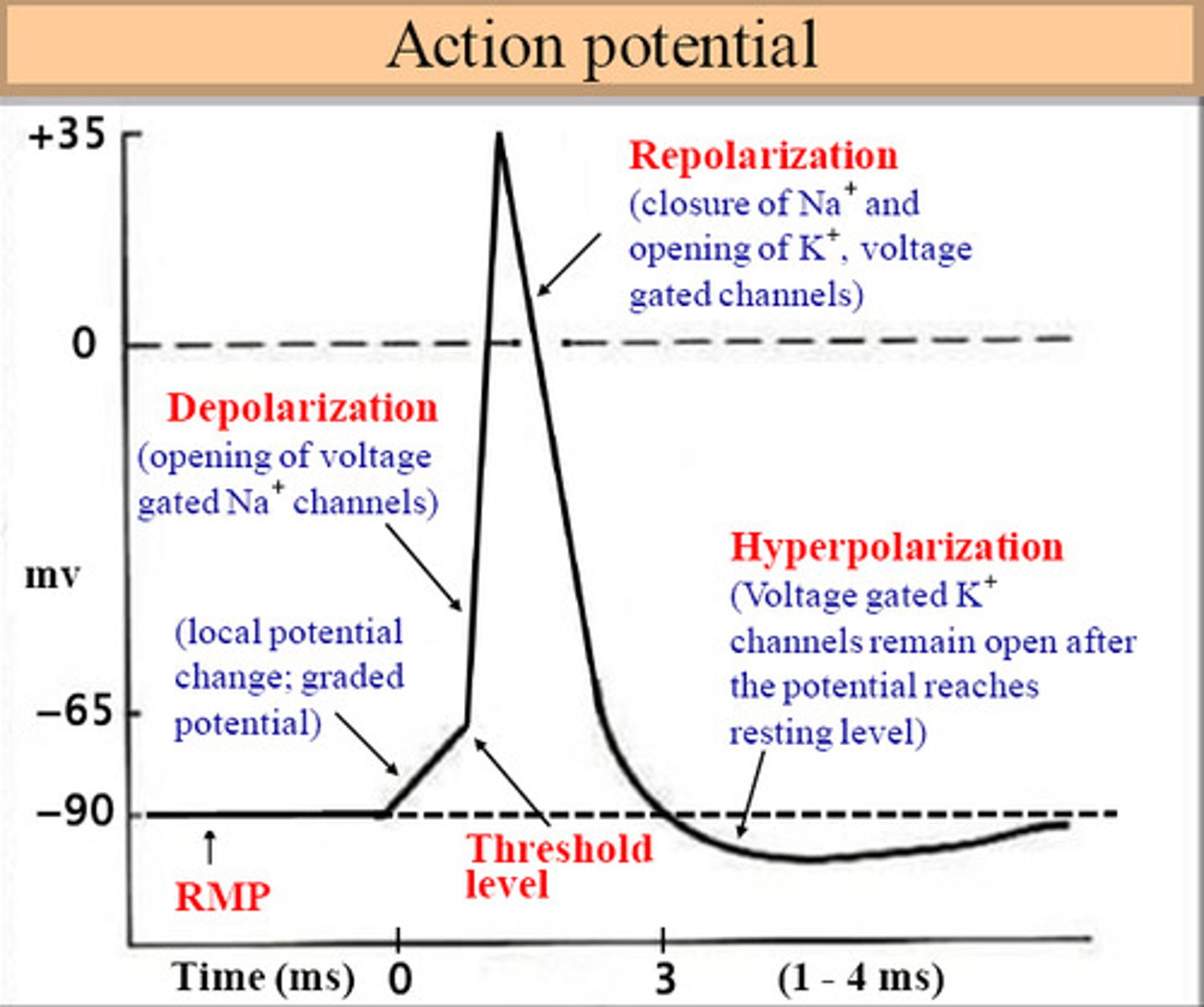
-(Reaching of threshold)
opening of fast na+ channel, Na+ in
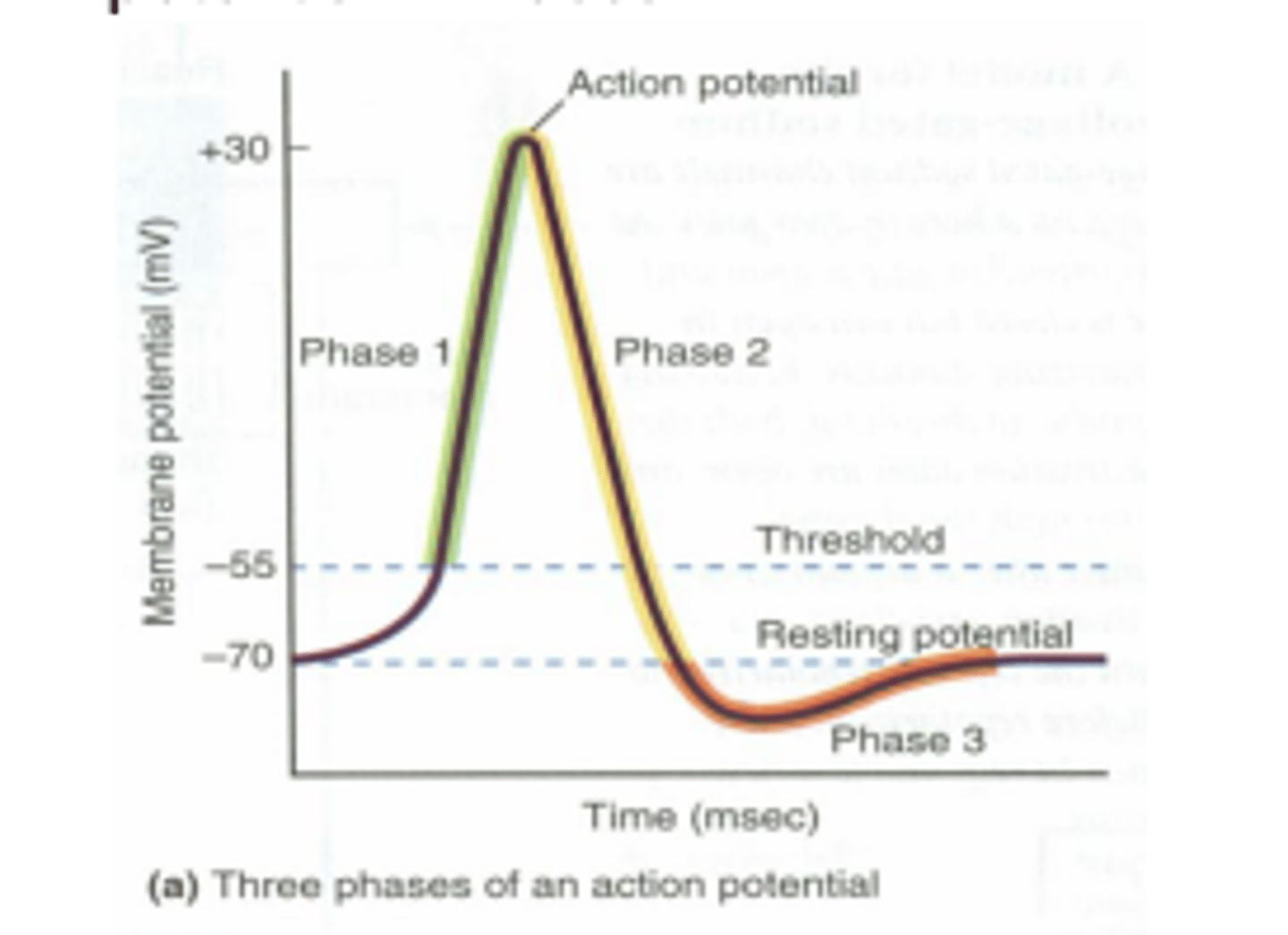
what occurs in Phase 0 of action potential?
a-resting potential maintained by k+
(membrane permeability)
b-the opening of Ca+ channels
(so ca+ flows in a way that it balances the k+ flow to maintain AP plateau)
c-opening of K+ channels, K+ out
(closing of ca+ channels)
d-depolarization, caused by an increase in sodium permeability, permeability to Na+ now more than K+, membrane potential approaches sodium equilibrium potential of +60mV and *Na+ channel activation gates opening
e-(Reaching of threshold)
opening of fast na+ channel, Na+ in
depolarization, caused by an increase in sodium permeability, permeability to Na+ now more than K+, membrane potential approaches sodium equilibrium potential of +60mV and *Na+ channel activation gates opening
what occurs in Phase 1 of action potential?
a-resting potential maintained by k+
(membrane permeability)
b-the opening of Ca+ channels
(so ca+ flows in a way that it balances the k+ flow to maintain AP plateau)
c-opening of K+ channels, K+ out
(closing of ca+ channels)
d-depolarization, caused by an increase in sodium permeability, permeability to Na+ now more than K+, membrane potential approaches sodium equilibrium potential of +60mV and *Na+ channel activation gates opening
e-(Reaching of threshold)
opening of fast na+ channel, Na+ in
the opening of Ca+ channels
(so ca+ flows in a way that it balances the k+ flow to maintain AP plateau)
what occurs in Phase 2 of action potential?
a-resting potential maintained by k+
(membrane permeability)
b-the opening of Ca+ channels
(so ca+ flows in a way that it balances the k+ flow to maintain AP plateau)
c-opening of K+ channels, K+ out
(closing of ca+ channels)
d-depolarization, caused by an increase in sodium permeability, permeability to Na+ now more than K+, membrane potential approaches sodium equilibrium potential of +60mV and *Na+ channel activation gates opening
e-(Reaching of threshold)
opening of fast na+ channel, Na+ in
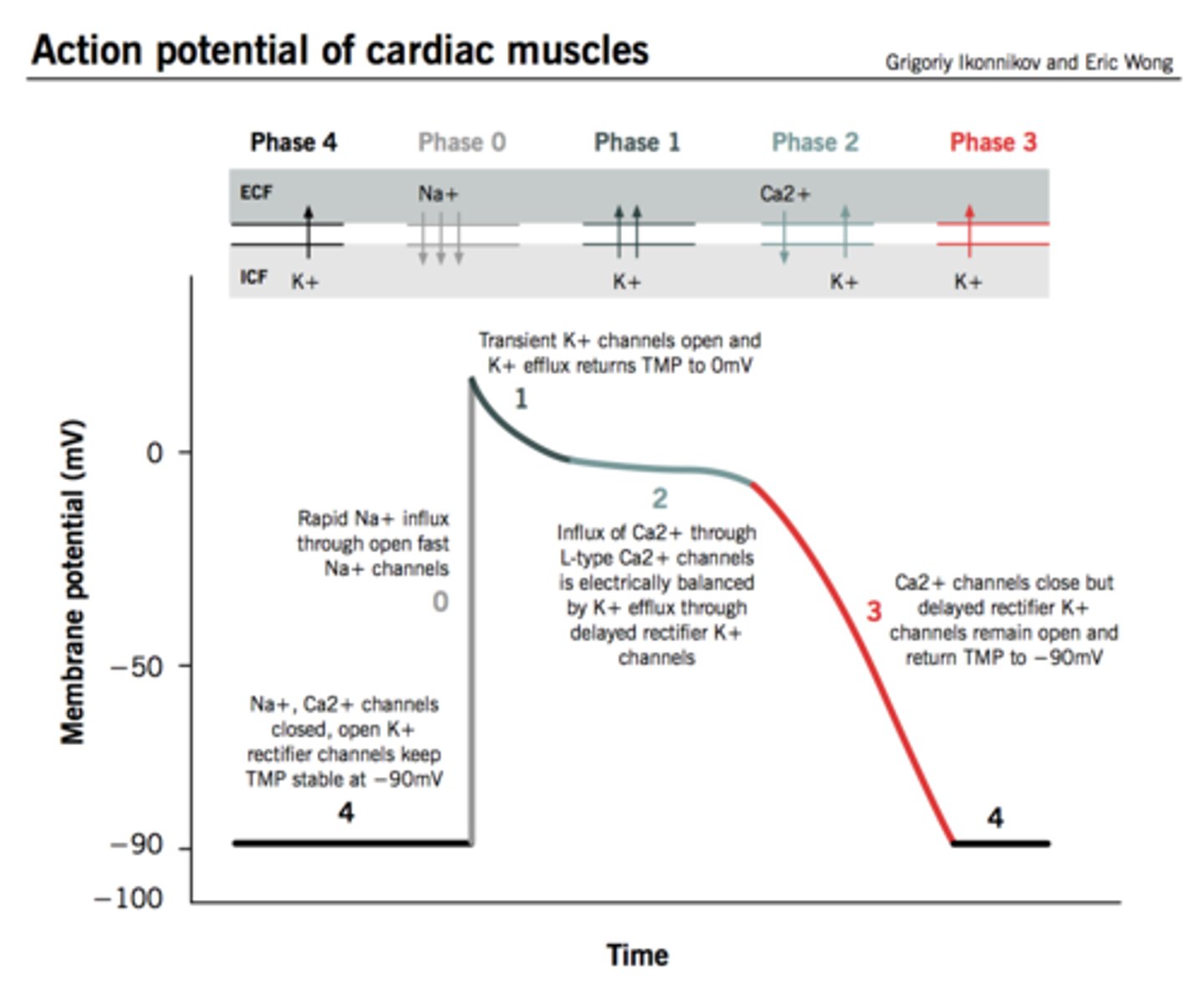
opening of K+ channels, K+ out
(closing of ca+ channels)
what occurs in Phase 3 of action potential?
a-resting potential maintained by k+
(membrane permeability)
b-the opening of Ca+ channels
(so ca+ flows in a way that it balances the k+ flow to maintain AP plateau)
c-opening of K+ channels, K+ out
(closing of ca+ channels)
d-depolarization, caused by an increase in sodium permeability, permeability to Na+ now more than K+, membrane potential approaches sodium equilibrium potential of +60mV and *Na+ channel activation gates opening
e-(Reaching of threshold)
opening of fast na+ channel, Na+ in
resting potential maintained by k+
(membrane permeability)
what occurs in Phase 4 of action potential?
a-resting potential maintained by k+
(membrane permeability)
b-the opening of Ca+ channels
(so ca+ flows in a way that it balances the k+ flow to maintain AP plateau)
c-opening of K+ channels, K+ out
(closing of ca+ channels)
d-depolarization, caused by an increase in sodium permeability, permeability to Na+ now more than K+, membrane potential approaches sodium equilibrium potential of +60mV and *Na+ channel activation gates opening
e-(Reaching of threshold)
opening of fast na+ channel, Na+ in
The Nerves and all 3 muscle types
Excitable cells are capable of using eletrical/action potentials (signals): which of the following would most likely generate a signal?
(A) The liver
(B)The Nerves and all 3 muscle types
(C)The kidney and its tubules
(D) The urethra and its surrounding muscles
lots of Na+, Ca2+, Cl- , little of K+
Positive and negative ions are equal inside and outside of the cell due to the Rule of eletro-neutrality so both intracellular and extracellular fluids can be said to be electroneutral. While the charge is neutral for both ICF and ECF, they have different ion compositions for a certain ion species, which ions are most prevalent outside of the cell?
(A) lots of Ca2+, Cl- , little of Na+, Cl-
(B)lots of K+, little of the Na+, Ca2+, Cl-
(C)Lots of Cl-, ittle of the Na+, Ca2+, K+
(D) lots of Na+, Ca2+, Cl- , little of K+
lots of K+, little of the Na+, Ca2+, Cl-
Positive and negative ions are equal inside and outside of the cell due to the Rule of eletro-neutrality so both intracellular and extracellular fluids can be said to be electroneutral. While the charge is neutral for both ICF and ECF, they have different ion compositions for a certain ion species, which ions are most prevalent inside of the cell?
(A) lots of Ca2+, Cl- , little of Na+, Cl-
(B)lots of K+, little of the Na+, Ca2+, Cl-
(C)Lots of Cl-, ittle of the Na+, Ca2+, K+
(D) lots of Na+, Ca2+, Cl- , little of K+
K+ and Na+
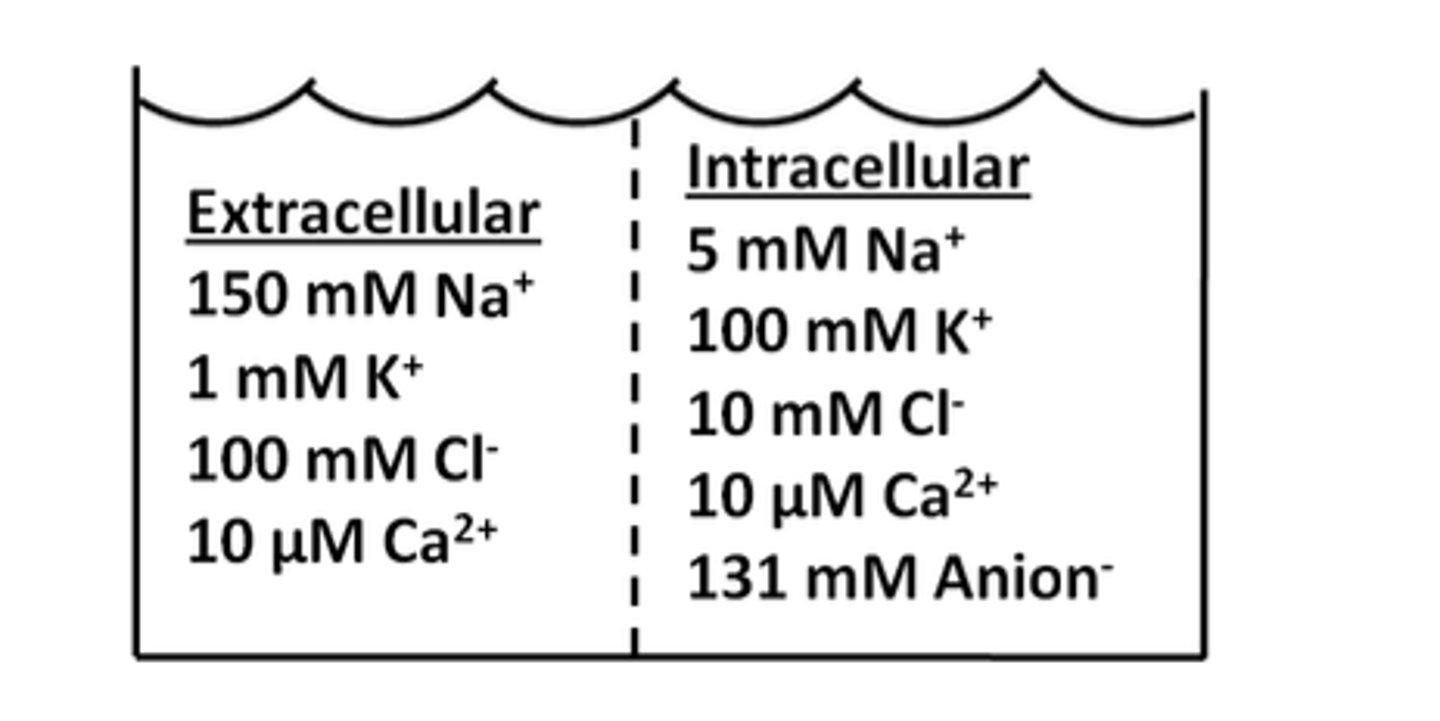
Na+ equilibrium potential = 60 x log (150/5) = 60 x (1.5) = +90 mV K+ equilibrium potential = 60 x log (1/100) = 60 x -2 = -120 mV If the membrane has the same permeability to both ions, then the membrane potential will be in the middle of both equilibrium potentials. A potential of -15 mV is exactly a potential equally distant (105 mV) from -120 mV and +90 mV and therefore the correct answer.
Ion concentrations in the ICF and ECF are given below. Opening a ligand-gated channel with equal permeability to which of these two ions will create a membrane
potential of approximately -15 mV?
A) Na+ and Ca++
B) K+ and Ca++
C) Cl- and K+
D) Na+ and ClE) K+ and Na+
K+ and Na+
all the above
Permeability of plasma membrane during resting conditions for ions
differs depending on the type of ion. individual cell types and the state of activity of the cells. How can the resting permeability of ions be modified?
(A) Voltage stimuli
(B) ligands
(C) mechanical stimuli.
(D) all the above
move the potential from -70 to +60
Each ion will always move in the direction that will help it achieve its equilibrium potential. Sodium will move its positive charges into the cell to try to:
a-move the potential from -70 to +35
b-move the potential from -70 to -55
c-move the potential from -70 to -90
d-move the potential from -70 to +60
move the potential from -70 to -90
Each ion will always move in the direction that will help it achieve its equilibrium potential.Potassium will move its positive charges out of the cell to try to:
a-move the potential from -70 to +35
b-move the potential from -70 to -55
c-move the potential from -70 to -90
d-move the potential from -70 to +60
net electromotive force that acts on the ion. ... Its arithmetic sign (i.e., positive or negative) along with the knowledge of the valence of the ion (i.e., cation or anion) can be used to predict the direction of ion flow across the plasma membrane (i.e., into or out of the cell). = Vm- EiVm = membrane voltageEi = equilibrium potential+ efflux- Influx
what is the net driving force?
(A)Used to calculate resting membrane potential
(B)Used to calculate equilibrium potential
E Ion= 60log [ion] outside/[ion] inside
(C)(B)Used to calculate threshold potential
(D)Used to calculate equilibrium potential
E Ion= 60log [ion] inside/[ion] outside
(E) net electromotive force that acts on the ion. ... Its arithmetic sign (i.e., positive or negative) along with the knowledge of the valence of the ion (i.e., cation or anion) can be used to predict the direction of ion flow across the plasma membrane (i.e., into or out of the cell). = Vm- EiVm = membrane voltageEi = equilibrium potential+ efflux- Influx
![<p>what is the net driving force?</p><p>(A)Used to calculate resting membrane potential</p><p>(B)Used to calculate equilibrium potential</p><p>E Ion= 60log [ion] outside/[ion] inside</p><p>(C)(B)Used to calculate threshold potential</p><p>(D)Used to calculate equilibrium potential</p><p>E Ion= 60log [ion] inside/[ion] outside</p><p>(E) net electromotive force that acts on the ion. ... Its arithmetic sign (i.e., positive or negative) along with the knowledge of the valence of the ion (i.e., cation or anion) can be used to predict the direction of ion flow across the plasma membrane (i.e., into or out of the cell). = Vm- EiVm = membrane voltageEi = equilibrium potential+ efflux- Influx</p>](https://knowt-user-attachments.s3.amazonaws.com/3d954c93-2605-40d9-b571-82beb0942c7b.png)
ENa+ = + 65 mV, Eca++=+120 mV, EK+=-85 mV, ECl-=-85 mV
Equilibrium potential is the Potential at which the electrical force (which is low at first) becomes equal to the concentration force (which is high at first) for a specific ion tendency of ions (electrically charged particles) to flow across a cell membrane from regions of high concentration and It depends on membrane pemeability and ion concentration on both sides of the membrane (high the concentration, the higher the ep) . Thus There is no net movement.
For example , before any movement of ions, the charge on inside and out is neutral. There is less potassium outside of the cell, so it is going to flow outwards. Eletrical force wants to bring K+ back inside because K+ is positive. So there is a Concentration and electrical force. In the beginning, when the cell is neutral, the Concentration force overrides the electrical force until there is an equal force. concentration: High then lets lower and then equalize Electrical: Low then becomes higher and equalize
Which of the following is the typical equilibrium potential of Na, K+, Ca and Cl- in nerves and muscles?
(A) ENa+ = + 120 mV, Eca++=+65 mV, EK+=-85 mV, ECl-=-85 mV
(B) ENa+ = + 65 mV, Eca++=+120 mV, EK+=-85 mV, ECl-=-85 mV
(C) ENa+ = + 85 mV, Eca++=+120 mV, EK+=-85 mV, ECl-=-65 mV
(D) ENa+ = + 65 mV, Eca++=+85 mV, EK+=-120 mV, ECl-=-85 mV
Solutions A and B are separated by a semi-permeable membrane that is permeable to Ca2+ and impermeable to Cl-
. Solution A contains 10 mM CaCl2, and solution B contains
1 mM CaCl2. What will be the electrical potential of the membrane on the solution A side
as compared to the solution B side?
A. +120mV
B. +60 mV
C. +30 mV
D. -30 mV
E. -60 mV
F. -120 mV
-30 mV
Since the membrane is impermeable to Cl- , it cannot contribute to the potential difference between A and B at rest (in this case Cl- is behaving like Na+). Ca++ equilibrium potential = (60/2) x log (Ca++ in A/Ca++ in B) = 30 x log (10/1) = 30 x 1 = +30 mV. But, this is the resting potential for side B versus side A. One way to work through this is to imagine A is outside and B is inside. Then, we know the electrical driving force at equilibrium has to either 'keep' calcium on side A (i.e. a negative potential) or 'repel' calcium from side B (i.e. a positive potential).
Use to estimate the resting membrane potential , estimates Vm when no net current through membrane
What is goldman-hodgkin-katz equation
(A)(B)Used to calculate resting membrane potential
(B)Used to calculate equilibrium potential
E Ion= 60log [ion] outside/[ion] inside
(C)Use to estimate the resting membrane potential , estimates Vm when no net current through membrane
(D)Used to calculate equilibrium potential
E Ion= 60log [ion] inside/[ion] outside
Used to calculate equilibrium potential
E Ion= 60/zlog [ion] inside/[ion] outside
z= valence (Ca2+ has 2 so it's 2). (inside is always the bigger number and outside is the small number)
This is to calculate the membrane potential
When given a compound just add the Ep for both
What is the Nest equation?
(A)Used to calculate resting membrane potential
(B)Used to calculate equilibrium potential
E Ion= 60log [ion] outside/[ion] inside
(C)(B)Used to calculate threshold potential
(D)Used to calculate equilibrium potential
E Ion= 60log [ion] inside/[ion] outside
the membrane potential at which chemical and electrical forces are balanced for a single ion.
what is equilibrium potential?
(A) the electrical charge of a neuron when it is not active
(B)the membrane potential at which chemical and electrical forces are balanced for a single ion.
(C)Return of the cell to resting state, caused by reentry of potassium into the cell while sodium exits the cell.
(D)The process during the action potential when sodium is rushing into the cell causing the interior to become more positive.
Concentration and electrical driving forces are equal and opposite
Electrochemical equilibrium for an ion is reached when
A) The concentration gradient is greater than the electrical gradient
B) The electrical gradient is greater than the concentration gradient
C) The membrane potential reaches a value of 0 mV
D) The membrane potential reaches a resting value
E) Concentration and electrical driving forces are equal and opposite
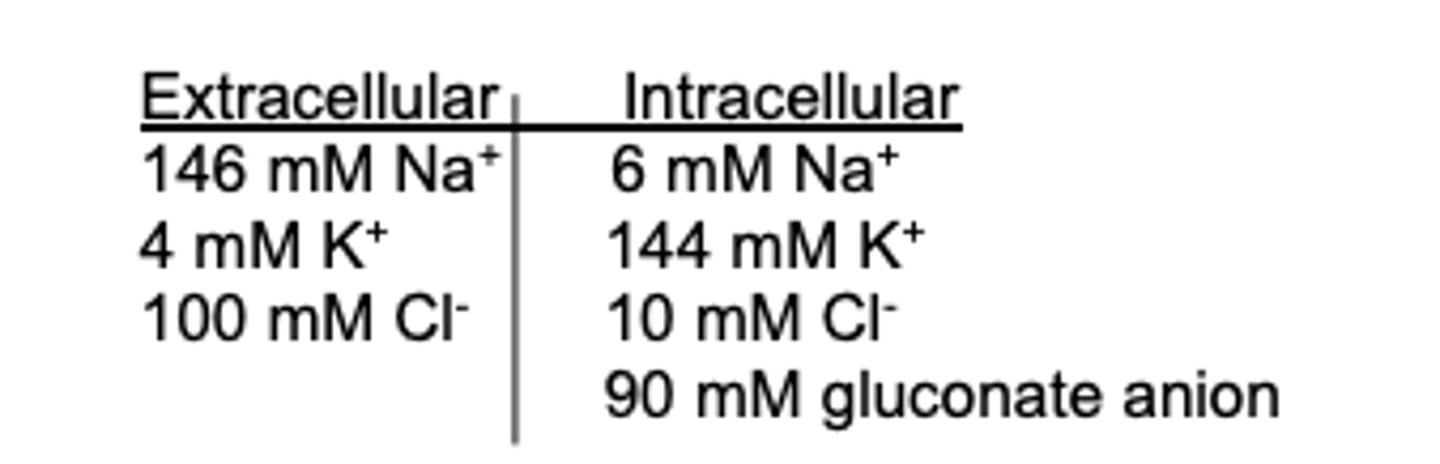
equilibrium potential = 60 x log (10/100) = 60 x (-1) = -60 mV
* if you use Ci/Co then you do not use a z of -1 and vice versa
. The ionic composition of intracellular and extracellular volumes is given below for a cell in the resting state
What is the equilibrium potential for Cl- in mV?
A) +100
B) + 80
C) + 60
D) - 60
E) - 80
F) -100
K+ exit out of the cell through potassium channels
Resting membrane potential is measured as the potential difference across the cell membrane so it is determined by multiple ions attempting to reach their individual equilibrium potentials.
What process is predominantly involved in the generation of the negative resting membrane potential (-70)?
A) Transport of sodium out of the cell by Na+/K+ ATPase
B) Transport of potassium into the cell by Na+/K+ ATPase
C) A decrease in the concentration of chloride ions outside the cell
D) K+ exit out of the cell through potassium channels
E) Entry of Na+ into the cell through ligand-gated sodium channels
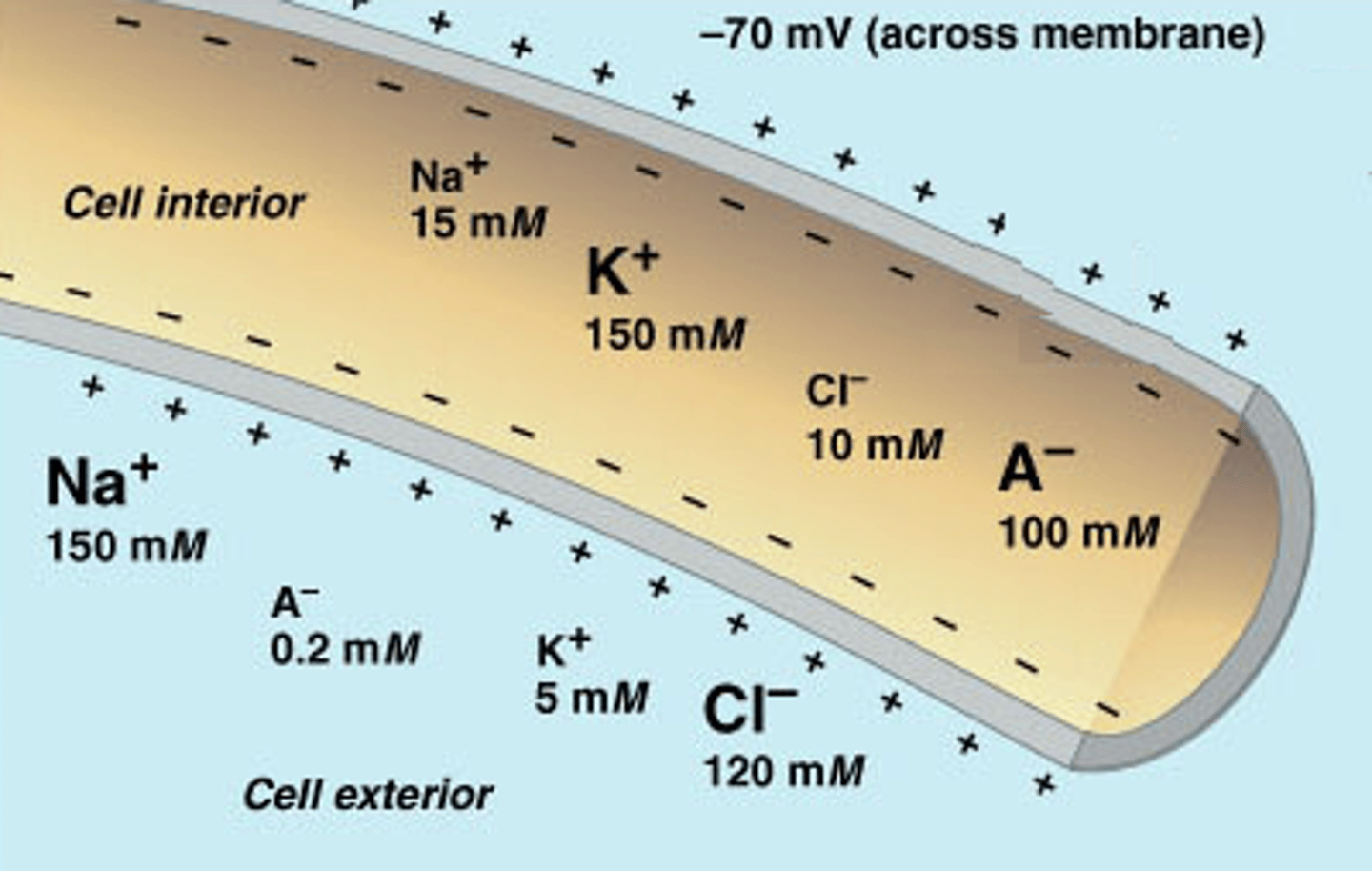
F
Calculating the Nernst potential for each ion, it is only F- that has an equilibrium potential near the resting membrane potential.
. For the aliens on image, they have the same body temperature as we do, and their
nerves and muscles have resting membrane potentials of -80 mV. Membrane
permeability to which ion is responsible for their resting membrane potential?
A) Li+
B) Rb+
C) Cs+
D) F
E) Sr++
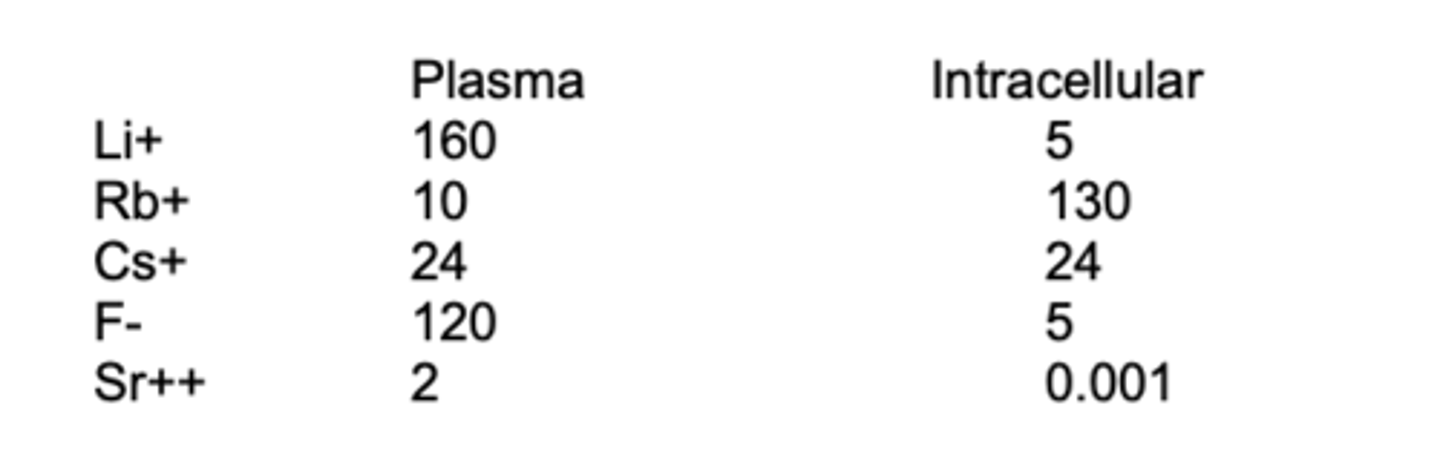
If the aliens above generate action potentials that overshoot 0 mV the way ours do,
then this depolarization is likely achieved with
A) Voltage-gated Li+ channels
B) Voltage-gated Rb+ channels
C) Voltage-gated Cs+ channels
D) Voltage-gated F- channels
Voltage-gated Li+ channels
B is incorrect because the distribution of Rb+ is like potassium for us, and produces a
negative equilibrium potential. Cs+ would have an equilibrium potential of 0 mV, and Fwould set the negative resting membrane potential. Voltage-gated Sr++ channels would
also be a correct answer, but it is not one of the choices given.
would be 0 mV
we are saying the channels open and stay open, which means the gradients would eventually dissipate via diffusion, leading to the loss of membrane potential (i.e. EK and ENa would both become 0 mV). For those wondering, the Na/K ATPase could not compensate for this constant and large rate of diffusion.
For a typical neuron, if an equal number of sodium and potassium channels opened
and stayed open, creating the same membrane permeability for each ion, then at equilibrium the membrane potential
A) would be closer to EK
B) would be closer to ENa
C) would be half-way between EK and ENa
D) would be 0 mV
90mV
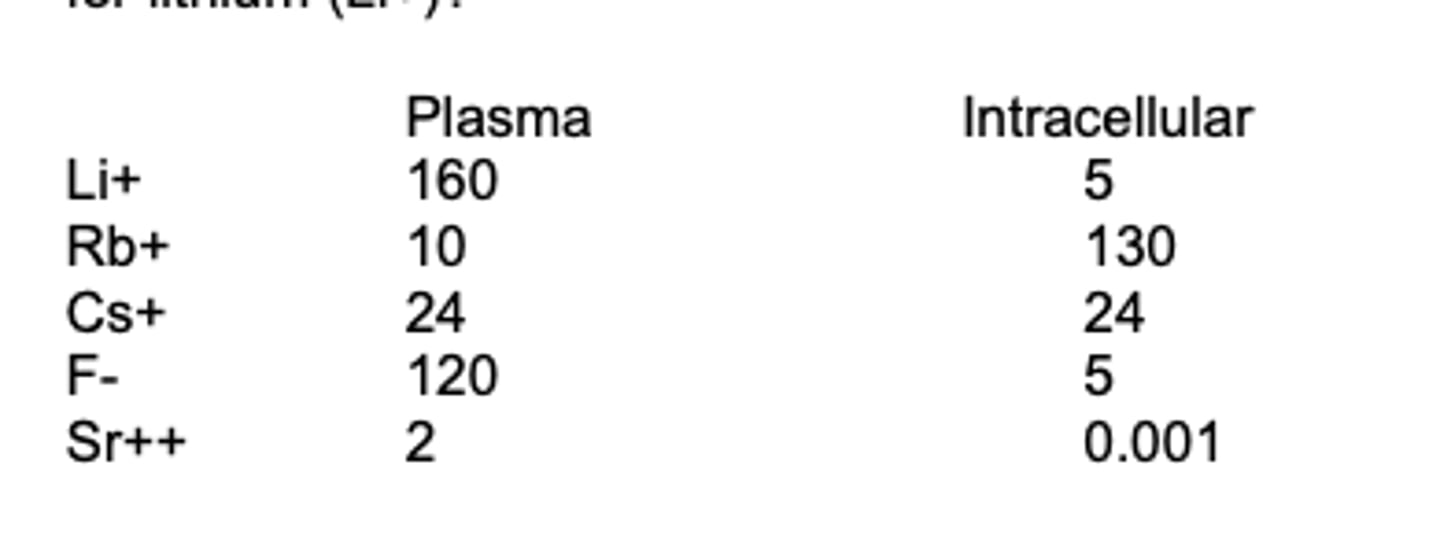
Li+ is high outside cells and low inside, just like Na+ in our physiology. So, using the Nernst equation just like we would for sodium yields (60) x log (160/5) = 60 x (1.5) = 90 mV.
The aliens have landed! They have a strange make-up of electrolytes in their blood plasma and cells. Based on these values below (in mM), what is the equilibrium potential
for lithium (Li+)?
A) +160 mV
B) + 90 mV
C) + 32 mV
D) - 32 mV
E) - 90 mV
F) - 160 mV
lose charge before reaching threshold
Any potential that decreases over distance (i.e. loses charge) without reaching threshold is by definition a graded potential.
The decremental (The act or process of decreasing or becoming gradually less.) spread of a graded potential, i.e. electrotonic conduction, occurs when excitable membranes
A) have a myelin sheath
B) lack potassium channels
C) lack sodium channels
D) lose charge before reaching threshold
E) reach threshold before losing charge
Magnesium
is the only small charged ion that might have
channels (it does) and contribute anything to Vm (it normally doesn't).
Which of the following is most likely to make a small contribution to resting membrane
potential?
A) Glucose
B) Lactate
C) Magnesium
D) Urea
Saltatory conduction
Every answer except E is either a graded potential or an example of graded potential conduction. Saltatory conduction, however, is the propagation of action potentials.
Graded Potentials are changes in membrane potential that are confined to a relatively small region of the plasma membrane and die out within 1-2mm of their site of origin and occurs through Depolarization or hyperpolarization of neuron back to resting potential and is determine by stimulus strength.
All of the following are examples of graded potentials except
A) EPSP
B) IPSP
C) Passive conduction
D) Electrotonic conduction
E) Saltatory conduction
sensory transduction
what is turning different kinds of stimuli into action potentials in the nervous system?
A) EPSP
B) IPSP
C) Passive conduction
D) Sensory transduction
E) Saltatory conduction
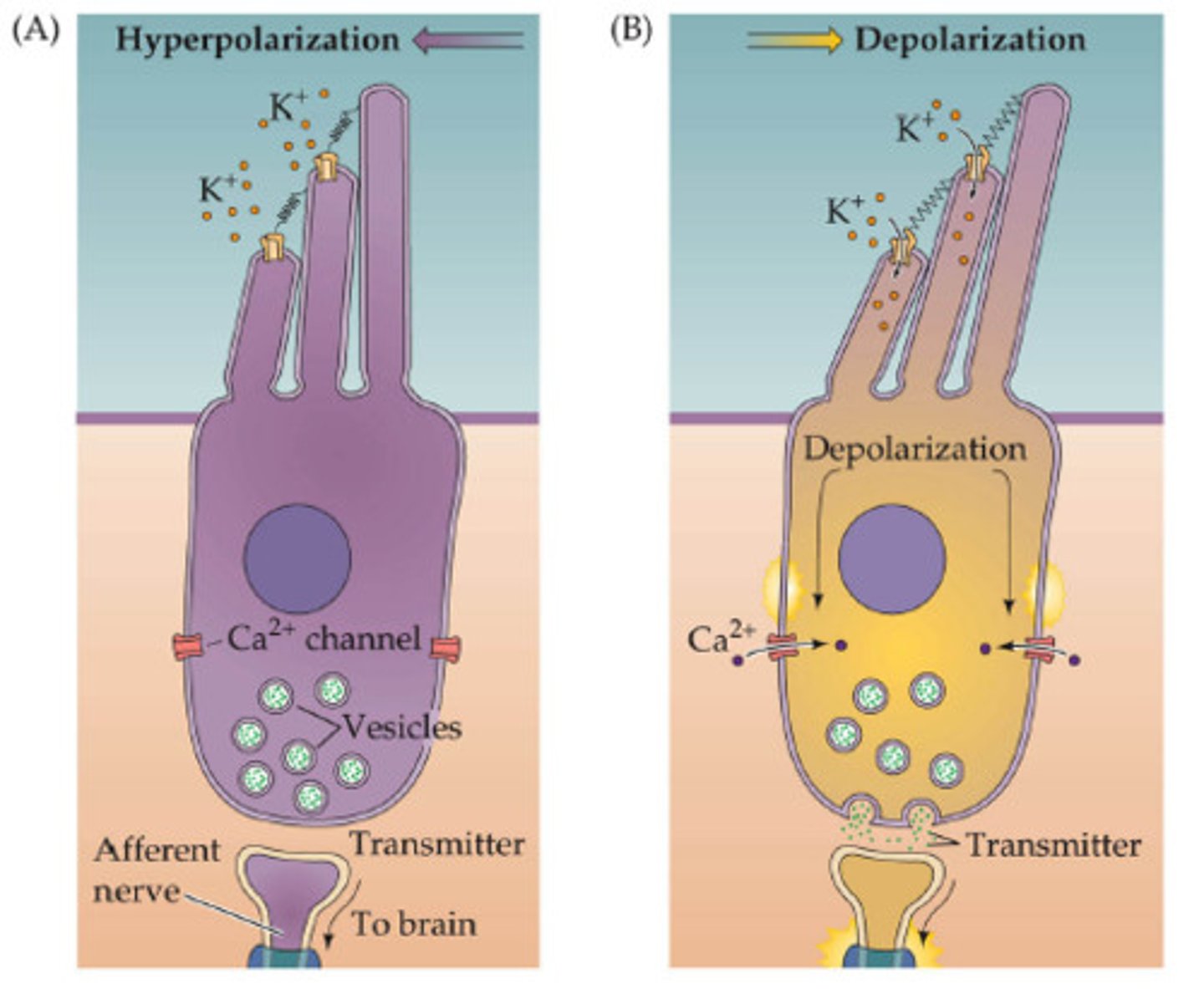
Electrotonic conduction
what is the passive spread of a graded potential from the site of origin within a cell. it can be local or graded and occurs
A) EPSP
B) IPSP
C) Passive conduction
D) Electrotonic conduction
E) Saltatory conduction
microelectrode recording
a technique used to measure the activity of individual cells such as neurons and muscle
A) EPSP
B) Microelectrode recording
C) Passive conduction
D) Electrotonic conduction
E) Saltatory conduction
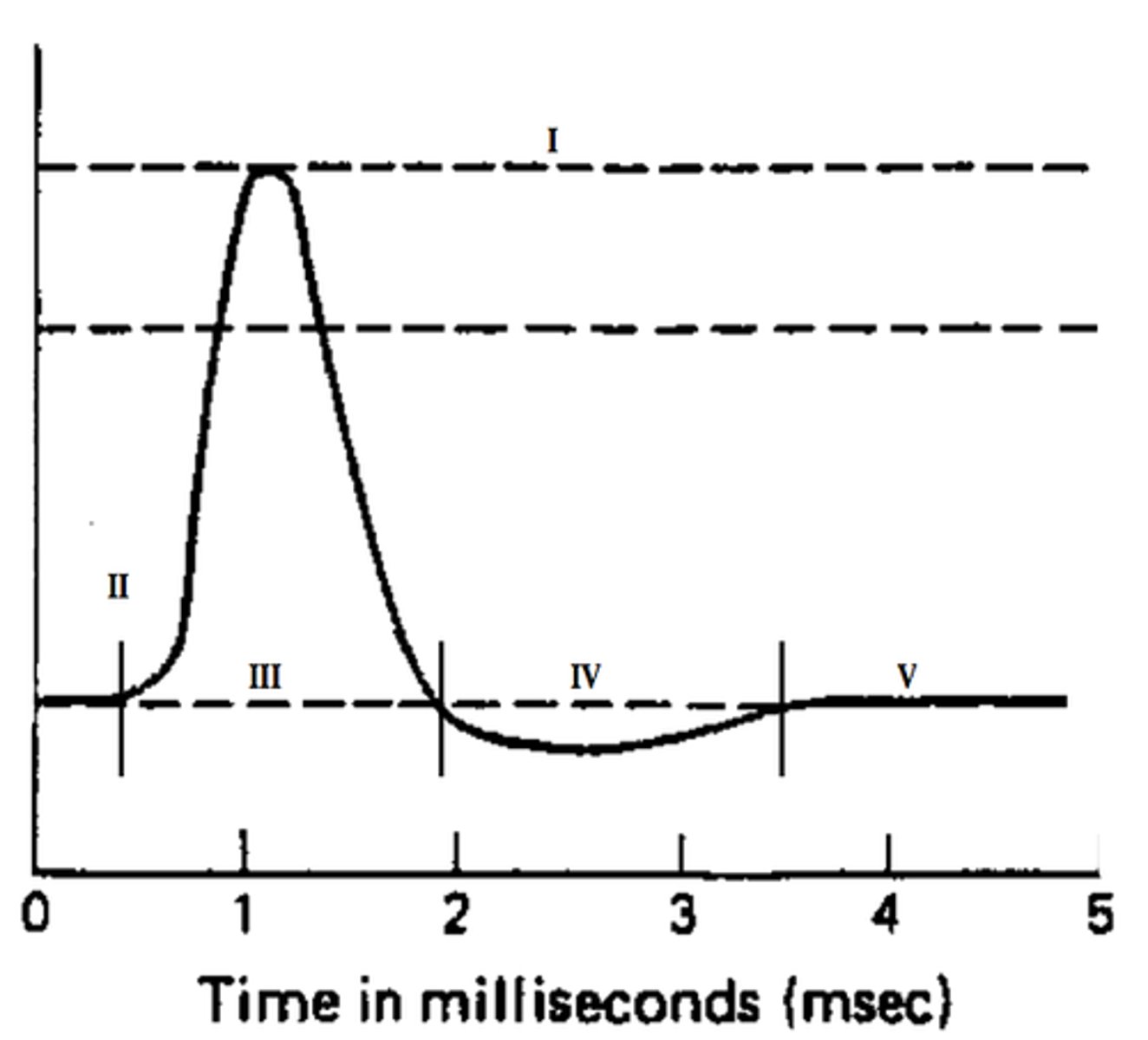
Saltatory conduction
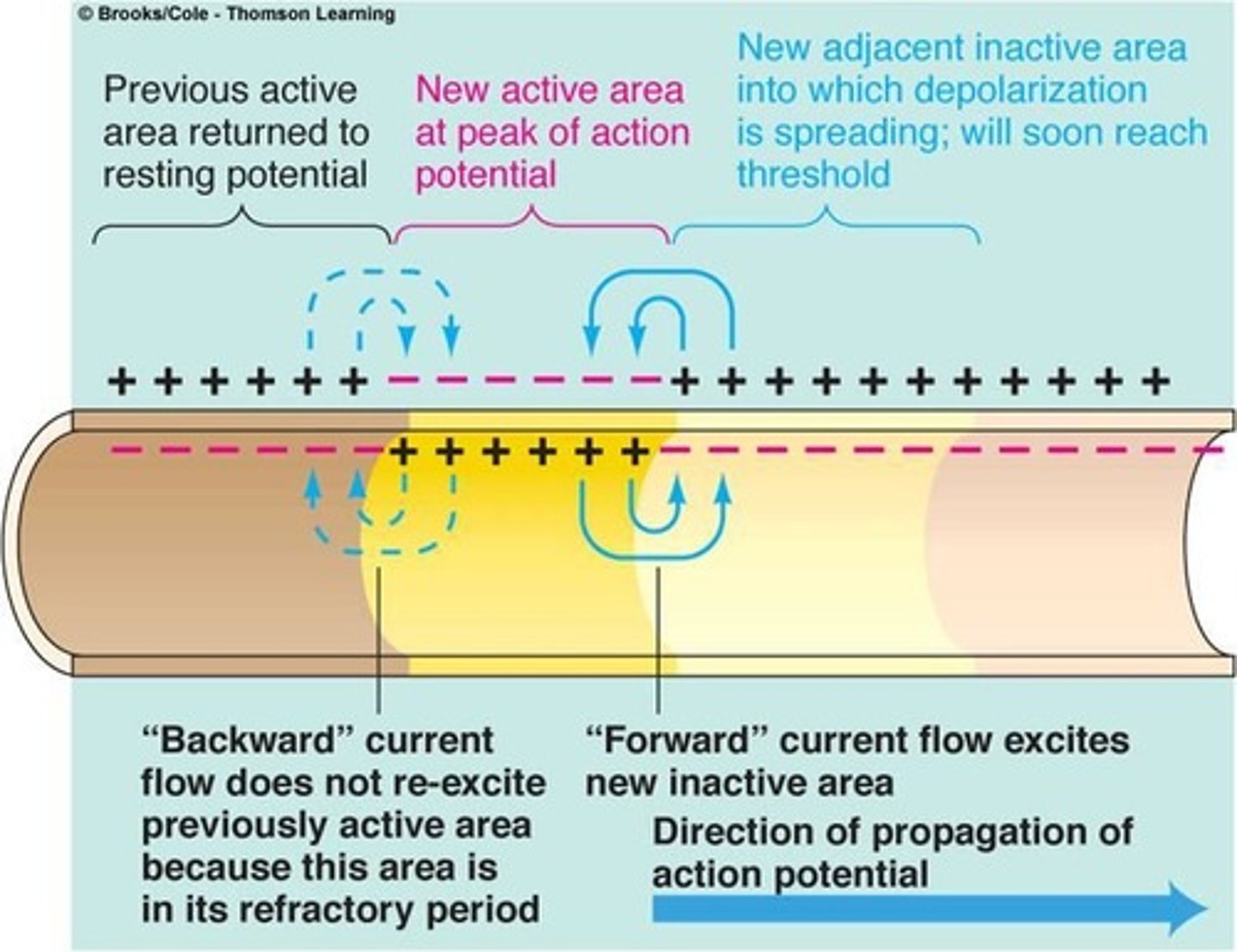
This is Propagation of the action potential or transmission of an action potential down an axon. Once the potential in one site of the axon is positive while the adjacent ones are negative, it'll travel to the next distal segment. This will cause the next distal site to reach the threshold and the proximal region will begin its refractory period. It'll continue down the axon depolarizing each segment
A) EPSP
B) Microelectrode recording
C) Passive conduction
D) Electrotonic conduction
E) Saltatory conduction
-70 to -80 mV
Neurons are excitable, with a membrane potential of about
a-70 to -90 mV
b-70 to -80 mV
c-+60 mV
d-70
4-35
+60 mV
Since Na has a ____________mV, it makes it the
strongest electrical gradient favoring influx of sodium
a-70 to -90 mV
b-70 to -80 mV
c-+60 mV
d-70
4-35
create small current of graded potentials. As they spread out, they lose their ability to change potentia
Local signaling sites :
a- strongest electrical gradient favoring influx of sodium
b- an action potential
c-Have different signaling locations grades potentials meet at one spot or Have one spot release its "raindrops" of voltage change multiple times very quickly
d-create small current of graded potentials. As they spread out, they lose their ability to change potential
e-summate, so overlapping waves "pile up" on one another, making a BIG change in membrane potential
summate, so overlapping waves "pile up" on one another, making a BIG change in membrane potential
Graded potentials can:
a- strongest electrical gradient favoring influx of sodium
b- an action potential
c-Have different signaling locations grades potentials meet at one spot or Have one spot release its "raindrops" of voltage change multiple times very quickly
d-create small current of graded potentials. As they spread out, they lose their ability to change potential
e-summate, so overlapping waves "pile up" on one another, making a BIG change in membrane potential
Have different signaling locations grades potentials meet at one spot or Have one spot release its "raindrops" of voltage change multiple times very quickly
which are ways to summate ?
a- strongest electrical gradient favoring influx of sodium
b- an action potential
c-Have different signaling locations grades potentials meet at one spot or Have one spot release its "raindrops" of voltage change multiple times very quickly
d-create small current of graded potentials. As they spread out, they lose their ability to change potential
A, B, C, D, E
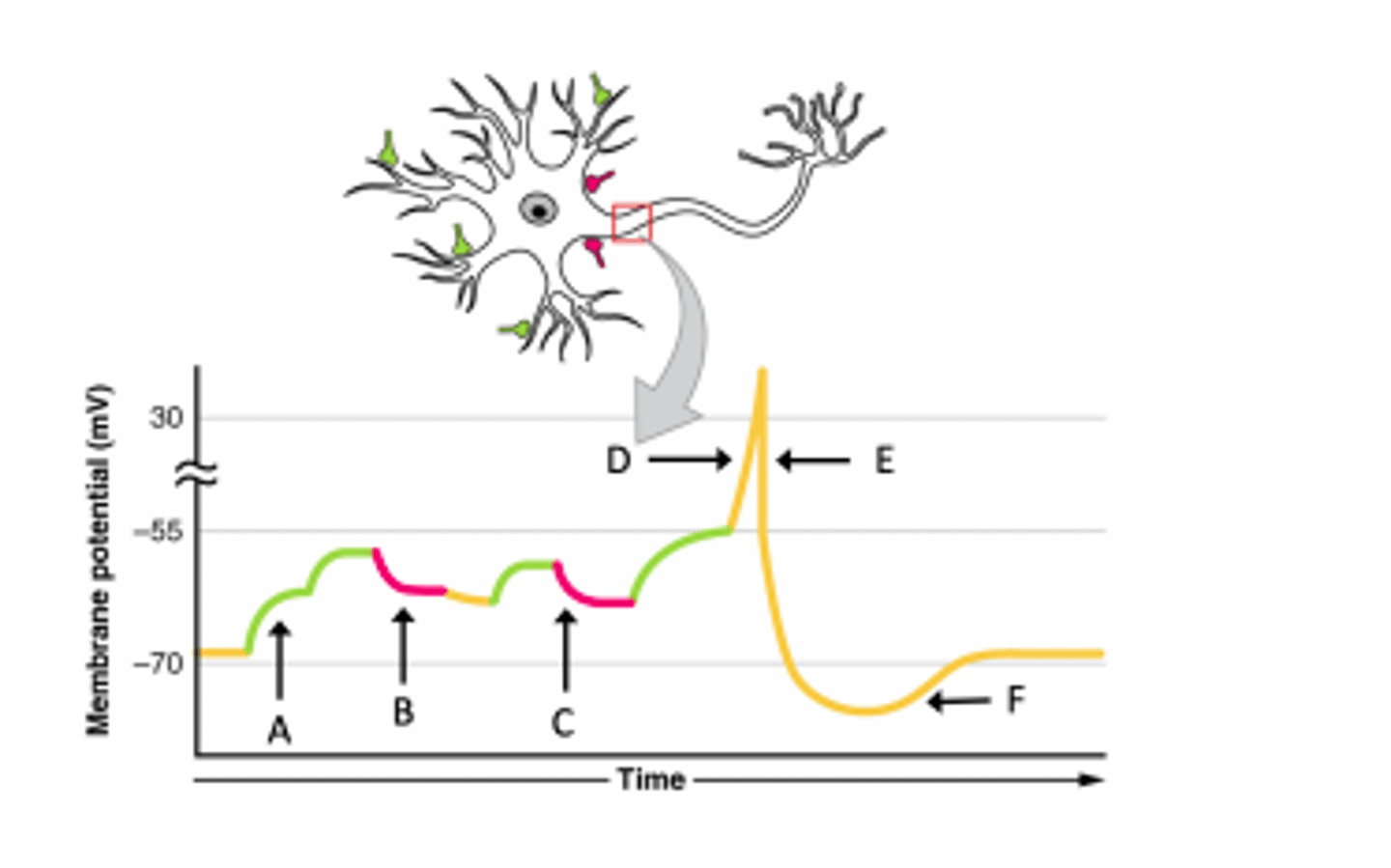
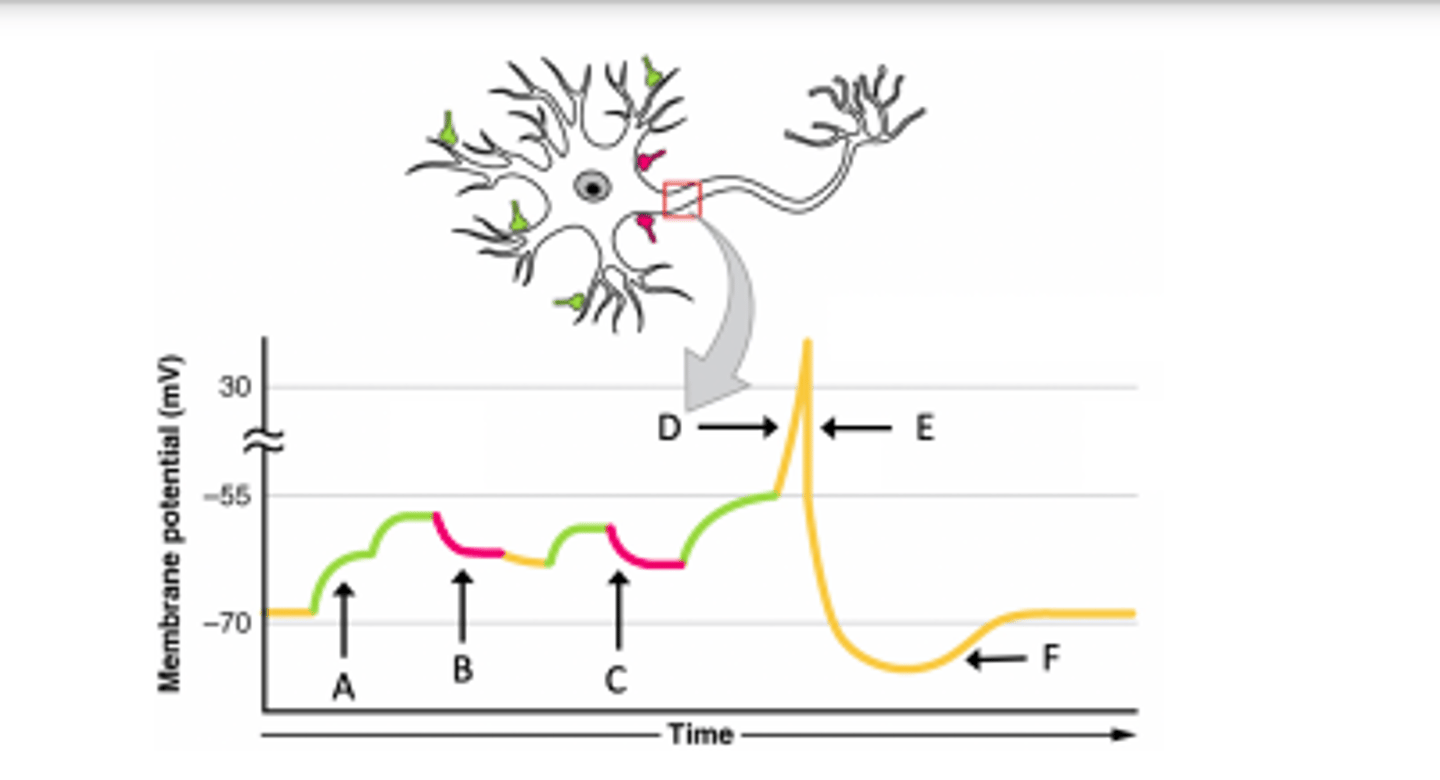
This is a good example of how the wording can really matter. all of the labels, except F, are pointing to depolarizations above the resting membrane
potential.
Which point(s) show a depolarization above resting membrane potential?
A) A
B) B
C) C
D) D
E) E
F) F
G) A, D
H) A, D, F
I) A, B, C, D
J) A, B, C, D, E
K) A, B, C, D, E, F
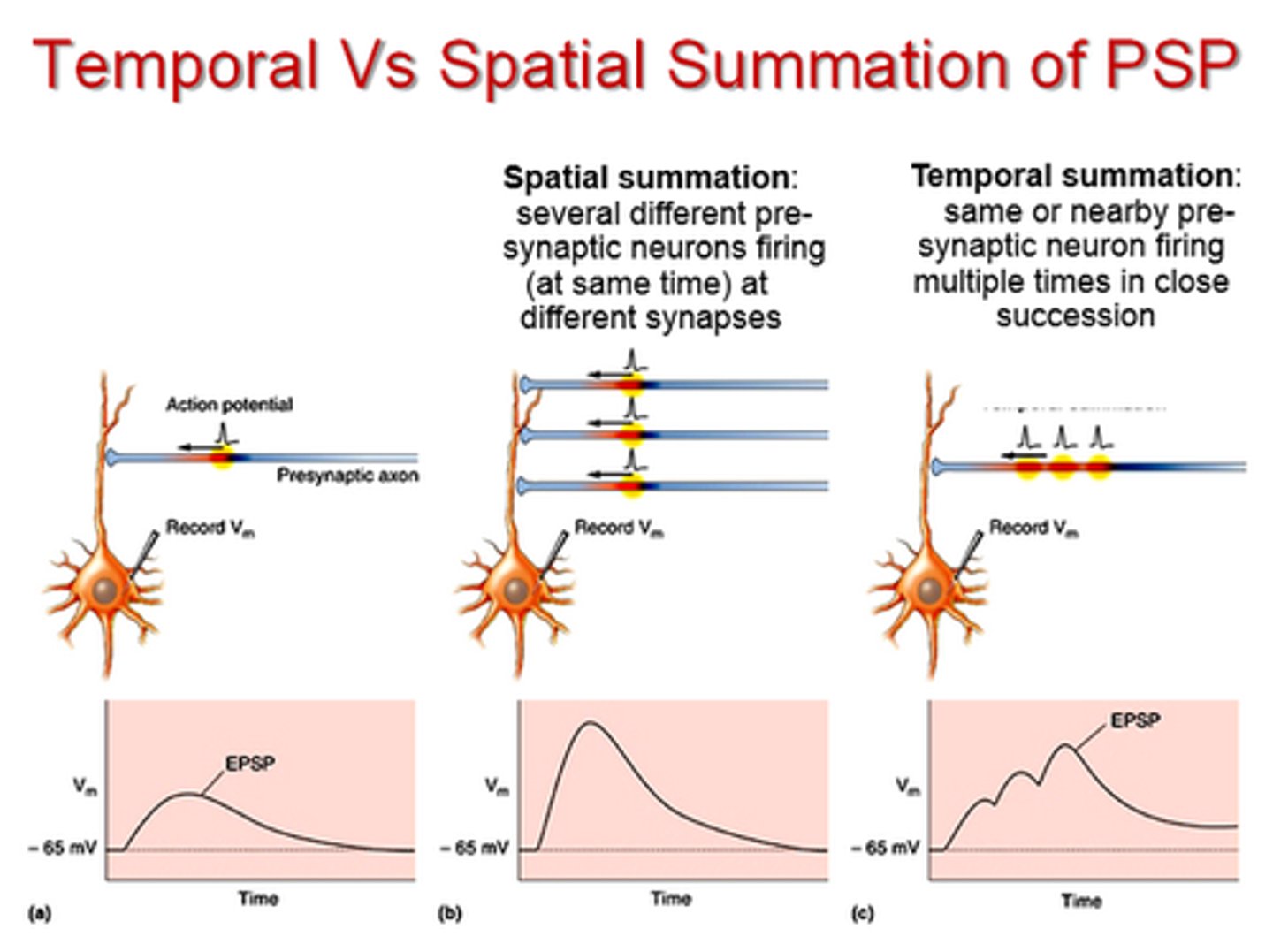
Spatial summation
combining EPSPs and IPSPs from a large number of upstream neurons, each firing only once is:
a-Relative refractory period
b-Temporal summation
c-Absolute refractory period
d-Spatial summation
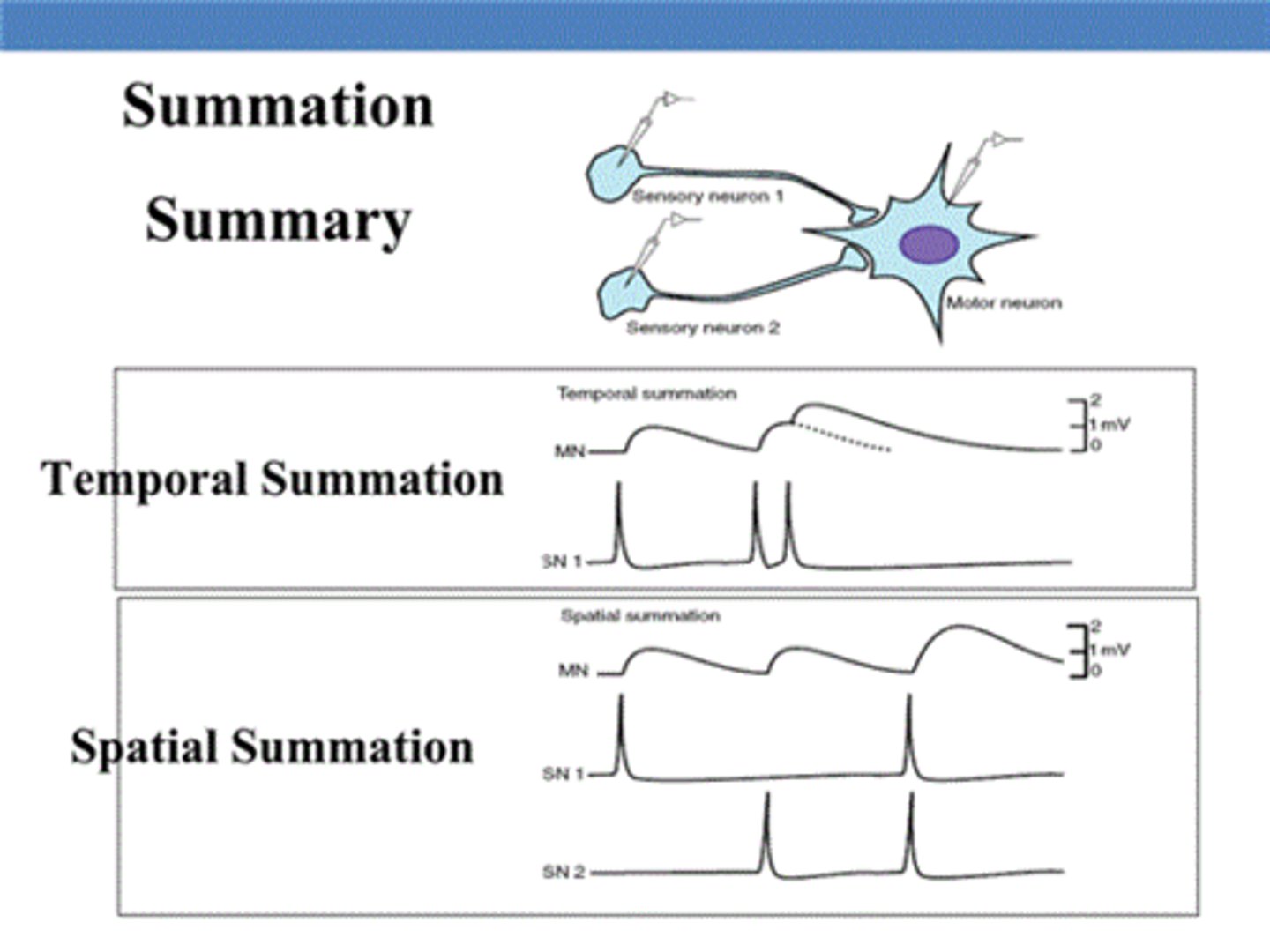
Temporal summation
Combining multiple EPSPs or IPSPs from the same, rapidly firing upstream neuron is:
a-Relative refractory period
b-Temporal summation
c-Absolute refractory period
d-Spatial summation
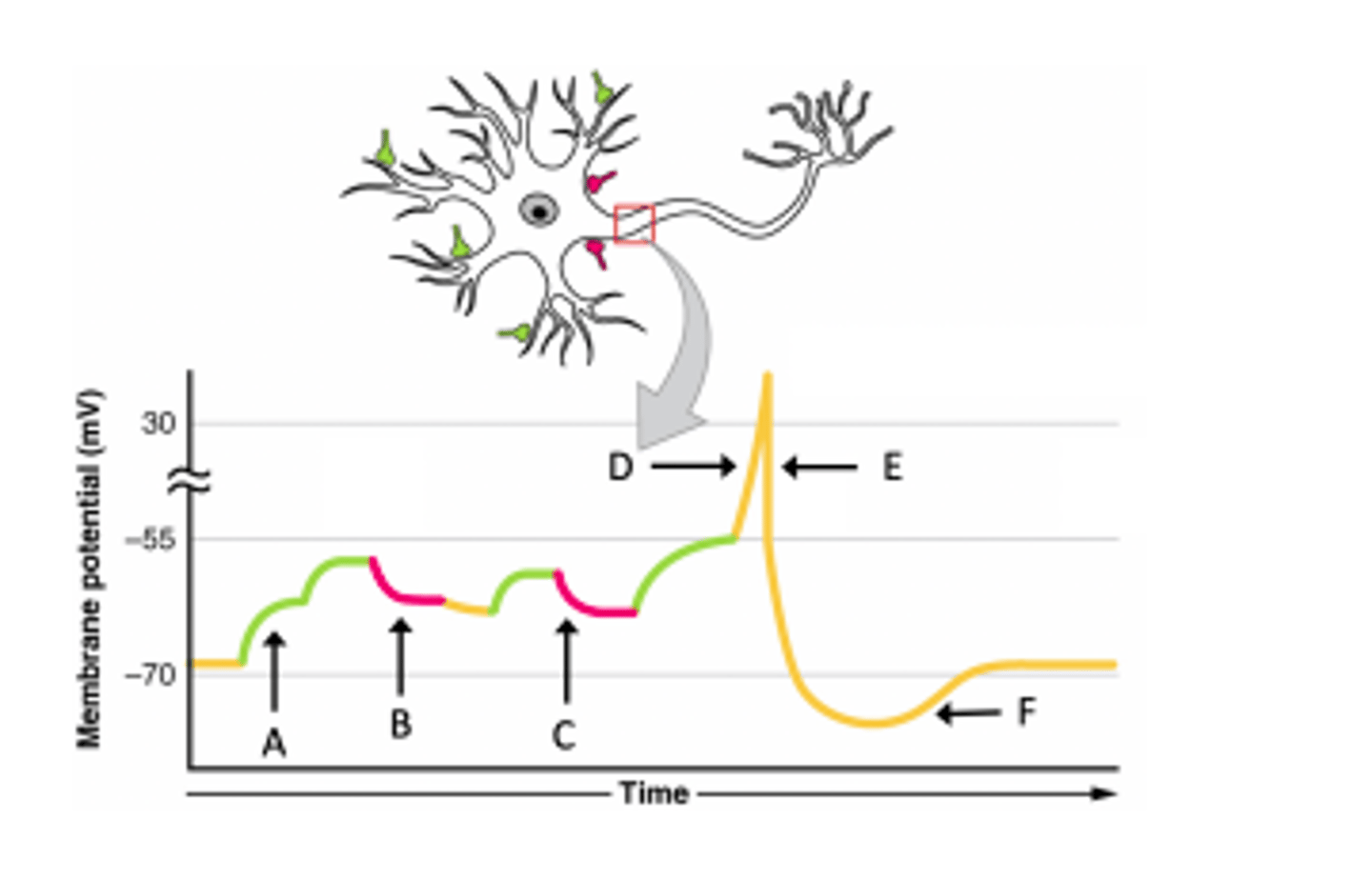
A
Which point(s) show a depolarization from resting membrane potential?
A) A
B) B
C) C
D) D
E) E
F) F
G) A, D
H) A, D, F
I) A, B, C, D
J) A, B, C, D, E
K) A, B, C, D, E, F
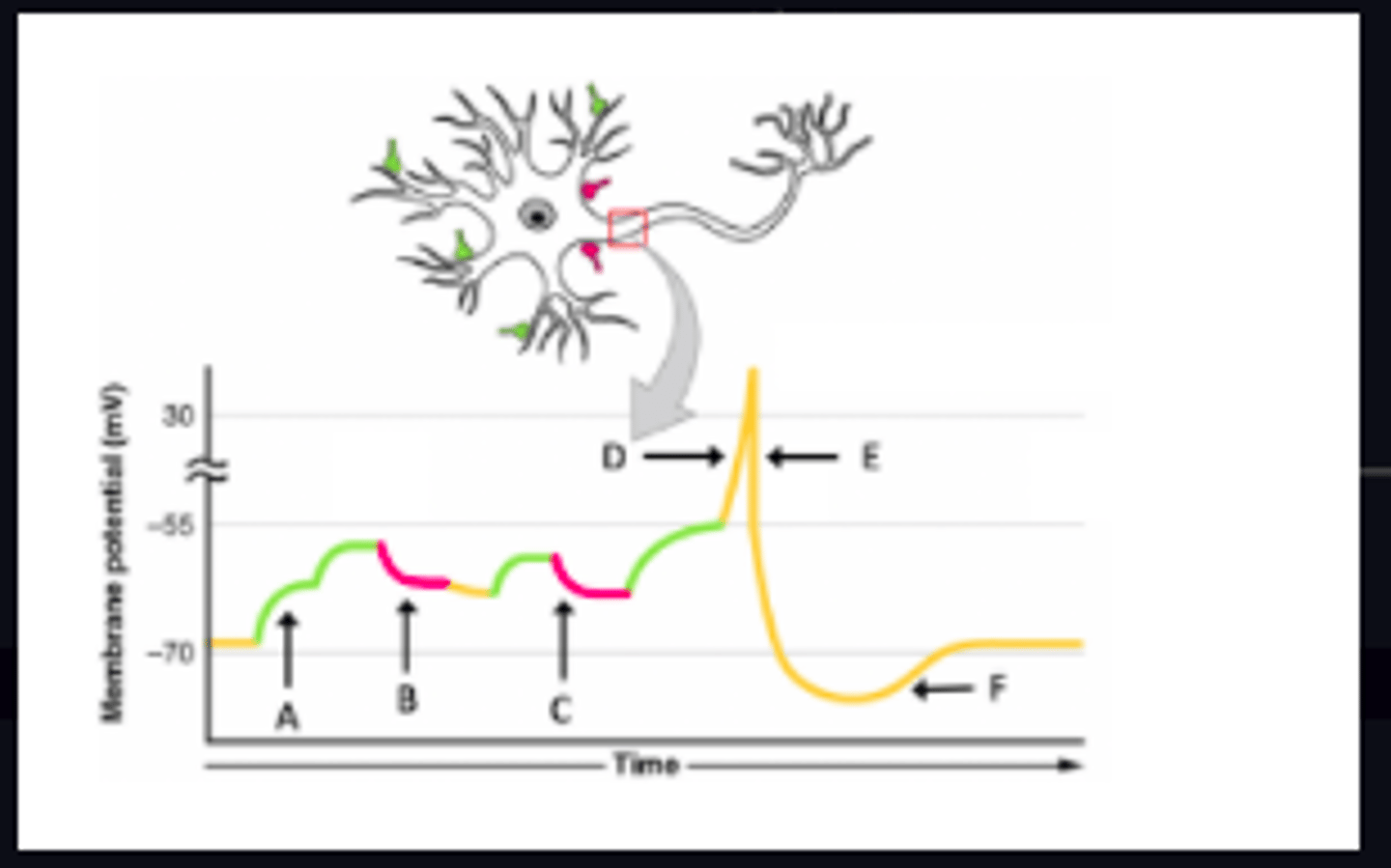
B
The pink curves are inhibitory post-synaptic potentials (IPSPs) and B is being generated right after the summation of two EPSPs.
An inhibitory postsynaptic potential (IPSP) is a kind of synaptic potential that makes a postsynaptic neuron less likely to generate an action potential and an excitatory postsynaptic potential (EPSP) is a synaptic potential that makes a postsynaptic neuron more likely to generate an action potential. Summation occurs when you add up the effect of multiple stimuli, that are all individually subthreshold so that together they are suprathreshold and are able to generate an action potential (a response)
Which point shows an IPSP generated after the summation of 2 EPSPs?
A) A
B) B
C) C
D) D
E) E
F) F
Vm will depolarize
In a neuron, what will be the result of doubling extracellular [K+]?
A) The amplitude of Vm will double
B) The amplitude of Vm will be halved
C) Vm will depolarize
D) K+ will no longer determine Vm
E) Vm will hyperpolarize towards EK
Open voltage gated sodium channels
Depolarization occurs when ions flood into the cell.
Which of the following would most depolarize a neuron by making the membrane potential more positive and less negative than the resting potential. ?
A) Increased K+ permeability
B) Open voltage-gated potassium channels
C) Increased Cl- permeability
D) Open voltage-gated sodium channels
E) Increased Na+/K+ ATPase activity
Inactivation of the Na+ channels, and opening of K+ channels
Which of the following would most repolarize a neuron by making the membrane potential go back to a negative value. ?
A) Inactivation of the Na+ channels, and opening of K+ channels
B) Open voltage-gated potassium channels
C) Increased Cl- permeability
D) Open voltage-gated sodium channels
E) Increased Na+/K+ ATPase activity
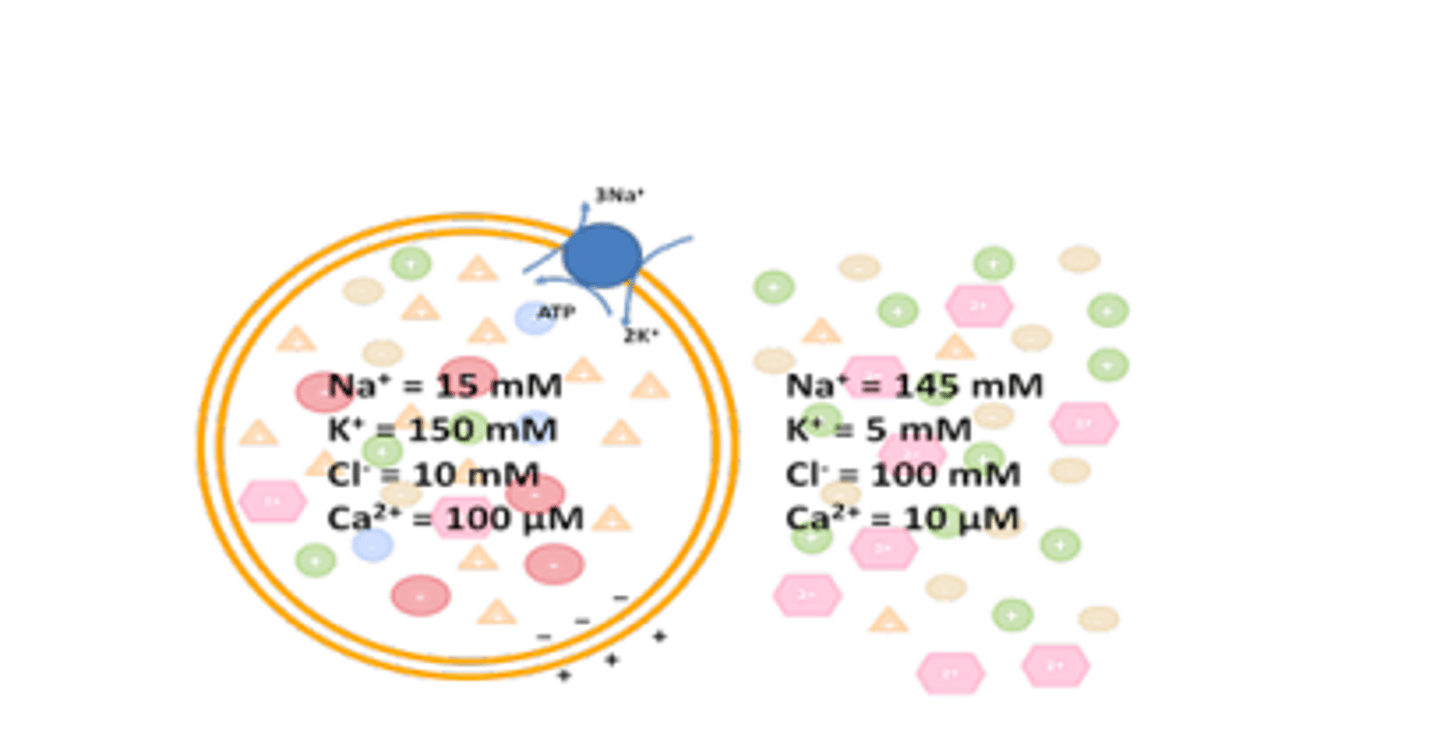
Cl- will move out of the cell and will depolarize the cell.
In the simplest terms, a membrane potential (or any potential, a.k.a. voltage) is a separation of charge. A and B are true statements, but they are not why a membrane potential exists. C is incorrect, because while the electrogenic Na/K ATP does separate charge, this is miniscule compared to the separations due to electrochemical gradients. E is incorrect because the typical membrane potential results from several different equilibrium potentials (as determined by the GHK equation).
An excitable cell is illustrated below that has a membrane potential of -70 mV at rest.
What change in Cl- movement and in the membrane potential of this cell will occur when a stimulus increases its chloride ion permeability?
A) Cl- will move into the cell and will hyperpolarize the cell.
B) Cl- will move out of the cell and will depolarize the cell.
C) Cl- will move into the cell but membrane potential will not change
D) Cl- will move out of the cell but membrane potential will not change
remain unchanged
An action potential is all-or-none, the amplitude does not change with frequency of discharge
As action potential firing frequency in an axon increases (e.g. from 50/sec to 100/sec), the action potential amplitude will
A) decrease
B) increase
C) remain unchanged
both A and B
As the myelin sheath degrades, it would take longer for current to make it to the next node because of current 'leaks' in places leaks didn't exist before. Eventually, the leaks would be enough to prevent depolarization of the next node, or a 'dropped' AP. With further disease progression, 'dropped' APs would become more common, i.e. the AP firing frequency received by the post-synaptic neuron would continue to decrease.
Demyelinating diseases would
A) decrease conduction speed between nodes ( saltatory conduction AKA action potential)
B) decrease AP frequency as disease progresses
C) increase conduction speed between nodes
D) increase AP frequency
E) both A and B
F) both C and D
G) both B and C
H) both A and D
increase membrane resistance to current flow but doesn't change the internal resistance
The main function of myelin on axons is to
A) increase membrane resistance to current flow but doesn't change the internal resistance
B) increase internal resistance to current flowbut doesn't change the internal resistance
C) decrease membrane resistance to current flow but doesn't change the internal resistance
D) decrease internal resistance to current flow but doesn't change the internal resistance
internal resistance to ion flow is reduced
Type 1a motor fibers have the largest diameters and myelin too, making them the fastest of all neurons. Larger diameter increases velocity because:
a-internal resistance to ion flow is increased
b-external resistance to ion flow is reduced
c-internal resistance to ion flow is reduced
d-external resistance to ion flow is increased
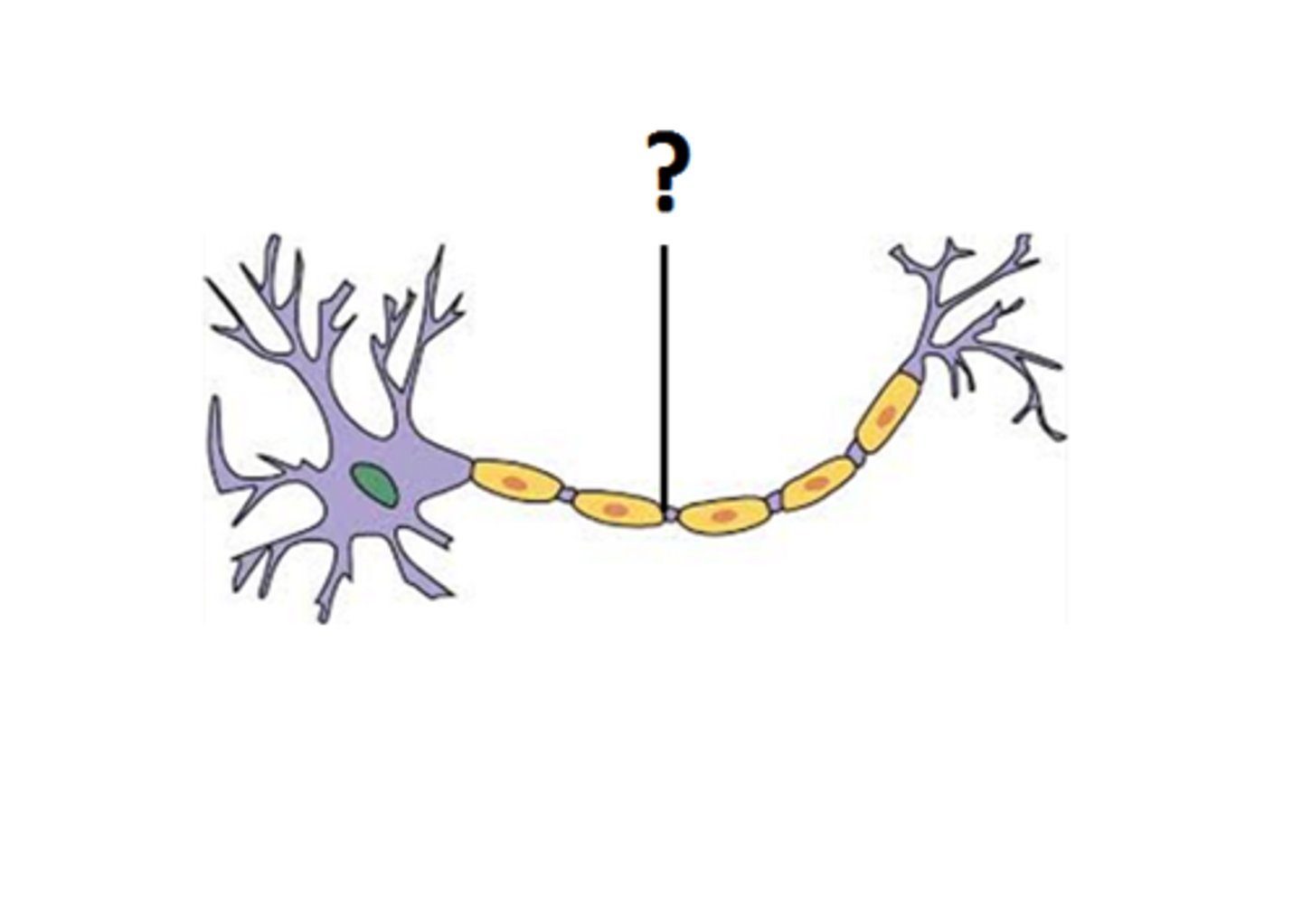
node of Ranvier (myelin sheath gap)
Myelination is the solution to
energy and speed issues. what is a bare region of axonal membrane in myelinated axons only?
a- axon
b-dendrites
c-axon hillock
d-node of Ranvier (myelin sheath gap)
e-cell body
Increased K+ permeability
Hyperpolarization occurs when ions rapidly leave the cell and the membrane potential becomes more negative than resting potential.
Which of the following would most hyperpolarize a neuron?
A) Increased K+ permeability
B) Open voltage gated potassium channels
C) Increased Cl- permeability
D) Open voltage gated sodium channels
E) Increased Na+/K+ ATPase activity
Decrease of the sodium concentration gradient across the membrane
With a typical resting membrane potential of -70 mV, both Na+ and K+ are not at their
respective equilibrium potentials and therefore, Na+ leaks into the cell and K+ leaks out
of the cell. Na+/K+ ATP-ase pumps compensate for these leaks and move Na+ out of the
cell and K+ into the cell. Inactivation of this pump means the compensation for leaks is prevented, and as a result the gradients of these ions will slowly disappear.
Inactivation of the sodium-potassium ATPase pump will cause which of the following
to occur?
A. Decrease of the sodium concentration gradient across the membrane
B. An increase in the intracellular potassium concentration
C. A hyperpolarization of the membrane potential
D. An increase in the flow of sodium out of the cell
be hyperpolarized
In normal conditions, the electrogenic Na/K ATPase can make a small contribution to the membrane potential (depending on how many pumps and their activity). If these pumps started moving out an extra positive charge with each cycle of activity, the membrane potential would be hyperpolarized.
. The main Na/K ATPase pumps 3 Na+ out for each 2 K+ brought in. Assuming no changes in any other conditions, if the ATPase now pumped out 4 Na+ and still brought in 2 K+, the resting membrane potential would
A) remain unchanged
B) be depolarized
C) be hyperpolarized
larger, delayed
Voltage gated K+-channels are activated by depolarization, but this activation is delayed compared to activation of voltage gated Na+ channels, which are responsible for the depolarization and peak amplitude of the action potential. Preventing these channels from opening will not only delay the repolarization phase of the cell membrane but will also affect the amplitude of the action potential. The open voltage-gated K+-channels at the peak of the AP tend to prevent the membrane from reaching closer to ENa+ than it might otherwise - with these K+ channels blocked the AP amplitude would be considerably larger.
A certain drug has the property of preventing voltage-gated potassium channels from
opening. If this drug is applied to an axon, what changes in the amplitude of depolarization (phase 1) and in the time course of repolarization (phase 2) of the action potential will occur to Amplitude of AP Repolarization and phase of AP ?
A larger faster
B larger unchanged
C larger delayed
D unchanged faster
E unchanged unchanged
F unchanged delayed
G smaller faster
H smaller unchanged
I smaller delayed
An inactivation of voltage-gated sodium channels
Inactivated voltage gated Na+-channels cannot be opened by any stimulus no matter how strong the stimulus will be. Therefore, an action potential cannot be produced as long as all the voltage-gated Na+ channels are inactivated (i.e. this is the absolute refractory period)
Refractory periods occur during the action potential when a second stimulus will NOT produce a second action potential.
What process underlies the absolute refractory period?
A) A decrease in Na/K ATPase activity
B) An increase in Na/K ATPase activity
C) An inactivation of ligand-gated sodium channels
D) An inactivation of voltage-gated sodium channels
E) An inactivation of ligan-gated potassium channels
F) An inactivation of voltage-gated potassium channels
K+ channels are open
While the K+ channels are open, the cell is in the relative refractory period. Only a very large depolarization will cause a signal, because as the Na+ flows in, in an attempt to create an action potential, the K+ will flow out, short-circuiting the attempt. With positive charge flowing in and out, only a very large stimulus will cause a depolarization large enough to be registered.
Refractory periods is period of time in which the electrically active cell is totally or partially inhibited from being able to respond to a stimulus. Absolute refractory period is minimum length of time after an action potential during which another action potential cannot begin and Relative refractory period is a period after firing when a neuron is returning to its normal polarized state and will fire again only if the incoming message is much stronger than usual.
What process underlies the relative refractory period?
A) A decrease in Na/K ATPase activity
B) K+ channels are open
C) An inactivation of ligand-gated sodium channels
D) An inactivation of voltage-gated sodium channels
E) An inactivation of ligan-gated potassium channels
F) An inactivation of voltage-gated potassium channels
could... because this is the relative refractory period
At point F, another action potential could/could not be generated because
A) could... because this is the absolute refractory period
B) could... because this is the relative refractory period
C) could not...because this is the absolute refractory period
D) could not...because this is the relative refractory period
sodium channels proximal to the AP inactivate
the most proximal segment is in an absolute refractory period, and the
AP can't 'backfire'. This is how things normally work but do know that if an electrode was used to stimulate a resting axon right in the middle, the AP would propagate in both directions.
. The main reason action potential propagation in an axon is unidirectional is because
A) potassium channels proximal to the AP inactivate
B) potassium channels distal to the AP inactivate
C) sodium channels proximal to the AP inactivate
D) sodium channels distal to the AP inactivate
axon hillock
This is region of the neuron in which new action potentials are initiated, is Located at the junction of the soma and Threshold must occur here.
a- axon
b-dendrites
c-axon hillock
d-synapse
e-cell body