BIOL 430 EXAM
 Call Kai
 Learn
Learn Practice Test
 Spaced Repetition
 Match
Match Flashcards
 Knowt Play
1/22

There's no tags or description
Looks like no tags are added yet.
Name | Mastery | Learn | Test | Matching | Spaced | Call with Kai |
|---|
No analytics yet
Send a link to your students to track their progress
23 Terms
Catabolism
produces energy
generates monomers
produces reduced coenzymes and (e-)
overall- OXIDATIVE
LEO- lose electrons oxidate!
to be most oxidized means to have the most oxygens and the fewest Hs
ex. carbohydrates → pyruvate
Anabolism
uses energy
uses monomers
uses reduced coenzymes and (e-)
overall- REDUCTIVE
GER- gain electrons reduce!
to be most reduced means to have the fewest oxygens and the most Hs
ex. pyruvate → carbohydrates
Heavily reduced molecules serve as _____ while heavily oxidized molecules serve as _____
Reduced → long term energy
Oxidized → short term energy
Metabolism
totality of chemical reactions within the cell
metabolic pathways possess both near and far from equilibrium reactions
Far reactions
essentially irreversible under cellular conditions
very very negative Δ G
Near reactions
easily reversible under cellular conditions
slightly negative or positive Δ G
Metabolic pathways possess both near and far rxns because…
energetically expensive to maintain (replicate and transcribe) all 10 enzymes so if near rxns didn’t exist you would need even more energy because near enzymes are shared between glycolysis and glucleogenesis (7 enzymes shared)
Thermodynamic coupling
Typically occurs in one enzyme’s active site, but endergonic and exergonic reactions occur
ex. ATP → ADP -30.5 kJ/mol (Energy required from reaction 1 that goes towards ATP hydrolysis)
G+P → G6P + ADP +13.8 kJ.mol (This is the amount of energy used in reaction 1)
total Δ G° = -30.5+13.8= -16.7 kJ/mol
Biochemical reactions Δ G° and Keq
Need to account for cellular reactants and products to accurately determine Δ G
Δ Gcellular= Δ G°’ +RT ln(Q) where Q= prod/react
NTPs and other high energy molecules serve as “chemical currency” inside cells
Hydrolysis products (gamma phosphate clipped) are lower energy
Hydrolysis leads to more conformational states for products (resonance, reduce electrostatic
repulsion)
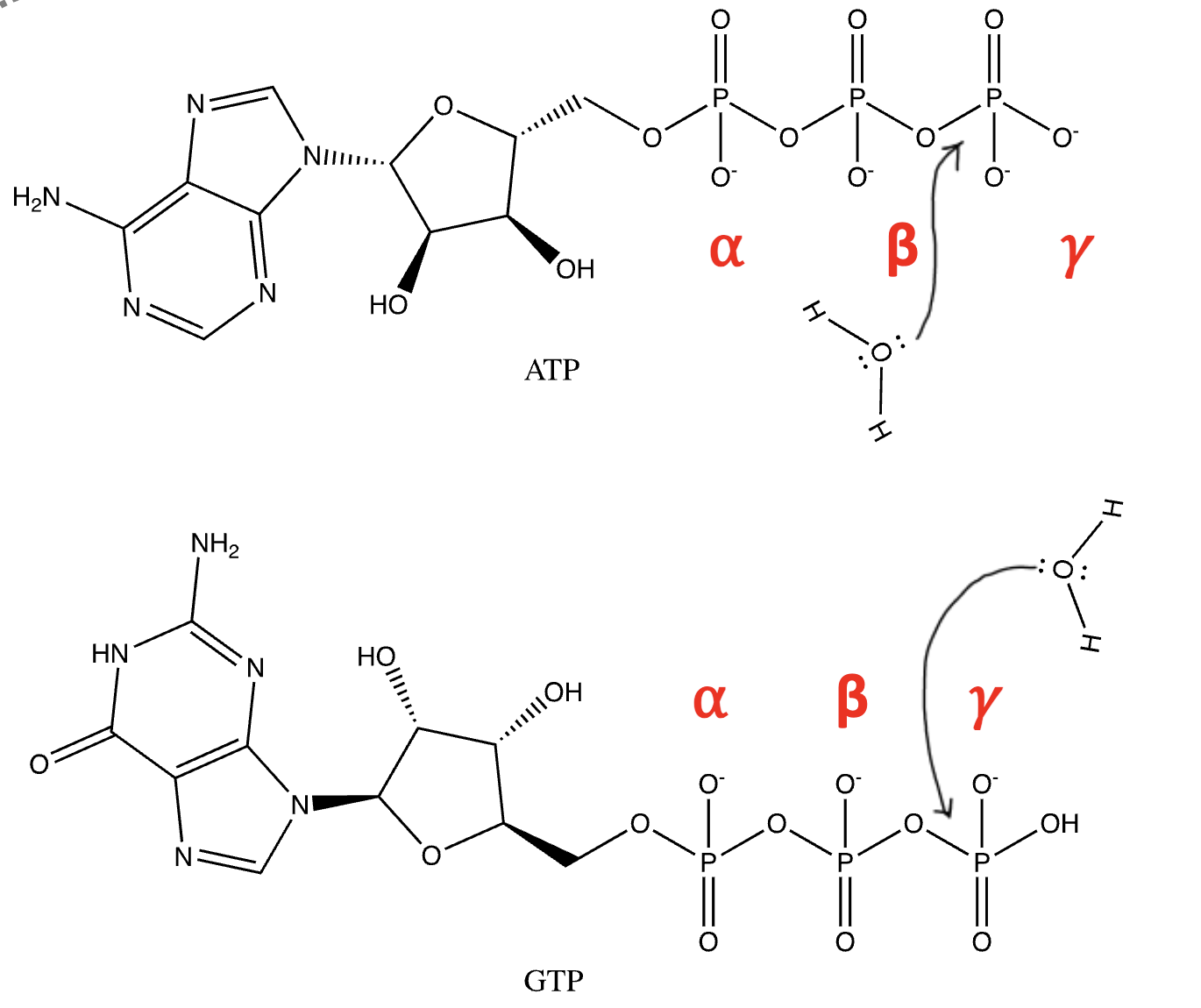
Δ G° and Keq for ATP+CDP → ADP+CTP
Δ G°~0 kJ/mol
so Keq=1
NAD+(ox) + 2e- + 2H+ → NADH(red) + H+
FAD(ox) + 2e- + 2H+ → FADH2(red)
Both NAD+ and FAD have 2 electron acceptors, so why is it NADH and FADH2 at the end?
because of the respective strucuture of each molecule- only room for one H on NAD+
Glycolysis def
catabolic- breaking down of glucose into 2 pyruvate (+2ATP generated)
Gluconeogenesis def
anabolic- reverse of glycolysis, pyruvate to glucose