Microeconomics Graphs

0.0(0)
Studied by 0 people
call kaiCall Kai
learnLearn
examPractice Test
spaced repetitionSpaced Repetition
heart puzzleMatch
flashcardsFlashcards
GameKnowt Play
Card Sorting

1/22

encourage image

There's no tags or description

Looks like no tags are added yet.

Last updated 12:27 PM on 4/22/26
Name
Mastery
Learn
Test
Matching
Spaced
Call with Kai

No analytics yet

Send a link to your students to track their progress

23 Terms

1
New cards

PPC and Explain

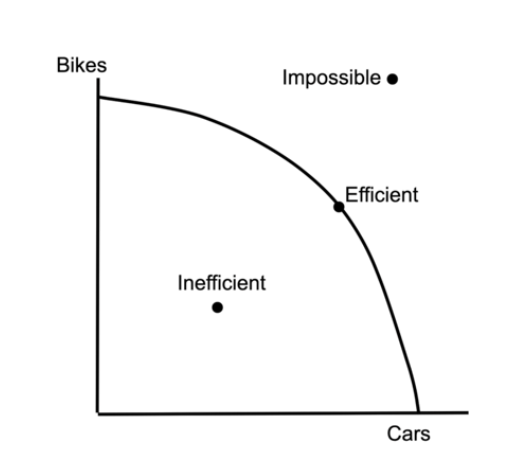
On the curve: Productive Efficiency
In the curve: Inefficient (Misallocation, unemployment, idle capacity)
Out the curve: Currently unattainable

Must be able to highlight points on allocative efficiency and productive efficiency.

  • Any point on the PPC shows Productive Efficiency

  • The allocative efficiency point is on the curve but we cannot determine where it is due to a lack of data
<p><span style="line-height: 1.5rem;"><span>On the curve: Productive Efficiency</span><span><br></span><span>In the curve: Inefficient (Misallocation, unemployment, idle capacity)</span><span><br></span><span>Out the curve: Currently unattainable</span></span></p><p></p><p><span style="line-height: 1.5rem;"><span>Must be able to highlight points on allocative efficiency and productive efficiency.</span></span></p><p></p><ul><li><p><span style="line-height: 1.5rem;"><span>Any point on the PPC shows Productive Efficiency</span></span></p></li></ul><ul><li><p><span style="line-height: 1.5rem;"><span>The allocative efficiency point is on the curve but we cannot determine where it is due to a lack of data</span></span></p></li></ul><p></p>
2
New cards

Supply and Demand Curve

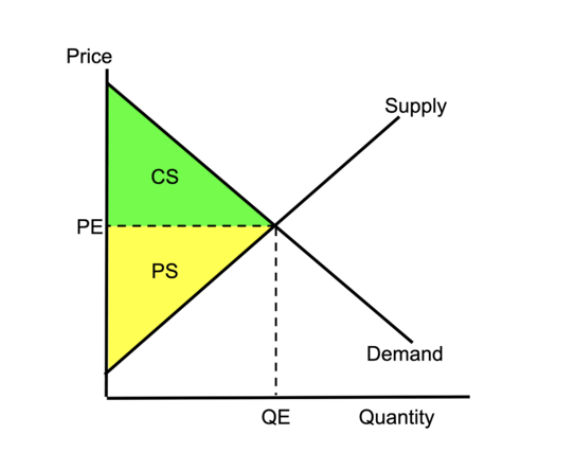
Ensure CS and PS is highlighted properly.


*TIP: CS is always the triangle that touches the Demand Curve because consumer yk and PS touches the Supply Curve because producer
<p><span style="line-height: 1.5rem;"><span>Ensure CS and PS is highlighted properly.</span></span></p><p><span style="line-height: 1.5rem;"><span><br></span><span>*TIP: CS is always the triangle that touches the Demand Curve because consumer yk and PS touches the Supply Curve because producer</span></span></p>
3
New cards

S and D curve when Demand is Inelastic, state PED

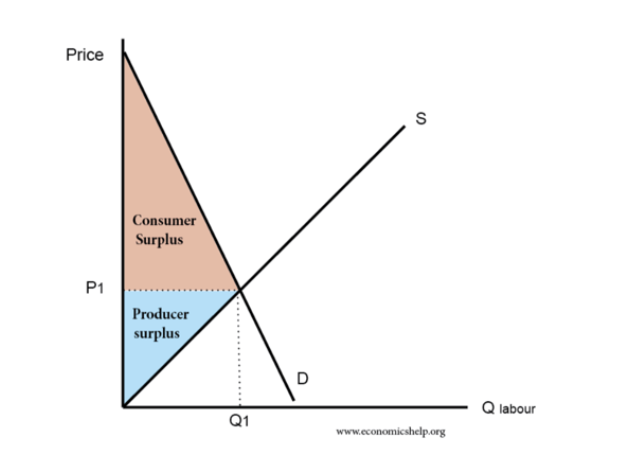
  • PED between 0 and 1

  • Curve is steep

  • If P increase, CS decrease and PS increase. Vice versa.
<ul><li><p><span style="line-height: 1.5rem;"><span>PED between 0 and 1</span></span></p></li><li><p><span style="line-height: 1.5rem;"><span>Curve is steep</span></span></p></li><li><p><span style="line-height: 1.5rem;"><span>If P increase, CS decrease and PS increase. Vice versa.</span></span></p></li></ul><p></p>
4
New cards

S and D curve when Demand is Elastic, state PED

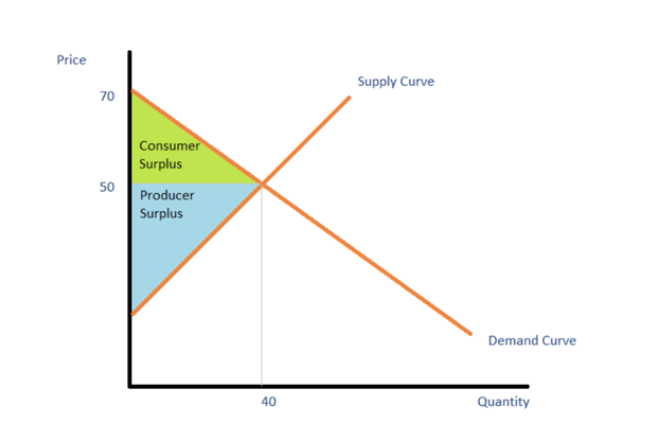
  • PED > 1

  • Curve is flatter

  • When price increase, PS fall (because the loss from selling fewer units outweighs the gain from the higher price per unit)

  • When price increase, CS also falls sharply because consumers pay more and buy less
<ul><li><p><span style="line-height: 1.5rem;"><span>PED &gt; 1</span></span></p></li><li><p><span style="line-height: 1.5rem;"><span>Curve is flatter</span></span></p></li><li><p><span style="line-height: 1.5rem;"><span>When price increase, PS fall (because the loss from selling fewer units outweighs the gain from the higher price per unit)</span></span></p></li><li><p><span style="line-height: 1.5rem;"><span>When price increase, CS also falls sharply because consumers pay more and buy less</span></span></p></li></ul><p></p>
5
New cards

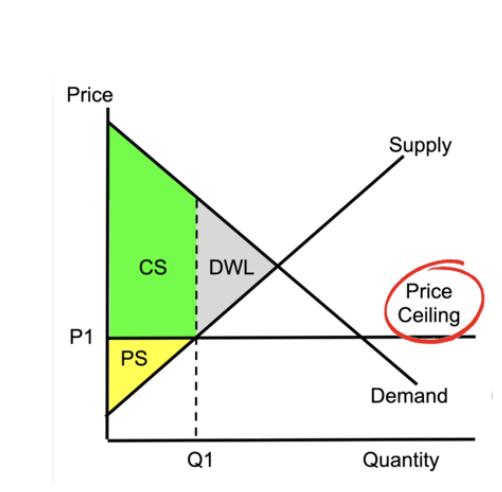
Price Ceiling, define and draw

Analyse consumer and producer surplus

Why does DWL occur?

State effects

A government-imposed maximum price limit on how high a price can be charged for a specific good or service.

  • QD > QS, Shortage

  • CS increase for those who get to buy it

  • PS falls because producers sell less and at a lower price

  • DWL occurs because there are lost trades (some consumers want to buy and some producers want to sell, but the price is too low for producers)

This could lead to:

  • Consumer surplus increase, can afford essential goods more easily

  • Long lines

  • Black markets

  • Loss of allocative efficiency (Marginal benefit exceed marginal cost)

  • Reduction in market size (Lower production levels, can also cause unemployment)

  • Shortages

  • Reduced quality (Producers want to cut cost to earn profit)
<p><span style="line-height: 1.5rem;">A government-imposed maximum price limit on how high a price can be charged for a specific good or service.</span></p><p></p><ul><li><p><span style="line-height: 1.5rem;">QD &gt; QS, Shortage</span></p></li><li><p><span style="line-height: 1.5rem;">CS increase for those who get to buy it</span></p></li><li><p><span style="line-height: 1.5rem;">PS falls because producers sell less and at a lower price</span></p></li><li><p><span style="line-height: 1.5rem;">DWL occurs because there are lost trades (some consumers want to buy and some producers want to sell, but the price is too low for producers)</span></p></li></ul><p></p><p><span style="line-height: 1.5rem;">This could lead to:</span></p><ul><li><p><span style="line-height: 1.5rem;">Consumer surplus increase, can afford essential goods more easily</span></p></li><li><p><span style="line-height: 1.5rem;">Long lines</span></p></li><li><p><span style="line-height: 1.5rem;">Black markets</span></p></li><li><p><span style="line-height: 1.5rem;">Loss of allocative efficiency (Marginal benefit exceed marginal cost)</span></p></li><li><p><span style="line-height: 1.5rem;">Reduction in market size (Lower production levels, can also cause unemployment)</span></p></li><li><p><span style="line-height: 1.5rem;">Shortages</span></p></li><li><p><span style="line-height: 1.5rem;">Reduced quality (Producers want to cut cost to earn profit)</span></p></li></ul><p></p>
6
New cards

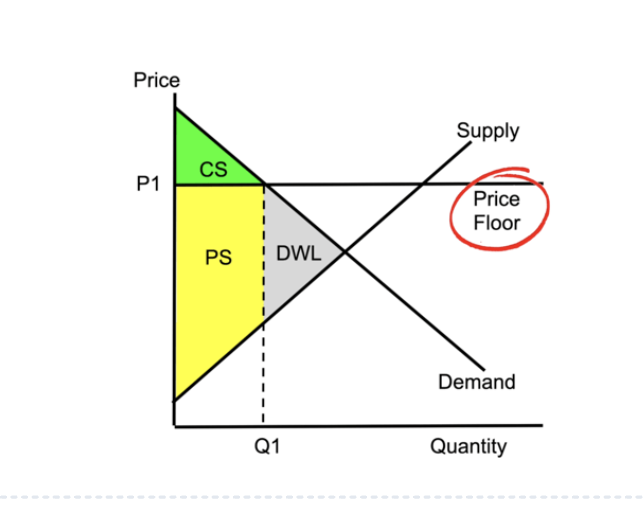
Price Floor, define and draw

Analyse graph

Why does DWL occur?

State effects

A price floor is a government-imposed limit preventing the price of a good, service, or resource from falling below a certain level.
*To be effective (binding), it must be set above the market equilibrium price.

  • QS > QD, surplus

  • CS falls because price is higher, consumer buy less

  • PS increases because units are sold at a higher price, but some units not sold because of surplus therefore some PS is lost

  • Extension in supply, contraction in demand

  • DWL occurs because there are lost trades (some producers want to sell but no consumers buy at that high price)

  • It protects producers or workers by ensuring minimum income but creates surpluses and reduces consumer welfare.

  • It can also lead to unemployment, wasted resources, gov intervention (gov buys the surplus to stabilise markets), and may also encourage black markets (employees offer under-the-table prices)

  • *Agricultural markets: governments usually purchase excess supply to store or export

  • Loss of allocative efficiency (artificially high price prevents market from reaching equilibirum, leading to MC exceeding MB)
<p><span style="line-height: 1.5rem;">A price floor is a government-imposed limit preventing the price of a good, service, or resource from falling below a certain level.<br><em><u>*To be effective (binding), it must be set above the market equilibrium price.</u></em></span></p><p></p><ul><li><p><span style="line-height: 1.5rem;">QS &gt; QD, surplus</span></p></li><li><p><span style="line-height: 1.5rem;">CS falls because price is higher, consumer buy less</span></p></li><li><p><span style="line-height: 1.5rem;">PS increases because units are sold at a higher price, but some units not sold because of surplus therefore some PS is lost</span></p></li><li><p><span style="line-height: 1.5rem;">Extension in supply, contraction in demand</span></p></li><li><p><span style="line-height: 1.5rem;">DWL occurs because there are lost trades (some producers want to sell but no consumers buy at that high price)</span></p></li></ul><p></p><ul><li><p><span style="line-height: 1.5rem;">It protects producers or workers by ensuring minimum income but creates surpluses and reduces consumer welfare.</span></p></li><li><p><span style="line-height: 1.5rem;">It can also lead to unemployment, wasted resources, gov intervention (gov buys the surplus to stabilise markets), and may also encourage black markets (employees offer under-the-table prices)</span></p></li><li><p><span style="line-height: 1.5rem;">*Agricultural markets: governments usually purchase excess supply to store or export</span></p></li><li><p><span style="line-height: 1.5rem;">Loss of allocative efficiency (artificially high price prevents market from reaching equilibirum, leading to MC exceeding MB)</span></p></li></ul><p></p>
7
New cards

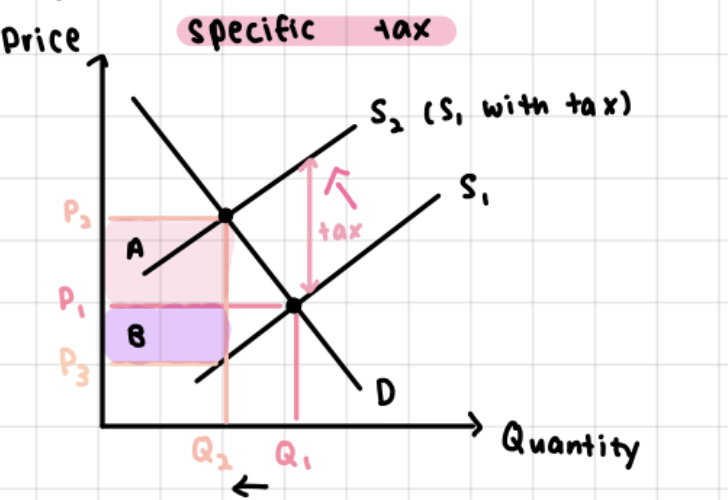
S and D with an excise tax

Clearly state differences of consumer incidence of elasticities

State effects

  • Pink + Purple area is Tax Revenue (P2-P3) x Q2 (total consumer + producer burden)

  • P2: Buyer pays, P1: Original price received by both buyer and seller, P3: Seller receives

  • CS falls because consumers pay a higher price and they buy less

  • Calculate C burden, Area A: (P2-P2) x Q2

  • Calculate P burden, Area B: (P1-P3) x Q2

  • PS falls because producers receive a lower effective price and they sell lower units

  • DWL occurs because loss of mutually beneficial trades due to increased price.

When Demand is inelastic: Consumers bear more tax

When Supply is inelastic: Producers bear more tax

Effects:

  • Final Price increase, Quantity demanded decrease

  • Reduce consumption of harmful goods (externalities)

  • May reduce producer income and cause unemployment

  • Gov can use revenue for public services
<ul><li><p><span style="line-height: 1.5rem;">Pink + Purple area is Tax Revenue (P2-P3) x Q2 (total consumer + producer burden)</span></p></li><li><p><span style="line-height: 1.5rem;">P2: Buyer pays, P1: Original price received by both buyer and seller, P3: Seller receives</span></p></li><li><p><span style="line-height: 1.5rem;">CS falls because consumers pay a higher price and they buy less</span></p></li><li><p><span style="line-height: 1.5rem;">Calculate C burden, Area A: (P2-P2) x Q2</span></p></li><li><p><span style="line-height: 1.5rem;">Calculate P burden, Area B: (P1-P3) x Q2</span></p></li><li><p><span style="line-height: 1.5rem;">PS falls because producers receive a lower effective price and they sell lower units</span></p></li><li><p><span style="line-height: 1.5rem;">DWL occurs because loss of mutually beneficial trades due to increased price.</span></p></li></ul><p></p><p><span style="line-height: 1.5rem;">When Demand is inelastic: Consumers bear more tax</span></p><p><span style="line-height: 1.5rem;">When Supply is inelastic: Producers bear more tax</span></p><p></p><p><span style="line-height: 1.5rem;">Effects:</span></p><ul><li><p>Final Price increase, Quantity demanded decrease</p></li><li><p><span style="line-height: 1.5rem;">Reduce consumption of harmful goods (externalities)</span></p></li><li><p><span style="line-height: 1.5rem;">May reduce producer income and cause unemployment</span></p></li><li><p><span style="line-height: 1.5rem;">Gov can use revenue for public services</span></p></li></ul><p></p>
8
New cards

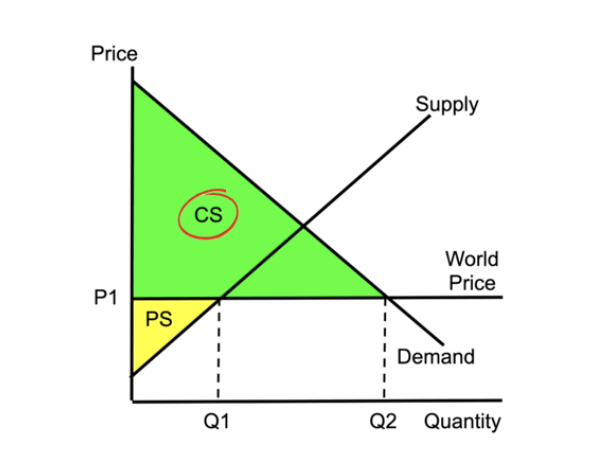
Supply and Demand showing result of trade (Skip first, not in syllabus yet)

World Price: International Market Price of a good, determined by global supply and demand

notes incomingggg once i get it ... jacob clifford yt vid
<p><span style="line-height: 1.5rem;"><span>World Price: International Market Price of a good, determined by global supply and demand</span></span></p><p><span style="line-height: 1.5rem;"><span>notes incomingggg once i get it ... jacob clifford yt vid</span></span></p>
9
New cards

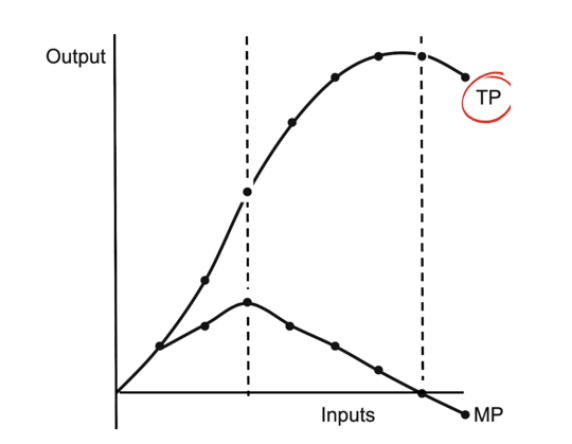
Short Run Production Function

TP: Total Product Produced

  • As you hire more workers it increases at an increasing rate, then it increases at a decreasing rate, then eventually it starts to decrease

MP: Marginal Product Produced

  • MP increases as workers increase at an increasing rate, but decreases when it increases at a decreasing rate. Each worker still increases output, but at a less rate than before. This might be due to inefficiencies (Law of Diminishing Returns). When TP starts to decrease, MP will go into the negatives, meaning adding one more worker reduces total output.

*Kinda not a high chance to have a question just about this, but good to know in case to elaborate on other cases.
<p><span style="line-height: 1.5rem;"><span>TP: Total Product Produced</span></span></p><ul><li><p><span style="line-height: 1.5rem;"><span>As you hire more workers it increases at an increasing rate, then it increases at a decreasing rate, then eventually it starts to decrease</span></span></p></li></ul><p><span style="line-height: 1.5rem;"><span>MP: Marginal Product Produced</span></span></p><ul><li><p><span style="line-height: 1.5rem;"><span>MP increases as workers increase at an increasing rate, but decreases when it increases at a decreasing rate. Each worker still increases output, but at a less rate than before. This might be due to inefficiencies (Law of Diminishing Returns). When TP starts to decrease, MP will go into the negatives, meaning adding one more worker reduces total output.</span></span></p></li></ul><p></p><p><span style="line-height: 1.5rem;"><span>*Kinda not a high chance to have a question just about this, but good to know in case to elaborate on other cases.</span></span></p>
10
New cards

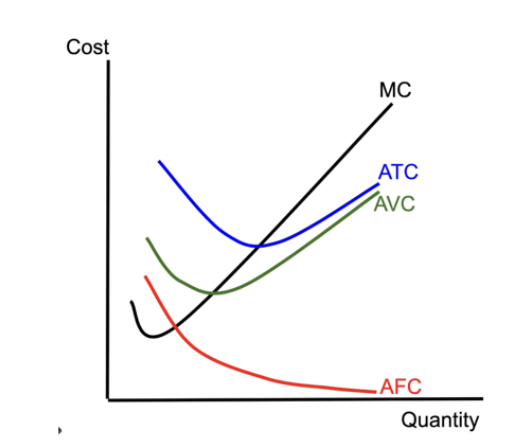
Short Run Per Unit Cost Curves

MC: Always go down and back up (Nike)
ATC: Go down, hit a minimum at MC, and go up
AVC: Go down below the ATC, then go up and close to the ATC
AFC: Downwards decreasing

AFC not that important, AVC only when figuring out shutdown costs
So the most important curves are the MC and ATC!

MC: tells you how much to produce
ATC: tells you how much loss or profit you are making
<p><span style="line-height: 1.5rem;"><span>MC: Always go down and back up (Nike)</span><span><br></span><span>ATC: Go down, hit a minimum at MC, and go up</span><span><br></span><span>AVC: Go down below the ATC, then go up and close to the ATC</span><span><br></span><span>AFC: Downwards decreasing</span></span></p><p><span style="line-height: 1.5rem;"><span>AFC not that important, AVC only when figuring out shutdown costs</span><em><span><br></span></em><span>So the most important curves are the MC and ATC!</span></span></p><p><span style="line-height: 1.5rem;"><span>MC: tells you how much to produce</span><span><br></span><span>ATC: tells you how much loss or profit you are making</span></span></p>
11
New cards

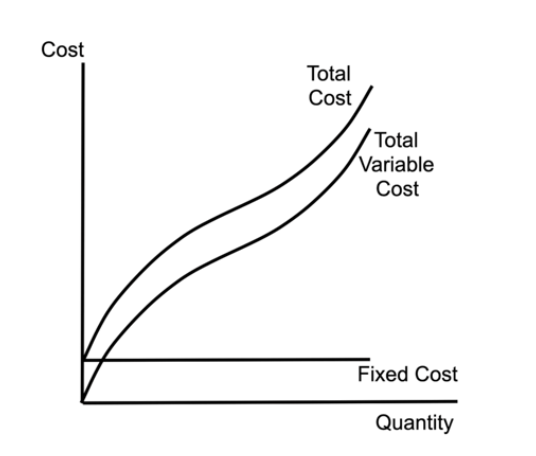
Short Run Total Cost Curves

*Not a very important graph but shows some concepts

  • We pay the same fixed cost on any producing amount

  • VC below TC

  • TC is the VC plus Fixed Costs

*Per unit graph is more important but just know this in case
<p><span style="line-height: 1.5rem;"><span>*Not a very important graph but shows some concepts</span></span></p><p></p><ul><li><p><span style="line-height: 1.5rem;"><span>We pay the same fixed cost on any producing amount</span></span></p></li><li><p><span style="line-height: 1.5rem;"><span>VC below TC</span></span></p></li><li><p><span style="line-height: 1.5rem;"><span>TC is the VC plus Fixed Costs</span></span></p></li></ul><p></p><p><span style="line-height: 1.5rem;"><span>*Per unit graph is more important but just know this in case</span></span></p>
12
New cards

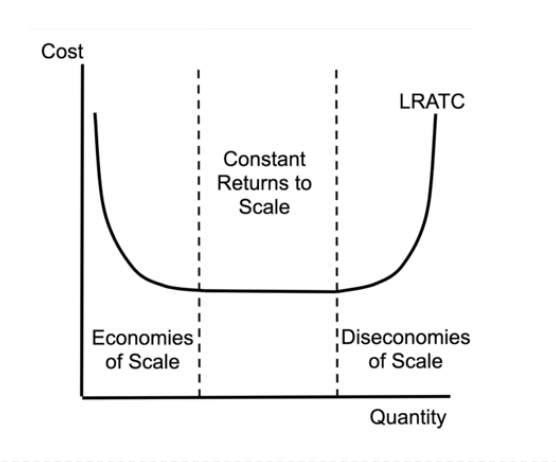
Long Run Average Total Cost Curve (LRATC)

*Not a very important graph but shows some concepts

  • We pay the same fixed cost on any producing amount

  • VC below TC

  • TC is the VC plus Fixed Costs

*Per unit graph is more important but just know this in case
<p><span style="line-height: 1.5rem;"><span>*Not a very important graph but shows some concepts</span></span></p><p></p><ul><li><p><span style="line-height: 1.5rem;"><span>We pay the same fixed cost on any producing amount</span></span></p></li><li><p><span style="line-height: 1.5rem;"><span>VC below TC</span></span></p></li><li><p><span style="line-height: 1.5rem;"><span>TC is the VC plus Fixed Costs</span></span></p></li></ul><p></p><p><span style="line-height: 1.5rem;"><span>*Per unit graph is more important but just know this in case</span></span></p>
13
New cards

Perfect Competition and their Cost Curves, Side by Side graph

  • Price set by the market, so horizontal demand, D=MR=AR (because every product is priced the same, so eg $5 is D, next revenue is $5, and all revenue divided is also $5 coz perfect comp)

  • Always produce where MR=MC, remember if MR>MC it means you have to produce more you move up to where MR=MC, PROFIT MAXIMISATION!! (The firm increases output until MC rises to equal price. At this point, profit is maximised because producing any more would increase costs more than revenue.)

Achieving allocative efficiency at that point because: benefit to society = cost of society -> P=MC
Productive efficiency: producing at lowest possible cost

  • Extremely efficiency

  • No DWL

Example of NORMAL profit for a perfect competition as it is breaking even since ATC intersects MC where they touch the D curve. so P=D.
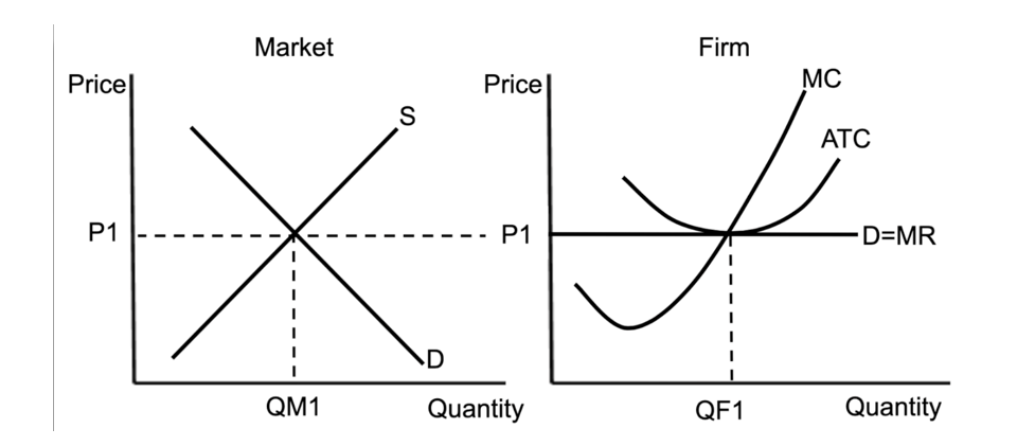
<ul><li><p><span style="line-height: 1.5rem;"><span>Price set by the market, so horizontal demand, D=MR=AR (because every product is priced the same, so eg $5 is D, next revenue is $5, and all revenue divided is also $5 coz perfect comp)</span></span></p></li><li><p><span style="line-height: 1.5rem;"><span>Always produce where MR=MC, remember if MR&gt;MC it means you have to produce more you move up to where MR=MC, PROFIT MAXIMISATION!! (The firm increases output until MC rises to equal price. At this point, profit is maximised because producing any more would increase costs more than revenue.)</span></span></p></li></ul><p></p><p><span style="line-height: 1.5rem;"><span>Achieving allocative efficiency at that point because: benefit to society = cost of society -&gt; P=MC</span><span><br></span><span>Productive efficiency: producing at lowest possible cost</span></span></p><p></p><ul><li><p><span style="line-height: 1.5rem;"><span>Extremely efficiency</span></span></p></li><li><p><span style="line-height: 1.5rem;"><span>No DWL</span></span></p></li></ul><p></p><p><span style="line-height: 1.5rem;"><span>Example of NORMAL profit for a perfect competition as it is breaking even since ATC intersects MC where they touch the D curve. so P=D.</span></span></p>
14
New cards

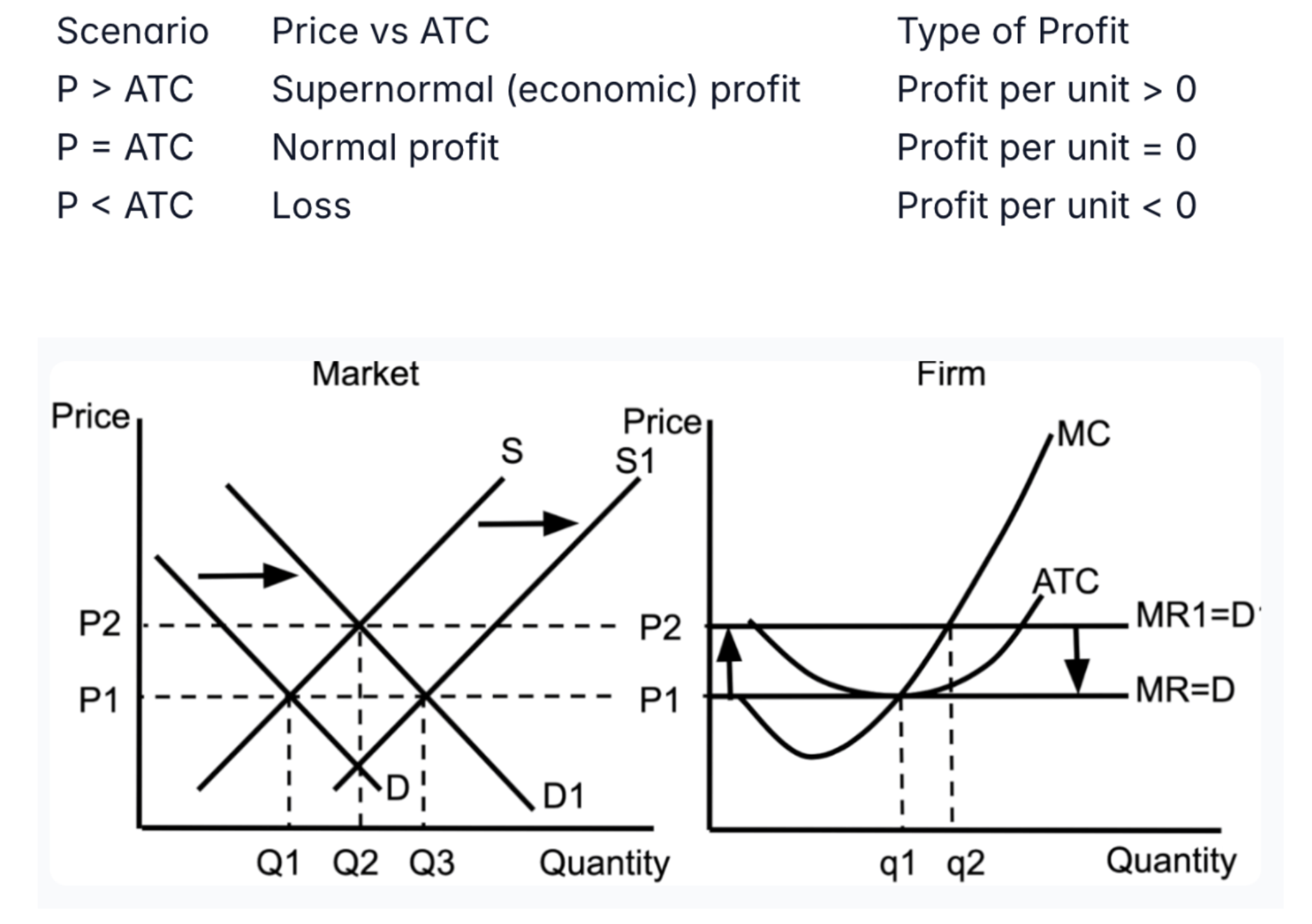
Perfect Competition (Short-run profit)

  • ATC curve below D=MR

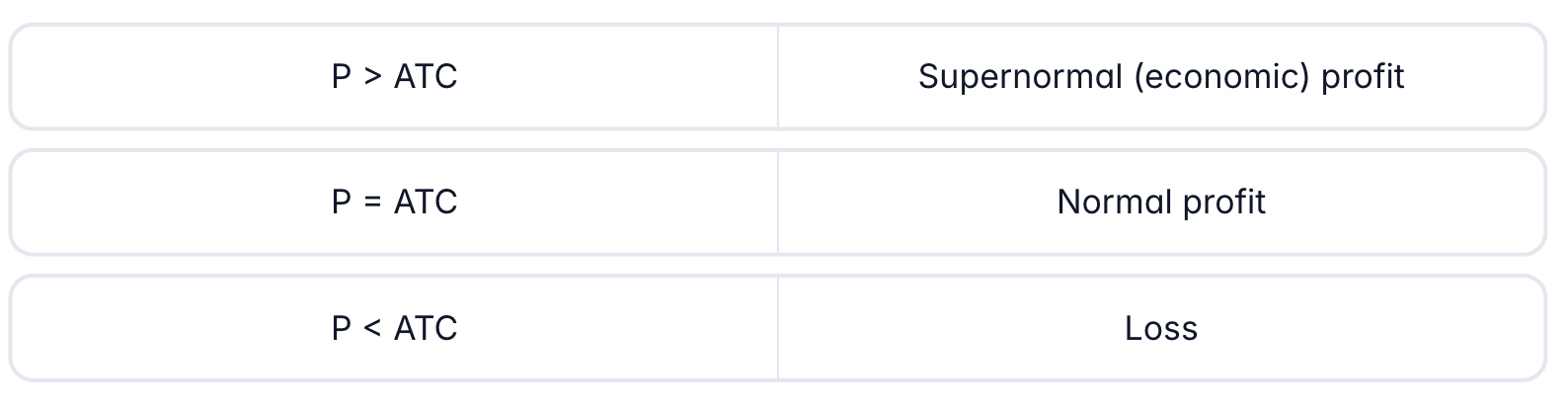
  • Firm makes a profit if P > ATC, breaks even if P = ATC, and makes a loss if P < ATC.

  • Since ATC where it intersects MC is lower than P, the firm is making a profit. (supernormal profit)
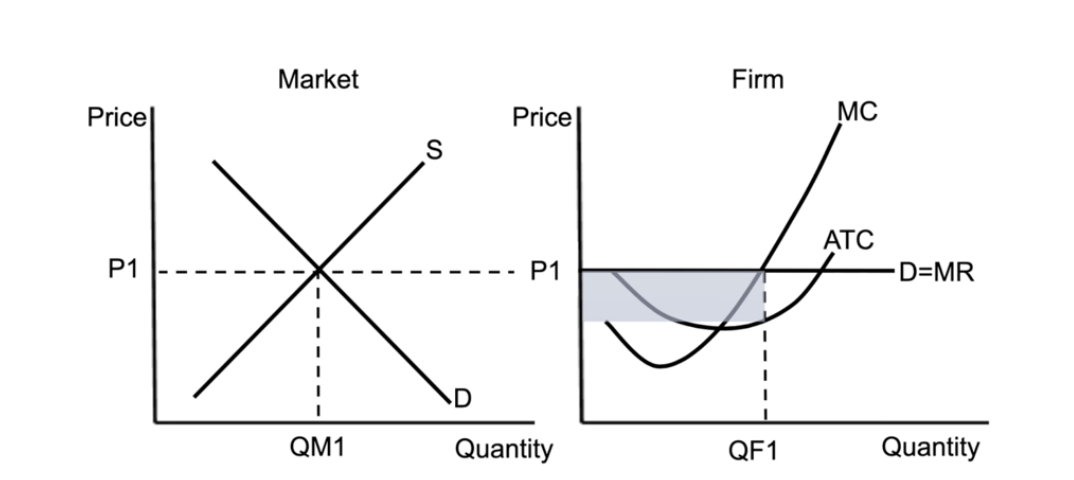
<ul><li><p><span><span>ATC curve below D=MR</span></span></p></li><li><p><span><span>Firm makes a profit if P &gt; ATC, breaks even if P = ATC, and makes a loss if P &lt; ATC.</span></span></p></li><li><p><span><span>Since ATC where it intersects MC is lower than P, the firm is making a profit. (supernormal profit)</span></span></p></li></ul><p></p>
15
New cards

Perfect Competition (Short-run loss)

ATC curve above D=MR
Firm makes a profit if P > ATC, breaks even if P = ATC, and makes a loss if P < ATC.
Since ATC where it intersects MC is above P, the firm is making a loss.
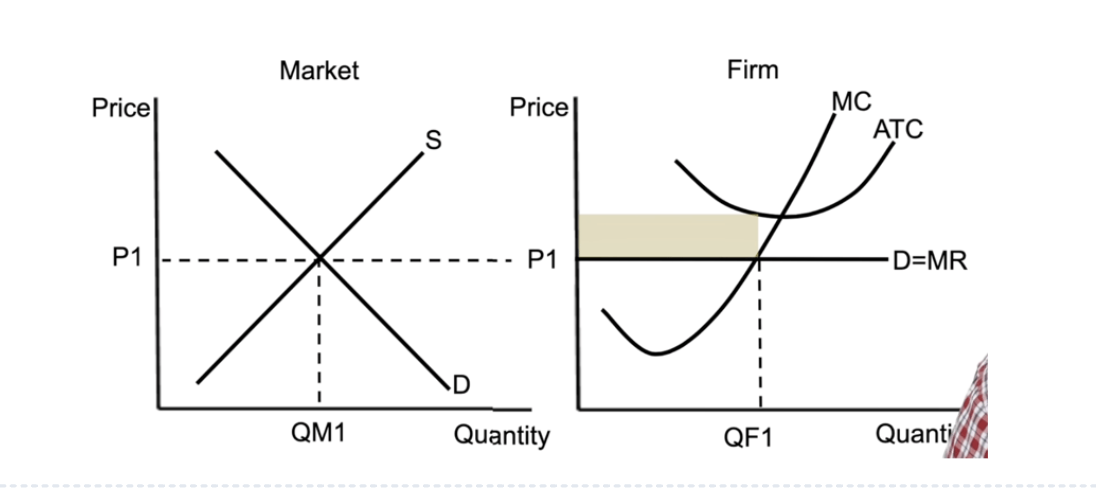
<p><span style="line-height: 1.5rem;"><span>ATC curve above D=MR</span><span><br></span><span>Firm makes a profit if P &gt; ATC, breaks even if P = ATC, and makes a loss if P &lt; ATC.</span><span><br></span><span>Since ATC where it intersects MC is above P, the firm is making a loss.</span></span></p>
16
New cards

Identify the relationship between Price (P) and Average Total Cost (ATC) with the resulting type of profit per unit
<p></p>
17
New cards

Perfect Competition Long Run to Long Run

  • Supernormal profit → firms enter → supply ↑ → price ↓ → normal profit

  • Loss → firms exit → supply ↓ → price ↑ → normal profit

  • Long-run equilibrium: P = MC = ATC, no economic profit, productive & allocative efficiency achieved

The adjustment process continues until, at the profit-maximising output (MR = MC), price equals average total cost (P = ATC). At this point firms earn normal profit, there is no incentive for entry or exit, and the market reaches long-run equilibrium. The “cycle” of entry and exit only occurs if supernormal profits or losses exist.

*Profit-maximising output does not mean when it makes a profit, refer below table).
<ul><li><p><span style="line-height: 1.5rem;"><span>Supernormal profit → firms enter → supply ↑ → price ↓ → normal profit</span></span></p></li><li><p><span style="line-height: 1.5rem;"><span>Loss → firms exit → supply ↓ → price ↑ → normal profit</span></span></p></li><li><p><span style="line-height: 1.5rem;"><span>Long-run equilibrium: P = MC = ATC, no economic profit, productive &amp; allocative efficiency achieved</span></span></p></li></ul><p></p><p><span style="line-height: 1.5rem;"><span>The adjustment process continues until, at the profit-maximising output (MR = MC), price equals average total cost (P = ATC). At this point firms earn normal profit, there is no incentive for entry or exit, and the market reaches long-run equilibrium. The “cycle” of entry and exit only occurs if supernormal profits or losses exist.</span></span></p><p></p><p><span style="line-height: 1.5rem;"><span>*Profit-maximising output does not mean when it makes a profit, refer below table).</span></span></p>
18
New cards

S and D with a subsidy

State difference in price labels

Analyse graph and explain DWL

Clearly state differences of consumer incidence of elasticities

State effects

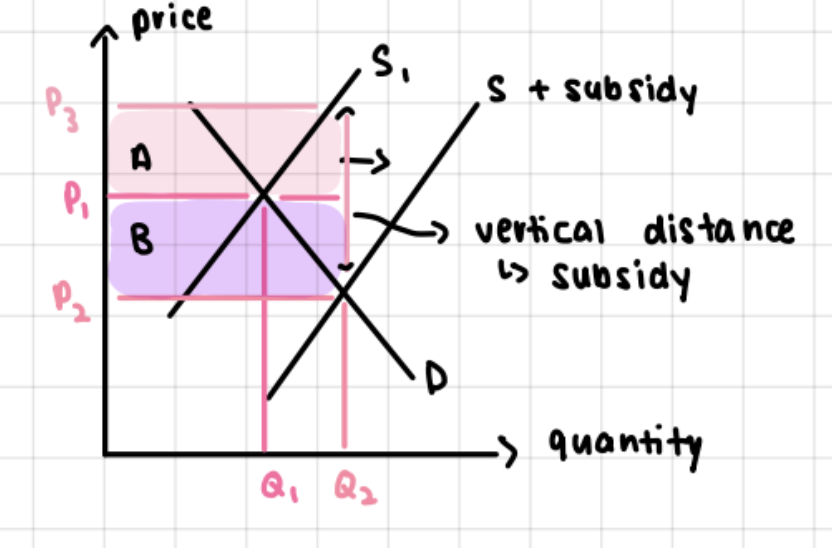
  • Pink + Purple area is Subsidy Amount (P3-P2) x Q2

  • P1: Original price received by both buyer and seller

  • Price consumers pay decrease from P1 to P2

  • Price produces receive increases from P1 to P3

Producers receive P2 from consumers + Subsidy per unit from government

So Producer Revenue: P3 x Q2

Analysis:

  • Subsidy cause outward shift in supply

  • Increase QD to Q2

  • New eq P2Q2

  • Higher QD, lower P

  • DWL occurs because the cost of producing is higher than the value consumers place on them

When Demand is inelastic: Consumers receive higher surplus

  • Because consumers wont buy more, firms would have to decrease prices to have competitive value and ‘steal’ customers from other firms

When Demand elastic: Producers receive higher surplus

  • Producers can decrease price by a little and cause a large change in QD

When Supply is inelastic: Producers receive higher surplus

  • Gap between their cost and their price widens

  • Will not increase supply, price does not change as well

  • Gov want to ensure they can still stay in business (Pad their income)

Effects:

  • Final Price decrease, Quantity demanded increase, Quantity supplied potentially increase

  • Can help domestic industries → can help inc exports

  • Support specific industries with production costs

  • Can increase consumption of merit goods
<ul><li><p><span style="line-height: 1.5rem;">Pink + Purple area is Subsidy Amount (P3-P2) x Q2</span></p></li><li><p><span style="line-height: 1.5rem;">P1: Original price received by both buyer and seller</span></p></li><li><p><span style="line-height: 1.5rem;">Price consumers pay decrease from P1 to P2</span></p></li><li><p><span style="line-height: 1.5rem;">Price produces receive increases from P1 to P3</span></p></li></ul><p></p><p>Producers receive P2 from consumers + Subsidy per unit from government</p><p>So Producer Revenue: P3 x Q2</p><p></p><p>Analysis:</p><ul><li><p><span style="line-height: 1.5rem;">Subsidy cause outward shift in supply</span></p></li><li><p><span style="line-height: 1.5rem;">Increase QD to Q2</span></p></li><li><p><span style="line-height: 1.5rem;">New eq P2Q2</span></p></li><li><p>Higher QD, lower P</p></li><li><p><span style="line-height: 1.5rem;">DWL occurs because the cost of producing is higher than the value consumers place on them</span></p></li></ul><p></p><p><span style="line-height: 1.5rem;">When Demand is inelastic: Consumers receive higher surplus</span></p><ul><li><p>Because consumers wont buy more, firms would have to decrease prices to have competitive value and ‘steal’ customers from other firms</p></li></ul><p>When Demand elastic: Producers receive higher surplus</p><ul><li><p>Producers can decrease price by a little and cause a large change in QD</p></li></ul><p><span style="line-height: 1.5rem;">When Supply is inelastic: Producers receive higher surplus</span></p><ul><li><p>Gap between their cost and their price widens</p></li><li><p>Will not increase supply, price does not change as well</p></li><li><p>Gov want to ensure they can still stay in business (Pad their income)</p></li></ul><p></p><p><span style="line-height: 1.5rem;">Effects:</span></p><ul><li><p>Final Price decrease, Quantity demanded increase, Quantity supplied potentially increase </p></li><li><p><span style="line-height: 1.5rem;">Can help domestic industries → can help inc exports</span></p></li><li><p><span style="line-height: 1.5rem;">Support specific industries with production costs</span></p></li><li><p><span style="line-height: 1.5rem;">Can increase consumption of merit goods</span></p></li></ul><p></p>
19
New cards

Socially optimum output, draw graph

State conditions

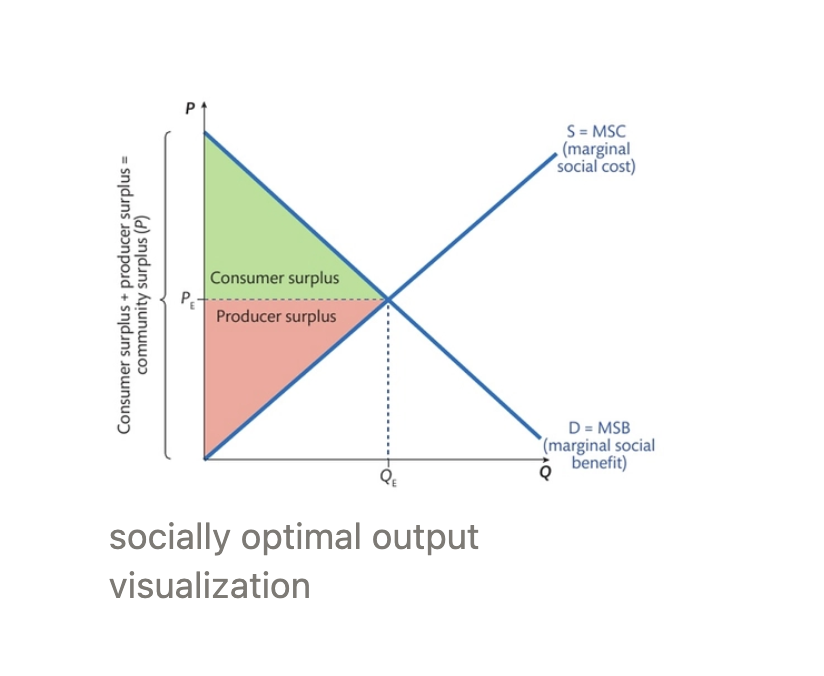
MSB=MSC (The point at which resources are allocated most efficiently, maximising overall societal welfare)

MPC=MSC (No external costs → no externalities)

MPB=MSB (No external benefits → no externalities)

  • When externalities exist, the free market does not produce at the socially optimal output
<p>MSB=MSC (The point at which resources are allocated most efficiently, maximising overall societal welfare)</p><p>MPC=MSC (No external costs → no externalities)</p><p>MPB=MSB (No external benefits → no externalities)</p><p></p><ul><li><p>When externalities exist, the free market does not produce at the socially optimal output </p></li></ul><p></p>
20
New cards

Positive consumption externalities

Draw graph

State condition and why

State level of consumption and why

State DWL and why

Give 3 examples

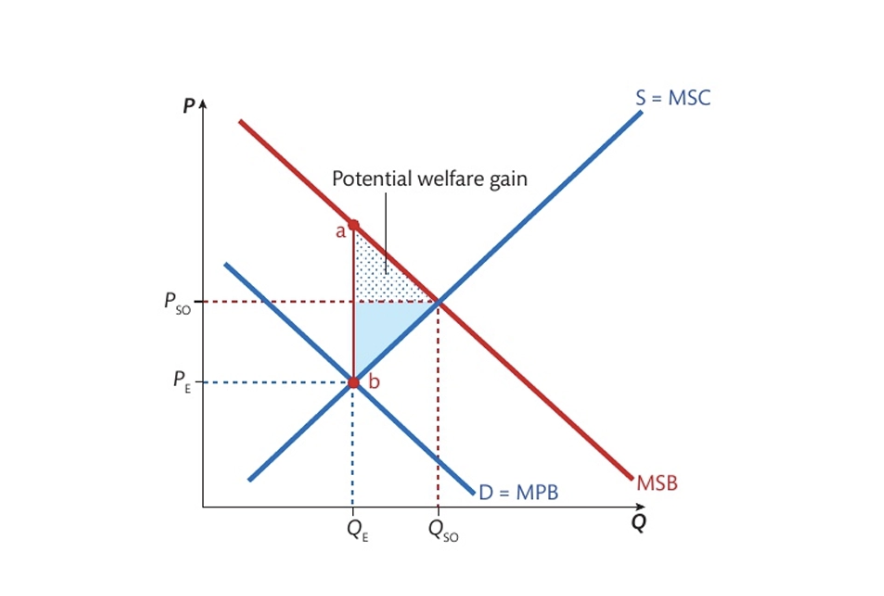
  • MSB>MPB since society values the good more than the private consumers does

  • Market under-consumes these goods as private individuals do not consider these extra benefits → producing a quantity lower than the socially optimal quantity (Qe < Qso)

  • Blue triangle: DWL (total benefit society would have enjoyed if extra units were consumed, as currently it is underconsumed,, e.g: A vaccine costs $50. A student only feels it’s worth $40 to them, so they don't buy it. But if they got it, it would save the community $30 in infection costs. Society misses out on a $70 benefit (Student health + Community safety) that only costs $50. We "lost" a $20 gain for the world.)

Examples:

  • healthcare (improves individual wellbeing while benefitting society by reducing disease spread and increasing productivity)

  • education (improves individual skill set but also contributes to more productive workforce, higher tax revenues, and societal progress)

  • public transportation (reduces traffic for private drivers)
<ul><li><p>MSB&gt;MPB since society values the good more than the private consumers does</p></li></ul><ul><li><p>Market under-consumes these goods as private individuals do not consider these extra benefits → producing a quantity lower than the socially optimal quantity (Qe &lt; Qso)</p></li><li><p>Blue triangle: DWL (total benefit society would have enjoyed if extra units were consumed, as currently it is underconsumed,, e.g: A vaccine costs $50. A student only feels it’s worth $40 to them, so they don't buy it. But if they got it, it would save the community $30 in infection costs. Society misses out on a $70 benefit (Student health + Community safety) that only costs $50. We "lost" a $20 gain for the world.)</p></li></ul><p></p><p>Examples:</p><ul><li><p>healthcare (improves individual wellbeing while benefitting society by reducing disease spread and increasing productivity)</p></li></ul><ul><li><p>education (improves individual skill set but also contributes to more productive workforce, higher tax revenues, and societal progress)</p></li><li><p>public transportation (reduces traffic for private drivers)</p></li></ul><p></p>
21
New cards

Negative consumption externalities

Draw graph

State condition and why

State level of consumption and why

State DWL why

Give 2 examples

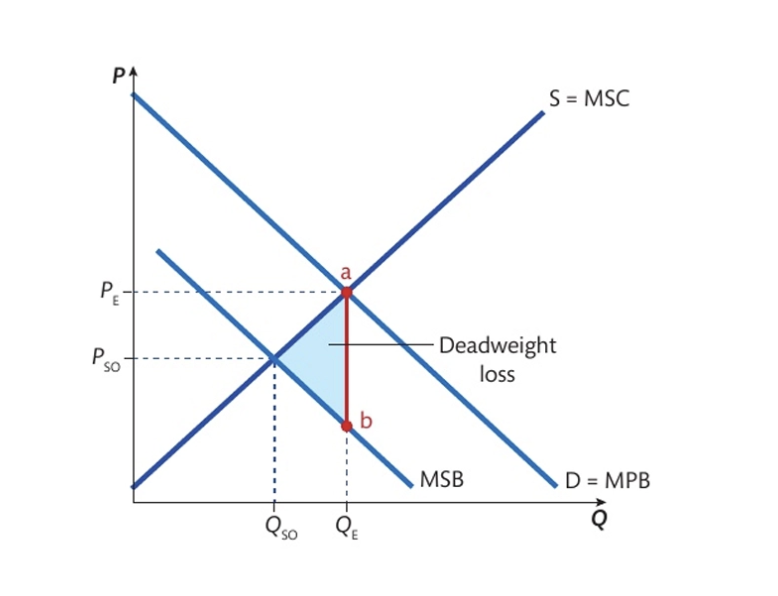
  • MSC < MPB since society experiences more harm than the private consumer acknowledges

  • Market over-consumes these goods as private individuals do not consider these additional costs → producing a quantity higher than the socially optimal quantity (Qe > Qso)

  • Blue triangle: DWL (costs to society exceeds the benefit due to overconsumption e.g: A driver uses a loud, high-emission car that causes $50 in noise pollution. The driver gets $150 of enjoyment from the trip. Society is "paying" $200 (the cost of the fuel + the $50 social damage) for a trip that only provides $150 of benefit to the driver.)

Examples:

  • demerit goods like cigs (second hand smoke) and alcohol ( inc risk of accidents and domestic violence)

  • overuse of common pool resources (like overfishing, deforestation, water pollution)
<ul><li><p>MSC &lt; MPB since society experiences more harm than the private consumer acknowledges</p></li><li><p>Market over-consumes these goods as private individuals do not consider these additional costs → producing a quantity higher than the socially optimal quantity (Qe &gt; Qso)</p></li><li><p>Blue triangle: DWL (costs to society exceeds the benefit due to overconsumption e.g: A driver uses a loud, high-emission car that causes $50 in noise pollution. The driver gets $150 of enjoyment from the trip. Society is "paying" $200 (the cost of the fuel + the $50 social damage) for a trip that only provides $150 of benefit to the driver.)</p></li></ul><p></p><p>Examples:</p><ul><li><p>demerit goods like cigs (second hand smoke) and alcohol ( inc risk of accidents and domestic violence)</p></li><li><p>overuse of common pool resources (like overfishing, deforestation, water pollution)</p></li></ul><p></p>
22
New cards

Positive production externalities

Draw graph

State condition and why

State level of consumption and why

State DWL why

Give example

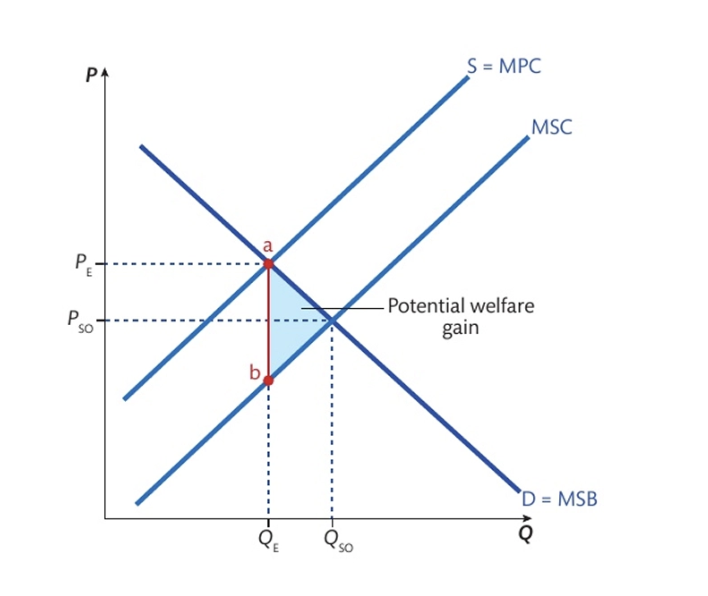
  • MSC < MPC since social cost of production is lower than what private producers consider

  • Market under-produces these goods as firms do not account for these extra benefits → leads to a quantity lower than the socially optimal quantity (Qe < Qso)

  • Blue triangle: DWL (the total benefit society missed out on as they are underproducing, e.g: A beekeeper could add a new hive for $100. The honey is only worth $80 to him, so he doesn't do it. But that hive would also give the neighbors $40 in free apples. Society misses out on a $120 benefit (Honey + Apples) that only costs $100 to make. We "lost" a $20 profit for the world.)

Example:

  • Honey production (farmers gain by bees pollinating their crops, improving agricultural efficiency)
<ul><li><p>MSC &lt; MPC since social cost of production is lower than what private producers consider</p></li><li><p>Market under-produces these goods as firms do not account for these extra benefits → leads to a quantity lower than the socially optimal quantity (Qe &lt; Qso)</p></li><li><p>Blue triangle: DWL (the total benefit society missed out on as they are underproducing, e.g: A beekeeper could add a new hive for $100. The honey is only worth $80 to him, so he doesn't do it. But that hive would also give the neighbors $40 in free apples. Society misses out on a $120 benefit (Honey + Apples) that only costs $100 to make. We "lost" a $20 profit for the world.)</p></li></ul><p></p><p>Example:</p><ul><li><p>Honey production (farmers gain by bees pollinating their crops, improving agricultural efficiency)</p></li></ul><p></p>
23
New cards

Negative production externalities

Draw graph

State condition and why

State level of consumption and why

State DWL why

Give 3 examples

  • MSC > MPC since society bears greater burden from production than firms acknowledge

  • Market overproduces these goods as firms do not consider these extra costs → quantity higher than socially optimal quantity (Qe > Qso)

  • DWL: Blue triangle (costs to society exceeds the benefits as they are overproducing, e.g: Smoke from a factory causing $200 in healthcare costs for someone that inhaled it. Product from the factory worth $300. Society paying $500 for a product worth only $300 to the buyer.)

Examples:

  • coal production (air pollution and dangerous working conditions)

  • textile manufacturing (often involves exploitative labor practices)

  • industrial agriculture (uses harmful chemicals that pollute air, water, and soil, affecting ecosystems and human health)



