Science Forces, Momentum, and Friction
 Call Kai
 Learn
Learn Practice Test
 Spaced Repetition
 Match
Match Flashcards
 Knowt Play
1/24

There's no tags or description
Looks like no tags are added yet.
Name | Mastery | Learn | Test | Matching | Spaced | Call with Kai | Chat |
|---|
No analytics yet
Send a link to your students to track their progress
25 Terms
Momentum
a property of an object that is related to how much force is necessary to change its motion. A vector quantity, as it has velocity which has direction
SI Unit for Momentum
kg x m/s
Formula for Momentum
p = m·v
Law of Conservation of Momentum
Momentum can be transferred from one object to another
The momentum of an object will not change (it is conserved) unless its mass, velocity, or both, change
“In the absence of an external force (gravity, friction), the total momentum before the collision is equal to the total momentum after the collision, or is CONSERVED.”
Elastic Collisions
collisions where the objects bounce off of each other or separate.
Inelastic Collisions
collisions where the objects stick together and move as one. The mass after the collision is equal to the sum of the masses and there is just one final velocity.
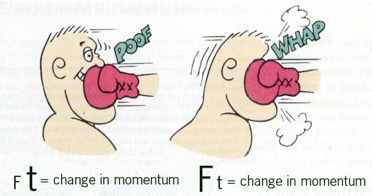
Impulse-Momentum Theorum
the impulse (the time over which a force is applied) acting on an object is equal to the change in momentum of the object (its mass x the change in velocity)
Impulse Equation
Impulse (force x time) = change in momentum (mass x change in velocity)
Force
A push or pull that one object can exert on another, causing the object to change in position (move/accelerate)
f=ma
Formula for force (force = mass x acceleration)
kg x m/s² (Newton)
SI unit for force
Balanced Force
when equal forces in opposite directions are applied to an object, resulting in no change in motion as they cancel out
Unbalanced Force
When a force is applied to an object and is not balanced by another force, resulting in a change in motion / acceleration
Net Force
The result (sum) of all forces acting on an object
Inertia
-The tendency of an object to resist a change in motion
-A property of matter (mass)
-The greater the mass of an object, the greater its resistance to a change in motion
Newton’s 1st Law of Motion
The tendancy of an object to resist a change in motion unless acted on by an unbalanced force.
Newton’s 2nd Law of Motion
An object will accelerate in the direction of the net force
Law of Universal Gravitation
The attractive force between any two masses that is greater when the objects are closer together and have more mass
Newton’s 3rd Law
Every action has an equal opposite reaction
Friction
The force between two surfaces that are touching one another
Factors Affecting Friction
The objects’ masses and the materials touching each other
Fluid Friction
The friction of an object moving through a fluid
Static Friction
The friction between two surfaces that are not moving past each other - the greatest type of friction due to needing to overcome it to begin motion
Rolling Friction
The friction between a rolling object and the surface it rolls on - the least amount of friction because each point of the wheel does not make contact with the surface it rolls on for long enough for the surfaces to interlock
Centripetal Force
A force directed toward the center of a circle for an object traveling in a circular path