Earth Science
 View linked note
 Call Kai
 Learn
Learn Practice Test
 Spaced Repetition
 Match
Match Flashcards
 Knowt Play
1/33

Earn XP
Description and Tags
Minerals and Rock Resources
Name | Mastery | Learn | Test | Matching | Spaced | Call with Kai | Chat |
|---|
No analytics yet
Send a link to your students to track their progress
34 Terms
These are resources that provide for the needs of all organisms. They are available in different types and forms. The geologic processes and natural systems of Earth ensure that these resources are replenished, whether within our lifetime or geologic time.
Earth’s materials
These are naturally occurring inorganic solid with crystalline structure, and chemical composition which may be fixed or vary within certain limits.
Minerals
Minerals are considered natural because they are formed by?
natural geological processes
These are building blocks of rocks.
Minerals
Minerals undergo different geological processes and become part of or develop into rocks, in which case they become known as?
rock-forming minerals
Not all rock-forming minerals contains various types and amounts of minerals that may be useful to man. If the minerals found in these rocks are enriched with one or more valuable or useful materials, they are referred to as?
mineral resources
Most of the mineral resources used as raw materials for buildings and other structure require the application of geological principles and they go through various processes before they can be used as materials. Some minerals do not need or require little processing such as?
gemstones
Most of the mineral resources used as raw materials for buildings and other structure require the application of ______ ________ and they go through various processes before they can be used as materials. Some minerals do not need or require little processing such as gemstones.
geological principles
Mineral resources can be divided into two groups. What are these groups?
metallic mineral resources and nonmetallic mineral resources
These are hard, ductile, malleable pure substance that are melted to obtain new products. These minerals possess a metallic luster, contain metals in their composition, and are potential source of the metal that can be obtained through mining. They are usually associated with igneous rocks.
metallic mineral resources
They do not have properties of the metallic minerals and thus can be easily disintegrated or broken into pieces. They are usually associated with sedimentary rocks.
nonmetallic mineral resources
Metallic mineral resources are hard, ductile, malleable pure substance that are melted to obtain new products. These minerals possess a _____ ______, _______ _____ ___ ______ __________, and are ________ ______ ____ ___ _____ that can be obtained through mining. They are usually associated with igneous rocks.
metallic luster, contain metals in their composition, potential source of the metal
Examples of metallic mineral resources are _____, ____, ____, ____, ____, _____, ______ and ________.
gold, iron, silver, copper, lead, zinc, nickel, aluminum.
Metallic minerals may be further classified into: _______ and ______.
ferrous minerals and nonferrous minerals
Minerals that contain iron.
ferrous minerals
Minerals that do not contain iron.
nonferrous minerals
examples of ferrous minerals (3)
iron ore, manganese, and chromite
examples of nonferrous minerals (4)
gold, silver, copper and lead.
examples of nonmetallic mineral resources (3)
coal, clay, and salt
enumerate the 7 chemical properties of minerals
chemical composition
atomic structure and bonding
reactivity with acids
solubility
radioactivity
pH sensitivity
magnetism and electrical conductivity
To classify a mineral resource, the minerals in rock should first be identified. Minerals can be identified through their physical properties. In some cases, same minerals may be found in different places and in different forms but their fundamental physical properties remain the same.
physical properties of minerals
enumerate the 11 physical properties of minerals
color
streak
hardness
cleavage and fracture
crystalline structure / crystal lattice
transparency or diaphaneity
magnetism
tenacity
luster
odor
specific gravity
It is the most evident characteristic and is usually the first property used to identify minerals. It is a result of the way minerals absorb light.
color
Color may not be used in identifying translucent to transparent minerals due to the presence of other ________ _________ or _________. Therefore, color is considered the least reliable means of identifying minerals.
trace minerals or impurities
It is the color of the mineral in powder form. Usually, the mineral is rubbed on _____ plate to determine its color. (A _____ plate may be an unglazed side of porcelain). In cases when the color of a mineral appears different because of trace particles inside it, scientists would pulverize it to get its true color. In this case, the color of the mineral becomes more
visible and clear. However, the disadvantage of pulverizing the mineral is tedious, making the mineral lose its integrity.
streak
This refers to the measure of the mineral’s resistance to scratching.
hardness
To quantify the hardness of a mineral, the ______ _____ is used. The harder the mineral, the less prone it is to scratches. Most minerals also react to certain chemicals. Thus, some minerals get corroded when exposed to certain chemicals.
Mohs scale
the Mohs scale of mineral hardness and its common objects
Talc - powder
Gypsum - fingernails
Calcite - tooth
Fluorite - iron nail
Apatite - window glass
Orthoclase feldspar - steel file
Quartz - porcelain
Topaz - hardened steel
Corundum - Sapphire and ruby
Diamond - none
________ and ______ are used to describe how minerals break into pieces. Minerals are crystalline structures, and breakage of minerals may take place in weak parts of the structure. The planes of weak bonding or the breakage along the crystalline structure where a mineral is likely to break smoothly is known as _______.
Cleavage and fracture
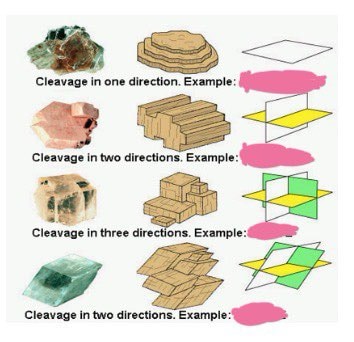
muscovite
feldspar
halite
calcite