Human Evolution - Out of Africa
0.0(0)
Studied by 2 people Call Kai
 Learn
Learn Practice Test
 Spaced Repetition
 Match
Match Flashcards
 Knowt Play
Card Sorting
1/10

Earn XP
Description and Tags
11 Terms
1
New cards
1st dispersal
According to current evidence, the first dispersal out of Africa happened around 1.5 mya. It is widely accepted that Homo ergaster left Africa and spread across Asia. Moving north, they interacted with and learnt to exploit. different types of habitats and fauna. These populations became geographically and reproductively isolated and evolved into variants (e.g. H. erects and H. neanderthalensis).
2
New cards
2nd dispersal
Approximately 100 000 years ago there was a second emigration out of Africa of the species Homo sapiens. They
gradually replaced the other Homo populations that occupied Asia and Europe. This dispersal of hominins from Africa to Eurasia occurred at approximately the same time as climatic changes linked to glacial/interglacial cycles.
gradually replaced the other Homo populations that occupied Asia and Europe. This dispersal of hominins from Africa to Eurasia occurred at approximately the same time as climatic changes linked to glacial/interglacial cycles.
3
New cards
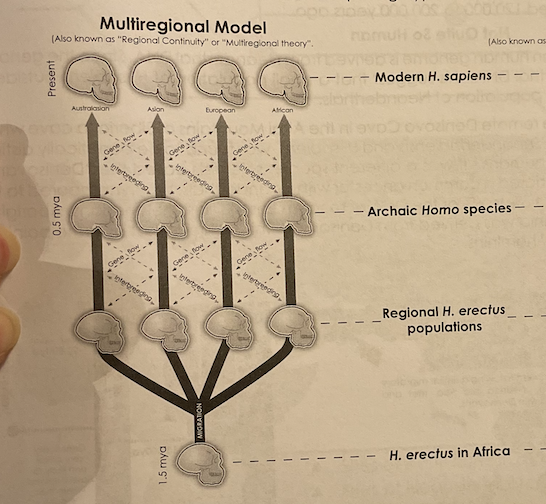
Multiregional Model
4
New cards
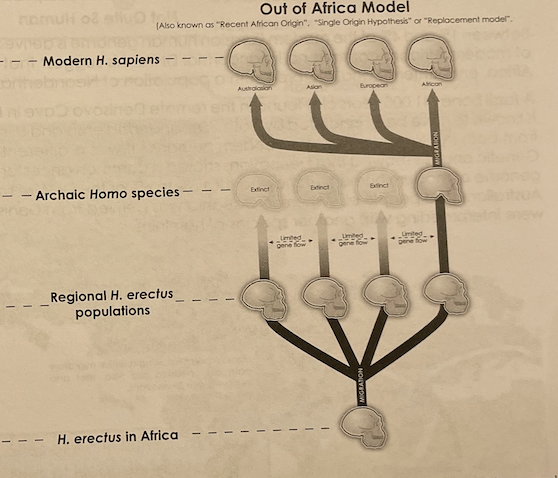
Out of Africa Model
5
New cards
The multiregional Model argues that H. erectus left Africa around 1.5 mya and
spread to Europe and Asia.
spread to Europe and Asia.
H. sapiens then evolved simultaneously in these
archaic populations. Interbreeding between separate
populations prevented speciation and
ensured adaptations were dispersed to all populations of a
single species (H. sapiens).
archaic populations. Interbreeding between separate
populations prevented speciation and
ensured adaptations were dispersed to all populations of a
single species (H. sapiens).
6
New cards
If the Multiregional Model is correct then:
Fossils of transitional forms between H. sapiens and
its ancestors should appear in all regions.
H. sapiens traits should appear in the fossil record
relatively simultaneously in all regions.
Modern H. sapiens should have a high degree of
genetic diversity as it is an old species.
Modern H. sapiens should have a similar amount
of genetic variation as African populations as they
have been evolving for the same amount of time.
its ancestors should appear in all regions.
H. sapiens traits should appear in the fossil record
relatively simultaneously in all regions.
Modern H. sapiens should have a high degree of
genetic diversity as it is an old species.
Modern H. sapiens should have a similar amount
of genetic variation as African populations as they
have been evolving for the same amount of time.
7
New cards
If the Out of Africa Model is correct then:
Fossils of transitional forms between H. sapiens and
its ancestors should only appear in Africa. H. sapiens traits should appear in the fossil record first in Africa, then later elsewhere. Populations of H. sapiens and archaic populations should co-exist for a period of time. Modern H. sapiens populations should have relatively low genetic diversity as it is a young species. Populations of modern H. sapiens in Africa should have the most genetic variation as they are the
oldest.
its ancestors should only appear in Africa. H. sapiens traits should appear in the fossil record first in Africa, then later elsewhere. Populations of H. sapiens and archaic populations should co-exist for a period of time. Modern H. sapiens populations should have relatively low genetic diversity as it is a young species. Populations of modern H. sapiens in Africa should have the most genetic variation as they are the
oldest.
8
New cards
MtDNA
Mitochondria have their own DNA called mitochondrial DNA (mtDNA). Mitochondria are found in the ovum but not in the head of a sperm cell, so mitochondrial DNA is inherited only from our mothers. mtDNA does not recombine during meiosis. This means that the variation in mtDNA between individuals can only be caused by mutation.
The rate at which these mutations occur is fairly consistent and so acts as a "biological clock' - the more difference in mtDNA between populations, the longer they have been separated.
mtDNA can be traced back to one common mitochondrial sequence that existed between
100 000 and 200 000 years ago - belonging to an individual nicknamed "Mitochondrial Eve".
Mitochondrial Eve was not the only woman alive at that time - she was part of a population that would have contained many other women with other mtDNA sequences. However, over time these other lineages died out, and by chance, her lineage replaced all the others.
The rate at which these mutations occur is fairly consistent and so acts as a "biological clock' - the more difference in mtDNA between populations, the longer they have been separated.
mtDNA can be traced back to one common mitochondrial sequence that existed between
100 000 and 200 000 years ago - belonging to an individual nicknamed "Mitochondrial Eve".
Mitochondrial Eve was not the only woman alive at that time - she was part of a population that would have contained many other women with other mtDNA sequences. However, over time these other lineages died out, and by chance, her lineage replaced all the others.
9
New cards
Y - Chromosome
Scientists can also use the Y-chromosome (inherited from father to son) to trace all modern males back to a man
(called "Y-chromosomal Adam") who lived 120 000 to 200 000 years ago.
(called "Y-chromosomal Adam") who lived 120 000 to 200 000 years ago.
10
New cards
Interbreeding with another species of hominins
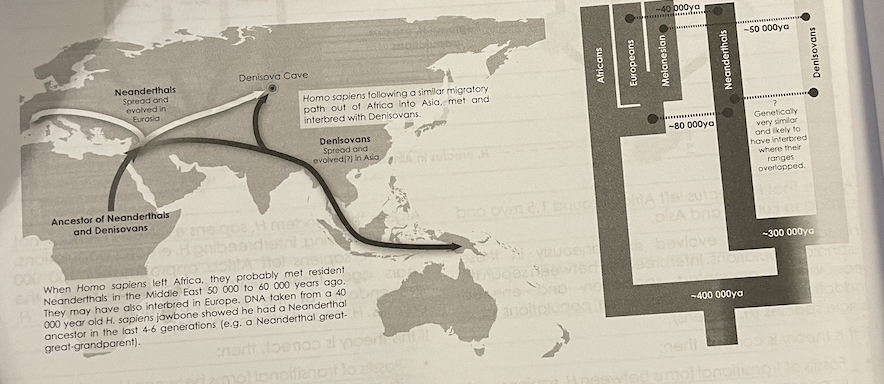
Between 1% and 4% of the modern Eurasian human genome is derived from Neanderthal DNA. Since the genome
of modern Africans contains no Neanderthal DNA, this suggest that a small population of H. sapiens outside of
Africa, encountered and interbred with a population of Neanderthals.
A fossil bone (41 000 years old) found in the remote Denisova Cave in the Altai Mountains of Siberia, a cave which
is known to have been inhabited by both H. neanderthalensis and H. sapiens, was found to be genetically distinct
from both the Neanderthals and modern humans - it was a different species scientists called the "Denisovans"
Genetic analysis showed that Denisovans shared a common ancestor with Neanderthals. When compared to the
genome of modern humans, it showed that 3% to 6% of the DNA of modern East Asians, Melanesians, Aboriginal
Australians and people elsewhere in Oceania was derived from Denisovans. This suggests that at some point we
were interbreeding with another species of hominins.
of modern Africans contains no Neanderthal DNA, this suggest that a small population of H. sapiens outside of
Africa, encountered and interbred with a population of Neanderthals.
A fossil bone (41 000 years old) found in the remote Denisova Cave in the Altai Mountains of Siberia, a cave which
is known to have been inhabited by both H. neanderthalensis and H. sapiens, was found to be genetically distinct
from both the Neanderthals and modern humans - it was a different species scientists called the "Denisovans"
Genetic analysis showed that Denisovans shared a common ancestor with Neanderthals. When compared to the
genome of modern humans, it showed that 3% to 6% of the DNA of modern East Asians, Melanesians, Aboriginal
Australians and people elsewhere in Oceania was derived from Denisovans. This suggests that at some point we
were interbreeding with another species of hominins.
11
New cards
Genetic Diversity and Dispersal Models
Most genetic evidence supports the Out of Africa hypothesis:
Most genetic evidence supports the Out of Africa hypothesis:
- Humans as a species have very little genetic diversity when compared to other mammalian species. For example, there is much more genetic diversity between two randomly selected, unrelated chimpanzees than there is between two randomly selected, unrelated humans.
- Within the human population, nearly all genetic studies indicate greater diversity within African populations. This is consistent with an African origin of modern humans since diversity is a function of both time (we've been present in Africa longer than anywhere else) and population size.
- Non-African populations also tend to be more similar to one another than they are to African populations, suggesting that a subset of the African population left the continent and colonised the rest of the world. Reduced genetic variability in non-African populations is a result of the 'Founder Effect'.
- Within the human population, nearly all genetic studies indicate greater diversity within African populations. This is consistent with an African origin of modern humans since diversity is a function of both time (we've been present in Africa longer than anywhere else) and population size.
- Non-African populations also tend to be more similar to one another than they are to African populations, suggesting that a subset of the African population left the continent and colonised the rest of the world. Reduced genetic variability in non-African populations is a result of the 'Founder Effect'.