GCSE Physics: P1 - Conservation and dissipation of energy
 Call Kai
 Learn
Learn Practice Test
 Spaced Repetition
 Match
Match Flashcards
 Knowt Play
1/50

There's no tags or description
Looks like no tags are added yet.
Name | Mastery | Learn | Test | Matching | Spaced | Call with Kai |
|---|
No analytics yet
Send a link to your students to track their progress
51 Terms
What is kinetic energy?
the energy stored in moving objects
How much kinetic energy do stationary objects have?
stationary objects have no kinetic energy
e.g. a parked car
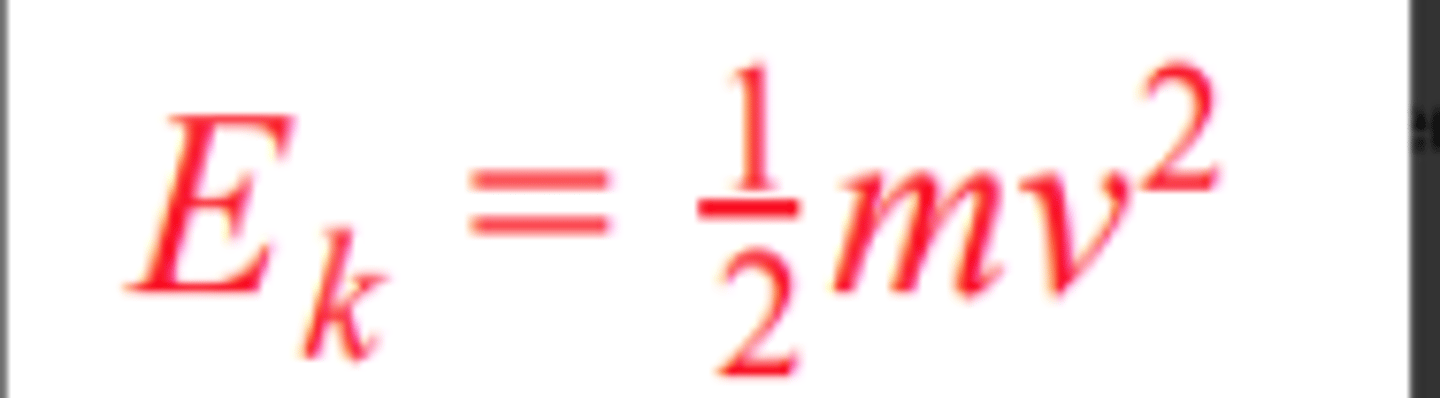
What is the equation for calculating kinetic energy?
Kinetic energy (J) = 1/2 X mass (kg) X speed^2 (m/s)
Describe the energy transfers that occur when a car travels at a constant speed
- energy transfers from chemical energy store in the car's petrol
- transfers to the kinetic energy store as the car moves
A car with a mass of 700 kg is moving with a speed of 20 m/s. Calculate the kinetic energy of the car.
Ek = 1/2 X m X v^2
Ek = 1/2 X 700 kg X 400 m/s
Kinetic energy of the car = 140 000 J
= 140 kJ
What is elastic potential energy?
the energy stored in a springy object when you stretch or squash it
What is the equation for calculating elastic potential energy?
Ee = 1/2 k e^2
Elastic potential energy (J) = 1/2 X spring constant (N/m) X extension^2 (m)
A spring has an extension of 20 cm. Calculate the elastic potential energy stored in the spring (k = 100 N/m)
Ee = 1/2 X k X e^2
Ee = 1/2 X 100 N/m X 0.2 m ^2
Ee = 1/2 X 100 N/m X 0.04 m
Ee = 2 J
What is gravitational potential energy?
the energy stored in an object due to its position above the Earth's surface
What force acts on an object when it is above the Earth's surface?
gravity
Describe the energy transfers that take place when a ball is placed on a shelf and when the ball falls off the shelf
- when the ball is placed on the shelf, the chemical energy store in the person's muscles is used
- this is transferred to the gravitational potential energy store in the ball as it is now above the Earth's surface
- if the ball were to fall off the shelf, its gravitational potential energy store would transfer to the kinetic energy store as the ball is now moving
- some energy is transferred to the thermal energy store of the surroundings due to work done by air resistance as the ball falls
What is the equation for calculating gravitational potential energy?
Ep = m g h
gravitational potential energy (J) = mass (kg) X gravitational field strength (N/kg) X height (m)
What is thermal energy?
the energy stored due to an objects temperature
What is the Law of Conservation of Energy?
Energy can be transferred usefully, stored or dissipated, but cannot be created or destroyed
What is a system?
an object or group of objects
What is a closed system?
a system in which no energy can enter or leave
Describe the energy transfers that take place when a pendulum swings
- when the pendulum is at its highest position, it has the maximum store of gravitational potential energy
- as the pendulum swings, energy is transferred to the kinetic energy store
- the pendulum has the maximum kinetic energy store at the bottom of the swing as this is where the pendulum has the most speed
- as the pendulum swings back up, the kinetic energy store transfers to the gravitational potential energy store again
- friction occurs in the pendulum's fixed point and work is done by air resistance as the pendulum passes through air particles
- friction causes some of the energy to be dissipated to the thermal energy store of the surroundings
- friction will cause the pendulum to swing with less energy and eventually stop
How can we stop energy from being dissipated (wasted) as the pendulum swings?
- we can reduce the energy dissipated by reducing friction, which causes unwanted energy transfers
- we can reduce friction by using a lubricant on the pendulum's fixed point and by removing the air particles from around the pendulum
Describe the energy transfers that take place during a bungee jump
- at start of the jump, all energy in the system is in the store of gravitational potential energy
- as the jumper falls, energy is transferred from gravitational potential energy store to kinetic energy store because the bungee jumper is moving
- when the bungee rope begins to tighten, the kinetic energy store is at its maximum
- when rope is fully extended, energy is transferred from the kinetic energy store to the elastic potential energy store
- as the bungee rope recoils, energy is transferred from the elastic potential energy store back to the kinetic energy store
- as the bungee jumper ascends, energy transfers from the kinetic energy store back to the gravitational potential energy store
- at the top of the ascent, all of the energy is in the gravitational potential energy store
- some energy is dissipated in the thermal energy store of the surroundings due to friction with air particles as the jumper passes through the air, and due to stretching effects in the bungee rope
What is work done?
when energy is transferred from one store to another
What is mechanical work?
work done that involves using a force to move an object
What is electrical work?
work done that involves a current transferring energy
What is the equation for calculating work done?
Work done (J) = force (N) X distance (m)
W= Fs
During braking, a force of 2000N is applied to the brakes of a car. The car takes 20m to come to a stop. Calculate the work done
W = Fs
W = 2000 N X 20 m
Work done = 40 000 J
Describe the energy transfers that take place when a car brakes
- the car has a kinetic energy store as it moves
- when the driver presses on the brakes, the brake presses against the wheel of the car
- creating friction between the brake and the wheel
- the kinetic energy store of the car is transferred to the thermal energy store in the brakes
- the temperature of the brakes increases and the car slows down and stops
What is power?
The rate at which energy is transferred or the rate at which work is done
What are the equations for calculating power?
Power (W) = Energy transferred (J) / Time (s)
P = E/t
Power (W) = Work done (J) / time (s)
P = W/t
When a car stops, 40 000 J of work is done by the brakes in a time of 5 s. Calculate the power of the brakes.
P = W/t
P = 40 000 J / 5 s
Power = 8000 W
What is efficiency?
the fraction of the energy supplied to a device which is transferred in a useful form
What are the equations for calculating efficiency?
efficiency = useful energy output / total energy input
efficiency = useful power output / total power input
An electric hob is used to heat water. 15,000 J of thermal energy is transferred by the hob. 12,000 J of thermal energy passes into the water. Calculate the efficiency of energy transfer into the water
efficiency = useful output energy transfer/
total input energy transfer
efficiency = 12 000 J / 15 000
efficiency = 0.8
Name some important things to remember when calculating efficiency
- efficiency should not be higher than 1
- if it is, you have probably done the equation the wrong way round
- some questions may ask you to write the value for efficiency as a percentage
What is chemical energy?
the energy stored in fuels, foods, and batteries
What is nuclear energy?
the energy stored in the nucleus of an atom
Name some ways that devices and appliances dissipate energy
devices waste energy due to:
- friction between the moving parts
- electrical resistance
- unwanted sound energy
- unwanted thermal energy
How can we increase the efficiency of an energy transfer?
- by reducing unwanted energy transfers
- so more of the total input energy is usefully transferred
How can we increase the efficiency of mechanical devices?
- mechanical devices can be made more efficient through lubrication in order to reduce friction between the moving parts of the device and therefore increase the amount of energy usefully transferred
How can we increase the efficiency of a system designed to transfer thermal energy
- systems designed to transfer thermal energy can be made more efficient by using insulation to reduce dissipation of thermal energy to the surroundings
The maximum gravitational potential energy store of an object is equal to.....
..... the maximum kinetic energy store of the object
because
- if we increase the gravitational potential energy of an object by increasing its position above the Earth's surface
- the kinetic energy store of the object will increase too as the object will move more as it falls from a greater height in the air
'If a moving object doubles its speed, it doubles the energy in its kinetic energy store' Is this statement true?
If a moving object doubles its speed, this does not mean its kinetic energy doubles.
The speed is squared, so doubling the speed does not mean the kinetic energy doubles.
Describe the useful energy transfers in a hairdryer
- in a hairdryer, energy is electrically transferred from the mains supply to the thermal energy store of the heating element
- and the kinetic energy store of the fan blades
Describe the energy transfers that take place in a fan heater, which has an electric heater and a fan driven by an electric motor
- energy is transferred by the electric current to the heater and the motor
- in the heater, this increases the thermal energy store, so the heater becomes hot
- in the fan, energy is transferred to the air as kinetic energy from the motor blades
- the air that is warmed by the heater then heats other objects it comes into contact with
- the heater warms the fan heater case, so the vibrating parts of the heater create sound waves
A train moves onto an inclined section of railway line.
Explain why the output power of the engine needs to be increased for the train to maintain a constant speed
- the train gains gravitational potential energy as it travels up the inclined section
- and the rate the train transfers energy to the surroundings is unchanged, as the speed is the same and resistive forces are unchanged
- this means output engine power needs to be greater
- as more energy must be transferred to the train as gravitational potential energy, as well as to the surroundings
Describe the energy transfers that take place after a catapult is released and a stone is fired into the air from the catapult
- initially, energy is stored in stretched cord of catapult as elastic potential energy, which transfers to kinetic energy when the cord is released
- as stone gains height, its kinetic energy decreases and its gravitational potential energy increases
- at its maximum height, the stone has its maximum gravitational potential energy and its minimum kinetic energy
- some energy is transferred to the air as the stone travels through the air, due to work done by air resistance
Suggest why it is good scientific practice to repeat the tests involved in an investigation
An investigator should repeat the tests, to ensure measurements are repeatable.
An independent researcher investigates the batteries in a set of electric shavers. Why may he have decided to supply the same amount of energy to the chemical energy store of each battery?
He may have decided to supply the same amount of energy to each battery, in order to allow a comparison to be made between the batteries in the shavers.
What effect may friction have when two surfaces are rubbed together?
Friction dissipates some energy from the heat between the two surfaces being rubbed together to the thermal energy store of the air
A graph shows a straight line going from the origin for the relationship between the height of a rock and the transfer of energy to the gravitational potential energy store of the rock.
Describe the relationship between the height of the rock and the transfer to the gravitational potential energy store of the rock
- as the height of the rock increases, the transfer of energy to the gravitational potential energy store of the rock increases
- this means they are directly proportional
Why must the springs in a trampoline not exceed their elastic limit when being used?
To ensure the springs return to their original length after a bounce.
Why may the manufacturers of springs used in a trampoline test the springs beyond the normal working load?
The springs may be tested beyond the normal working load for safety reasons, in case the springs snap when more than one person uses the trampoline.
1 s =
1 s = 1000 ms