Karen Horney (1885-1952)
 Call Kai
 Learn
Learn Practice Test
 Spaced Repetition
 Match
Match Flashcards
 Knowt Play
1/22

Earn XP
Description and Tags
“For the very reason that love in our civilization is so rarely a genuine affection, maltreatment and betrayal abound.”
Name | Mastery | Learn | Test | Matching | Spaced | Call with Kai |
|---|
No analytics yet
Send a link to your students to track their progress
23 Terms
Horney - Background
Family
Was Norwegian living in Germany
Father was a Norwegian sea captain who was 18 years older than her mother
Karen was second born in this marriage (father had 4 children previously)
Father was very stern and controlling – many arguments!
Education
According to father, education was “man’s domain”
Karen’s grandmother received a BA (unusual at that time), and Karen vowed to disobey her father
Women’s Rights
Karen went to school since father was at sea so much
Wrote of the value of women in society
Went to medical school (2300 men, 58 women)
Marriage
Married a lawyer late in her medical training and had a son
Stress of school/parenthood led to depression (attempted suicide) … Started studying Freud’s ideas
United States
Marriage dissolved and she moved to US
Wasn’t allowed to join Psychoanalytic Institute, so she founded the American Institution of Psychoanalysis
Horney vs. Freud
Psychosexual stages are not entirely correct
Penis envy and electra complexes are bogus!
Personality is largely driven by results of interpersonal conflicts (not sexual ones)!
Gender differences are the result of socialization
Normal Personality Development
Children develop “basic confidence” in themselves and others
Most likely when parents convey:
Predictable warmth
Interest
respect
Abnormal Development
Child feels . . .
Small, helpless, deserted, and endangered
. . . In a world that is out to abuse, cheat, attack, humiliate, and betray
Caused by parents who . . .
Belittle
Are indifferent
Make false promises
Otherwise abuse . . .
Leads to Basic Anxiety, the root of neurosis
Basic Anxiety
A child’s feeling of being isolated and helpless in a hostile world.
Wants to be helpless/dependent, but can’t
Wants to be angry/aggressive (basic hostility), but can’t
Basic Hostility
A reaction to parental neglect or rejection
Child cannot act in a hostile manner, for fear that it would result in further punishment or neglect
But child also cannot act in a dependent manner, for fear of further rejection
—> increased anxiety!
Child needs parents and wants to approach them
But simultaneously hates them and wants to punish them!
What should the child do? - Three choices
Three Interpersonal Orientations
Means of interpersonal control and coping:
Moving Toward - Getting Type
Self-effacing solution
Ingratiating; “human doormats”
Moving Against - Ruling Type
Expansive solution
Aggressive and domineering
Moving Away - Avoiding Type
Resignation solution
Avoid people altogether
See people as being essentially troublesome and demanding
Moving Toward: Self-effacing
Morbid dependency: The need for a partner
Feeling weak and helpless
Assuming others are superior to themselves
Sacrificing for others
So that others will like them
Need for love
Find self-worth in a relationship
Moving Against: The Expansive Solution
Narcissistic
Love their own high self-image
Perfectionistic
Arrogant
And vindictive of those who “try” to pull them down
Need to be right
Argumentative
Need for recognition
Moving Away: The detached personality
Resigned; Strive for little
Desire freedom
Rebel against any constraints from others
An “on-looker”: Detached from emotional experiences
Self-sufficient and independent
Remain uninvolved with others
Need for privacy
Neuroticism to Horney
Everybody changes their stances to others from time to time (move towards to move away) . . .
But neurotic people are unable to shift posture
“indiscriminate application to all persons”
The Neurotic Needs
Moving toward
For affection and approval
A partner who will take over one’s life
Moving Against
For power, control over others, or for omnipotence
To exploit others and get the better of them
For social recognition and prestige
For personal admiration
For personal achievement
For perfection
Moving Away
To restrict one’s life within narrow borders
For self-sufficiency and independence
The overlap with today’s personality disorders is fairly obvious and Horney spent many years trying to categorize the 10 discrete trends into descriptors of personalities (both normal and abnormal)
None of these “needs” is, by itself, abnormal!
Neurotic needs resemble healthy values, but differ in 4 key ways:
Disproportionate in intensity
Indiscriminate in application to all persons
Evidence extreme disregard for reality
Provoke intense anxiety when unsatisfied
Application to Problems
Jealousy: The fear of losing a relationship that is viewed as the best available means of satisfying an insatiable need for affection and incessant demand for unconditional love
Jealousy can be “normal” or pathological
Pathological adult jealousy is a carry-over from childhood neurosis involving unresolved basic anxiety and attachment to parents
Tyranny of Shoulds: Belief that one “should” do things . . .
Can generate guilt and anxiety
Is part of the process of turning away from one’s real self and towards their ideal self
Related: Neurotic Search for Glory: Striving for Idealized Self
Need for perfection
Fear of Success: Belief that women are likely to undermine their abilities because men are competitive and lead women to believe they are bad if they are successful
In dealing with basic anxiety …
Neurotic individuals use defense mechanisms, some of which we have already studied (Freud) . . .
But also some new ones!
Major Adjustments to Basic Anxiety
Eclipsing the Conflict
“Eclipse” the conflict by raising the opposite to predominance
Hostile —> Dependent (moving towards)
Dependent —> Hostile (moving against)
Detachment
Moving away from others to reduce the conflict (moving away)
The Idealized Self
Move away from “real self”
The unique, alive, and personal center of ourselves
Moving towards someone “ideal” (e.g., less helpless and more perfect)
For these people, their “real self” is not valuable. Hence, they move towards their “ideal” self
Externalization (like projection)
Projects inner conflicts onto the outside world
E.g., If one feels rage . . .
Get irritated easily by others
Believe that others are irritated with us
Experience somatic complaints!
Secondary Adjustments to Basic Anxiety - Ideal Self
Blind Spots
Being unaware of overt behavior that is incompatible with idealized self-image
E.g., patient who “shot at” co-workers using finger
Compartmentalization
Incompatible behaviors are recognized, but solely within different arenas
E.g., patient who saw “ruthless” behavior at work but not in family
Secondary Adjustments to Basic Anxiety - Minimizing Conflict
Arbitrary Rightness
Declaring, arbitrarily and dogmatically, that I am right
Inner doubts are denied and external challenges are discredited
Elusiveness
Almost the exact opposite of Arbitrary rightness
Do not commit to any opinion!
Decreases the chance of experiencing conflict
Interesting Side Notes
Gender roles are culturally (not biologically) formed
Men have “stamped” success as their domain
Gender roles assign power or dominance for males and submissiveness/nurturance for females
Strategies to influence partner is related to “strength”: income, education, and age
More powerful member is more likely to act in an autocratic manner (Howard et al. research)
Penis envy is cultural!
Women simply envy power that is typically held by men
Once thought that women who were professionals suffered personality disturbances
However, it is the absence of “masculine” qualities (e.g., assertiveness) that predicts decreased well-being
The absence of “feminine” qualities, too, adversely impacts psychological well-being.
Summary of Major Contributions
Childhood may be a time of anxious helplessness and hidden anger toward powerful but often indifferent adults
Strategies to cope with these feelings may alienate the person from his/her true self
The neurotic personality cannot simply “be,” but must
Avoid others (moving away)
Attack others (moving against)
Completely comply with others (moving towards)
Therapy
Therapist provides security to delve into unhappy or painful topics
Therapist encourages patient to explore current relationships, including expectations that affect relationships
Therapist/Client relationship is explored, which allows patient to understand assumptions about themselves and their parents
Therapist helps patient explore how childhood experiences influence current expectations, perceptions, and emotions
Are these images adaptive? If not, must form new images
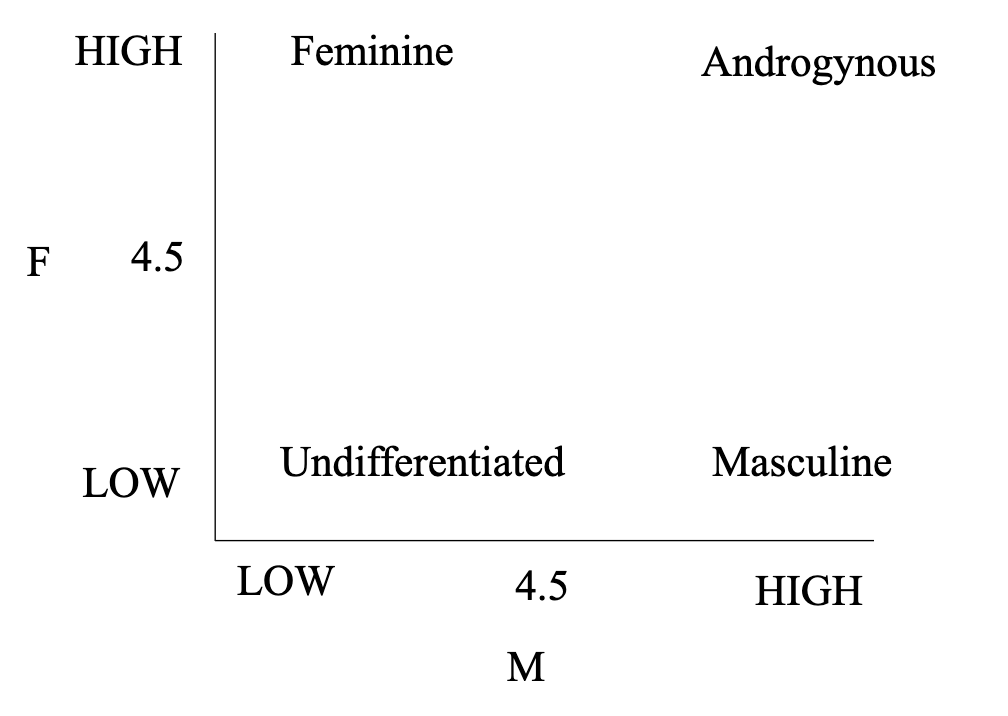
Bem Sex Role Inventory - Scoring (first non-bipolar test!)
Add item 1 and every third item
i.e., 1, 4, 7, 10, 13, 16, 19, 22, 25, 28
Divide by 10
Record score as M
Add item 2 and every third item
i.e., 2, 5, 8, 11, 14, 17, 20, 23, 26, 29
Divide by 10
Record score as F
Bem Sex Role Inventory - Medians
For women:
M = 3.5, F = 5.6
For men:
M = 5.6, F = 3.6
Bem Sex Role Inventory - Descriptives