Biology Regents Review
 Call Kai
 Learn
Learn Practice Test
 Spaced Repetition
 Match
Match Flashcards
 Knowt Play
1/33

There's no tags or description
Looks like no tags are added yet.
Name | Mastery | Learn | Test | Matching | Spaced | Call with Kai |
|---|
No analytics yet
Send a link to your students to track their progress
34 Terms
DNA
Genetic material with instructions for building proteins
DNA structure
two single strands of DNA that twist and form a double helix. Each strand is formed from a series of nucleotides.
Nucleotide
the DNA building block that consists of a sugar, phosphate, and base.
DNA replication
Process that results in two identical copies of DNA
DNA Replication Base pairing rule
A pairs with ?
G pairs with?
A pairs with T
G pairs with C
RNA
A single stranded polymer that is produced by DNA. There are three types: mRNA, tRNA, and rRNA
Protein synthesis
The process that creates proteins from a sequence of DNA made up of chains of amino acids. This process occurs in the ribosome and involves two main stages: transcription (copying DNA into mRNA and translation (reading mRNA to build the protein).

Where is DNA found
in the nucleus
Transcription changes….
DNA to mRNA
Transcription is
The first step of protein synthesis. The DNA code is copied into
messenger RNA (mRNA). The DNA double helix unwinds, and an
enzyme called RNA polymerase reads one strand of DNA and
creates a complementary mRNA strand.
Base pairing rule Transcription (DNA-mRNA)
A pairs with ?
G pairs with ?
A pairs with U
G pairs with C
Translation goes from
mRNA to a Proteins
Translation is
The second step of protein synthesis. mRNA travels to the ribosome, the cell's protein-making
factory. Here, the mRNA sequence is read in sets of three bases (codons), each specifying a
particular amino acid. Transfer RNA (tRNA) brings the appropriate amino acids to the ribosome to form a protein.
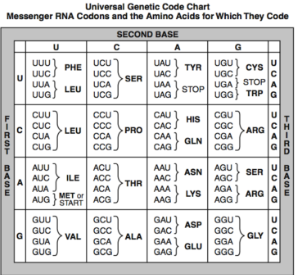
The Codon Chart is used to
Determine which amino acids will be assembled
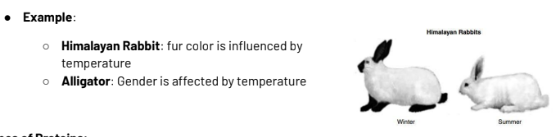
Gene expression
An organism’s environment can affect the expression of some genes.
Type of Protein
Enzymes:
A type of Protein that acts as biological catalysts to speed up chemical reactions. Enzymes are catalysts used in digestion and synthesis.
Enzyme reaction rates are affected by:
Shape- Lock and Key Model, if it is the wrong shape, it will not work.
Temperature- each Enzyme works best at a specific temperature.
pH- each Enzyme works best at a specific pH.
Structural Proteins:
Provide shape and support to cells and tissues.
Cell receptors:
Proteins on cell surfaces that receive and transmit signals.
Hormones:
Chemical messengers that control/ regulate many bodily functions (ex: insulin)
Antibodies:
Immune system proteins that identify and kill foreign substances.
Smallest to biggest of the structures
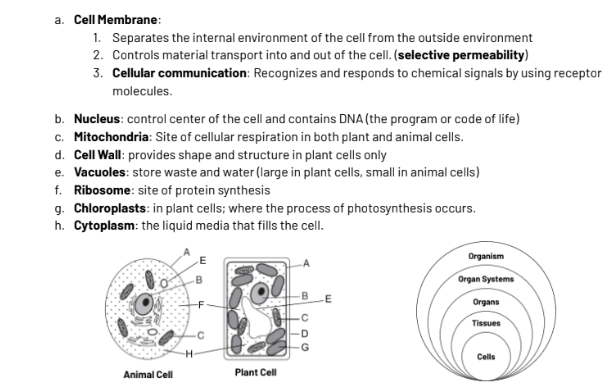
(smallest) Cells- Tissues- Organs- Organ Systems- Organism (biggest)
Organelles
Small parts that make up a cell ( each has at least one specific function)
cell membrane
Separates the internal environment of the cell from the outside environment.
Controls material transport into and out of the cell (selective permeability)
Cellular communication: Recognizes and responds to chemical signals by using receptor molecules.
A
Nucleus
Control Center of the cell and contains DNA (the program or code of life)
1. B
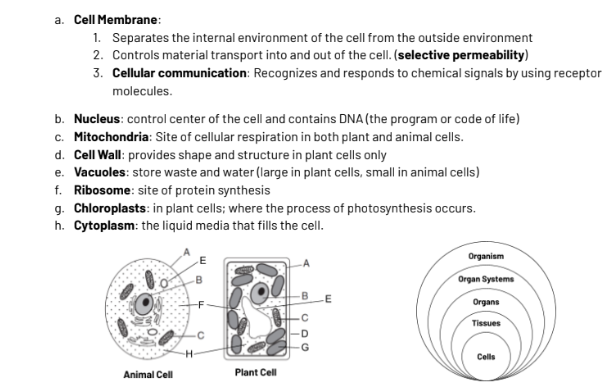
Mitochondria
SIte of cellular respiration in both plant and animal cells.
C
Cell Wall
provides shape and structure in plant cells only
D
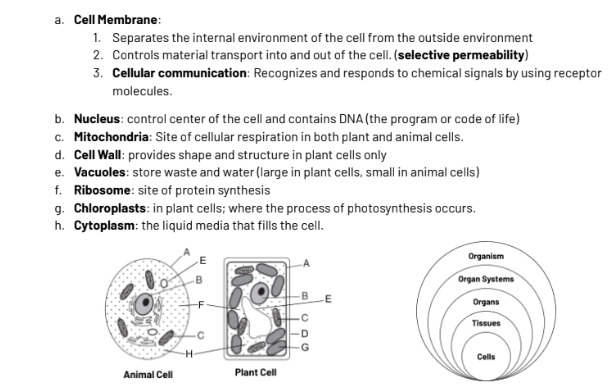
Vacuoles
Store waste and water (large in plant cells, small in animal cells)
E