Calculus I Exam 4
0.0(0)
Studied by 0 people Call Kai
 Learn
Learn Practice Test
 Spaced Repetition
 Match
Match Flashcards
 Knowt Play
Card Sorting
1/6

There's no tags or description
Looks like no tags are added yet.
Last updated 3:01 PM on 4/17/26
Name | Mastery | Learn | Test | Matching | Spaced | Call with Kai |
|---|
No analytics yet
Send a link to your students to track their progress
7 Terms
1
New cards
Define Antiderivatives
A function F(x) is an antiderivative of f(x) if F’(x) = f(x)
The most General antiderivative is F(x) + C
2
New cards
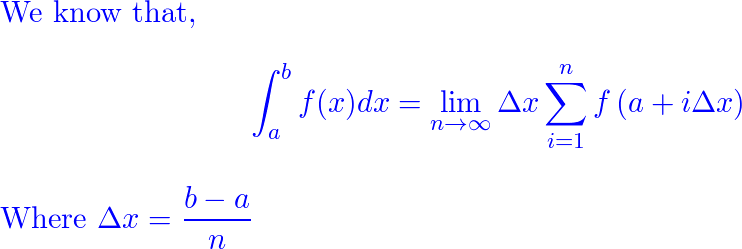
State the limit definition of a Riemann Sum and the expressions to find its components
3
New cards
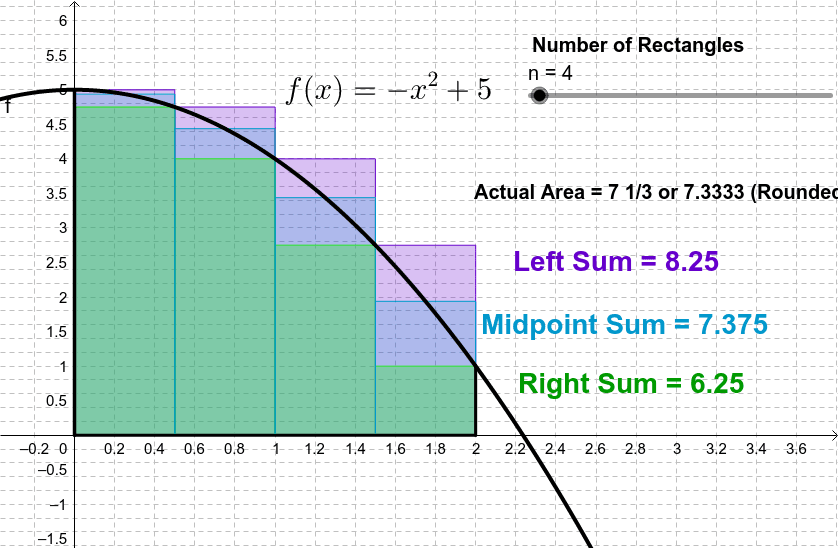
Know how to find left handed vs right handed vs (midpoint) riemann sums
4
New cards
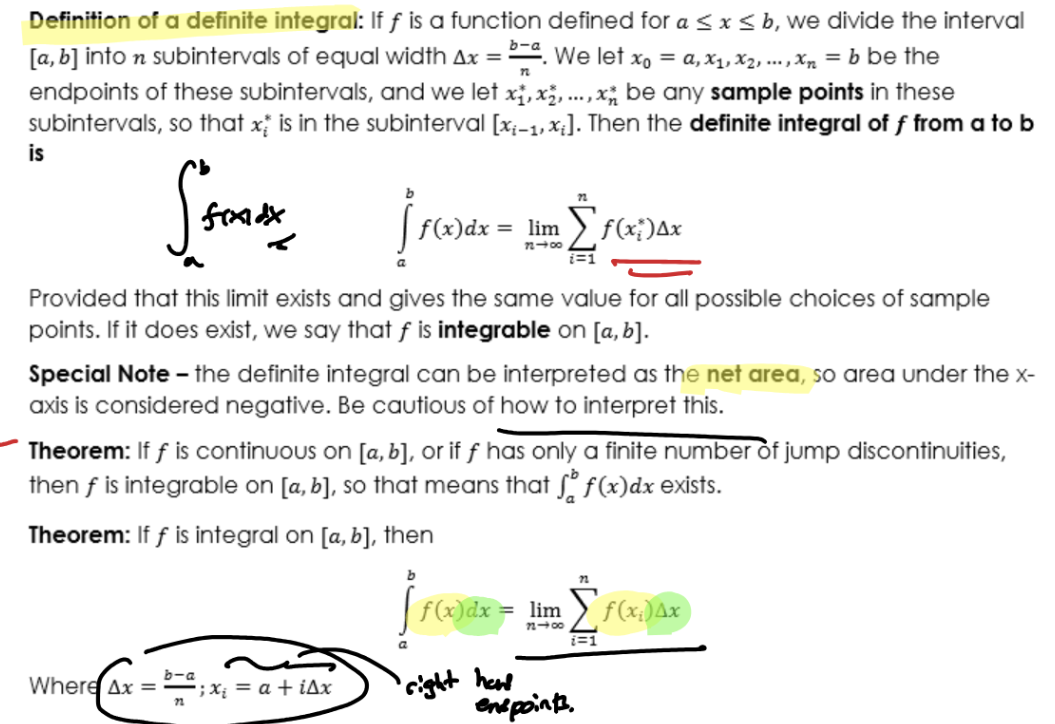
Definition of a Definite Integral?
5
New cards
State Part 1 of FTC
If function f is continuous on [a,b],
then the integral from a → x is = g(x)
WHERE:
g(x) is also continuous on [a,b],
differentiable on (a,b)
and g’(x) = f(x)
![<p>If function f is continuous on [a,b],</p><p></p><p>then the integral from a → x is = g(x)</p><p>WHERE:</p><p>g(x) is also continuous on [a,b],</p><p>differentiable on (a,b)</p><p>and g’(x) = f(x)</p><p></p>](https://assets.knowt.com/user-attachments/67900f18-e953-45e3-8b95-26ebe3aeab54.png)
6
New cards
State Part 2 of FTC
If f is continuous on [a, b], then:
![<p>If f is continuous on [a, b], then:</p>](https://assets.knowt.com/user-attachments/116c0b5f-062b-4c90-a462-7d6131ac4ced.png)
7
New cards
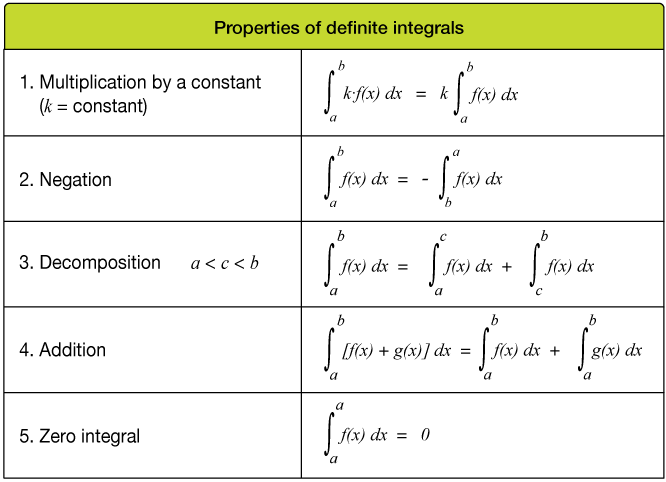
Properties of definite integrals