HL ppt4- hearing aids
 Call Kai
 Learn
Learn Practice Test
 Spaced Repetition
 Match
Match Flashcards
 Knowt Play
1/44

There's no tags or description
Looks like no tags are added yet.
Name | Mastery | Learn | Test | Matching | Spaced | Call with Kai |
|---|
No analytics yet
Send a link to your students to track their progress
45 Terms
A hearing aid (HA) is an electronic amplifier that has, at a minimum, four main components:
1. microphone
2. amplifier
3. receiver
4. battery
HA is an ______________
electric amplifier
converts the acoustic signal into an electrical signal
HA microphone
boosts the electrical signal and delivers it to the receiver
HA amplifier
converts the electrical
signal back into an acoustic signal to
be delivered to the ear
HA receiver
powers the device
HA battery
1. microphone
2. amplifier (inside)
3. battery (inside)
4. receiver (covered by rubber dome that goes in ear canal)
1.
2.
3.
4.
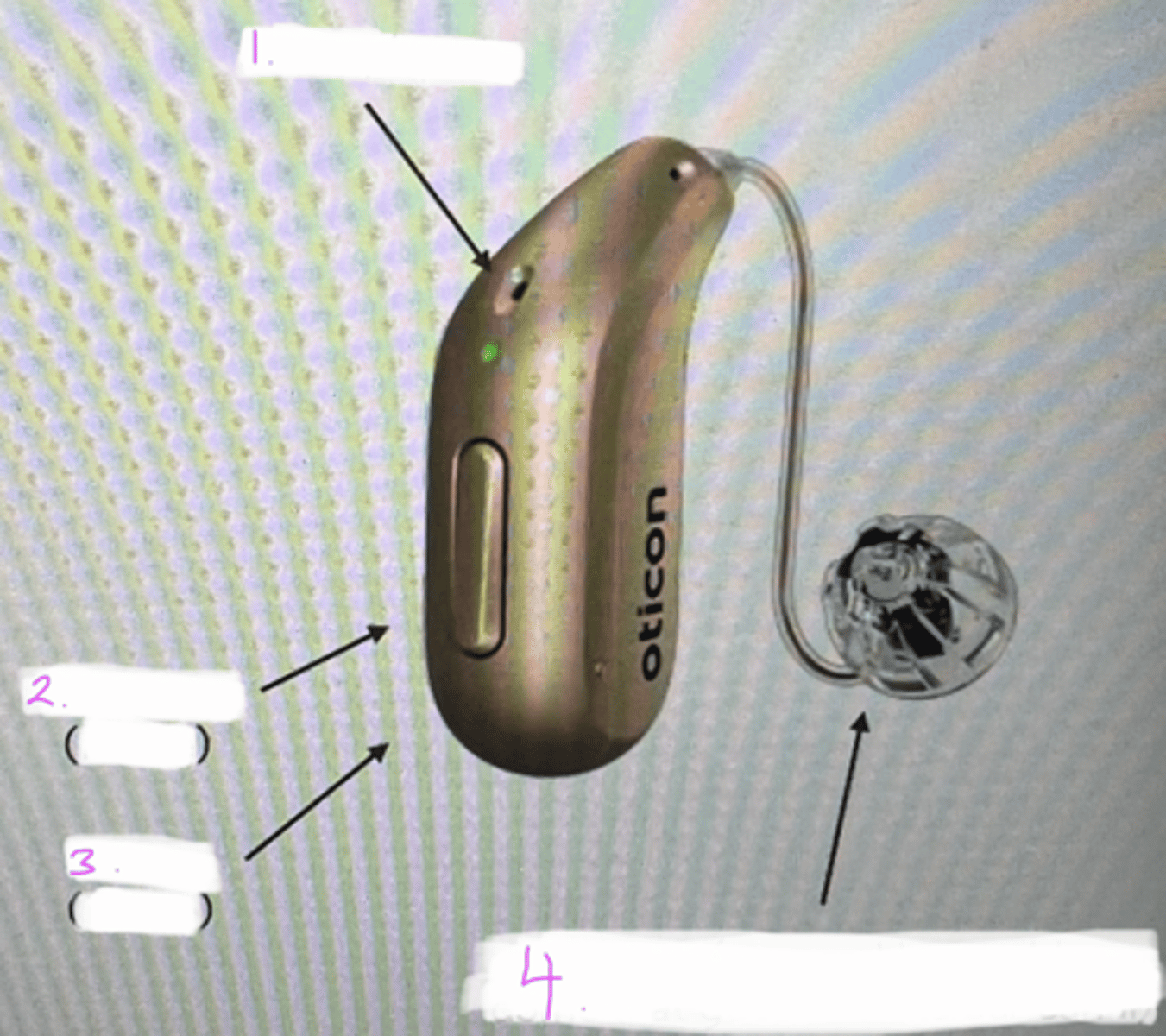
sound into an HA:
sound -> _________ -> ________ -> __________-> _______
microphone, amplifier, receiver, ear
list the types of HAs:
(7)
1. behind the ear BTE
2. receiver in canal RIC
3. custom
4. in the ear ITE
5. in the canal ITC
6. completely in the canal CIC
7. invisible in the canal IIC
consists of two pieces - piece behind the ear and one in the ear (earmold or dome) - connected by wire or tubing
behind the ear BTE HA
all parts located in the body of the hearing aid; sound is sent through tubing to the ear- tubing is connected to earmold in the ear
traditional BTE
why is BTE used for children:
(4)
1. safest and most durable
2. children's ears grow as they age so they'll need a new earmold made almost every time they grow a size
3. earmolds attached to BTEs can be remade and changed as children grow
4. cost effective bc parents don't regularly have to purchase new ones
all parts except the receiver are located in the body of the hearing aid; a wire connects the device to the reciever that fits inside the ear with an earmold or dome
receiver in canal (RIC) HA
Consist of one piece that holds all the technology and fits inside
the ear
custom HA
All parts are housed in one device that fills the concha (or ½ the concha) of the auricle.
in the ear/ ITE HA
two types of ITE HA:
full-shell and half-shell
fill the entire concha bowl
Full shell ITE
only partially fill the concha bowl
half shell ITE
All parts are housed in one device that fills the outer portion of the ear canal. Only the faceplate is visible in the opening of the canal
in the canal / ITC HA
All parts are housed in one device that fits
completely in the ear canal. The faceplate is only partially visible to others
completely in the canal/ CIC HA
All parts are housed in one device that fits
completely in the ear canal, making it "invisible" to others
invisible in the canal / IIC HA
used to couple a hearing aid to the wearers ear
earmolds
earmolds can be used for ______ and _______ HAs
RIC and traditional BTE
Children are almost always fit with ________ earmolds
full shell
Earmolds can be made out of three different materials:
silicone, acrylic, or vinyl
Children almost always have _______ earmolds
silicone
Hearing aids can utilize r
____________ or
__________ as a power source.
rechargeable batteries, disposable batteries
Rechargeable Hearing Aids use a__________ (not removable by
patient)
Lithium ion battery
Disposable (Replaceable) Battery Hearing Aids Use ________
zinc-air batteries
signs the HA is on and functioning properly:
(4)
1. Indicator light is flashing to signal it is on (pediatric hearing aids)
2. Increased awareness of environmental sounds (doors, footsteps, voices)
3. The client turns to their name or soft sounds more consistently
4. The client will usually will respond more quickly to speech with less reliance on visual cues
signs the HA is off/ not working:
(4)
1. The indicator light is not on
2. Client reports: "I can't hear anything" or "It's not working"
3. No change in responsiveness compared to unaided condition
4. Misses sounds they typically detect when aided
signs of a good fit of a HA:
(8)
1. Device stays in place (does not fall out with head movement, talking, chewing)
2. Snug and comfortable (no pressure or tightness reported)
3. No gaps between earmold/dome and ear canal
4. Tubing/wire lays naturally along the ear (not pulling or sticking out)
5. Behind-the-ear part rests comfortably on the pinna (does not slip)
6. Skin looks normal (no redness, irritation, sores, or indentations)
7. Patient can wear it all day without discomfort
8. No feedback/whistling due to proper seal
signs of a poor fit of a HA:
(7)
1. Device is loose or falls out easily
2. Patient keeps adjusting or removing the hearing aid
3. Gap between earmold/dome and ear canal (poor seal)
4. Reports pain, pressure, or soreness
5. Redness, irritation, or pressure marks/indentations in ear
6. Tubing/wire sticks out or is too tight (leaves indentations)
7. Feedback/whistling when still or with talking, chewing, etc.
first step to insert a HA
Identify right vs left device
after the first step, what are the next steps to insert a BTE/RIC HA:
(3)
1. place device over top of ear
2. gently insert earmold/dome into ear canal
3. make sure it fits snugly and comfortably
after the first step, what are the next steps to insert a custom HA:
(1)
1. Align with ear canal and gently push/twist into place
first step to remove a BTE/RIC HA:
(1)
1. Gently pull earmold/dome out first, then lift device off the ear
first step to remove a ITE HA:
(1)
use fingertips or removal string (if present), then gently twist and pull out
after the first step, what are the next steps to removing a HA:
(2)
1. remove slowly and carefully
2. avoid pulling on tubing/wiring alone
Do a LING sound check to check if the hearing aids are working properly BEFORE _________ for children with hearing loss
EVERY SESSION
steps to doing a LING sound check:
1.make sure hearing aids are on, functioning, & properly inserted.
2. position yourself at ear level, about 3-6 feet from patient
3. eliminate visual cues by covering your mouth or sitting slightly behind/side
4. present sounds
5. having patient respond
6. if sound is missed, repeat it once to confirm
when you present LING sounds, make sure to:
(2)
1. say each sound clearly at normal convo level
2. use a random order
when having the patient respond for a LING sound check, make sure to:
(3)
1. repeat the sound
2. point to pic/object
3. raise hand when they hear (young children)
If a sound is missed, you repeat it once to confirm, and also make sure to:
(2)
1. check device (battery, placement)
2. if they continue to miss sounds, refer to their managing audiologist
list the LING sounds:
10
"ah, mmm, eee, ooo, sh, sss, nnn, zzz, j, h"