Everything MIL 2nd Semester Final Term
 Call Kai
 Learn
Learn Practice Test
 Spaced Repetition
 Match
Match Flashcards
 Knowt Play
1/52

There's no tags or description
Looks like no tags are added yet.
Name | Mastery | Learn | Test | Matching | Spaced | Call with Kai |
|---|
No analytics yet
Send a link to your students to track their progress
53 Terms
Mediation
Process of representing or conveying something
Ideas, knowledge, and reality can only be encountered in their materially contained form
Mediatization
Media in the sense of mechanical and electronic media technologies
Presence of media has become a structural condition for the determination of society
Traditional Media
Newspapers, magazines, radio, television (what you use to get information)
Mechanical Media
Printing press, typewriter, film projector (how the media is made or delivered)
Electronic Media
Media that uses electricity or digital technology to communicate information
‘The Medium is the Message’
Aphorism by Marshall McLuhan
The concept that media influences how people view the world
Marshall McLuhan
He distinguishes the difference between hot media and cool media
George Eastman
American entrepreneur who founded the Kodak Company and helped to bring the photographic use of roll film into the mainstream
Message
The change of scale or pace or pattern
Harold Innis
Bias of Communication
Each medium creates its own information and knowledge monopoly
Print Media
Amplified writing and gave birth to the new world
Introduced books of all sorts, from religious to scholarly to artistic texts
Everyone is exposed to exactly the same texts that experts are exposed to and their own discoveries
Newspaper
Controls the message by choosing what is important
Books
Makes the message deeper and more reflective
Magazines
Makes the message more about lifestyle and appearance
Motion Picture
Captures series of pictures and made it available for manipulation
Deploys the capability of painting, sculpture, architecture, dance, music, theater, and literature
Andre Bazin
Film Theorist
‘Humanity always desired to capture reality’
Silent Film Scene
Message is not just the story, it becomes the visual emotion
Cinema Experience
Makes the message powerful and emotional
Film on Smartphone
Changes how we understand the message, less immersive, more casual
Mass Dissemination
Distribution or spreading of information, news, content through mass media
Social Homogenization
Process by which societies become more similar or uniform in terms of culture, values, norms, behavior, and attitude
Broadcast
One-way signals to an unknown number of receivers through a device
Radio Broadcast
Amplified the print media and gave emphasis on oral medium
Message more imaginative and personal
Television Broadcast
Took the enthusiasm and variety of radio and made it visual
Message feels immediate and real
Hot Media
High in informational content and invites low participation
Print Media, Photographs, Films, Lectures
Cool Media
Less information and encourages more interaction
Television, Cartoons, Seminars, Telephone, Conversations
Niklas Luhmann
‘No interaction among those co-present can take place between sender and receivers…’
New Media/Emerging Media
Characterized by their means of crafting and allowing interactive networks through and across cyberspace
Intelligent environments enabled by electronics
Misinformation
Inaccurate information
Untruth
Carefully constructed lies
Networked User
Allows to personalize media use and mediatize time and space
Intermedia Convergence
Interconnection of information and communications technologies
Telenovela
Portmanteau of ‘television’ and ‘novel’ referring to popular television drama series
Reality TV
Hybrid television genre that mixed the serial drama and documentary
George Orwell
Wrote a dystopian novel entitled 1984
1984
Cautionary tale, warning that if we don’t learn from history, the future might be a repetition of what happened in the past
Manipulative use of media technologies to keep the masses of people under control and surveillance
Orwellian use of Media Technology
Media is used to manipulate how society thinks, acts, and feels
Connotes brutal control of media dissemination of propaganda, deliberate misinformation, surveillance, reversal of truth, repression, rewriting of history, and manipulation of memory
Paul Levinson
Media historian and science fiction writer
‘Argues that the history of media is guided by soft determinism’
‘The impact of every medium is subject to an audience of human appraisal, expressed not only in ideas but in the behavior of utilizing a medium or not’
Soft Determinism/Compatibilism
Belief that free will and determinism can co-exist
Technological advancements and innovations in media have a deterministic influence on society but still individual and culture have the ability to shape the direction and impact on media technology
Means that emergence and dominance of media technologies do not cause social realities but it influences social tendencies
Soft Sell
Emotional and direct
Associative in nature
Hard Sell
Direct and forceful
Utilize explicit message
Brian Winston
Media historian
‘Argues that technological prototypes do not always emerge as a force in society, because many social factors are involved in turning inventions into necessities’
Petroglyphs
Around 30,000 BCE - 10,000 BCE
Earliest human carvings on stone
Rosetta Stone
196 BCE
Helped decode egyptian writing
Printing Press
1440 CE
Johannes Gutenberg
Start of mass printing
Philippine Revolution
1986
Use of newspapers like Kalayaan and writings of Jose Rizal
Telegraph
1837
Samuel Morse
First electronic communication
Telephone
1876
Alexander Graham Bell
Voice communication
Radio
Early 1900s
Mass broadcasting begins
Motion Picture
1895
Lumiere Brothers
First films shown to the public
Internet
Tim Berners-Lee
Global communication network
Worldwide network of computers that use the same telecommunication protocol
New Media
2000s
Present social media, smartphones, Web 2.0
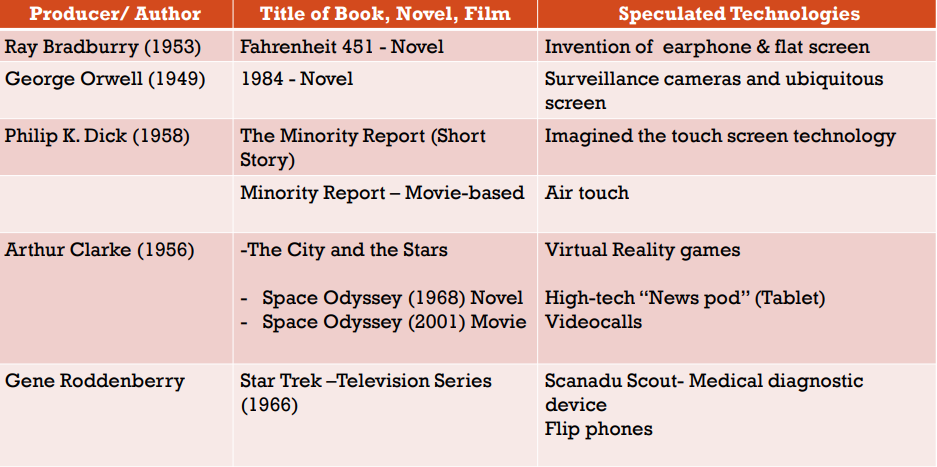
Speculative Technologies in Science Fiction Narratives