6: Prims .
 Call Kai
 Learn
Learn Practice Test
 Spaced Repetition
 Match
Match Flashcards
 Knowt Play
1/70

There's no tags or description
Looks like no tags are added yet.
Name | Mastery | Learn | Test | Matching | Spaced | Call with Kai |
|---|
No analytics yet
Send a link to your students to track their progress
71 Terms
why do we prescribe prism
to help a patient with heterophoria-
to correct fixation disparity
to reduce double vision in some types of heterotropia
to help with convergence insufficiency - headahces until double vision
to enalbe single binocular vision in a high power spectacle magnifier
if seeing double vision, prism is used to move the images until can see single binocular vision
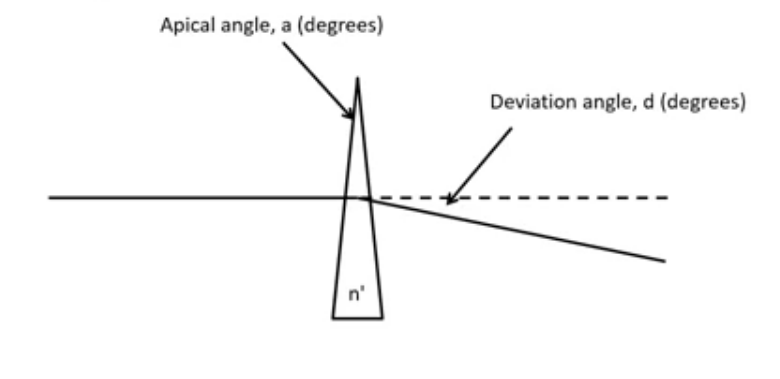
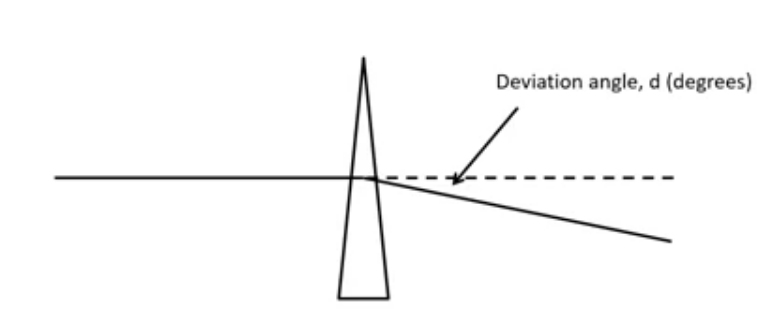
cross sectional view through a prism
made from certain refractive material n’deviates light by certain angle- d
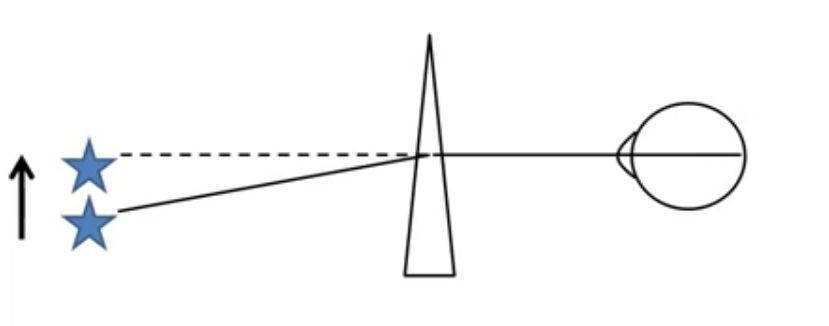
effect on image position when looking through a prism
prisms deviate light towarda the base
the image appears to move towards the apex of prism
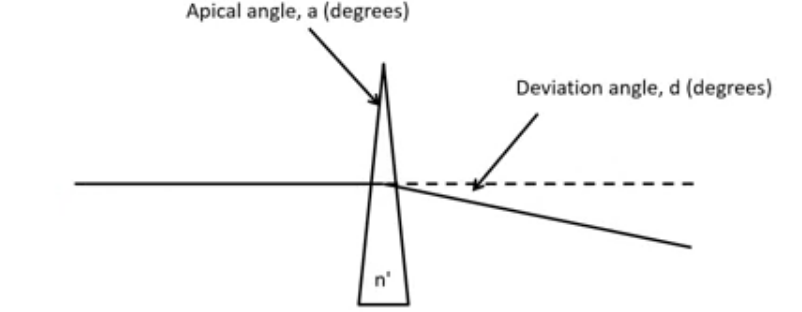
relationship between a, d , and n’
Deviation angle= (n’-1)a
equation useful for prsims where apical angle is 10 degrees or less
e.g a prism made from crown glass n’ = 1.523 with an a[ical angle of 10 degrees
d= (1.523-1) x 10 = 5.23 degrees
to work out eact deviation angle can use snells law
a prims made from a material of refractive index 1.523 has an apical angle of 2 desgrees. what is the deviation angle of the prism
deviation angle = (n’-1) a
(1.523-1) x 2 = 1.046
1.005 degrees
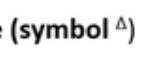
the prism dioptre
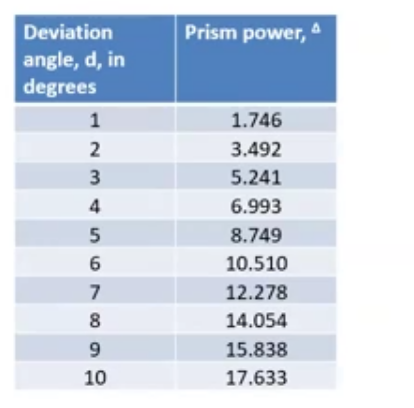
can convert from deviation angle to prism power in dioptres
a prism power of 1 will deviate light by 1 unit at a distance of 100 units, e.g 1cm deviation at 1 metre
prism power = 100 x tan x d
prism dioptre calculations
e.g deviation angle is 2 degrees
prism power = 100 x tan(2)
prism power= 3.49
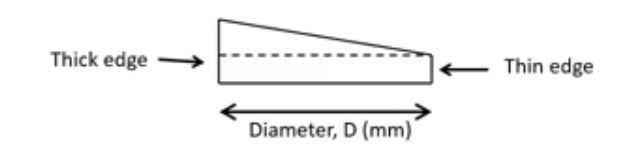
thickness of different prisms
gives the relationship between the thin and thick edges of a prism of given power, diameter and refarctive index - the workshop prism formula
another way of calculating prism power
prims thickness difference mm, g = thick egde - thin edge
P = prism power in prism dioptres
P = 100 (n’-1)g / D
g= PD / 100(n’-1)
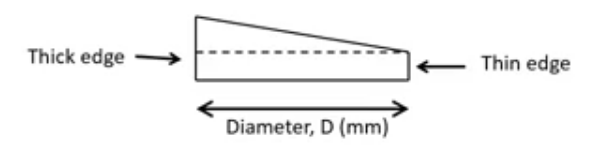
worked example of thickness difference in prisms:
calculate the power P of a prism of 38 mm diameter made from opthalmic crown glass (n’ = 1.523) with a thinn edge of 3mm and a thick edge of 7mm
prism thickness difference, g = 7-3 = 4mm
P = 100(n’-1)g / D
P= 100 x (1.523-1) x 4 / 38
P = 5.51
calculate the prism thick ness difference , g of a 4 prism power of a 38mm diameter made from opthalmic crown glass of 1.523
g= PD / 100(n’-1)
g= 4 × 38 / 100(1.523 - 1)
g = 2.91 mm
so if the thin edge was 2mm the thick edge would be 4.91 mm
form of opthalmic prisms
can be produced in a curved meniscus form
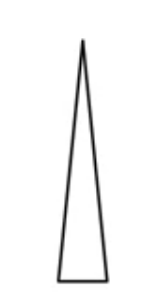
form of opthalmic prisms - prism in a flat form
these are generally trial case prisms and prism bar elements
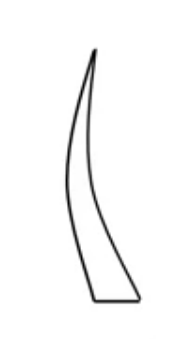
form of opthalmic prisms = curved form
this is the sort of prism that would be incorporated into the spectacle lens
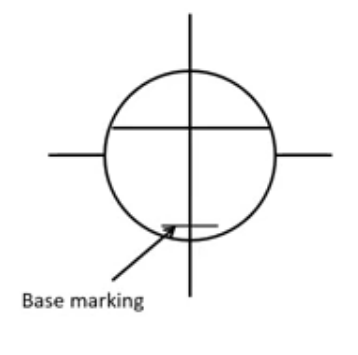
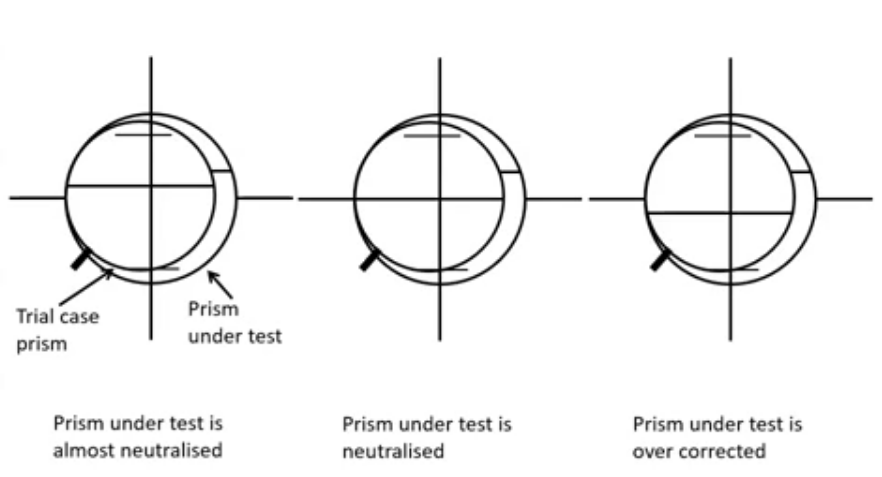
measurement of prismatic power : hand neutralisation
whats done when we look through a trial case prism of known power
prism on top of cross, and seen that the horizontal line has been pushed away from base marking towards th apex
vertical line is unchanged
if horizontal line moves i mens the vertical displacement occured
usully only see horizontal line moving in base up or base down when prisms base is oreintated vertically
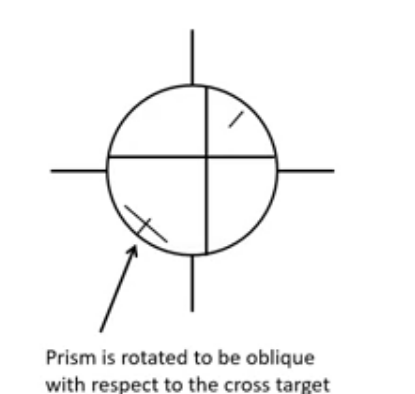
prims rotated it to be oblique
base apex line is along the 45 degree marking
horizontal and vertical line displaced
hand neutralisation
we can hand neutralsie a prism by having a set of known powered prisms ad placing them over unknown prism until there is no displacement
base up down : vertical prism
vertical displacement occurs so horizontal line moves
base in out ; horizontal prism
horizontal displacement occurs so the vertical line moves
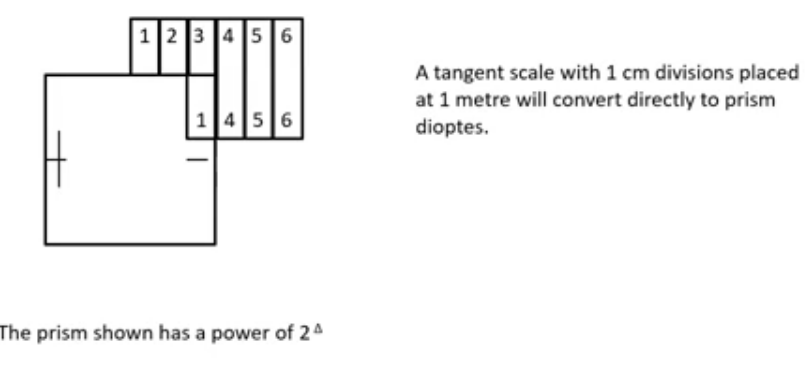
tangent scale- measurement of prismatic power
a scale placed some distance from the prism under test
displacement of the markings on a tangent scale indicates the prism power
see how much displacement
prism measurement by focimetry
an eye piece focimeter contains an astronomical telescope. this inverts the image, so base down prism will move the image in the eyepeice downwards, nnot upwards
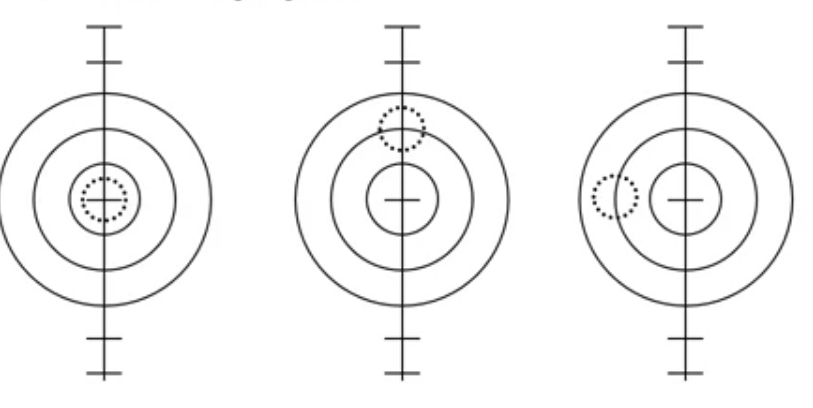
first image shows no displacement
in second image, ring is upwards, so it would be base UP, has 2 prism dioptres
final image shows horizontal prism, its 2 prism dioptres
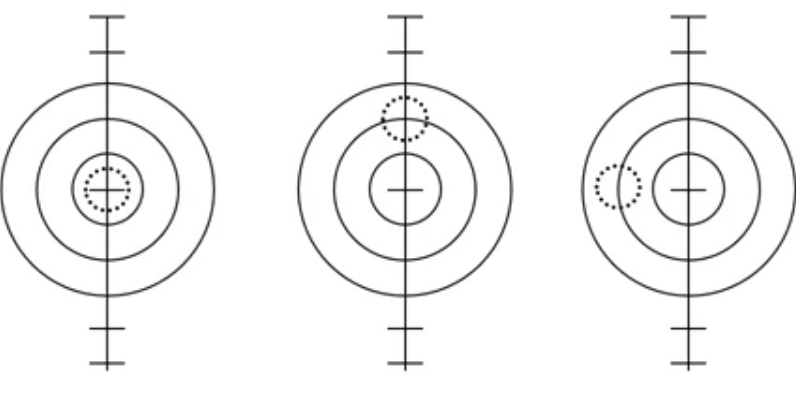
HORIZONTAL prism
on image on right, if dealing with a right eye it would be 2 prism dioptres base OUT
if left eye, it would be 2 prism dioptres base IN
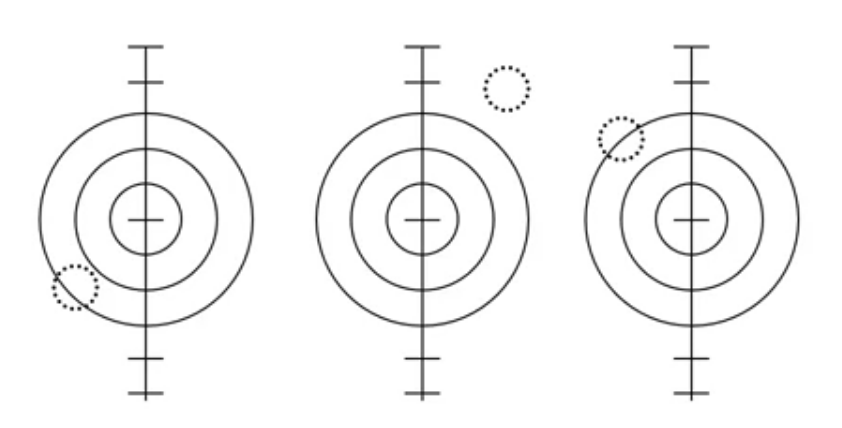
all right eyes
draw line from middle of target and see where it meets the ring
for 1. just more than 2 prism dioptres base DOWN , and 2 prism dioptres base OUT
4 prism dioptres base up, 3 dioptres base IN
2.5 prism dioptres base UP, 2 base OUT
prism measurement by focimetry- use of loose trial case prisms
prim thinning used on vary focal lenses even if prism is not neede d
loose trial case prims can be placed into the optical path of focimeter to move the image of the target to a more convenient location
e.g to centre the image in a progressive addition lens with prims thinnning
prism thinning affs ase down to a PAL
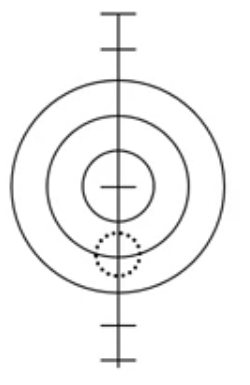
prism thinning
if a lot of prism thinning is needed a trial case prism is used to neutralise the thinning so an accurate measurement can be made
example in picture shows 2 base down; a normal value for prism thinnng in a progressive addition lens
a prism compensator sits behind focimeter telescope and can dial up howveer much prism you want. used to also centre the image
why do we use prism thinning for those who dont have prism
when making progressive lenses, the lens is thicker at the bottom becase the near vision part adds more curvature , hich can make it look thicker and hevaier at bottom
by adding small equal amounts of base down prim the optical cenre is slightly shifted to reuce thickness difference
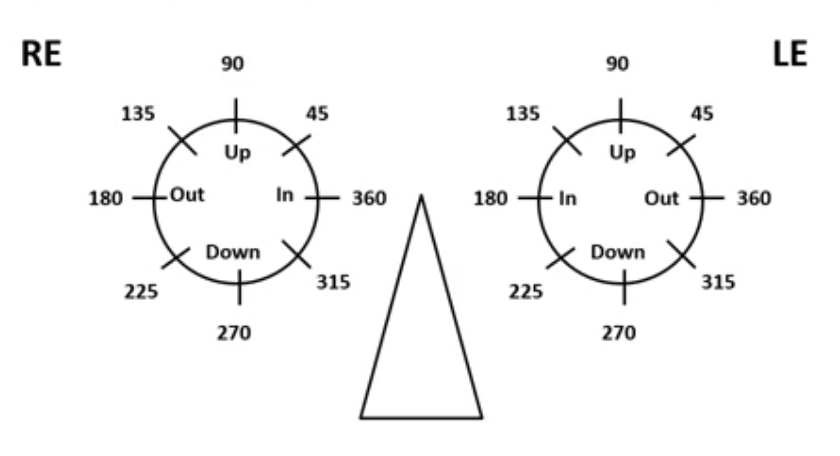
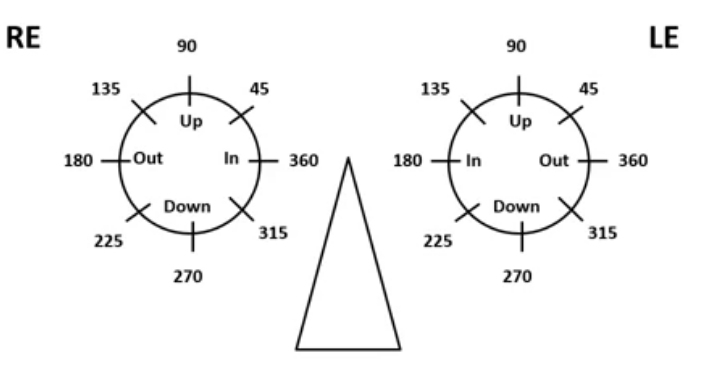
standard notation for base oreintation
triangle should be patients nose
base ou tin the RE would have an axis notation of 180 degrees, and base out for the ledt eye would be 360 degrees
how do we provide prism in a spectacle lens?
prism power can be induced into a single vision lens by:
working the prismatic element into the lens (worked prism)- forming a wedge onto lens. only done if cant decentre
by decentering the lens - moving optical centre to another position
the lens has to have a sufficient refractive power for this to be possible
what are the reasons why we cant decentre the lenses
if its a vary focal or bi focal
if its aspheric
or if theres not enough refractive power in the lens to achieve the amount of prism u want
effect of decentration of an opthalmic lens
when a patient looks through a point other than the optical centre of the lens, a degree of prismatic power will be induced as light rays bend , prentices rule can be used to calculate this
opictal centre- point where light passes undeviated
minus lens (concave) decentration effect
iif optical centre i sin the mddle
if the pateint looks upward, theyrenow looking through the upper part of the lens which acts like a base up prism
this means image is shifted downward toward the apex
prentices rule
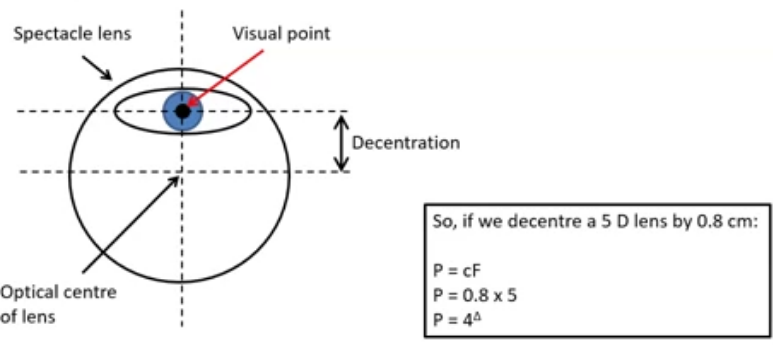
P = cF
primsatic power is equal to the decentration x refractive power of lens in that meridian
c is measured in cm
decentration- where the lens is moved
lens is moved downwards by 0.8cm
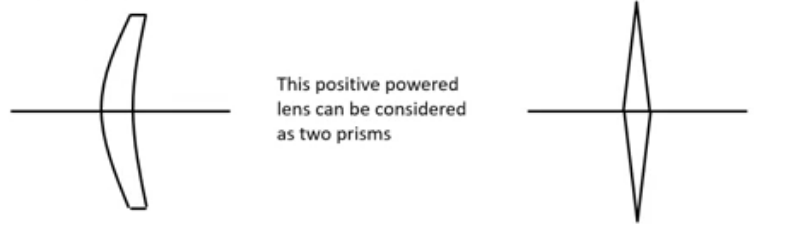
base direction of positive lens
this lens is 2 prisms with the bases together
base down and out are positive
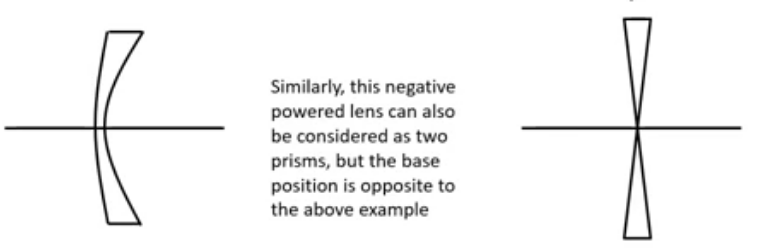
base direction of negative lenses
considered as 2 prisms but their bases are opposite, instead their apexes are together
base up and in are negative
applies to decentration and base direction from calculation
prism is toward the apex opposite the decentration
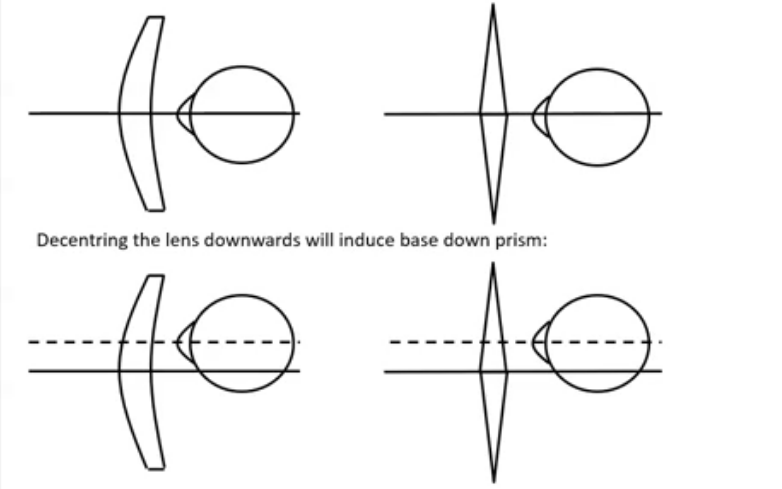
decentering a positive power lens
if we decentre the positive lens
should induce a base down prism
upper part of positive len behaves as a base down
lower part of the lens behaves like base up
apex of prism goes down which is base down prism
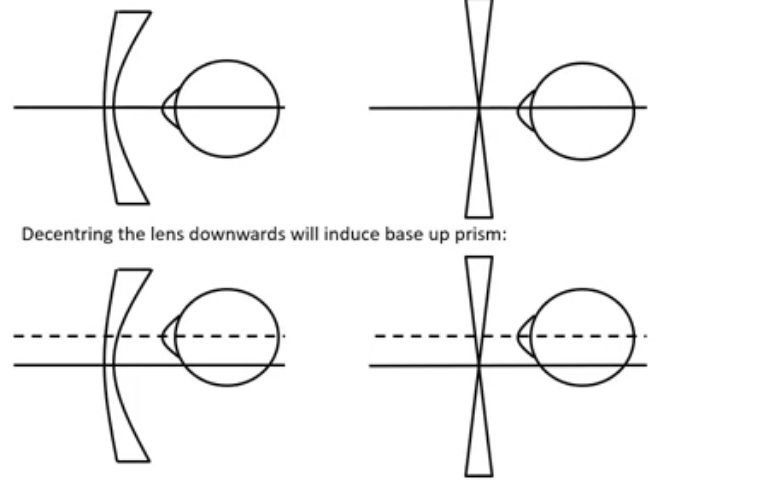
decentering a negative lens
will induce a base up prism
since the lens is moved downward, eye is looking through the upper part
rays entering the eye are deviated downwards so image is upward on the retina, making it base up
positive lenses and relationship to direction in prism
decetering a lens in a given direction moves the base of the prism in that direction
eg upwards decentration gives base up inwards decenteration gives base in
out decentration gives base out
negative powered lenses and relationship to direction in prism
decentering a lens in a given direction moves base of prism in opposite direction
eg
upwards decentrartion gives base down
horizontal prism
positive = base out
minus = base in
vertical prism
positive = base down
minus = base up
decentering: R +2.00 / -4.00 × 180
decentering this lens inwards gives a base in prism
decentering the prism upwards induces base down prism as in the meridian the power is -2
prismatic effect of cylindrical and sphero cylindrical lenses
prismatic effects due to decentration of cylindrical and sphero cylindrical lenses requires careful consideration
plano / -3.00 × 180
decentering this lens vertically will induce prism according to prentices rule
decentering the lens horizontally i.e along the axis of the cylinder , will induce no prism as F is plano along horizontal line
decentering this lens along some other orientation will induce prism power,
+4.00 / -1.00 × 180
determine cross cyl of the lens
F in vertical meridian = +3.00
F in horizontal meridian = +4.00
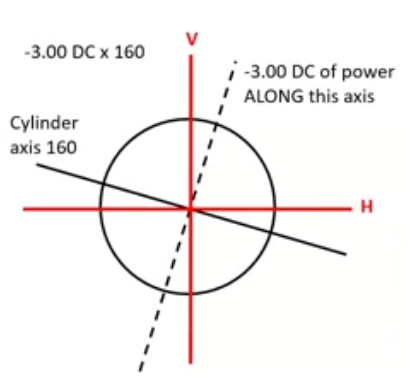
working out prisms for cylinder axes that are not 90 or 180 ; oblique cylinders
e.g decentering plano / -3.00 × 160 horiznotally or vertically
-3.00 acts along 70
if this lens was decentred vertically, a smaller vertical prismatic effect than -3.00 decentration will be induced
a horizontal prismatic effect will also be induced
prismatic effect of a decentred sphero cylindrical lens
calculates how much prism youre getting horizontally and vertically when cyls are not 90 or 180
out is plus, in is minus
xS is prentices rule
first part of formula is for cylinder as its not on its principal meridian
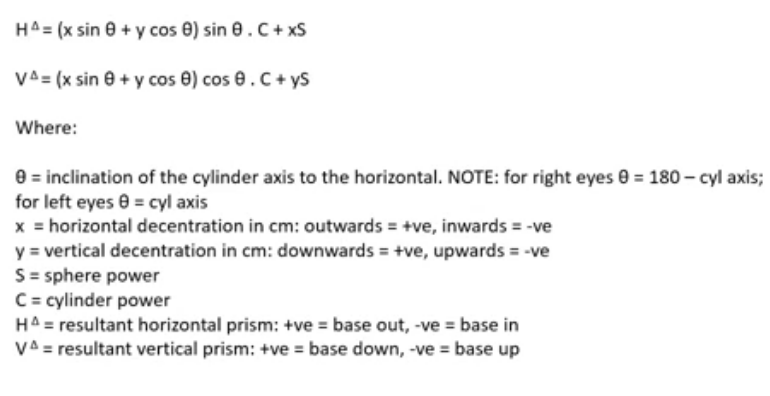
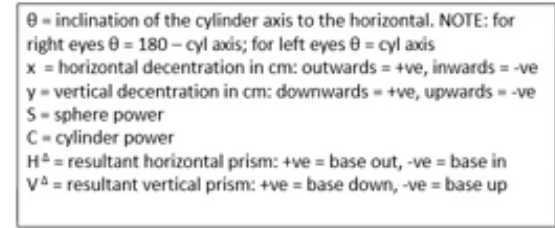
worked example- consider R: +4.00 / -1.00 × 5 decentered upwards by 2cm ad out by 1.5cm. calculate induced prism
horizontal prism:
feta for right eye will be 180- cyl axis = 180 -5 = 175
x = +1.5 and y is -2H = (1.5 x sin 175 + (-2) x cos 175) sin 175 x (-1) + 1.5 × 4.00
H = +5.81
as positive horizontal its base out so its 5.81 base out
roughly similar to the power along horizontal axis (4)
so to see if correct use 4 × 1.5 = 6 which is close enough to 5.81

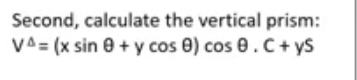
R +4.00 / -1.00 × 5 decentred upwards by 2cm and outwards by 1.5cm. calculate induced prims of vertical prism
S= +4.00
C= -1.00
feta = 180 - 5 = 175 as its a right lens
x= +1.5 y = -2
(1.5 x sin 175 + (-2) x cos 175 x (-1.00) + (-2) x 4.00
V = -5.88
minus vertical so base up
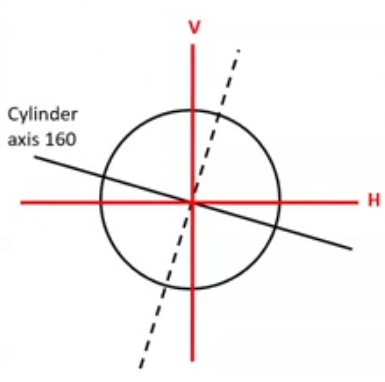
prismatic effects of oblique cylinders
displaced vertically
so biggest prismatic effect is verticallu, only some horizontal is induced
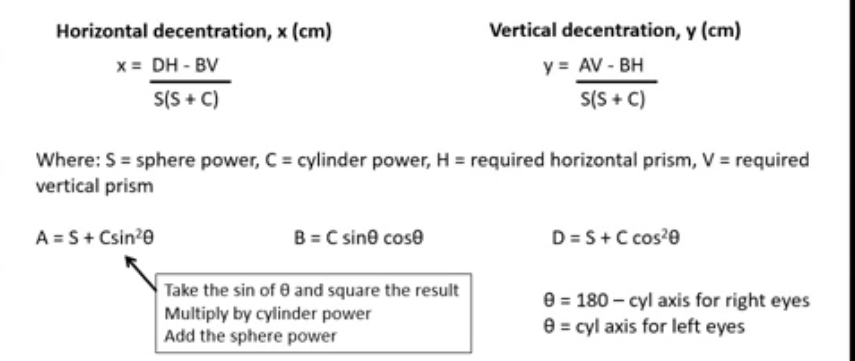
working out how much decentration is needed for a given prism power, for when cylinder axis is not at 90 or 180
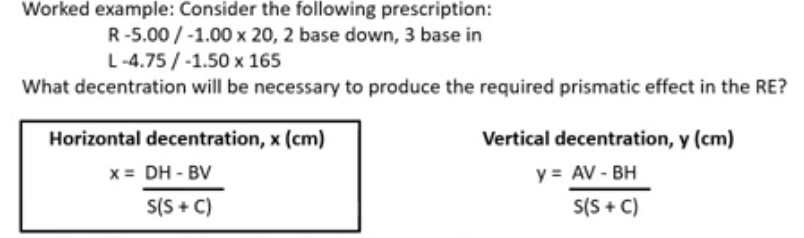
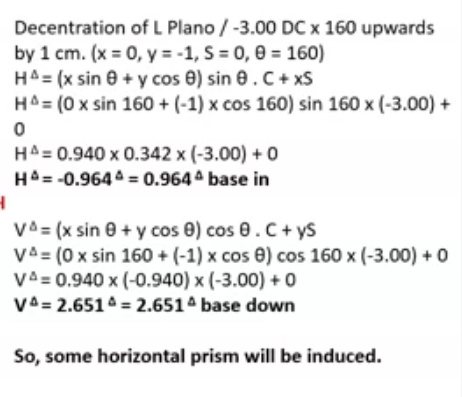
worked example numer 1 for horizontal
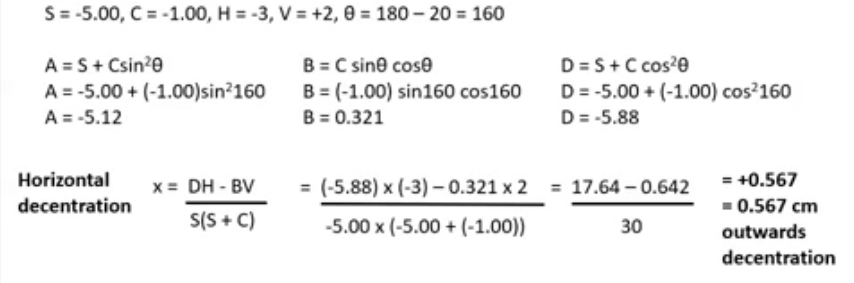
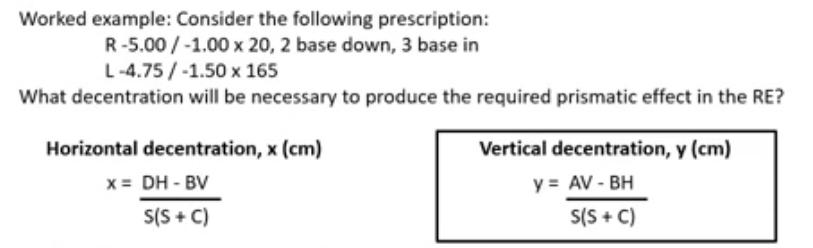
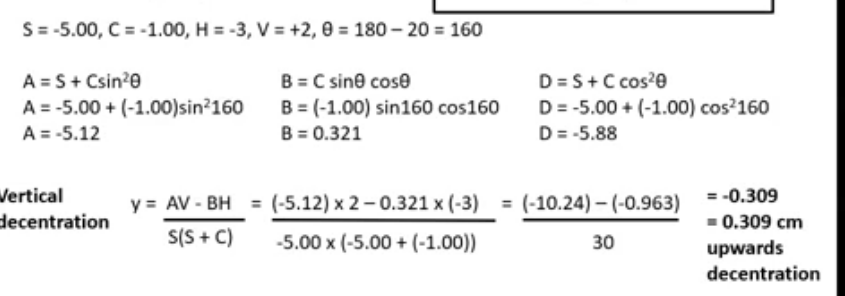
worked example number 1 vertical
upwards decentration givees base down prism
prismatic effects of complete spectacles
for higher prescriptions, tilt of a spectacle frame can induce significant amounts of unwanted prism, leading to vertical diplopia
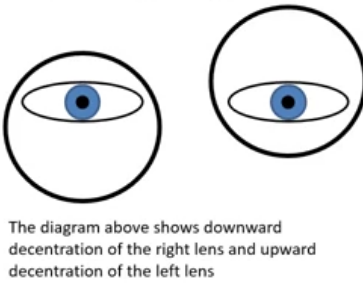
consider a patient with R -10.00 DS, L -10.00 DS. Their frame is bent accidnetly resulting in upwards decentration of the right lens by 3mm and downwards deventration of left lens by 3mm
calculate the prismatic effect
P = cF
0.3 x -10.00 = 3 base down for the right eye, and 3 prism power base up for the left eye
vertical differential prism = 6
yhis would most likely produce vertical diplopia
consider a patient with R +2.00 DS and L +1.50 DS
the frame is bent, resulting in decentration of the right lens upwards by 3mm and decentration of L lens downwards by 3mm. calculate the vertical prismatic effect
P = cF
RE = 0.3 × 2 = 0.6 base up
LE = 0.3 × 1.5 = 1.05 base down
total vertical prismatic effect = 0.6 + 0.45 = 1.05
dividing prism ; how prism is prescribed when dispensing
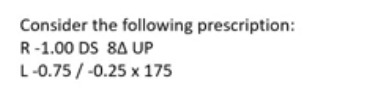
if all prism is in the right eye it would look very thick at the bottom as 8 up
right lens will be heavier than left
prism power can be divided between the eyes to even out the wight and cosmetic appearance of the 2 lenses
solution could be:
R -1.00 DS 4 base up
L -0.75/ -0.25 × 175 4 base down
rules for dividing prism
for vertical prism the opposite of base up in one eye is base down in the fellow eye
for horizontal prism the opposite of base out in one eye is base out in the fellow eye
examples of dividing prism
R = -2.00 DS 4 base IN
L= -1.75 / -0.25 × 15
could divide the prism as:
R -2.00 2 base IN
L -1.75/-0.25 × 15 2 base IN
know its horizontal as its base in ; can be base in or out for horizontal
split: R -2.00
L -1.75 / -0.25 × 15 4 base up
divided by
R -2.00 2 base down
L -1.75 /-0.25 × 15 2 base up
vertical as up; can be up down for vertical
R -2.00 DS 4 base IN 6 base UP
L -1.75 /-0.25 × 15
split prism
R -2.00 DS 2 base IN 3 base UP
L -1.75 / -0.25 × 15 2 base IN 3 base DOWN
R -2.00 DS 10 base DOWN
L -1.75 / -0.25 × 15 6 base OUT
split prism
R -2.00 DS 3 base OUT 5 base DOWN
L -1.75/-0.25 × 15 3 base OUT 5 base UP
compounding prism power
horizontal and vertical prism can be combined into a single value, with the base direction specified using a protractor scale and standard notation
compounding prism power:
R +0.50 DS 4 base IN 3 base UP
L +0.75 /-0.25 ×90
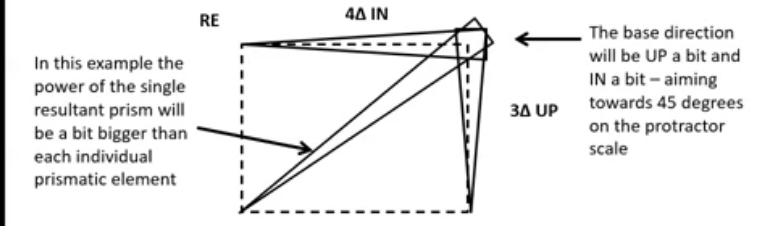
the prismatic power in the right eye can be compounded from a horizontal and vertical element into a single prismatic component , as follows:
single power prism will be the hypotenuese of the triangle
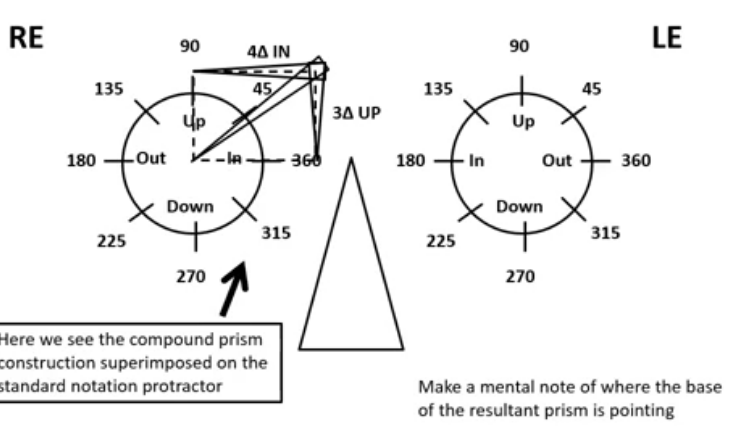
identifying base direction using prottractor scale; from prev flashcard
axis pointing to 45
makes sense as 45 for right eye is up and in
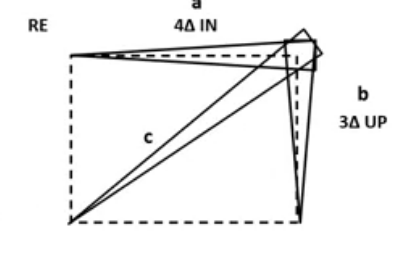
calculating exact resultant power and base direction
a² + b² =c²
so c = square root of 4² +3² = 5 compound prism dioptre
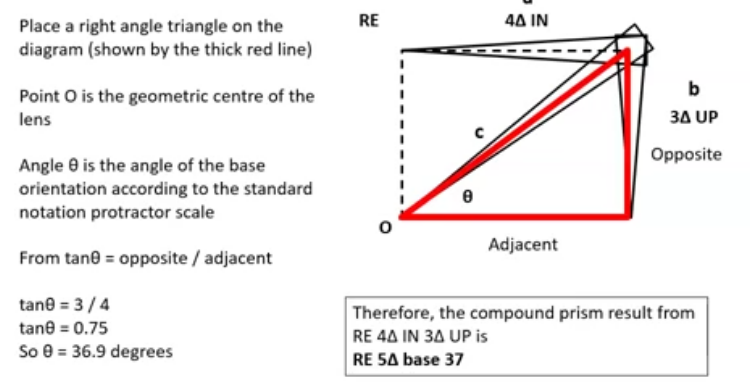
to work out angle
place a right angle triangle on the diagram
point O is the geometric centre of lens
angle is the angle of base oreintatino
from tan feta = opposite / adjacent ( can use sOH cAH tOA)
= ¾
so feta is 36.9 degrees
another compound prism:
R +0.50 DS
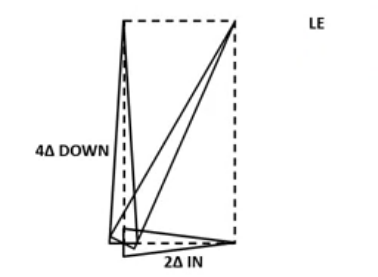
L +0.27 /-0.25 × 90 2 base IN 4 base DOWN
a² + b² = c²
c²= 4² + 2² ; square root
= 4.47
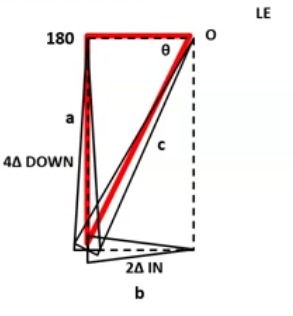
tan = opp /adjacent
= 4/2 = 2
63.4 degrees
axis is 180 + 63= 240 degrees
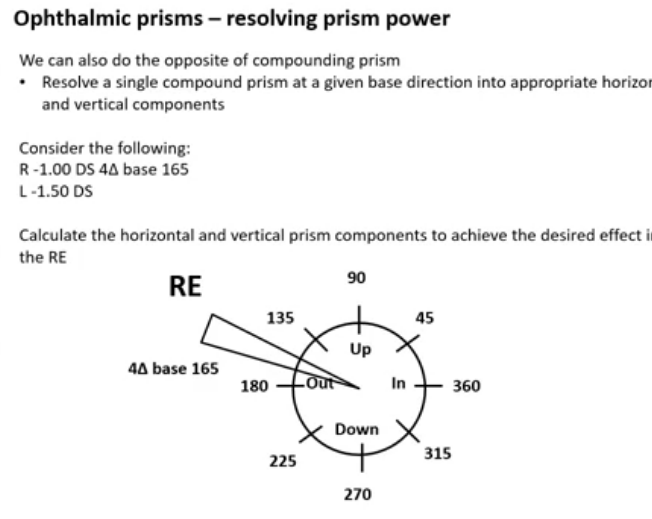
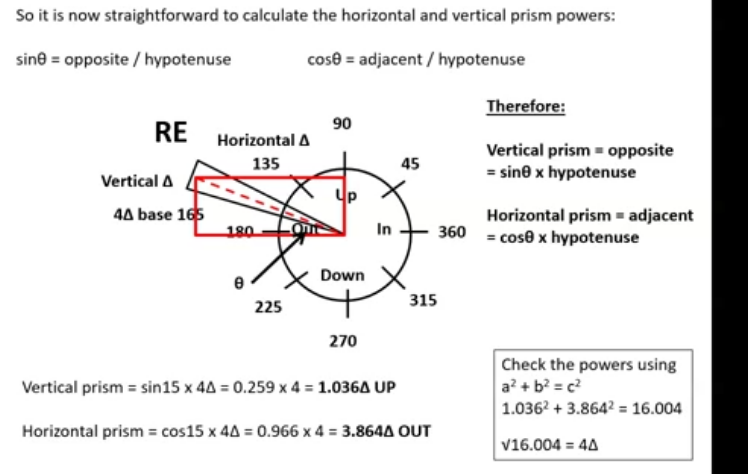
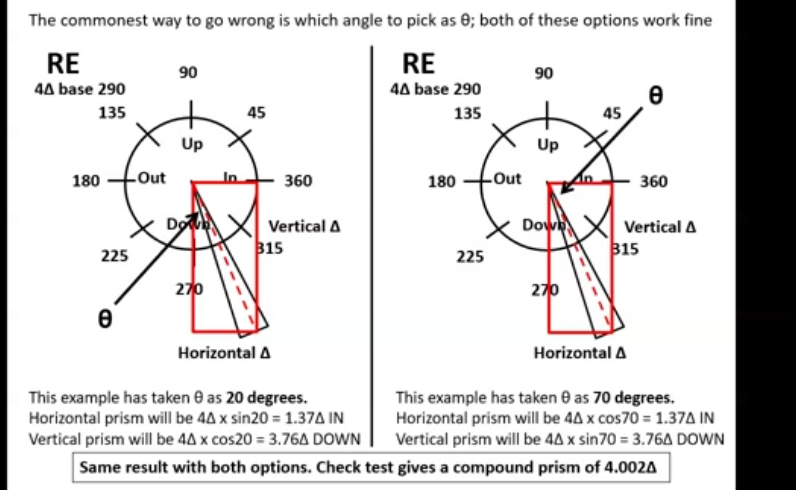
resolving prism power
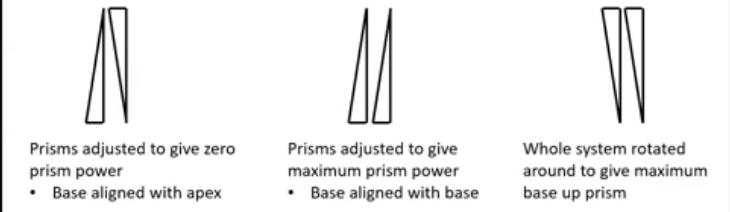
rotary prism
found on phoropters
reffered to risley prims
device contains 2 prismatics elements of equal power
allows individual prisms to contra rotate to eachother as a wheel is turned
the whole arrangement van be rotated about the optical axis of the phoropter to alter base setting

fresnel prism
a special type of prism, formed from lots of little prisms made in a sheet
usually made from flexible plastic sheet. they can be cut t osize with scissors and stuck to the front surface of spectacle lens
temporary prism correction if someone for example has a stroke
good for those with large prismatic corrections,