Biology Unit 9 Biotechnology IHS Skavaril
 Call Kai
 Learn
Learn Practice Test
 Spaced Repetition
 Match
Match Flashcards
 Knowt Play
1/42

There's no tags or description
Looks like no tags are added yet.
Name | Mastery | Learn | Test | Matching | Spaced | Call with Kai |
|---|
No analytics yet
Send a link to your students to track their progress
43 Terms
DNA sequencing
Process used to determine the order of nucleic acids in DNA
The four step of the Sanger Method of DNA sequencing
Cut
Copy
Sort
Read
What type of macromolecule do scientists use to complete Step 1 of the Sanger method
Restriction enzymes
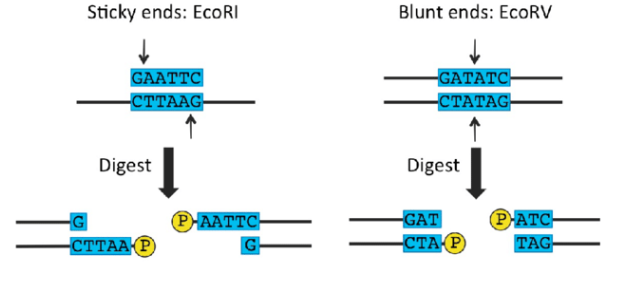
What are the two types of cut restriction enzymes can make in DNA
Blunt ends and sticky ends
What is the mass of the average DNA sample taken from humans
1-10 nanograms
What is the mass of DNA needed for Sanger sequencing
1000 nanograms
What is the process used to complete Step 2 of the Sanger Method
Polymerase chain reaction (PCR)
What are the four substrates needed for PCR
DNA (to copy wanted DNA)
Primers (to mark the starting line)
DNA polymerase enzymes (to make the DNA)
Nucleotides (the building blocks)
How many copies of DNA are made after 1 PCR cycle
2
Equation: 2ᕽ (x = the amount of PCR cycles)
What is the process used to complete Step 3 of the Sanger Method
Gel electrophoresis
What electric charge does DNA segments have
Slightly negative
What direction does DNA segments move in the gel
To the positive end
How can you tell what DNA fragment is the longest/shortest
The shorter pieces are further down the positive end of the gel
How to read sequence of the DNA fragment made during PCR
Read from shortest DNA strand to longest
Sequence of original DNA fragment is the complement of the read DNA
Selective breeding
A way to make sure desired trats are passed down to the next generation
e.g. dogs: same ancestors (wolves) but bred for specific traits
Hybridization
Type of selective breeding; when humans bred 2 things together to get the best traits of each.
e.g. mules: cross of horse and donkey
Inbreeding
Type of selective breeding; once a trait has been identified, they breed within the family to keep the traits
e.g. pugs: small, flat nose
Recombinant DNA
Taking a gene from one organism and inserting it into another organism
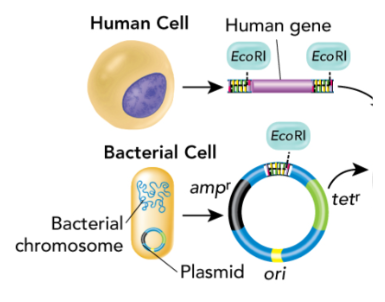
Plasmids
Circular DNA molecules in bacteria that only code for a few proteins
Why is it necessary to cut the gene to be inserted and the plasmid with the same restriction enzyme
So they have the same sticky ends so the actual gene can be inserted into bacteria
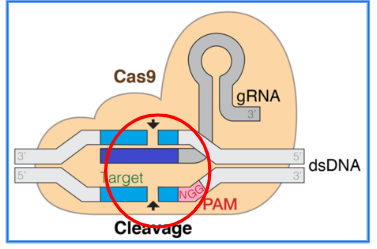
CRISPR
Direct gene editing in organism’s genome
An enzyme cuts the DNA → DNA can be changed
When certain bacteria are attacked by a virus, they incorporate part of the invader's DNA into their own, allowing them to create specialized molecules that humans can harness
4 applications of biotechnology
Genetically modified organisms (GMO)
Clones
DNA finger printing (forensics)
Gene therapy
Gene therapy
Correcting the underlying genetic conditions to treat a disease
Cloning
Process of making an exact copy of an organism
The 5 steps of cloning
Remove egg from donor
Remove nucleus from egg
Take nucleus out of somatic (body) cell
Insert somatic nucleus into egg cell
Implant egg back into donor
Restriction enzymes
Enzymes that cut and destroys foreign DNA
How many bases are in the human genome
6 billion
Research efforts that resulted from the Human Genome Project
Sharing of scientific data
Sanger sequencing & gel electrophoresis
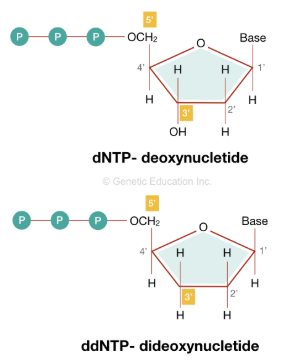
How do we know when ddNTPs stop DNA replication
With a bright fluorescent light (it glows)
What is used in Sanger sequencing
Scientists use a mix of regular nucleotides and dideoxynucleotides (ddNTPs)
Describe how people increase genetic variation
Sexual reproduction or controlled mating of organisms
Describe how scientists copy the DNA of living organisms
Polymerase Chain Reaction, plasmids in bacteria
Describe the use of recombinant DNA
Can be used to create more plasmids, more proteins, or injected into other organisms
Describe how transgenic organisms are produced
Plasmid Injection
CRISPR
Describe the benefits of genetic engineering for agriculture and industry
Increase in yield (plant grown), disease resistant, pesticide resistant = more food for more people
Describe how biotechnology can improve human health
Gene therapy
Describe how DNA is used to identify individuals
DNA fingerprinting
Describe ethical issues with biotechnology
How far do we take this technology?
If we discover a cure to a disease, do we charge for it? What is a human life worth?
Ex: Designer Babies. Who decides what is right or in fashion? Who decides access to these technologies?
The four reagents that must be added to the reaction mixture in Sanger sequencing
Template DNA
dNTPs
ddNTPs
DNA polymerase
When would a scientist want to use polymerase chain reaction (PCR) before they analyze a DNA sample
When only a small amount of DNA is available
When gene therapy is successful, how does it treat the disorder
By replacing a faulty gene with a normal gene in the human genome
The CRISPR system allows biologists to alter the nucleotide sequence of specific genes. What task could theoretically be achieved by applying the CRISPR system
Transferring a gene from one organism to another
Transgenic
Organisms that contain genes from a different species