AIS Exam 1 (Chapter 4 & 5)
 Call Kai
 Learn
Learn Practice Test
 Spaced Repetition
 Match
Match Flashcards
 Knowt Play
1/30

There's no tags or description
Looks like no tags are added yet.
Name | Mastery | Learn | Test | Matching | Spaced | Call with Kai |
|---|
No analytics yet
Send a link to your students to track their progress
31 Terms
Changing Roles of Accountants
Past - Focus on stewardship & reporting, prep. financial reports, auditing
Present - Help enterprises optimize processes, achieve competitive advantage, max S/H value
Business Process
Defined sequence of business activities that use resources to transform specific inputs into specific outputs to achieve a business goal
Business Analysis
The process of defining business process requirements and evaluating potential improvements
Business Model
A simple abstract representation of one or more business processes
Documentation
Explains how business processes and business systems work; a tool for information transmission and communication
Sarbanes-Oxley Act of 2002
Made documentation required for businesses.
Required managers to assess and attest business’s IC structure and procedures.
Required external auditors to audit mgnt’s assessment of effectiveness of IC & express opinion of company’s ICFR
Activity Model
Represent the sequential flow and control logic of a set of related activities.
Business Process Model and Notation (BPMN)
Model designed to show business processes
What makes a good BPMN?
Correct, Clear, Complete, Consistent
Activities
Describes an action being taken

Sequence Flow
Progression of activity within the process

Gateways
Shows process branching and merging as a result of a decision

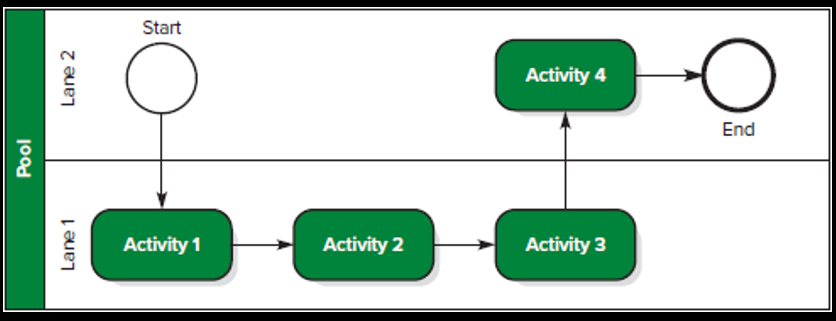
Pools and Lanes
Pools - Shows the organization as a whole
Lanes - Shows departments or functional area within the org.
Flow can cross through lanes
Message Flow
Exchanges between two different pools. (Token doesn’t flow through message flows)

Exclusive Gateway
Only one path can be taken (this or that)

Inclusive Gateway
One or more paths can be taken (this, that, or both)

Parallel Gateway
All paths must be taken (this and that)

Intermediate Timer Event
Indicates delay in process flow until specific time, date, or period

Intermediate Error Event
Indicates alternative flow when an error occurs

Steps to Prepare BPMN
Purpose
Context
Basic Process Flow
Activities
Decompose (if necessary)
Validate
Structure Model
Describe the data and information structures inherent in a business process
Unified Modeling Language (UML)
Class diagrams describe the logical structure of a database system
Classes
Separately identifiable collections of things about which the organization wants to collect and store information
Associations
Depict the relationship between two classes
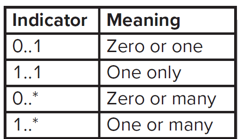
Multiplicities
Describe the minimum and maximum number of times instances of one class can be associated with instances in another class
Types of Classes
Resources (trucks, machines, buildings), Persons/Agents (customers, employee), Events (sales, purchase, cash receipts)
Attributes
data elements that describe the characteristics of instances in a class
Primary Keys
An attribute or combination of attributes that uniquely identifies each instance in a class or row in a table
Foreign Keys
An attribute or combination of attributes that allows tables to be linked together
Linking Table
Connects a many-to-many association to utilize multiple primary & foreign keys
Internal Controls
Prevent problems, detection of problems that arises, correction of errors & related losses