netty 12
 Call Kai
 Learn
Learn Practice Test
 Spaced Repetition
 Match
Match Flashcards
 Knowt Play
1/64

There's no tags or description
Looks like no tags are added yet.
Name | Mastery | Learn | Test | Matching | Spaced | Call with Kai |
|---|
No analytics yet
Send a link to your students to track their progress
65 Terms
802.11
Specifications developed by IEEE for wireless networking over microwave radio transmission in the 2.4 GHz, 5 GHz, and 6 GHz frequency bands.
six main iterations:
a, b, g, Wi-Fi 4 (n), Wi-Fi 5 (ac), and Wi-Fi 6 (ax).
specify different modulation techniques, supported distances, and data rates, etc
csma/cd
Mechanism used by 802.11 Wi-Fi standards to cope with contention over the shared access media.
Request to Send (RTS) and Clear To Send (CTS) mechanism
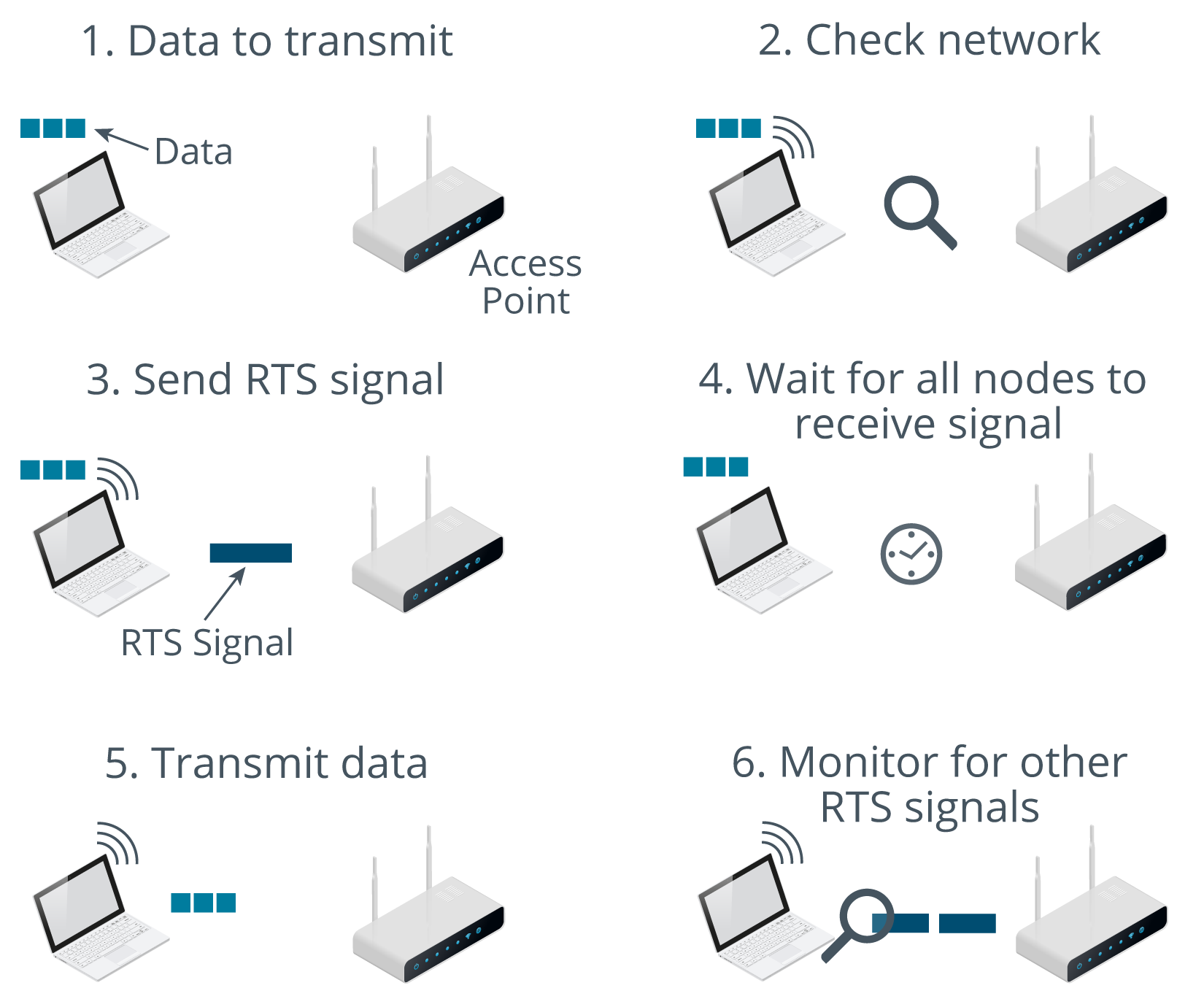
frequency band
Portion of the microwave radio-frequency spectrum in which wireless products operate, such as 2.4 GHz band or 5 GHz band.
channel
Subdivision of frequency bands used by Wi-Fi products to allow multiple networks to operate at the same location without interfering with one another.
2.4ghz
Wi-Fi has a longer range and works better through walls and solid objects. However, it has fewer channels and is often crowded with other Wi-Fi networks and devices like Bluetooth, which can cause interference and slower speeds.
band is subdivided into up to 14 channels
channels 1, 6, and 11 do not overlap in the band
5 ghz
Wi-Fi has a shorter range and does not pass through walls as well. However, it has more available channels, less interference, and usually provides faster speeds at close range.
802.11a
a standard specifies use of the 5 GHz frequency band and a multiplexed carrier scheme called Orthogonal Frequency Division Multiplexing (OFDM).
54mbps
802.11b
uses the 2.4 GHz frequency band. It was released at the same time as 802.11a.
uses a signaling method called DSSS with CCK encoding. Its maximum speed was only about 11 Mbps, which was slower than the 802.11a.
more popular because they were released faster and were adopted more widely.
802.11g
was designed as an easy upgrade from 802.11b.
It uses the faster OFDM technology like 802.11a, but it still operates on the 2.4 GHz
54mbps
802.11n
Wi-Fi standard improves speed by using multiple antennas and a technology called MIMO (Multiple Input Multiple Output).
use 2.4ghz or 5ghz
allows channel bonding
72mbps
mimo
allows several data signals to be sent and received at the same time, which increases bandwidth and performance.
The antenna setup is written in a format like 2x2:2 or 4x4:4:
The first number = transmit antennas
The second number = receive antennas
The third number = data streams that can be used at the same time
channel bonding
Capability to aggregate one or more adjacent wireless channels to increase bandwidth.
practical option only in the 5 GHz band.
802.11ac
wifi 5
designed to work only in the 5 GHz band. The 2.4 GHz band can be used for legacy standards (802.11g/n) in mixed mode.
get throughput like that of Gigabit Ethernet or better.
supports up to four stations in parallel over the 5 GHz band only mumimo
802.11ax
wifi 6
aims to approximate 10G connection speeds, significantly improving upon the throughput
uses advanced modulation and signal encoding to improve the amount of data sent per packet by about 40%.
1,148 Mbps on the 2.4 GHz radio and 4,804 over 5 GHz.
use of a new 6 GHz frequency band, which is required to achieve the highest data rates.
can support up to eight MU MIMO stations communicating in parallel across 2.4 GHz, 5 GHz, and 6 GHz bands,
mu-mimo
lets a wireless access point (AP) communicate with multiple devices at the same time using multiple antennas. This improves speed and performance, especially in crowded networks.
wifi 5/6
band steering
Feature of Wi-Fi that allows an access point to try to ensure that clients use a particular frequency band, such as 5 GHz rather than 2.4 GHz.
cellular radio
establishes a connection with the nearest available cell or base station. Each base station has an effective range of up to 5 miles (8 km). The base station links the device to global telecommunications networks.
lte
Packet data communications specification providing an upgrade path for both GSM and CDMA cellular networks.
150 Mbps in theory, but around 20 Mbps is typical of real-world performance.
5g
Rather than a single large antenna serving a large wireless cell, involves installing hundreds of smaller antennae to form massive MIMO.
20 gbps theoretical
satellite
System of microwave transmissions where orbital satellites relay signals between terrestrial receivers or other orbital satellites.
internet connectivity is enabled through a reception antenna connected to the PC or network through a DVB-S modem.
leo
satellites support better bandwidth (around 70–100 Mbps at the time of writing) and are lower latency (100–200 ms RTT).
satellites move relative to the surface of Earth. The customer's premises antenna must be provisioned with a motor so that it can periodically realign with the array.
ssid
A character string that identifies a particular wireless LAN (WLAN).
bssid
MAC address of an access point supporting a basic service area.
bss (basic service set)
AP mediates communications between client devices using a specific frequency and channel
ess (extended service se)
Network name configured on multiple access points to form an extended service area.
Each BSS uses a different channel within each frequency band. When deployed like this, the network name is more properly called an Extended SSID
wifi range
indoor range of at least 30 m (100 feet). 2.4 GHz radios support better ranges than 5 GHz ones, and 802.11n
rssi
is the strength of the signal from the transmitter as measured at the client end.
Signal strength as measured at the receiver, using either decibel units or an index value.
values closer to zero representing better performance. -30 dBm is considered to be a perfect signal.
snr
comparative strength of the data signal to the background noise is called the signal-to-noise ratio
wireless survey
Documentation about a location for the purposes of building an ideal wireless infrastructure; it often contains optimum locations for wireless antenna and access point placement to provide the required coverage for clients and identify sources of interference.
roam
means that wireless clients can remain connected to the same network ESSID while moving around within an extended service area (ESA).
ds (distribution system)
Connecting access points to a switched network via cabling to facilitate roaming within an extended service area (ESA). A wireless distribution system uses a access points configured in repeater mode to facilitate roaming.
wireless controller
Device that provides wireless LAN management for multiple APs.
ap
a hardware device that bridges a wired local area network (LAN) with Wi-Fi devices
autonomous: firmware contains enough processing logic to be able to handle clients without the use of a wireless controller
lightweight:requires a wireless controller in order to function. cisco
antenna type
Specially arranged metal wires that can send and receive radio signals
omnidirectional: receives and sends signals in all directions more or less equally
unidirectional: focused in a single direction. Both the sender and receiver must use directional antennae
beamwidth: indicates the amount of directionality and is measured in degrees. A smaller beamwidth means the antenna is more directional, requiring more precise alignment.
polarization
refers to the orientation of the wave propagating from the antenna.
ibss
A type of wireless network where connected devices communicate directly with each other instead of over an established medium.
does not require an access point.
ad hoc topology, ex: shared printer
wmn (wireless mesh network)
Wireless network topology where all nodes—including client stations—are capable of providing forwarding and path discovery. This improves coverage and throughput compared to using just fixed access points and extenders.
foms mbss/mesh basic service set
point to point
usually used as a means of bridging two locations when it is not possible to connect them using cables.
establish a logical and physical connection between two devices
ad hoc
networks are direct connections between devices without an intermediary access point, less common for general Wi-Fi use.
infrastructure network
most common Wi-Fi setup, where devices connect through an access point. This setup provides a centralized point for data transmission and allows for greater range and connectivity options compared to other types.
wpa (wifi protected access)
Standards for authenticating and encrypting access to Wi-Fi networks.
uses the RC4 stream cipher to encrypt traffic but adds a mechanism called the Temporal Key Integrity Protocol (TKIP) to try to mitigate the various attacks against WEP that had been developed.
wpa2
AES cipher places RC4, and CCMP replaces TKIP.
CCMP provides authenticated encryption, which is designed to make replay attacks harder.
sae (simultaneous authentication of equals)
Personal authentication mechanism for Wi-Fi networks introduced with WPA3 to address vulnerabilities in the WPA-PSK method.
WPA3
AES GCMP replaces AES CCMP
Management frames are used for association and authentication and for disassociation and deauthentication messages as devices join and leave the network.
encrypts opne wifi
psk
A wireless network authentication mode where a passphrase-based mechanism is used to allow group authentication to a wireless network. The passphrase is used to derive an encryption key.
wpa2
enterprise authentication
A wireless network authentication mode where the access point acts as pass-through for credentials that are verified by an AAA server.
personal authentication
wireless network authentication
WPA2-Personal and WPA3-SAE ( WPA2-PSK and WPA3-Personal)
open authentication
Wireless network authentication mode where guest (unauthenticated) access is permitted.
byod
Security framework and tools to facilitate the use of personally owned devices to access corporate networks and data.
rogue ap
Wireless access point that has been enabled on the network without authorization.
evil twin
A wireless access point that deceives users into believing that it is a legitimate network access point.
deauthentication attack
Spoofing frames to disconnect a wireless station to try to obtain authentication data to crack.
rf attenuation
Loss of signal strength due to distance and environmental factors. Also referred to as free space path loss.
wifi analyzer
Device or software that can report characteristics of a WLAN, such as signal strength and channel utilization.
Antenna Cable Attenuation
Signal loss caused by an external antenna connected to an access point over coax cabling.
eirp
Signal strength from a transmitter, measured as the sum of transmit power, antenna cable/connector loss, and antenna gain.
channel overlap
refers to interference issues resulting from multiple access points that are all in range of one another and are configured to use similar wavelengths. There are two main types of channel interference:
cci
aci
cci (co channel interference)
Troubleshooting issue where access points within range of one another are configured to use the same channel, causing increased contention.
aci (adjacent channel interference
Troubleshooting issue where access points within range of one another are configured to use different but overlapping channels, causing increased noise. Also called channel overlap.
interference issues
mirrors caausing relflections/bounces
refraction from glass or water
absoption from walls, windows, people
emi from powerful radio or other source
spectrum analyzer
Device that can detect the source of interference on a wireless network.detects emi
dissaociation
Management frame handling process by which a station is disconnected from an access point.
roaming troubleshooting
Sticky clients: Devices that stay connected to a weak Wi-Fi access point (AP) even when another nearby AP would give them a stronger, faster connection.
Flapping clients: Devices that keep jumping back and forth between different Wi-Fi access points too often.
Devices without roaming support (802.11k, r, v):
Different coverage between 2.4 GHz and 5 GHz Wi-Fi
ap power
transmit power to 2/3rds of the weakest client's power helps balance the communication capabilities between the AP and client devices. This ensures that both the AP and the clients can effectively send and receive signals, reducing the likelihood of one-way communication issues and maintaining a stable connection.
inverse-square rule
distance between a transmitter and receiver is doubled, the signal strength is reduced by a factor of four, highlighting the rapid decrease in signal strength with increased distance.