Simple Pendulum
 Call Kai
 Learn
Learn Practice Test
 Spaced Repetition
 Match
Match Flashcards
 Knowt Play
1/42

There's no tags or description
Looks like no tags are added yet.
Name | Mastery | Learn | Test | Matching | Spaced | Call with Kai |
|---|
No analytics yet
Send a link to your students to track their progress
43 Terms
Yes, it is true
Is it true that a pendulum can be used to measure the acceleration due to gravity?
simple harmonic oscillator.
For small displacements, a pendulum is a…
θ
(1)
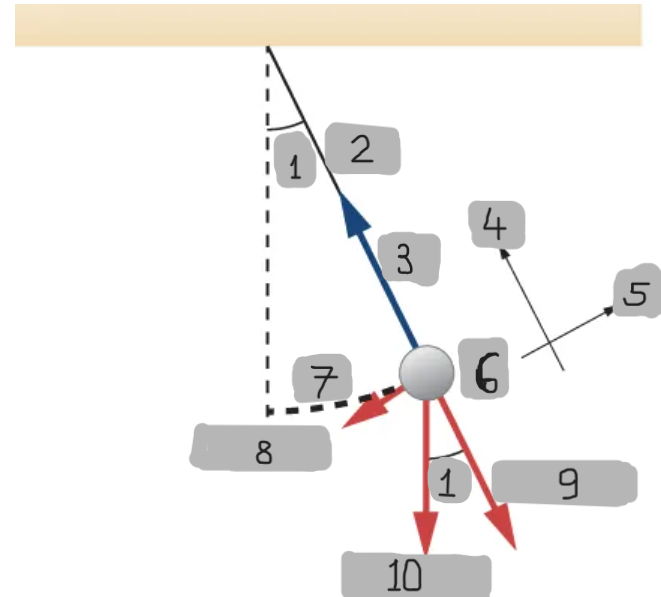
L
(2)
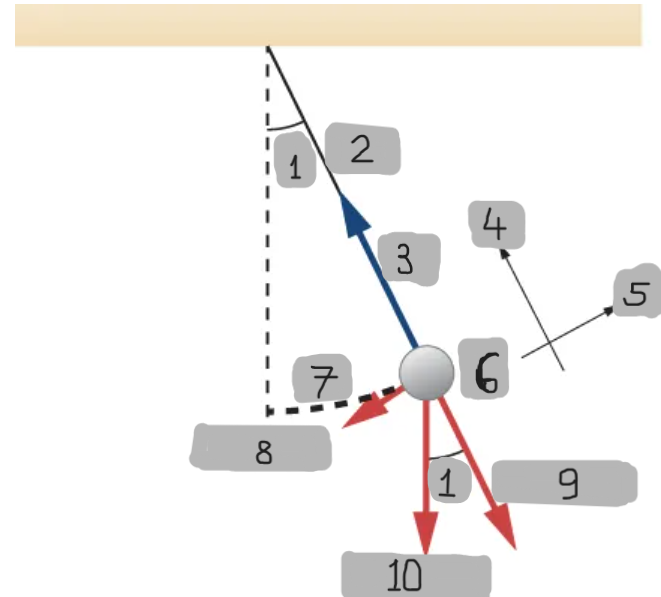
F_T
(3)
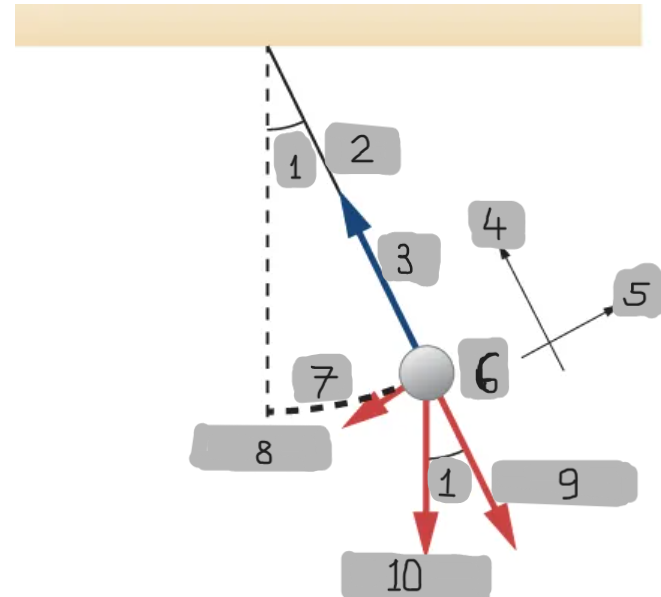
+y
(4)
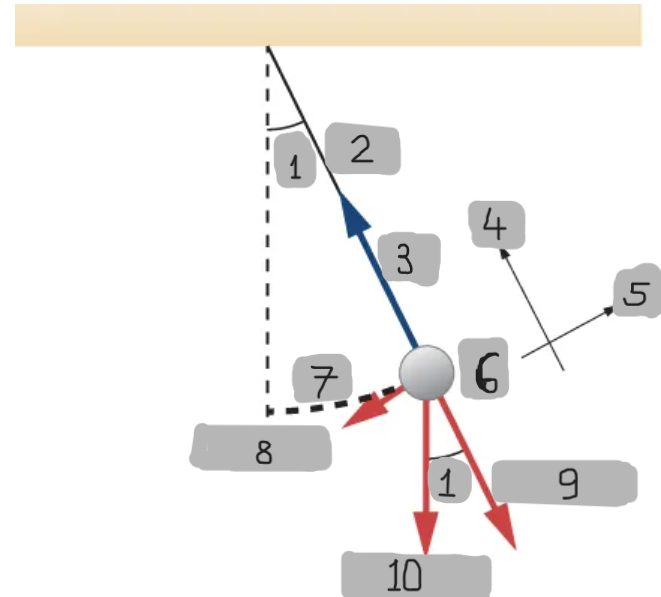
+x
(5)
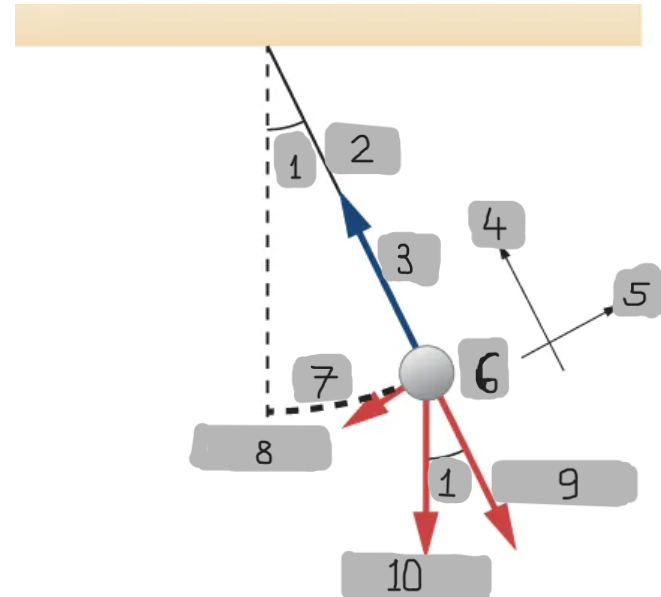
m
(6)
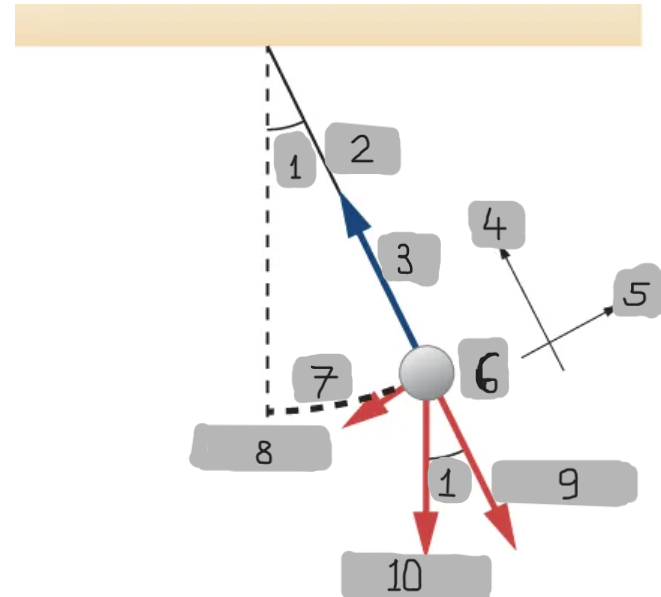
s
(7)
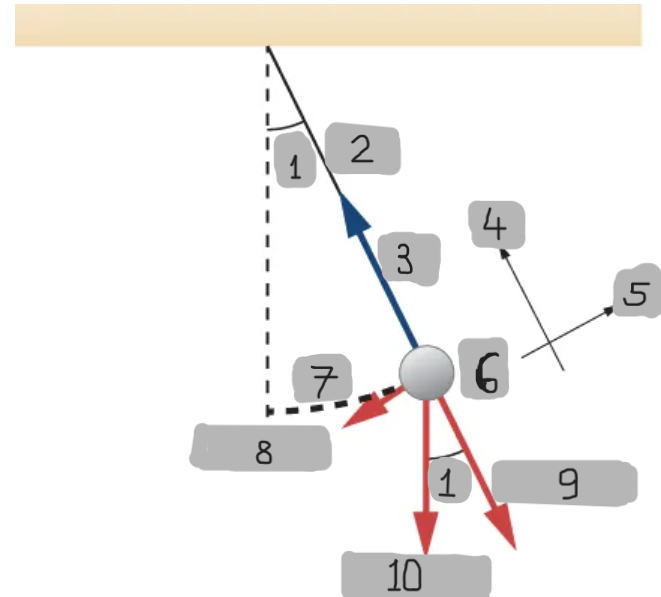
-mgsin(θ)
(8)
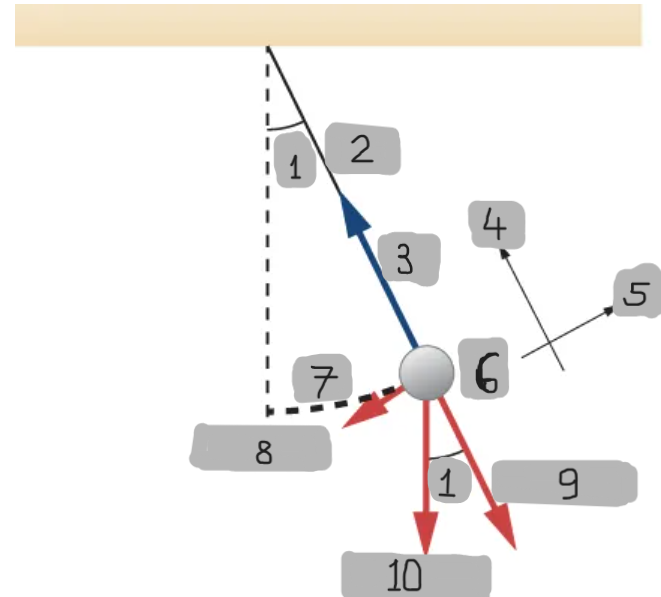
-mgcos(θ)
(9)
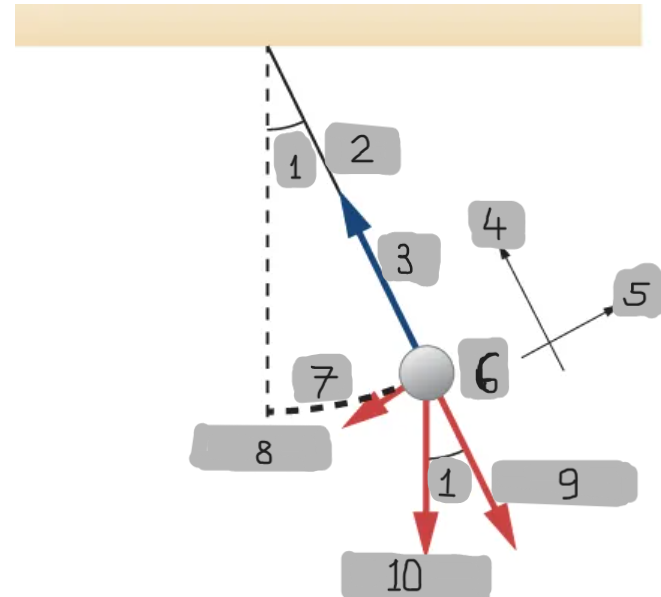
w = mg
(10)
Simple Pendulum
Consists of a point mass (bob)
Bob is suspended from a massless, inextensible string of length L
Swings back and forth under the influence of the gravity.
Experiences only two forces (tension and weight)
Weight and Tension
What are the two only forces that the bob in a simple pendulum experience?
Pendulum Bob
The small, dense point mass at the end of the pendulum string that moves along an arc during oscillation.
Linear Displacement (s)
The arc length that measures how far the pendulum bob is displaced from its equilibrium position.
Restoring Force in a Pendulum
The component of gravity that acts along the arc, pulling the bob back toward equilibrium.
F = -mgsin(θ)
Mathematical representation of the Restoring Force in a Pendulum
Restoring Torque
The torque due to the restoring force acting at a distance L from the pivot. It always acts to return the bob towards its equilibrium position.
τ = -L(mgsin(θ))
Mathematical representation of the Restoring Torque
Moment of Inertia (I)
A measure of an object's resistance to changes in its rotational motion about a specified axis. It depends on the object’s mass and the distribution of that mass relative to the axis of rotation.
I = ∑m(r^2)
Mathematical representation of the Moment of Inertia for the discrete particles.
I = ∫(r^2) dm
Mathematical representation of the Moment of Inertia for the continuous objects.
Torque
A measure of the tendency of a force to rotate an object about an axis. It depends on both the magnitude of the force and the perpendicular distance from the axis of rotation
τ = rFsin(θ)
Mathematical representation of the torque.
Angular Acceleration
The rate of change of angular velocity of an object with respect to time. It describes how quickly an object speeds up or slows down its rotational motion.
α = dω/dt
Mathematical representation of the Angular Acceleration
Newton’s Second Law for Rotation
Law that relates torque, moment of inertia, and angular acceleration
States that the torque applied to an object is equal to its moment of inertia multiplied by its angular acceleration.
The rotational analog of F=ma in linear motion.
τ = Iα
Mathematical representation of “Newton’s Second Law for Rotation“
Iα = -L(mgsin(θ))
Equation for the Restoring Torque after substituting the Newton’s Second Law for Rotation
I = m(L^2)
Formula for the Moment of Inertia for the Pendulum Bob
((d^2)(θ))/(dt^2) = -(g/L)sin(θ)
Equation for the Restoring Torque (final form) [Equation of the motion]
It indicates that the torque acts in the opposite direction to the angular displacement, always trying to restore the pendulum to equilibrium.
What does the negative sign in the torque equation τ = -L(mgsin(θ)) indicate?
Small-Angle Approximation
Used for small angles (θ < 15 degrees or 0.26 radians)
sin(θ) gets approximated to θ
Simplifying the motion to Simple Harmonic Motion
((d^2)(θ))/(dt^2) = -(g/L)θ
Equation for the Restoring Torque (final form with Small-Angle Approximation) [Equation of the motion]
ω = (g/L)^1/2
Formula for the angular frequency of a simple pendulum
T = 2π((L/g)^1/2)
Formula for the period of a simple pendulum
Because both the restoring force and inertia depend on the mass m, which cancels out in the equation of motion. Leaving the period only depend on the length L and the acceleration due gravity g.
Why does the period of a simple pendulum not depend on its mass?
For small amplitudes (θ < 15 degrees), the period is almost independent of amplitude. For larger angles, small nonlinear deviations occur.
Does the period of a simple pendulum depend on its amplitude?
It ensures that the restoring force is directly proportional to the displacement, making the motion linear and simple harmonic rather than complex and nonlinear.
Why is the small-angle approximation important?
g = (4(π^2)L)/T^2
Formula to measure the gravity that we get after rearranging the T = 2π((L/g)^1/2) equation
The string is massless and inextensible, the bob is a point mass, air resistance is negligible, and oscillations are of small amplitude.
What assumptions make a pendulum “simple”?
A stronger g (as at the poles) shortens the period, while a weaker g (as near the equator or at higher altitudes) makes the pendulum swing more slowly.
How does the local acceleration due to gravity affect the pendulum’s period

