Descent with Modification
 Call Kai
 Learn
Learn Practice Test
 Spaced Repetition
 Match
Match Flashcards
 Knowt Play
1/22

There's no tags or description
Looks like no tags are added yet.
Name | Mastery | Learn | Test | Matching | Spaced | Call with Kai |
|---|
No analytics yet
Send a link to your students to track their progress
23 Terms
Evolution
Pattern: descent with modification
Process: natural selection
Why do we say that evolution is a pattern and process? What did Darwin mean by the phrase “decent with modification”?
Evolution is a PATTERN because it’s revealed by data from many scientific disciplines such as biology, geology, physics, and chemistry. The data is facts—they’re observations about the natural world.
Evolution is a PROCESS because it consists of mechanisms that cause the observed pattern of change. These mechanisms represent natural causes of the natural phenomena we observe.
Descent with modification refers to the process by which species accumulate differences from their ancestors as they adapt to different environments over time. (Darwin’s view of life)
What is the difference between ancestral, shared characteris1cs and derived, shared characteris1cs?
Ancestral characteristics: a character that originated in an ancestor of the taxon (taxonomic unit at any level of hierarchy)
(backbone)
Derived characteristics: evolutionary novelty unique to a particular clade
(hair)
Why study evolution on an island?
Studying evolution on an island is beneficial because islands generally have many plant and animal species that are endemic (found nowhere else in the world).
Darwin also described how most island species are closely related to species from the nearest mainland or neighboring island.
Contributions of Linnaeus
founder of modern taxonomy
developed two-part, or binomial, format for naming species
adopted a nested classification system, grouping species into increasingly general categories
ascribed resemblance among species to the pattern of creation rather than evolution
Lyell
incorporated Hutton’s thinking into his proposal that the same geologic processes are operating today as in the past, at the same rate
Darwin
published ‘The Origin of Species’
noted that current species are descendants of ancestral species
argued that evolutionary relationships should be the basis for classification
study of fossils helped lay the groundwork for his ideas
concluded that life-forms could be arranged on a ladder, or scale, of increasing complexity: scala naturae
Wallace
developed hypothesis of natural selection identical to Darwin’s
Malthus
observed that human populations tend to increase faster than food supplies and other resources
Lamarck
hypothesized that species evolve through use and disuse of body parts and inheritance of acquired characteristics
Cuvier: theory of biological evolution
developed paleontology: study of fossils
extinctions were common but opposed idea of evolution\
each boundary between strata represented a catastrophic event that destroyed many species
Connect sedimentary strata with macroevolu1on. What is the difference between microevolution and macroevolution? What “bridges” the two?
older the stratum, the more dissimilar its fossils were to current life-forms
allows scientists to track evolutionary transitions
microevolution: changes over time in allele frequencies in a population
macroevolution: broad pattern of evolution above the species level
SPECIATION forms a conceptual bridge between micro- and macroevolution
Explain adaptive radiation and founder effect with Darwin’s finches beak size/shape. Why is this considered the outcome of natural selection rather than artificial selection?
Founder effect occurs when a few individuals become isolated from a larger population.
This is demonstrated by the finches that Darwin studied. Birds with larger beaks were more likely to be able to feed on large, hard seeds. Birds with deeper beaks were more likely to survive the drought and pass on this trait. These finches are an example of adaptive radiation because they’re flexible and therefore able to adapt to the new and harsh environment by exploiting new food types and developing new foraging techniques.
The mechanism of evolution is _________ ______________. What is the “raw material” used by this mechanism?
What bridges genotype with phenotype? How does this relate to allele frequencies in a population? Always remember, it is the _____________ that evolves through the selective pressure on the __________________. How is the term “fitness” related to these concepts?
The mechanism of evolution is natural selection.
Genetic variation provides raw material.
Gene expression bridges genotype with phenotype.
Allele frequencies dictate the proportion of genotypes in a population, which determines the visible distribution of phenotypes.
Population that evolves through the selective pressure on the individual
In a given environment, certain traits can lead to greater relative fitness: the contribution an individual makes to the gene pool of the next generation relative to the contributions of other individuals
Define species. What is genetic drift? How is this term related to the founder effect and bottlenecking in a species.
Species:
Strata
layers of sedimentary rock
Key Features of Natural Selection
populations evolve over time
natural selection can only increase or decrease heritable traits that differ among individuals in a population
specific traits that are adaptive will vary from place to place and over time
Staphylococcus aureus
commonly found on people’s skin or in nasal passages
became resistant to penicillin in 1945, two years after it was first widely used
evolved resistance to another antibiotic, methicillin, within two years of its widespread use
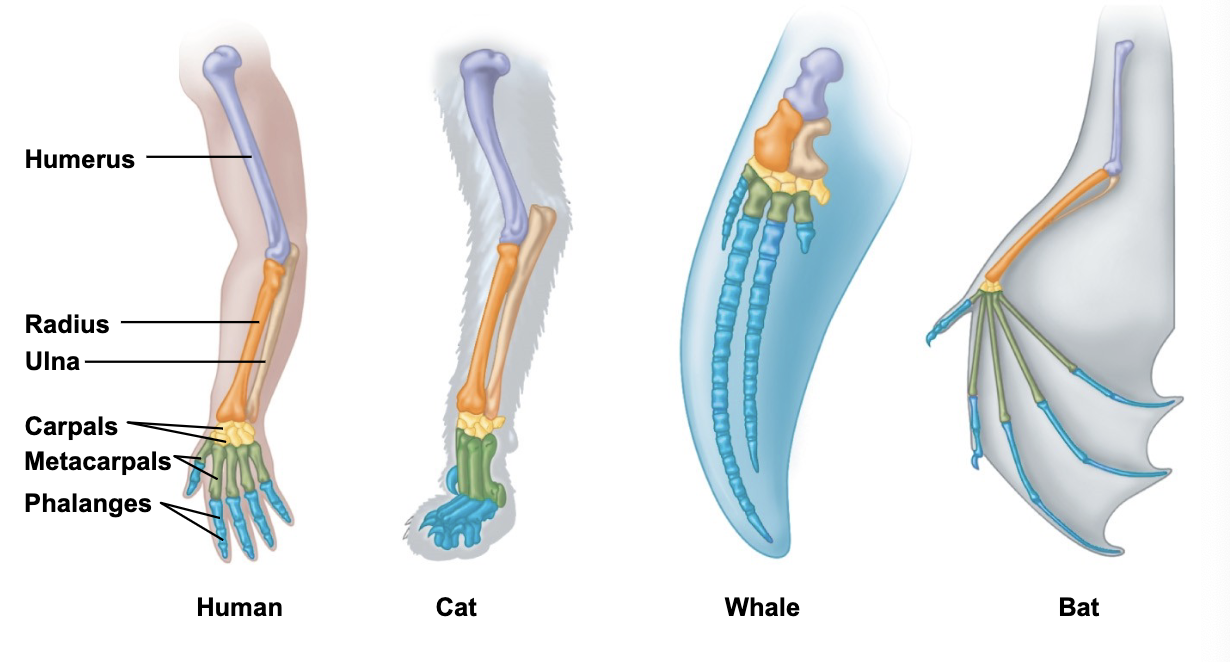
Homologous structures
anatomical resemblances that represent variations on a structural theme present in a common ancestor
Vestigial structures
remnants of features that served important functions in an organism’s ancestors but serve no current purpose (ex: tailbone, wisdom teeth)
Convergent evolution
evolution of similar, or analogous, features in distantly related groups
Analogous traits
arises when groups independently adapt to similar environments in similar ways
Comparative embryology
reveals anatomical homologies not visible in adult organisms