Central Dogma, DNA Replication, and Cell Cycle Flashcards
 Note
Note Call Kai
 Learn
Learn Practice Test
 Spaced Repetition
 Match
Match Flashcards
 Knowt Play
1/30

Earn XP
Description and Tags
Vocabulary practice flashcards generated from lecture notes covering the Central Dogma, DNA structure, transcription, translation, DNA replication, mutations, and the cell cycle.
Name | Mastery | Learn | Test | Matching | Spaced | Call with Kai | Chat |
|---|
No analytics yet
Send a link to your students to track their progress
31 Terms
Central Dogma of Molecular Biology
The framework describing the flow of genetic information within a biological system from DNA to RNA to protein.

Major Groove
A region on the DNA double helix that exposes nucleotides to facilitate the binding of transcription factors, polymerases, and nucleases.
Minor Groove
A narrower groove on the DNA double helix that serves as a primary binding site for antibiotics, dyes, and stains.

Law of Complementary Base Pairing
A lock and key principle in nucleic acids where a purine base specifically pairs with a pyrimidine base via hydrogen bonding.
Chromatin
A complex composed of DNA, protein, and RNA that functions to package DNA into a smaller volume, reinforce DNA for mitosis, prevent DNA damage, and control gene expression.

Nucleosome
A structural unit of chromatin consisting of a section of DNA wrapped around an octamer of histone proteins.
Enhancer
A regulatory region of DNA that binds activator proteins to stimulate chromatin remodeling and initiate transcription.
Promoter Region
A specific DNA sequence that binds RNA Polymerase and contains a TATA box (TATAAA) where DNA unwinding begins.
Exon
A sequence within a gene that is retained after RNA processing and contributes to the coding sequence of a mature protein.
Intron
A non-coding sequence within a pre-mRNA transcript that is excised during RNA processing.
Poly-A Signal Sequence
A specific nucleotide sequence that directs RNA Polymerase to halt transcription and detach from the DNA template.

Alternative Splicing
A post-transcriptional process that enables a single gene to encode multiple distinct protein isoforms by selectively including or excluding exons from mRNA.
Ribozyme
An RNA molecule capable of catalyzing specific biochemical reactions, such as ribosomes forming peptide bonds during protein synthesis.
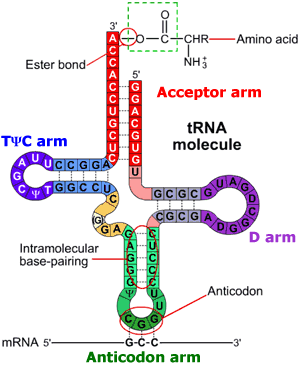
Transfer RNA (tRNA)
An adapter RNA molecule that carries a specific amino acid and contains an anticodon triplet to base-pair with a complementary mRNA codon.
Degeneracy
The characteristic of the genetic code in which more than one triplet codon can encode the same amino acid.
Cap-Dependent Initiation
A translation initiation pathway in which the 43S pre-initiation complex scans mRNA from the 5′ cap to locate the start codon before forming a active ribosome.

Cap-Independent Initiation
A translation initiation pathway where protein complexes bind directly to an internal site on mRNA without scanning, typically utilized during cellular stress.
Post-Translational Modifications (PTM)
Chemical or structural alterations made to proteins after translation, including processes such as acetylation, methylation, phosphorylation, sulfation, and glycosylation.
Origin Recognition Complex (ORC)
A hexameric protein complex that binds to AT-rich replication origins on DNA to initiate pre-replication complex formation.
Minichromosome Maintenance Complex (MCM)
A protein complex possessing helicase activity responsible for unwinding the DNA double helix during replication.
Replisome
A molecular machine assembled at the replication fork that contains MCM complexes and DNA Polymerases to carry out DNA replication.
Leading Strand
The DNA strand synthesized continuously in the 5′→3′ direction toward the expanding replication fork.
Lagging Strand
The DNA strand synthesized discontinuously in short Okazaki fragments in the 5′→3′ direction away from the replication fork.

Telomerase
An enzyme carrying its own RNA template that synthesizes repetitive DNA sequences at chromosome ends to protect against chromosome shortening.

Germline Mutation
A heritable genetic alteration originating in reproductive cells (gametes) that can be transmitted to offspring.
Somatic Mutation
A non-heritable mutation occurring in non-germline body cells that affects only the individual organism.
G0 Phase
A non-dividing state of the cell cycle entered by cells that are terminally differentiated, damaged, or otherwise no longer undergoing mitosis.
S Phase
The phase of interphase during which nuclear DNA is replicated and centrioles are duplicated.
Prophase
The early stage of mitosis in which chromatin condenses into distinct chromosomes, centrosomes move to opposite cell poles, and the mitotic spindle forms.
Prometaphase
The stage of mitosis where the nuclear envelope disintegrates, allowing spindle microtubules to attach to chromosome kinetochores.

Mitotic Checkpoint
A cellular control mechanism that prevents anaphase onset until all kinetochores are properly aligned and attached to the mitotic spindle.