StemUp: AQA A level Biology 3.3.2 Gas Exchange
 Call Kai
 Learn
Learn Practice Test
 Spaced Repetition
 Match
Match Flashcards
 Knowt Play
1/35

There's no tags or description
Looks like no tags are added yet.
Name | Mastery | Learn | Test | Matching | Spaced | Call with Kai |
|---|
No analytics yet
Send a link to your students to track their progress
36 Terms
What is meant by a correlation relationship? (1)
Where a change in one of two variables is reflected by a change in another variable
What is meant by a causation relationship? (1)
Where a factor directly causes a disease, in which there has to be concrete scientific evidence to back it up
Why may correlation not reflect causation? (1)
Some factors may show a correlation with a disease but there may be no actual evidence to prove it is the cause of the disease
What is meant by a 'risk factor'? (1)
Anything that increases the chances of getting a disease
What are some examples of risk factors for lung disease? (5)
- Smoking
- Air pollution
- Infections
- Genetics
- Occupation e.g. if you work with harmful chemicals
Why is there incomplete rings of cartilage supporting the trachea? (2)
- To prevent the trachea from collapsing during the pressure changes
- Which occur in ventilation
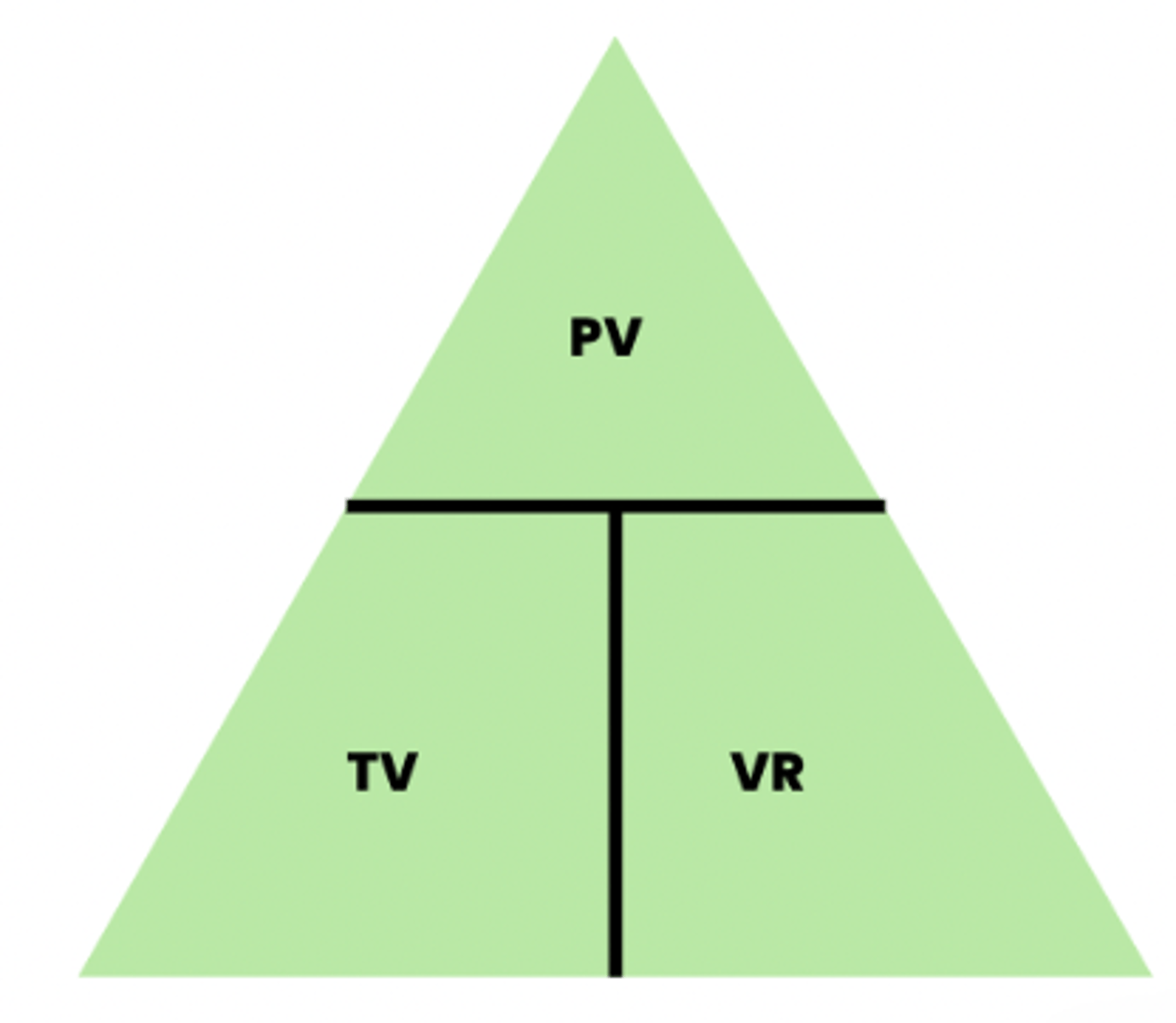
What is the formula triangle for pulmonary ventilation? (3)
Where;
PV = pulmonary ventilation
TV = tidal volume
VR = ventilation rate
What is meant by pulmonary ventilation? (1)
The total volume of air that is normally moved into the lungs per minute
What is the unit for pulmonary ventilation? (1)
dm^3 min^-1
What is meant by tidal volume? (1)
The volume of air that is normally taken in at each breathe
What is the unit for tidal volume? (1)
dm³
What is meant by ventilation rate? (1)
The number of breathes per minute
What is the unit for ventilation rate? (1)
min^-1
Describe the adaptations of single-celled organisms for gas exchange (2)
- They have a short diffusion pathway
- Which enables them to satisfy their gas exchange requirement and ensures removal of heat during respiration
What are dicotyledonous plants? (1)
Scientific way of saying a plant with two leaves e.g. sunflower etc
NOTE: The reason AQA specify this term on their specification is to prevent confusion of students believing monocotyledonous e.g. grass have the same adaptations as plants like roses
Describe the adaptations of the leaves in dicotyledonous plants for gas exchange (6)
- Thin
- So provide a short diffusion pathway for gaseous exchange
- Plant is constantly carrying out respiration and photosynthesis
- So maintains the diffusion gradient by using and producing oxygen and carbon dioxide
- There are numerous mesophyll cells lining the intercellular air spaces in the leaf
- Which provide a large surface area for gaseous exchange
What adaptations do xerophytes possess for limiting water loss and efficient gas exchange? (5)
- Thick waxy cuticle
- Which provides a long diffusion pathway to reduce the rate of evaporation
- Hairs on the leaf surface and the rolling up of leaves traps a layer of still air
- This then becomes saturated with water vapour and reduces the water potential gradient for water loss
- Some xerophytes (e.g. pine needles) have a reduced SA:V to prevent water loss
How do the gills within a fish provide a large surface area for gas exchange? (2)
- Contain a large number of gill filaments
- Which extend into lamellae
How do the gills within a fish provide a short diffusion pathway for gas exchange? (3)
- Blood and water are separated by a thin barrier
- Which contains of two cell layers
- The epithelial layer of the gill lamellae and the endothelial layer of the blood capillaries
What two components of the gills within a fish provide a high diffusion gradient for gas exchange? (4)
- Ventilation mechanism
- Which provides a continual flow of water over the gills bringing more oxygen and removing carbon dioxide
- Circulatory system
- Which ensures a continual flow of blood through the respiratory surface to absorb oxygen and remove carbon dioxide
What component of the gills within a fish maintains the high diffusion gradient along the length of the whole lamellae for gas exchange? (2)
- Counter-current system
- Ensures that blood continually meets water with a higher oxygen concentration
Describe the gas exchange pathway of oxygen and carbon dioxide in insects
Oxygen diffuses from the air, through the spiracles, along the trachea and tracheoles into the cells
Note: This isn't directly on the specification but you are expected to understand this to be able to answer any questions related to the gas exchange systems present in insects
What are spiracles in insects? (1)
Tiny holes on the surface of the insect
What are the trachea and tracheoles in insects? (1)
Tubes that deliver oxygen to and remove carbon dioxide from the cells
Describe the basic adaptations of insects for effective gas exchange (4)
- Their tracheoles are thin
- Which provides a short diffusion pathway
- They contain numerous tracheoles
- Which provides a large surface area for maximum diffusion
Describe how anaerobic respiration in insects helps with efficient gas exchange (5)
1. During increased activity, anaerobic respiration often occurs
2. This produces lactic acid in cells
3. The water potential of the cells decreases and some of the water in the ends of the tracheoles move into the cells by osmosis
4. This enables more air to move along into the tracheoles and then into the cells
5. Which speeds up the diffusion of oxygen into the cells
Describe how body muscles within insects help with efficient gas exchange (4)
1. In large or active insects (e.g. bees), their muscles may contract to compress the trachea and force air out of them
2. When the muscles relax, the trachea will spring back into it's shape and fresh air, rich in oxygen is drawn into them
3. This speeds up the rate of diffusion of oxygen and carbon dioxide
4. By creating a diffusion gradient
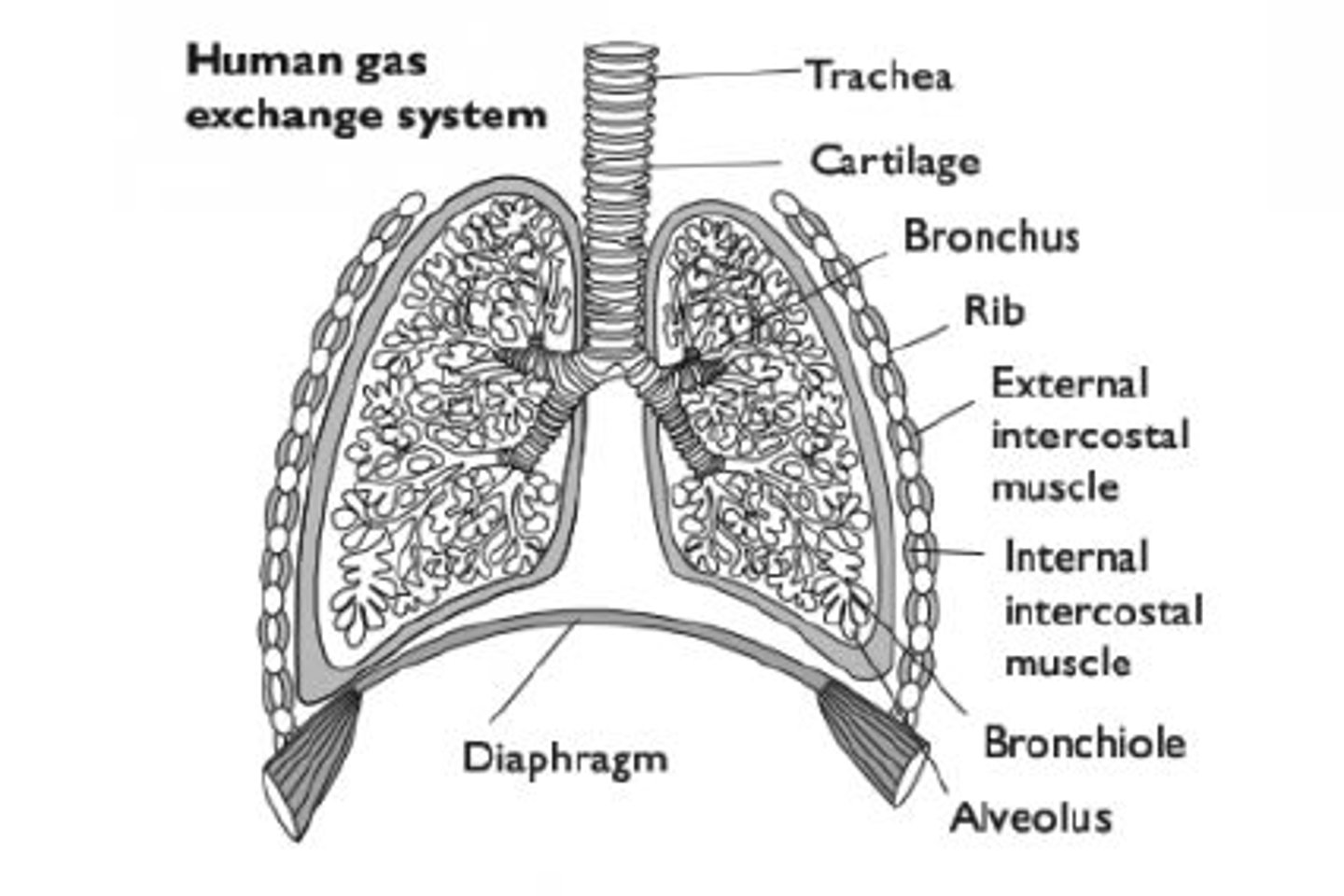
Describe the gross structure of the human gas exchange system
I.e. the lungs
- Consist of a trachea which is supported by incomplete rings of cartilage
- Trachea divides into two bronchi that repeatedly divide into smaller tubes, the bronchioles
- Alveoli (air sacs) are present at the end of the bronchioles
Describe the pathway of oxygen and carbon dioxide in human gas exchange (2)
1. Oxygen diffuses across the flattened epithelial cells of the alveolus to the endothelial cells of the capillary walls
2. Carbon dioxide moves in the exact opposite direction
What are the adaptations of the alveoli for providing a large surface area as a human gas exchange surface? (3)
- Shape of alveoli
- Large numbers of alveoli in lungs
- There is an extensive network of blood capillaries surrounding each alveolus for absorbing oxygen and releasing carbon dioxide
What role does the fluid lining the alveolus play in gas exchange? (1)
Allows gases to dissolve and diffuse across
What are the two mechanisms of ventilation in the human lungs? (2)
- Expiration (exhaling)
- Inspiration (inhaling)
What are the adaptations of the alveoli for maintaining a high diffusion gradient as a human gas exchange surface? (2)
- Circulatory system
- Which transports deoxygenated blood from the body to the lungs and returns oxygenated blood from the lungs back to the body
- Ventilation mechanism
- Which provides air with a high oxygen concentration and removes air with high carbon dioxide concentration
What are the adaptations of the alveoli for providing a short diffusion pathway as a human gas exchange surface? (2)
- There are only two cell layers that separate blood and air
- Epithelial cell layer of the alveolus and the endothelial cell layer of the capillary walls
Describe the process of expiration in mammals (5)
1. Internal intercostal muscles contract which pulls the ribs downwards and inwards, while the external intercostal muscles relax
2. Diaphragm muscle relaxes which moves the diaphragm up into its dome shape
3. Both of these actions decreases the volume of the thoracic cavity
4. Pressure inside the lungs increases above atmospheric pressure and air exits the lungs via a pressure gradient
5. Elastic recoil of the lung tissue helps to force the air out of the lungs during expiration
Describe the process of inspiration in mammals (4)
1. External intercostal muscles contract which pulls the ribs upwards and outwards, whilst the internal intercostal muscles relax
2. Diaphragm muscle contracts, which pulls the diaphragm downwards so it flattens
3. Both of these actions increase the volume of the thoracic cavity
4. Pressure inside the lungs decreases below atmospheric pressure and air enters lungs via a pressure gradient