Chapter 3-4: Electricity, Voltage, and Resistance
 Call Kai
 Learn
Learn Practice Test
 Spaced Repetition
 Match
Match Flashcards
 Knowt Play
1/102

Earn XP
Description and Tags
Created by Marianne Krisha Oraye
Name | Mastery | Learn | Test | Matching | Spaced | Call with Kai |
|---|
No analytics yet
Send a link to your students to track their progress
103 Terms
Electricity
The flow of charge.
Charge
A fundamental quantity in physics; this particle can be positively charged (+), negatively charged (-), or neutral.
Proton
A positively charged particle found in the nucleus of an atom.
Electron
A negatively charged particle that circles the nucleus of an atom
Neutron
A neutrally charged particle found in the nucleus of an atom.
Coulomb
The standard measure of electric charge
6,242,000,000,000,000,000 protons
equivalence of one coulomb to protons (answer format: no space and with comma)
Ampere (Amp, A)
The unit for the flow of charge.
DC (Direct Current)
Electricity flows continuously from the positive terminal to the negative terminal.
AC (Alternating Current)
The positive and negative sides continually reverse, switching back and forth many times per second (50-60 times per second for this mains).
Conventional current flow
What do you call the kind of current that flows from positive to negative, even though electrons actually move from negative to positive.
Electron current flow
What do you call the kind of current where it traces from negative to positive (rarely used).
Voltage
The amount of power each coulomb of electricity can deliver.
Volt
The unit of measurement for voltage.
Ground (GND)
A chosen point in a circuit that represents 0 volts, used as a reference for voltage measurements. Usually the negative terminal of the battery in DC electronics.
Common point (COM)
Another term for the 0-volt reference; often marked on multimeters.
Resistance
How much a circuit or device resists the flow of current. Measured in ohms (Ω).
Current decreases
What is the Effect of increasing resistance on current (constant voltage)?
Voltage increases
What is the Effect of increasing resistance on voltage (constant current)?
C) AC mains
High-power alternating current from wall outlets (e.g., ~120 volts, 15–30 amps) that is dangerous for untrained people. What is this called? (Answer format: A. Answer)
A) AC signal
B) DC current
C) AC mains
D) Ground potential
B) AC signal
Low-power alternating current, such as the small electrical vibrations produced by a microphone, that is almost undetectable and must be amplified to be useful with DC power. What is this called? (Answer format: A. Answer)
A) AC mains
B) AC signal
C) DC offset
D) Conventional current
C) Voltage is relative
The principle that voltage can never be measured absolutely; you can only measure the voltage difference between two points (e.g., a 9V battery has a 9-volt difference between its terminals, not 9 volts in an absolute sense). What is this principle called? (Answer format: A. Answer)
A) Ohm's Law
B) Conventional current flow
C) Voltage is relative
D) Ground potential
(Topic: Fundamental Charge Types)
A particle can be charged in which three ways?
A) Positively, negatively, or magnetically
B) Positively, negatively, or neutrally
C) Positive, negative, or zero
D) Proton, electron, or neutron
Correct Answer: B
Explanation: The text: "A particle can be charged in one of three ways—it can be positively charged, negatively charged, or neutrally charged."
(Topic: Protons and Neutrons Location)
Where are protons and neutrons located in an atom?
A) In the electron cloud
B) In the nucleus
C) In the outer shells
D) In the valence band
Correct Answer: B
Explanation: The text: "In the center of the atom are larger, heavier particles called protons and neutrons." Together they form the nucleus.
(Topic: Atomic Number Definition)
What does the atomic number of an element represent?
A) The number of neutrons
B) The number of protons
C) The total number of protons and neutrons
D) The number of electrons
Correct Answer: B
Explanation: The text: "This number refers to how many protons it has in its nucleus."
(Topic: Electron Attraction to Nucleus)
What keeps electrons contained within the atom?
A) Magnetic force
B) Strong nuclear force
C) Attraction between positive protons and negative electrons
D) Gravitational force
Correct Answer: C
Explanation: The text: "Positive and negative charges attract each other, which is what keeps electrons contained within the atom."
(Topic: Neutral Atom Condition)
When is an atom electrically neutral?
A) When it has more protons than electrons
B) When it has more electrons than protons
C) When the number of electrons equals the number of protons
D) When it has no neutrons
Correct Answer: C
Explanation: The text: "In these situations, the number of electrons and the number of protons are equal, making the atom as a whole electrically neutral."
(Topic: How Atoms Become Charged)
How can an atom become negatively charged?
A) By losing protons
B) By gaining electrons
C) By losing neutrons
D) By gaining protons
Correct Answer: B
Explanation: The text: "If the atoms gain electrons, then they are negatively charged."
In a battery, how is electricity generated?
A) By mechanical rotation
B) By a chemical reaction where reactants are separated by a medium
C) By nuclear fusion
D) By static electricity
Correct Answer: B
Explanation: The text: "The way that electricity is generated in a battery is that a chemical reaction takes place, but the reactants are separated from each other by some sort of medium."
(Topic: Charge Movement in Battery)
In a battery, where do positive charges move most easily?
A) Through the wire
B) Through the medium (electrolyte)
C) Through the air
D) Through the casing
Correct Answer: B
Explanation: The text: "The positive charges for the reaction move easiest through the medium, but the negative charges for the reaction move easiest through the wire."
One coulomb is equivalent to the electric charge of approximately how many protons?
A) 6,242,000 (6.242 million)
B) 6,242,000,000 (6.242 billion)
C) 6,242,000,000,000,000,000 (6.242 quintillion)
D) 6,242 (six thousand)
Correct Answer: C
Explanation: The text: "One coulomb is equivalent to the electric charge of about 6,242,000,000,000,000,000 protons."
One ampere is defined as:
A) One coulomb per second
B) One volt per ohm
C) One joule per coulomb
D) One watt per volt
Correct Answer: A
Explanation: The text: "One ampere is equal to the movement of 1 coulomb of charge out of the battery each second."
(Topic: Current Unit for Small Electronics)
For small electronic devices, current is usually measured in:
A) Amperes
B) Coulombs
C) Milliamperes (mA)
D) Microamperes
Correct Answer: C
Explanation: The text: "for electronic devices, we usually measure current in milliamperes, usually called just milliamps and abbreviated as mA."
A current of 37 mA flows for 1 minute. How many coulombs move?
A) 0.037 C
B) 2.22 C
C) 37 C
D) 2220 C
Correct Answer: B
Explanation: Convert 37 mA to 0.037 A; 0.037 C per second × 60 seconds = 2.22 C.
Why is DC not used for long-distance power transmission?
A) It is too dangerous
B) It quickly loses power over long distances
C) It cannot be generated
D) It requires special wires
Correct Answer: B
Explanation: The text: "DC, while great for electronics projects, very quickly loses power over long distances."
How many times per second does AC mains current switch direction?
A) 1–2 times
B) 10–20 times
C) 50–60 times
D) 100–120 times
Correct Answer: C
Explanation: The text: "switching back and forth 50–60 times per second."
(Topic: AC Mains Voltage)
What is the typical voltage of AC mains from a wall outlet?
A) 12 V
B) 120 V
C) 5 V
D) 240 V
Correct Answer: B (assuming US; the text says "about 120 volts")
Explanation: The text: "It is supposed to operate at about 120 volts."
(Topic: AC Mains Current Rating)
AC mains circuits are usually rated for about:
A) 1–5 amps
B) 15–30 amps
C) 50–100 amps
D) 0.5–1 amp
Correct Answer: B
Explanation: The text: "the circuits are usually rated for about 15–30 amps."
(Topic: AC Signal Example)
Which device produces AC signal (low-power alternating current)?
A) Battery
B) Solar panel
C) Microphone
D) LED
Correct Answer: C
Explanation: The text: "These currents come from devices like microphones."
What is conventional current flow?
A) Tracing current from negative to positive
B) Tracing current from positive to negative
C) Tracing electron movement
D) Tracing proton movement
Correct Answer: B
Explanation: The text: "The idea that we trace current from positive to negative is often called conventional current flow."
What is electron current flow?
A) Tracing current from positive to negative
B) Tracing charge from negative to positive
C) Tracing neutron movement
D) Tracing hole flow
Correct Answer: B
Explanation: The text: "If you are tracing charge the other way, that is called electron current flow."
In a wire, which way do electrons actually move?
A) From positive to negative
B) From negative to positive
C) Randomly
D) They do not move
Correct Answer: B
Explanation: The text: "electrons move from negative to positive."
Why do engineers usually trace current from positive to negative?
A) Because electrons are too small
B) Because the positive charge is like suction pulling electrons, and we trace the "suction"
C) Because batteries are labeled that way
D) Because it is required by law
Correct Answer: B
Explanation: The vacuum cleaner analogy: engineers trace the suction (positive charge) rather than the dust (electrons).
In electronics diagrams, the arrow on a component points in the direction of:
A) Electron flow
B) Conventional current (positive charge movement)
C) Neutron flow
D) Proton flow
Correct Answer: B
Explanation: The text: "any arrow in an electronics diagram is pointing toward the movement of positive charge."
Which materials are needed to make a simple potato/lemon battery?
A) Copper wire and aluminum foil
B) Thick copper wire, galvanized nail, and a potato or lemon
C) Iron nail and salt water
D) Carbon rod and zinc plate
Correct Answer: B
Explanation: The text: "three materials: thick copper wire or tubing, a galvanized nail, and a potato or a lemon."
What is the approximate output of a potato/lemon battery?
A) 9 V at 1 A
B) Less than 1 V and less than 1 mA
C) 3 V at 10 mA
D) 5 V at 500 mA
Correct Answer: B
Explanation: The text: "This battery will not produce very much current—less than a milliamp of current at less than 1 volt."
How does the power of AC signal (e.g., from a microphone) compare to DC power?
A) It is much more powerful
B) It is so low-powered as to be almost undetectable
C) It is the same as AC mains
D) It is dangerous
Correct Answer: B
Explanation: The text: "these ACs are so low powered as to be almost undetectable."
Why must AC signals from microphones be amplified?
A) They are too fast
B) They are too slow
C) They are too small to work with directly using DC power
D) They are in the wrong frequency range
Correct Answer: C
Explanation: The text: "They are so small we have to actually amplify these currents just to work with them using our DC power!"
What is the name of the current flow convention that traces current from positive to negative?
Conventional current flow
What is the name of the current flow convention that traces the movement of electrons from negative to positive?
Electron current flow
What type of current flows continuously from positive to negative?
Direct current (DC)
What type of current reverses direction many times per second (e.g., 60 Hz)?
Alternating current (AC)
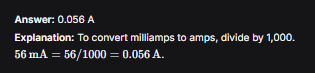
If I have 56 milliamps of current flowing, how many amps of current do I have flowing?
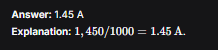
If I have 1,450 milliamps of current flowing, how many amps of current do I have flowing?
If I have 12 amps of current flowing, how many milliamps of current do I have flowing?

If I have 0.013 amp of current flowing, how many milliamps of current do I have flowing?

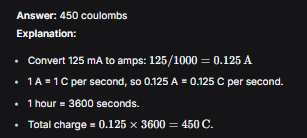
If I have 125 milliamps of current flowing for 1 hour, how many coulombs of charge have I used up?
In AC mains, how often does the direction of current go back and forth?

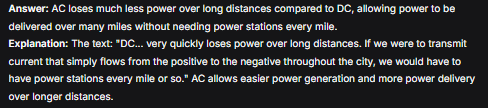
Why is AC used instead of DC to deliver electricity within a city?
. In working with electronic devices, do we normally work in amps or milliamps?

What does a 9‑volt battery rating actually mean?
There is a 9‑volt difference between the positive terminal and the negative terminal.
name of the designated 0‑volt point in a circuit?
Ground (or GND, common, COM).
In our DC circuits, which terminal of the battery is usually chosen as ground?
The negative terminal.
Roughly how many volts are needed to jump a 1‑inch air gap?
30,000 volts.
In the water hose analogy, what does coulomb compare to?
A) Pressure
B) Hose diameter
C) Liters (amount of water)
D) Flow rate
Correct Answer: C
Explanation: The text: "coulombs are a similar unit to liters—coulombs measure the amount of electric charge present just like a liter is the amount of water volume present."
Adding a spray nozzle to a hose increases the water pressure. What electrical quantity does this represent?
A) Current
B) Voltage
C) Resistance
D) Charge
Correct Answer: B
Explanation: The text: "We increased the pressure of the water, which is just like increasing the voltage on an electric charge."
Increasing voltage changes what property of each coulomb of electricity?
A) The amount of charge it carries
B) Its speed
C) Its color
D) The amount of work it can do
Correct Answer: D
Explanation: The text: "when we increase voltage, we change the amount of work that each coulomb of electricity can do."
Approximately how many volts are needed to jump a 1‑inch air gap?
A) 1,000 V
B) 30,000 V
C) 10,000 V
D) 100,000 V
Correct Answer: B
Explanation: The text: "it takes a lot of voltage—about 30,000 volts per inch of gap."
Why does a static electricity shock (thousands of volts) not harm you?
A) Because the voltage is too low
B) Because the current is DC
C) Because the amount of charge is extremely small
D) Because the human body has high resistance
Correct Answer: C
Explanation: The text: "the amount of charge in those shocks is so small that it doesn't harm you."
Can voltage be measured absolutely?
A) Yes, if you use the ground as reference
B) No, all voltage measurements are relative to other voltages
C) Yes, with a good multimeter
D) No, only current can be measured absolutely
Correct Answer: B
Explanation: The text: "You can actually never measure voltage absolutely. All voltage measurements are actually relative to other voltages."
To measure voltage in a circuit, where must you place the multimeter probes?
A) One probe on the positive terminal only
B) Both probes on the same point
C) One probe on ground only
D) Two probes on two different places to measure the voltage difference
Correct Answer: D
Explanation: The text: "I have to put my probe on two different places on the circuit and measure the voltage difference."
Question 10 (Topic: Voltage Drop Definition)
What is another name for the voltage difference between two points?
A) Voltage rise
B) Voltage drop
C) Current drop
D) Potential gain
Correct Answer: B
Explanation: The text: "measure the voltage difference (also called the voltage drop) between those two points.
To simplify calculations, we usually choose a point in the circuit to represent 0 volt. What is this point commonly called?
A) Positive terminal
B) Ground (GND)
C) Reference resistor
D) Common point
Correct Answer: B
Explanation: The text: "This 'zero point' goes by several names, the most popular of which is ground (often abbreviated as GND)."
On many multimeters, one electrode is labeled COM. What does COM stand for?
A) Current
B) Common
C) Communication
D) Complement
Correct Answer: B
Explanation: The text: "Many multimeters label one of their electrodes as COM, for the common electrode
Why is the zero‑volt reference called "ground"?
A) Because it is always connected to the Earth
B) Because it was invented by Ground
C) Because historically, the physical ground was used as a reference voltage
D) Because ground means lowest point
Correct Answer: C
Explanation: The text: "It is called the ground because, historically, the physical ground has often been used as a reference voltage for circuits."
In our DC circuits, what do we usually designate as the ground (0 V point)?
A) The positive terminal of the battery
B) The middle of the battery
C) Any resistor terminal
D) The negative terminal of the battery
Correct Answer: D
Explanation: The text: "in our circuits, when we refer to the ground, we are referring to the negative terminal on the battery."
In the water hose analogy, when water lands on the ground, it has lost all its energy. What does this represent electrically?
A) The water has become positively charged
B) The water has increased in voltage
C) The water has reached ground potential (0 V)
D) The water has turned into steam
Correct Answer: C
Explanation: The text: "when our electric charge is all puttered out, we say that it has reached 'ground potential.'"
In the water hose analogy, what does resistance correspond to?
A) The water pressure
B) The amount of water
C) How small the hose is
D) The length of the hose
Correct Answer: C
Explanation: The text: "resistance is how small the hose is, because a smaller hose will resist the flow of water more than a larger hose will."
Why does a 2‑liter soda bottle turned upside down pour slowly?
A) The liquid has low pressure
B) The bottle is too heavy
C) The liquid is too thick
D) The small opening gives resistance to the flow of liquid
Correct Answer: D
Explanation: The text: "That small opening is giving resistance to the flow of liquid, making it flow more slowly."
If you have a 5‑volt source and 10 ohms of resistance, how much current flows?
A) 2 A
B) 50 A
C) 0.5 A
D) 0.05 A
Correct Answer: C
Explanation: Example 4.4: I=5/10=0.5I=5/10=0.5 A.
If you have a 10‑volt source and want 2 A of current, what resistance is needed?
A) 20 Ω
B) 0.2 Ω
C) 12 Ω
D) 5 Ω
Correct Answer: D
Explanation: Example 4.5: R=10/2=5R=10/2=5 Ω.
You have a 9 V source and want to limit current to 10 mA. Before using Ohm’s law, what must you do?
A) Multiply 10 by 1000
B) Leave it as milliamps
C) Convert to kilohms
D) Divide 10 by 1000 to convert to amperes
Correct Answer: D
Explanation: The text: "I have to convert my current from milliamps to amps. Remember, to convert milliamps to amps, we just divide by 1,000."
What resistance is needed to limit a 9 V source to 10 mA?
A) 0.9 Ω
B) 90 Ω
C) 9,000 Ω
D) 900 Ω
Correct Answer: D
Explanation: Example 4.6: 10 mA = 0.010 A; R=9/0.010=900R=9/0.010=900 Ω.
In electronics work, what type of source do batteries typically provide?
A) Constant current source
B) Constant resistance source
C) Constant power source
D) Constant voltage source
Correct Answer: D
Explanation: The text: "batteries provide a constant voltage source. A 9‑volt battery will provide 9 volts in nearly every condition."
Putting your thumb over a hose increases resistance. What happens to the water pressure (voltage) if the water flow (current) is relatively constant?
A) Pressure decreases
B) Pressure stays the same
C) Flow stops
D) Pressure increases
Correct Answer: D
Explanation: The text: "This increases the resistance, and, since the current is relatively constant, the voltage (the force the water will have when it leaves the hose) will increase."
A soda bottle turned upside down has a small opening (high resistance). The push from gravity (voltage) is constant. What happens to the flow rate (current)?
A) It increases
B) It stays the same
C) It stops
D) It decreases
Correct Answer: D
Explanation: The text: "With the small opening, we had a large resistance, so the liquid came out slower."
In DC electronics, the chosen ground is usually:
A) The positive terminal of the battery
B) Any resistor terminal
C) The negative terminal of the battery
D) The middle of the circuit
Correct Answer: C
Explanation: Review point #5: "In DC electronics, the chosen ground is usually the negative terminal of the battery."
A 12‑volt battery indicates that:
A) The negative terminal has 12 V more than the positive terminal
B) Both terminals have 12 V relative to Earth
C) The positive terminal has 12 V more than the negative terminal
D) The battery contains 12 coulombs
Correct Answer: C
Explanation: By the definition of voltage difference, a 12 V battery has a 12 V difference from positive to negative.
If you measure the voltage across a resistor and get 5 V, what does that mean?
A) One end is at 5 V absolute
B) The resistor is 5 Ω
C) The current is 5 A
D) There is a 5 V difference between the two ends
Correct Answer: D
Explanation: Voltage measurement always gives the difference between two points.
Why do we choose a ground point in a circuit?
A) To make the circuit work
B) To increase the voltage
C) To reduce resistance
D) To simplify calculations and standardize voltage measurements
Correct Answer: D
Explanation: The text: "to simplify calculations and discussions, we usually choose some point on the circuit to represent '0 volt.' This gives us a way to standardize voltage measurements."
If I have a 4‑volt battery, how many volts are between the positive and negative terminals of this battery?
Answer: 4 volts
Explanation: A battery’s voltage rating is the potential difference between its positive and negative terminals. So a 4 V battery has a 4 V difference.
If I choose the negative terminal of this battery as my ground, how many volts are at the negative terminal?
Answer: 0 volts
Explanation: Ground is defined as the 0 V reference point. If the negative terminal is chosen as ground, it is at 0 V.
. If I choose the negative terminal of this battery as my ground, how many volts are at the positive terminal?
Answer: +4 volts
Explanation: The positive terminal is 4 V higher than the negative terminal. Since negative = 0 V, positive = +4 V.
If I choose the positive terminal of this battery as my ground, how many volts are at the negative terminal?
Answer: –4 volts
Explanation: If positive terminal is ground (0 V), then the negative terminal is 4 V lower, so –4 V relative to ground.
If I have a Point A on my circuit that is 7 volts above ground and I have a Point B on my circuit that is 2 volts above ground, what is the voltage difference between Point A and Point B?
Answer: 5 volts (Point A is 5 V higher than Point B)
Explanation: Voltage difference = VA−VB=7−2=5VA−VB=7−2=5 V.
Given a constant voltage, what effect does increasing the resistance have on current?
Answer: Current decreases
Explanation: Ohm’s law I=V/RI=V/R. If V is constant and R increases, I decreases.
Given a constant current, what effect does increasing the resistance have on voltage?
Answer: Voltage increases
Explanation: Ohm’s law V=I×RV=I×R. If I is constant and R increases, V increases.
If I have a 10 V battery, how much resistance would I need to have a current flow of 10 amps?
Answer: 1 Ω
Explanation: R=V/I=10/10=1R=V/I=10/10=1 Ω.
If I have a 3‑volt battery, how much resistance would I need to have a current flow of 15 amps?
Answer: 0.2 Ω
Explanation: R=3/15=0.2R=3/15=0.2 Ω.
Given 4 amps of current flow across 200 ohms of resistance, how much voltage is there in my circuit?
Answer: 800 V
Explanation: V=I×R=4×200=800V=I×R=4×200=800 V.